
In the Southern California industrial corridor, “good enough” packaging isn’t just a risk; it’s a guaranteed drain on your bottom line. You likely agree that off-the-shelf foam and standard boxes often fail to protect sensitive electronics or aerospace components from the harsh realities of the modern supply chain. Between rising carrier surcharges and the high cost of replacing damaged goods, the financial stakes have never been higher for local manufacturers. This guide will show you how to engineer custom packaging to prevent shock and vibration damage SoCal businesses can rely on to eliminate transit failures and optimize shipping volume.
We’ll explore advanced mitigation strategies, the importance of ISTA and ASTM testing, and how a local supplier can help you achieve zero-damage shipping cycles while lowering your total logistics costs. By focusing on the intersection of engineering and economics, you can turn your packaging from a necessary expense into a strategic advantage for your operations in Orange County, Los Angeles, or the Inland Empire. From free prototyping to specialized foam integration, we’ll cover the tools you need to secure your supply chain and protect your most sensitive assets during every mile of transit.
Key Takeaways
- Identify the critical differences between shock impacts and continuous vibration frequencies to select the correct polyethylene or polyurethane foam for your sensitive industrial components.
- Utilize CAD design and free prototyping to develop custom packaging to prevent shock and vibration damage SoCal, ensuring your shipments meet rigorous ASTM D4169 and MIL-STD-810 testing standards.
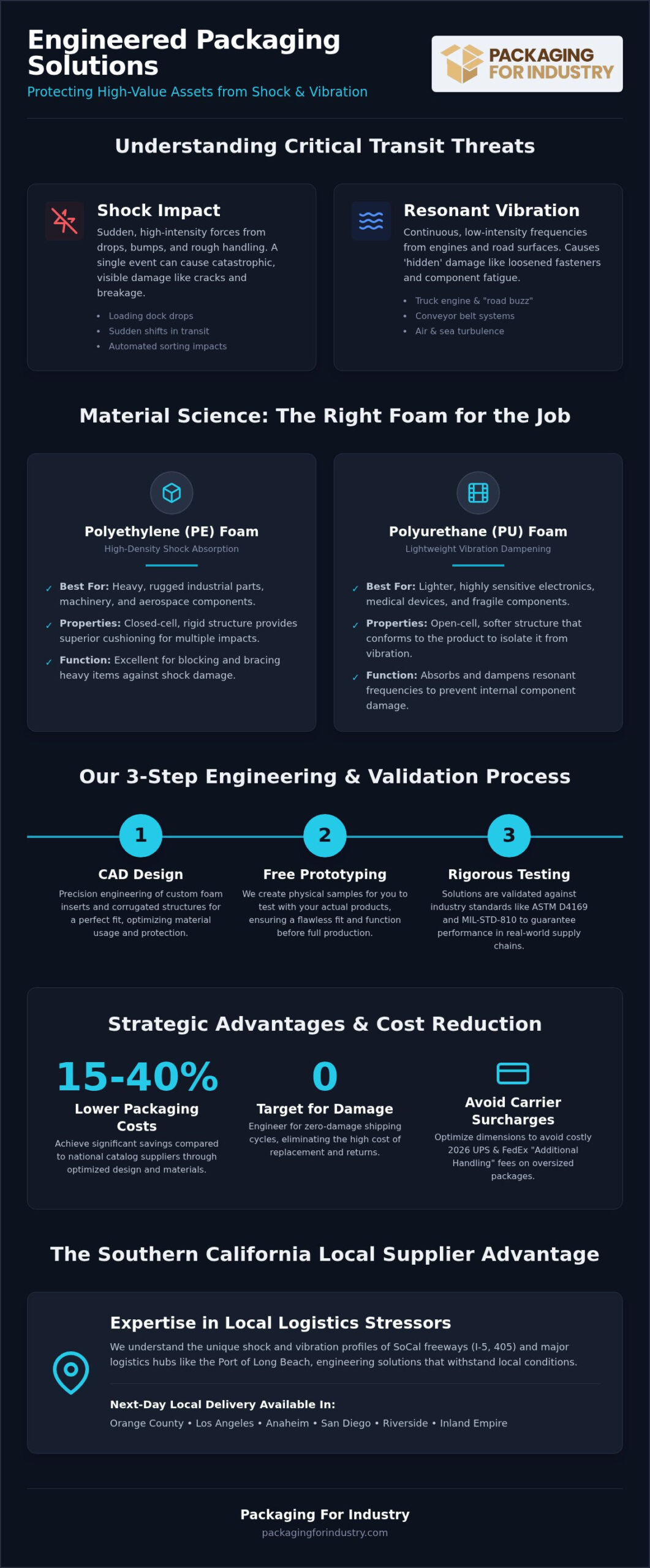
- Lower packaging costs by 15% to 40% compared to national catalog suppliers while optimizing dimensions to avoid expensive 2026 UPS and FedEx “Additional Handling” surcharges.
- Eliminate professional stress with integrated multi-material solutions that combine heavy-duty corrugated boxes, custom foam inserts, and wooden crates for total product protection.
- Leverage local SoCal expertise for next-day delivery in Anaheim, Los Angeles, and San Diego to reduce lead times and improve your supply chain reliability.
Understanding Shock and Vibration in the Southern California Supply Chain
Shipping sensitive industrial components through the Southern California logistics corridor requires a technical understanding of two distinct physical threats: shock and vibration. Shock is a sudden, high-intensity impact event, such as a package being dropped from a loading dock or a sudden shift during transit. In contrast, vibration is a continuous, lower-intensity frequency generated by truck engines, road surfaces, and sorting conveyors. While a single drop might cause visible breakage, continuous vibration often leads to “hidden” damage that isn’t immediately apparent. For electronics and aerospace manufacturers, this resonance can fatigue solder joints, loosen critical fasteners, and cause internal component friction that leads to premature field failure.
Most high-value medical and aerospace equipment has a documented G-force threshold. If the transit environment exceeds these limits, the product is compromised. To protect these assets, you must implement custom packaging to prevent shock and vibration damage SoCal industries face daily. Properly engineered solutions ensure that your products remain within their fragility limits, helping you reduce shipping damage and avoid the high costs of replacement and specialized logistics claims.
Shock vs. Vibration: Different Threats, Different Solutions
Shock protection relies on controlled deceleration. You use package cushioning materials to absorb kinetic energy and extend the time it takes for an item to come to a stop after an impact. Vibration protection, however, focuses on isolation and dampening. Every product has a natural frequency; if the shipping environment matches that frequency, the vibration amplifies, causing catastrophic internal damage. This is why a box that survives a standard drop test might still fail after four hours of “road buzz” on a heavy-duty trailer. Effective engineering requires selecting materials that dampen these specific frequencies before they reach the product.
Local Logistics Stressors in Southern California
Southern California presents a unique set of logistical stressors that national catalog suppliers often overlook. Goods moving through the Port of Long Beach or major hubs in the Inland Empire undergo multiple “touches” by forklifts and automated sorters, increasing the risk of shock. Furthermore, the 405 and 5 freeways create specific vibration profiles due to heavy traffic and uneven pavement. Temperature fluctuations in the region also play a role; extreme heat can alter the performance of certain foams, making them less effective at dampening vibration. Working with a local Anaheim packaging supplier allows you to test prototypes against these local conditions. By choosing a partner that understands these regional variables, you can lower packaging costs while ensuring your sensitive cargo arrives in perfect condition.
Material Science: Choosing the Right Foam for Impact and Vibration
Selecting the correct cushioning material is an engineering decision based on the fragility of your product and the expected hazards of the regional supply chain. While many catalog suppliers offer generic foam sheets, high-performance protection requires a data-driven choice between polyethylene and polyurethane. Using the wrong density can lead to “bottoming out” during a shock event or amplification during vibration, both of which result in costly product failures. Engineering custom packaging to prevent shock and vibration damage SoCal manufacturers experience requires a precise match between material properties and product weight.
Polyethylene vs. Polyurethane: A Technical Comparison
Polyethylene (PE) is a closed-cell, high-density foam designed for heavy industrial parts. It offers excellent energy absorption for multiple impacts and resists chemicals and moisture. If your operation involves shipping heavy aerospace components or machinery, PE provides the structural integrity needed to maintain protection throughout the shipping cycle. In contrast, Polyurethane (PU) is an open-cell, flexible foam. It is the ideal choice for vibration isolation for lighter, highly sensitive instruments. PU’s soft structure allows it to dampen the high-frequency “road buzz” that can rattle internal electronics.
When evaluating materials, purchasing managers should look at Indentation Load Deflection (ILD) and density ratings. ILD measures the firmness of the foam, while density indicates its weight per cubic foot. Balancing these factors ensures the foam doesn’t just look protective but actually adheres to established shock and vibration standards. You can request a packaging quote to see how these technical materials compare for your specific application and help you lower packaging costs by avoiding over-engineered waste.
Industries Served: Specialized Protection for SoCal Sectors
Packaging For Industry (PFI) serves a diverse range of sectors, each with unique material requirements to ensure zero-damage shipping cycles. For the electronics and semiconductor industries, we utilize anti-static and ESD foam inserts that dissipate charges before they reach your boards. This is critical for preventing electrostatic discharge during high-vibration transit. In the medical device and aerospace sectors, we provide mil-spec foam solutions that meet rigorous military durability requirements. These specialized materials are often integrated directly into custom corrugated boxes to ensure a tight, secure fit. By targeting the specific needs of these industries, we help businesses reduce shipping damage and improve their overall supply reliability across Southern California.
Vibration and Shock Testing for Sensitive Products SoCal
Testing sensitive industrial products isn’t just a technical hurdle; it’s a financial safeguard. Documented proof of protection is often the deciding factor in successfully resolving insurance claims and reducing the high replacement costs associated with damaged electronics or aerospace parts. By simulating real-world warehouse mishaps and transit rigors common in Los Angeles and Orange County, you can validate your design before committing to bulk production. Implementing custom packaging to prevent shock and vibration damage SoCal businesses require involves rigorous validation against industry standards like ASTM D4169 and MIL-STD-810.
Adhering to specific Vibration and Shock Testing protocols ensures your packaging meets the legal and safety requirements for industrial shipping. Beyond compliance, testing provides a significant economic benefit: identifying over-packaging. Many companies waste capital on excessive foam or oversized boxes that drive up dimensional weight surcharges. Professional testing helps you find the “sweet spot” where protection is maximized and material costs are minimized, directly helping you lower packaging costs.
The 5-Step Testing and Validation Process
Our engineering team follows a methodical approach to ensure every solution is fit for purpose. This process eliminates guesswork and builds supply reliability for manufacturers and distribution centers.
- Step 1: Product Fragility Assessment — We determine the specific G-force limits your equipment can withstand before internal damage occurs.
- Step 2: Prototype Design — Using CAD/CAM software, we create precision-cut inserts tailored to your product’s geometry.
- Step 3: Simulated Transit Testing — We use vibration tables and shock towers to replicate the frequencies and impacts of the Southern California supply chain.
- Step 4: Post-Test Inspection — Both the packaging integrity and the product’s functional state are audited for any signs of fatigue or failure.
- Step 5: Final Design Optimization — We refine the material density and dimensions to balance maximum protection with the lowest possible shipping volume.
Why Local Prototyping Matters for SoCal Manufacturers
Speed is a critical factor in maintaining a competitive supply chain. Working with a local Anaheim-based engineering team allows for rapid iteration that national catalog suppliers can’t match. You can often get a custom foam packaging sample in hand within 24 to 48 hours for immediate review. This proximity eliminates lead-time surprises and allows for on-site packaging reviews where our experts analyze your current damage rates and freight costs in person. By choosing a local partner, you ensure that your Anaheim packaging supplier is an integrated part of your quality control process.
Engineering Integrated Solutions: Beyond the Box
Effective protection doesn’t end with a box and a foam insert. Vibration damage often starts at the pallet level. If a load isn’t unitized properly, individual boxes shift and oscillate independently, causing internal cushioning to compress prematurely. Implementing custom packaging to prevent shock and vibration damage SoCal businesses require means looking at the entire unitized load as a single, stable system. By stabilizing the load, you reduce the mechanical stress on individual components and ensure your protective engineering performs as intended throughout the transit cycle.
Streamlining the pack-out process is also a vital part of efficiency for Southern California production lines. Many manufacturers in Anaheim and Los Angeles use kitting and assembly services to receive pre-assembled sets of boxes, foam, and edge protection. This approach reduces labor costs and ensures that every shipment is packed with the exact specifications required for zero-damage delivery. Integrating these components into a single workflow improves supply reliability and helps you lower packaging costs by eliminating assembly errors and material waste.
Stabilizing the Load with Stretch Film and Edge Protectors
Stretch film is more than just a containment tool; it’s a critical component of vibration dampening. If the film tension is inconsistent, products can oscillate at high frequencies, leading to surface abrasion even if the outer box remains intact. High-performance stretch film ensures the load moves in unison with the pallet, reducing internal friction. We often combine this with cardboard edge protectors to maintain structural integrity. These protectors allow for higher film tension without crushing the corners of your corrugated boxes, ensuring the stack remains vertical and secure during heavy-duty transit through the Inland Empire.
Heavy-Duty Protection: Custom Crates and Double-Wall Boxes
For heavy machinery or high-value aerospace equipment, standard corrugated boxes are often insufficient. In these cases, you should upgrade to custom wooden crates that provide a rigid skeleton for the shipment. These crates are frequently lined with specialized foam to isolate the product from long-haul vibration. For mid-range weights, heavy-duty double or triple-wall corrugated boxes offer a cost-effective alternative that still provides superior puncture resistance and stacking strength. To ensure total accountability, many high-value industrial shipments also integrate shock indicators and tilt sensors, which provide documented proof of how the load was handled at every major logistics hub between San Diego and Los Angeles.
Lowering Costs with a SoCal Industrial Packaging Partner
Partnering with a local supplier is a strategic move to stabilize your overhead and improve supply reliability. While national catalog suppliers offer broad availability, they often lack the engineering depth required for sensitive industrial needs. PFI provides specialized packaging for manufacturers/warehouses/distribution centers that focuses on high-performance protection rather than generic solutions. By implementing custom packaging to prevent shock and vibration damage SoCal companies can effectively reduce shipping damage and lower packaging costs. We ensure you have custom sizes available for every component, ensuring that your protection levels match your specific budget and fragility requirements.
With 2026 carrier surcharges increasing for oversized items, precision in packaging volume is more critical than ever. Every inch saved on a container helps you avoid “Large Package” fees and “Additional Handling” surcharges. Our local expertise allows for rapid iteration, ensuring your product fits perfectly in the smallest possible footprint. This proactive approach helps you compare packaging pricing and bulk packaging pricing against national alternatives to see the clear fiscal benefit of a dedicated industrial partner.
The PFI Advantage for Southern California Manufacturers
We combine the speed of fast nationwide shipping with the convenience of local next-day delivery throughout Orange County, Los Angeles, and San Diego. For those requiring custom boxes in Anaheim, we provide locally engineered corrugated and foam solutions that outperform off-the-shelf options. Our VMI and stocking programs ensure you never face a production stoppage due to packaging shortages. We hold your safety stock in our Anaheim facility, freeing up your warehouse floor space while guaranteeing that your custom-engineered protection is always ready for local packaging delivery.
Request Your Custom Packaging Quote Today
Getting started with a professional damage-reduction review is straightforward. If you are looking for a corrugated box quote, a stretch film quote, or a comprehensive custom packaging quote, our engineering team is ready to assist. Stop searching for a generic packaging supplier near me and partner with a specialist that understands the intersection of engineering and economics. From free CAD design to on-site packaging reviews, we provide the end-to-end support required for zero-damage shipping cycles. Request a packaging quote today to see how our integrated solutions can secure your supply chain and protect your bottom line.
Optimize Your Industrial Logistics for Zero-Damage Shipping
Protecting sensitive industrial components requires more than standard boxes; it demands a data-driven approach to material science and regional logistics. Precision matters. By implementing custom packaging to prevent shock and vibration damage SoCal industries can eliminate the professional stress of transit failures while significantly lowering packaging costs. Whether you’re in aerospace, electronics, or medical manufacturing, utilizing free CAD design and prototyping ensures your cargo stays within its fragility limits throughout the entire shipping cycle.
Switching from national catalogs to a local Southern California partner allows you to realize 15% to 40% cost savings while benefiting from local next-day delivery in Anaheim, Los Angeles, and San Diego. This partnership streamlines your operations and provides the reliability needed to scale without the risk of shipping damage. Our team is ready to help you optimize your pack-out process and avoid rising carrier surcharges through precision engineering. We look forward to helping you build a more resilient and cost-effective supply chain.
Frequently Asked Questions
What is the difference between shock and vibration testing?
Shock testing evaluates how a product survives sudden, high-impact events like drops or forklift collisions. Vibration testing focuses on the effects of continuous, long-term frequencies from truck engines or road surfaces. Both are critical for high-value industrial goods. By performing these tests, we ensure your custom packaging to prevent shock and vibration damage SoCal is engineered to withstand the specific mechanical stressors of local freeways and busy logistics hubs.
Why should I use custom foam instead of standard bubble wrap for electronics?
Standard bubble wrap doesn’t offer the structural integrity needed for consistent deceleration or vibration isolation. Custom foam, such as anti-static polyurethane or polyethylene, is engineered to match your product’s weight and fragility. This precision prevents the item from “bottoming out” during a drop and dampens harmful resonance. It’s a more dependable choice for electronics manufacturers who want to reduce shipping damage and avoid the high cost of replacing sensitive internal components.
How much can I save by switching from a catalog supplier to a local SoCal manufacturer?
Southern California businesses typically save between 15% and 40% when they switch from major national distributors to a local manufacturer. These savings result from better bulk packaging pricing and the elimination of middleman markups. Our local next-day delivery in Orange County and Los Angeles also lowers your total freight spend. We help you lower packaging costs by optimizing box sizes, which prevents expensive carrier surcharges related to dimensional weight and handling.
What are the common ASTM standards for vibration and shock testing for sensitive products SoCal?
The primary standard is ASTM D4169, which outlines performance testing for shipping containers. For specialized sectors, we also use ASTM D3580 for vibration and MIL-STD-810 for military applications. These protocols ensure that vibration and shock testing for sensitive products SoCal manufacturers ship meets rigorous safety and legal requirements. Following these standards provides your business with documented proof of protection, which is essential for insurance claims and maintaining high quality control standards.
Does PFI offer next-day delivery for custom packaging in Los Angeles?
Yes, PFI provides local next-day delivery across Los Angeles, Orange County, and the Inland Empire. While custom-engineered solutions like die-cut foam require initial design and production time, we manage recurring needs through our Vendor Managed Inventory (VMI) programs. We stock your custom materials in our Anaheim facility and deliver them to your warehouse as needed. This service prevents production stops and ensures you have a reliable industrial supply without wasting valuable warehouse floor space.
Can you design custom foam inserts for existing corrugated boxes?
We can design custom foam inserts to fit your existing stock or custom corrugated boxes. Our engineering team uses CAD/CAM support to create precision-cut polyethylene or polyurethane inserts that secure your product within its current container. This is often the most efficient way to improve protection without replacing your entire box inventory. We provide free prototyping to ensure a perfect fit before you commit to a bulk packaging pricing agreement or full production run.
What industries benefit most from vibration-resistant custom packaging?
Industries shipping sensitive, high-value equipment benefit most, including aerospace, medical device manufacturing, and the semiconductor sector. These items often have delicate internal components that fail due to continuous road vibration. Manufacturers of industrial machinery also use these solutions to prevent surface abrasion and mechanical fatigue during transit. Our custom packaging to prevent shock and vibration damage SoCal is specifically designed to meet the rigorous durability and safety requirements of these specialized industrial fields.