
Most warehouses treat stretch wrap as a commodity; however, choosing the wrong film is often the hidden cause behind thousands of dollars in annual transit damage and wasted labor. You’ve likely seen the results of improper containment, such as shifting loads, snapped film during high-speed wrapping, or crushed product corners from over-tensioning. You know that simply wrapping a pallet tighter isn’t a real strategy. It’s an expensive shortcut that leads to material waste and rising costs.
Learning how to select a stretch wrap film for your application is the only way to reduce shipping damage while you lower packaging costs. This industrial guide provides the technical criteria needed to master film selection for manufacturers and distribution centers. We’ll examine the specific performance differences between cast, blown, and pre-stretch options. You’ll learn how to match film physics to your load geometry to optimize warehouse throughput and achieve a lower cost-per-pallet. Whether you’re securing heavy industrial equipment or lightweight e-commerce parcels, selecting the correct gauge and resin type is critical for operational efficiency.
Key Takeaways
- Identify the specific volume thresholds where switching from hand wrap to machine film reduces labor costs and improves pallet containment consistency.
- Understand the technical differences between cast and blown films to ensure your wrap provides the necessary puncture resistance and optical clarity for warehouse scanning.
- Learn how to select a stretch wrap film for your application by accurately categorizing your inventory into A, B, or C load profiles to eliminate transit-related damage.
- Evaluate high-performance equivalent films and load containment metrics to reduce material waste and lower your total cost-per-pallet.
- Optimize your supply chain by leveraging bulk packaging pricing and local next-day delivery services throughout the Inland Empire, Orange County, and Los Angeles.
Understanding Hand vs. Machine Stretch Film Applications
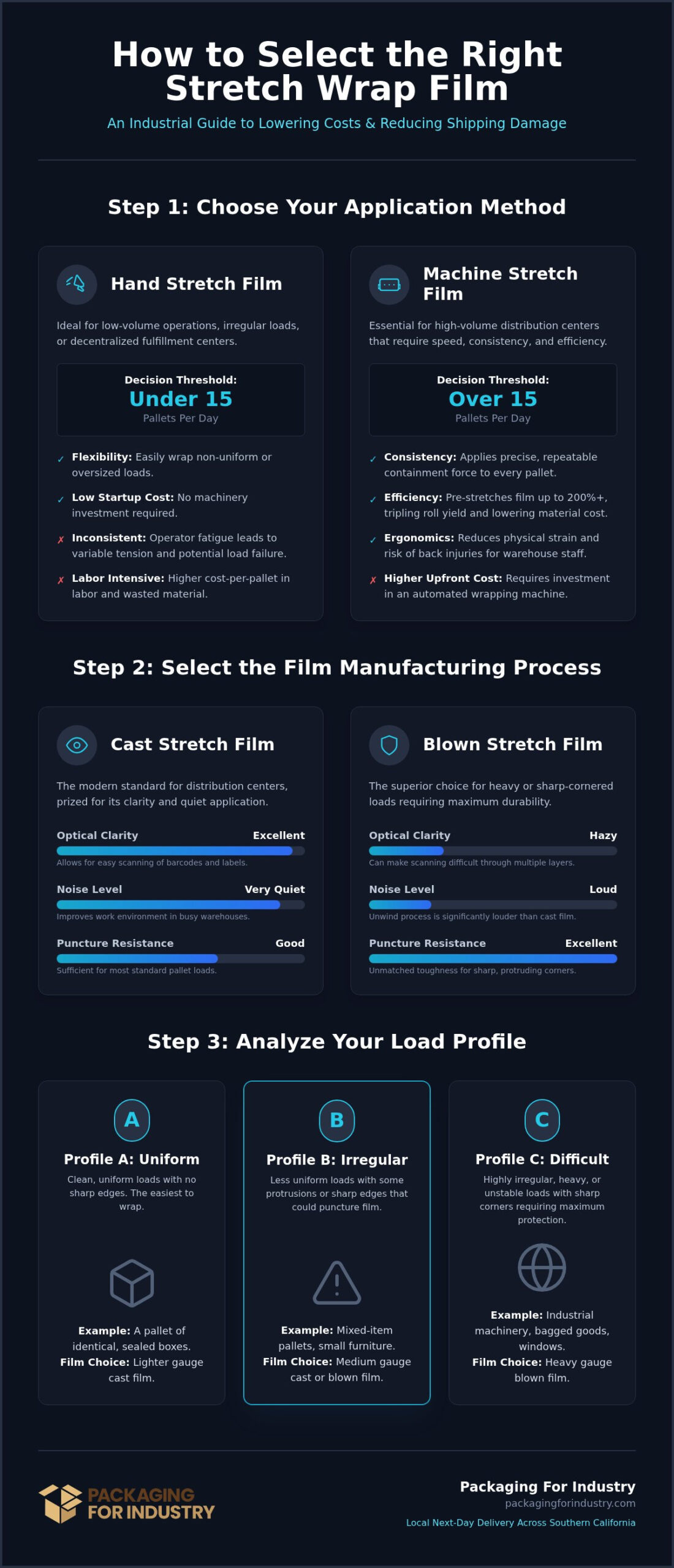
Choosing between manual and automated wrapping is the first strategic step in understanding how to select a stretch wrap film for your application. While both methods use LLDPE resins, the operational outcomes differ significantly in terms of labor costs, safety, and load integrity. Most warehouse managers find that the decision hinges on daily pallet volume and the need for repeatable containment force. If your team is wrapping more than 10 to 15 pallets per day, the labor hours spent on manual wrapping usually justify the transition to an automated system.
When to Deploy Hand Stretch Film
Hand film is the most flexible option for low-volume operations or decentralized fulfillment centers. It’s particularly effective for manufacturers who deal with highly irregular loads that require manual intervention to secure loose components during the wrap cycle. Because hand rolls are shorter and lighter, typically weighing between 5 and 9 pounds, they allow workers to move around the pallet easily. However, manual wrapping is prone to human error. Operator fatigue often leads to inconsistent tension, which is a primary cause of shifting loads and shipping damage. For businesses in Orange County or Los Angeles, PFI provides local next-day delivery on hand film to keep small-scale lines moving without the need for massive on-site inventory.
Transitioning to Machine Stretch Film
High-volume distribution centers in the Inland Empire and San Diego rely on machine-grade stretch film to maintain throughput speeds. A machine wrapper provides a level of consistency that manual labor cannot replicate; it applies the exact same containment force to every pallet, every time. This precision is vital for reducing material waste. Many modern machines can pre-stretch the film by 200% or more before it even touches the pallet, effectively tripling the yield of a single roll. When you are determining how to select a stretch wrap film for your application, you must evaluate your machine’s pre-stretch settings to ensure the film doesn’t snap under high tension.
Ergonomics play a massive role in this choice as well. Stretch wrap applied by hand requires workers to walk backwards while bending and reaching, which frequently leads to back injuries and workers’ compensation claims. Machine rolls are much heavier, often weighing 40 to 50 pounds, but because they are loaded onto a carriage, they eliminate the physical strain on your warehouse staff. We help our clients compare packaging pricing across both formats to find the point where automation pays for itself through reduced labor and lower material-per-pallet costs.
Cast vs. Blown Stretch Film: Choosing the Right Manufacturing Process
The manufacturing process is a fundamental variable in how to select a stretch wrap film for your application. Cast film is produced through a continuous extrusion process where the resin is fed onto cooling rollers. This results in a film with exceptional clarity and a quiet release. In contrast, blown film involves inflating a thick tube of resin into a large bubble. This process creates a film with superior mechanical strength but lower optical clarity and higher noise levels during application. Choosing between them requires balancing your need for visual identification against the physical demands of your load.
The Advantages of Cast Stretch Film
Cast film is the standard for most modern distribution centers. Because it’s highly transparent, it allows warehouse staff to easily scan barcodes and read shipping labels through multiple layers of wrap. This reduces inventory errors and speeds up the fulfillment process. Additionally, cast film is virtually silent when unwinding from the roll. In a high-traffic warehouse, reducing the constant screech of film release significantly improves the work environment. It also features two-sided cling, which helps the wrap stick to itself securely without needing additional adhesives. For businesses focused on high-speed fulfillment and inventory accuracy, cast stretch film is usually the most efficient choice.
The Durability of Blown Stretch Film
For manufacturers handling heavy industrial equipment or loads with sharp, protruding corners, blown film is often the superior choice. It offers unmatched puncture resistance; once a small hole is poked in blown film, the tear is less likely to propagate across the entire pallet. It also provides a higher force-to-load capacity, meaning it can secure much heavier weights with less material. One specific advantage of blown film is the option for one-sided cling. This prevents pallets from sticking to each other during transit, which is a common cause of damage when unloading trailers. While it’s noisier and has a hazy appearance, its structural integrity is essential for high-risk shipping environments.
Understanding these technical trade-offs ensures you don’t overpay for durability you don’t need or risk damage by using a film that’s too fragile. If you’re unsure which material fits your current machinery, you can request a packaging quote to have a specialist evaluate your load profile and help you lower packaging costs through better material selection. Matching the film’s manufacturing process to your specific transit challenges is a critical step in how to select a stretch wrap film for your application.
Analyzing Your Load Profile: A, B, and C Load Types
Load geometry is the single most important factor in determining the success of your containment strategy. If you don’t account for the shape and stability of your pallet, even the most expensive film will fail during transit. The packaging industry standardizes these shapes into three categories: Profile A, B, and C. Understanding these classifications is essential when learning how to select a stretch wrap film for your application because each profile places different physical stresses on the material. The thickness, or gauge, of the film must be matched to the weight and sharpness of the load to ensure the pallet reaches its destination intact.
Securing Profile A and B Loads
Profile A loads are uniform, square, and have no protrusions. These are the easiest to wrap and allow for significant downgauging to lower packaging costs. Profile B loads are slightly more complex; they have a generally square footprint but include irregular stacking or small protrusions that can catch the film. For these applications, a high-quality cast film is typically the most efficient solution. You can view our full range of industrial packaging supplies to compare options for these standard profiles.
The goal with A and B loads is to maximize pre-stretch settings. This allows you to get the most yield out of every roll without applying so much tension that you crush the underlying product. If you’re wrapping lightweight corrugated boxes, a high-performance, lower-gauge film provides the necessary containment force without the risk of corner crush. We help clients in Los Angeles and Orange County transition to these thinner, stronger films to reduce material waste and lower their total cost-per-pallet.
Engineering Protection for Profile C Loads
Profile C loads represent the highest risk for shipping damage. These are highly irregular pallets with sharp edges, odd shapes, and significant gaps. They’re common in sectors like aerospace, construction, and heavy manufacturing. When you’re deciding how to select a stretch wrap film for your application involving Profile C loads, standard cast film is rarely enough. You need the superior puncture resistance of a heavy-duty blown film.
To prevent film breaks on sharp corners, we recommend combining high-performance resins with corner and edge protection. This combination creates a reinforced structure that resists tearing, even when subjected to the vibrations of long-haul trucking. Using the right gauge for a Profile C load isn’t just about security; it’s about preventing the costly downtime caused by frequent film breaks on the production line.
Industries Served by PFI
We provide specialized stretch film solutions across a broad spectrum of Southern California’s industrial sectors. In the aerospace and defense industry, we engineer containment for high-value, irregular components that require maximum puncture resistance. For medical device and electronics manufacturing, we focus on high-clarity cast films that allow for precise inventory scanning while maintaining cleanroom standards. We also support food and beverage distributors in the Inland Empire with vented films and high-cling options for refrigerated environments. Our expertise ensures that regardless of your sector, your packaging for manufacturers is optimized for both safety and fiscal responsibility.
Gauging Performance: Stretch, Cling, and Puncture Resistance
Traditional 80-gauge film was once the universal benchmark for industrial shipping, but modern resin technology has made that standard obsolete. When you’re evaluating how to select a stretch wrap film for your application, focusing solely on the thickness of the material is a mistake. The real metric of success is load containment. This is the cumulative force that holds your pallet together during the vibrations and centrifugal forces of transit. High-performance ‘equivalent’ films use advanced multi-layer technology to match the strength of 80-gauge film while using significantly less plastic, which is the most effective way to lower packaging costs.
Film ‘memory’ also plays a vital role in containment. This is the material’s natural tendency to return to its original length after being stretched. This elastic recovery creates a constant inward pressure that keeps the load secure. If you select a film with poor memory, the wrap will loosen over time, leading to load shifting and potential shipping damage. We help our clients in Los Angeles and Orange County audit their current wrap performance to ensure their film maintains its tension from the warehouse floor to the final delivery dock.
Understanding Film Gauge and Microns
Modern manufacturing has moved toward micron measurements for greater precision. Translating traditional gauge to microns allows for a more accurate ‘down-gauging’ audit. By analyzing your specific load weight and transit distance, we can often identify opportunities to switch from a standard 80-gauge film to a high-performance 50-gauge equivalent. This transition reduces material waste and lowers bulk packaging pricing per pallet without compromising safety. Lightweight e-commerce parcels may only require a 30 to 40 gauge equivalent, while heavy manufacturing loads still demand the structural integrity of higher-micron materials.
Pre-Stretch Film: The Cost-Savings Leader
Pre-stretch film is a high-efficiency option for manual wrapping operations. It requires much less physical effort to apply because the operator doesn’t have to pull the film as hard to achieve the necessary tension. This significantly reduces worker fatigue and the risk of injury in the warehouse. Pre-stretch film is a material that is elongated past its primary yield point before being wound onto the roll. Because the film is already stretched, you get a much higher yield per roll compared to standard commodity films. This efficiency is why many fulfillment centers in Anaheim and Riverside are moving away from traditional stretch film to high-performance pre-stretch options.
Optimizing Your Stretch Wrap Procurement for Cost and Reliability
Procurement optimization goes beyond the price per roll. True efficiency requires analyzing material yield and labor costs alongside product protection. When you evaluate how to select a stretch wrap film for your application, the goal is to find a solution that minimizes waste while securing the load. We provide integrated shipping solutions where film works in tandem with our corrugated boxes and pallets. Because we understand that unique load geometries require specific dimensions, we ensure custom sizes available for specialized applications, allowing you to lower packaging costs through precision engineering.
For businesses in Southern California, local proximity is a major factor in supply chain reliability. If you’re searching for a reliable packaging supplier near me, PFI offers local next-day delivery across Orange County, Los Angeles, and the Inland Empire. This proximity allows you to maintain leaner inventory levels without the risk of production stops. We help manufacturers and distribution centers in Anaheim and Riverside avoid the high freight fees and long lead times associated with national catalog distributors.
Why Partner with PFI for Your Industrial Film Needs
PFI delivers a level of technical expertise that catalog companies can’t match. Our team provides custom packaging reviews specifically designed to reduce shipping damage for high-value industrial and aerospace components. We offer competitive bulk packaging pricing and a deep understanding of warehouse needs. Whether you need machine film for high-speed lines or specialized hand wrap, our local delivery network ensures you stay stocked for peak production periods. This focus on reliability helps you avoid the stress of emergency orders and unexpected shortages.
Request a Custom Packaging Quote
We start with a cost-reduction packaging analysis to find the most efficient material for your workflow. To prevent shortages, many of our clients utilize our VMI programs. These managed stocking plans ensure you never run out of critical supplies, as we monitor and replenish your inventory based on actual usage. This proactive approach simplifies purchasing and improves cash flow by reducing the capital tied up in excess warehouse stock. Our goal is to keep your shipping department moving with zero interruptions.
Optimize Your Warehouse Throughput and Reliability
Mastering the technical variables of stretch film is a necessity for any manufacturer aiming to reduce shipping damage and lower material costs. By identifying your specific load profile and selecting high-performance resins, you eliminate the waste associated with traditional 80-gauge commodity films. Understanding how to select a stretch wrap film for your application ensures your warehouse operates at peak efficiency without the risk of product shifting during transit. It’s about moving away from one-size-fits-all solutions toward a system that balances film physics with your specific economic goals.
PFI provides the regional expertise and logistics needed to support these objectives. We offer local next-day delivery across Orange County, Los Angeles, and the Inland Empire to keep your production lines moving. Whether you require specialized VMI programs for high-volume manufacturing or custom-engineered solutions for high-value aerospace components, we’re here to optimize your supply chain. Our team focuses on the intersection of engineering and economics to deliver tangible, real-world outcomes for your business.
We’re ready to help you eliminate professional stress by securing your loads and streamlining your procurement process. With the right material and a reliable supply partner, you can achieve zero transit-related damage while maintaining a leaner, more profitable operation.
Frequently Asked Questions
What is the difference between cast and blown stretch film?
Cast film is extruded over cooling rollers, resulting in high clarity and quiet release, which is ideal for barcode scanning in busy warehouses. Blown film is created by inflating a resin bubble, providing superior puncture resistance and higher force-to-load capacity for heavy industrial equipment. While cast film is the standard for high-speed warehouse operations, blown film remains the preferred choice for irregular loads with sharp edges that might tear thinner materials.
How do I determine which gauge of stretch film I need for my pallets?
Gauge selection depends on your pallet weight and load profile. Lightweight loads under 1,200 lbs often use 50 to 60 gauge equivalent films. Mid-range loads between 1,500 and 2,200 lbs typically require 70 to 80 gauge. Heavy or unstable industrial loads exceeding 2,500 lbs may need 100 gauge or higher. Understanding how to select a stretch wrap film for your application involves auditing these weights against the puncture risks posed by your specific product corners.
Can I save money by switching from hand wrap to machine stretch film?
Transitioning to machine stretch film usually becomes profitable once your facility wraps more than 15 pallets per day. Automation reduces labor costs and significantly improves material yield through precise pre-stretch settings that hand-wrapping cannot achieve. Machines apply a consistent containment force, which reduces shipping damage and eliminates the material waste caused by human error. Over time, the lower cost-per-pallet justifies the initial investment in automated wrapping equipment.
What are the common causes of stretch film breaking during application?
Film breaks are commonly caused by sharp corners on Profile C loads, incorrect tension settings on machine wrappers, or using a gauge that is too thin for the load weight. Nicks in the roll itself can also lead to propagation tears during the wrap cycle. To reduce shipping damage and production downtime, we recommend matching high-performance resins to your specific load geometry and ensuring your equipment pre-stretch rollers are properly maintained.
Is pre-stretched film better for my warehouse application?
Pre-stretched film is often better for manual warehouse applications because it requires significantly less physical effort to apply. Since the material is elongated during manufacturing, the operator doesn’t need to pull against the film’s primary tension to secure the load. This reduces worker fatigue and injury risks while providing a higher yield per roll. It is an excellent cost-saving alternative for fulfillment centers that haven’t yet transitioned to fully automated machine wrapping.
How many layers of stretch wrap are needed for a secure pallet?
A secure pallet generally requires two to three wraps at the top and bottom to lock the load to the pallet. The middle sections should maintain a 50% overlap to ensure consistent containment force throughout the stack. Heavier or more unstable loads might require additional revolutions to prevent shifting. We provide custom packaging reviews to help you determine the exact number of layers needed to achieve zero transit-related damage without wasting material.
Does PFI offer local delivery for stretch film in Southern California?
Yes, PFI provides local next-day delivery throughout Southern California, including Anaheim, Irvine, Los Angeles, and the Inland Empire. Our regional distribution network allows us to support warehouses and manufacturers with fast, dependable supply to prevent production downtime. By sourcing locally, businesses can lower packaging costs by reducing lead times and avoiding the high freight charges associated with shipping heavy film rolls from national catalog suppliers who lack a local presence.
Can stretch film be used for military or aerospace packaging requirements?
Stretch film is essential for military and aerospace packaging, particularly when securing high-value components or meeting strict mil-spec requirements. We provide specialized films, including anti-static (ESD) and heavy-duty blown options, that protect sensitive electronics and large aviation assemblies. When you learn how to select a stretch wrap film for your application in these sectors, we focus on high-performance resins and integrated solutions like custom foam inserts and corner protectors for maximum reliability.