
How much does a rejected shipment actually cost your operation when you factor in freight claims, retailer fines, and the damage to your professional reputation? If you’re searching for a packaging supplier near me that understands the technical rigors of transit validation, you likely need a partner that can help you reduce shipping damage while you lower packaging costs. We understand that for manufacturers and distribution centers, a single failed delivery is an expensive logistical nightmare that requires more than just a standard catalog solution.
This guide explains how to select a packaging supplier that can provide ISTA test reports to ensure 100% compliance with retailer or military standards. You’ll learn how to compare packaging pricing, evaluate bulk packaging pricing, and confirm custom sizes available for your specific product geometry. We’ll show you how to request a packaging quote and leverage local packaging delivery across Southern California to maintain a lean supply chain. By combining custom engineering with data-driven testing, we help you secure the technical documentation needed for your most sensitive industrial shipments.
Key Takeaways
- Understand the financial impact of transit damage and how ISTA protocols protect manufacturers from costly retailer rejections and freight claims.
- Learn to identify the right test protocols for your shipment type, whether you’re moving palletized industrial goods or individual parcel units.
- Discover the benefits of working with a packaging supplier that can provide ISTA test reports to ensure your custom designs meet rigorous aerospace and medical device standards.
- Find out how to request a custom packaging quote that includes design reviews and engineering validation to guarantee your prototypes pass lab testing on the first attempt.
- See how local next-day delivery and Vendor Managed Inventory (VMI) can improve your supply reliability across Southern California while lowering your total logistical costs.
Why ISTA Test Reports are Essential for Industrial Packaging Compliance
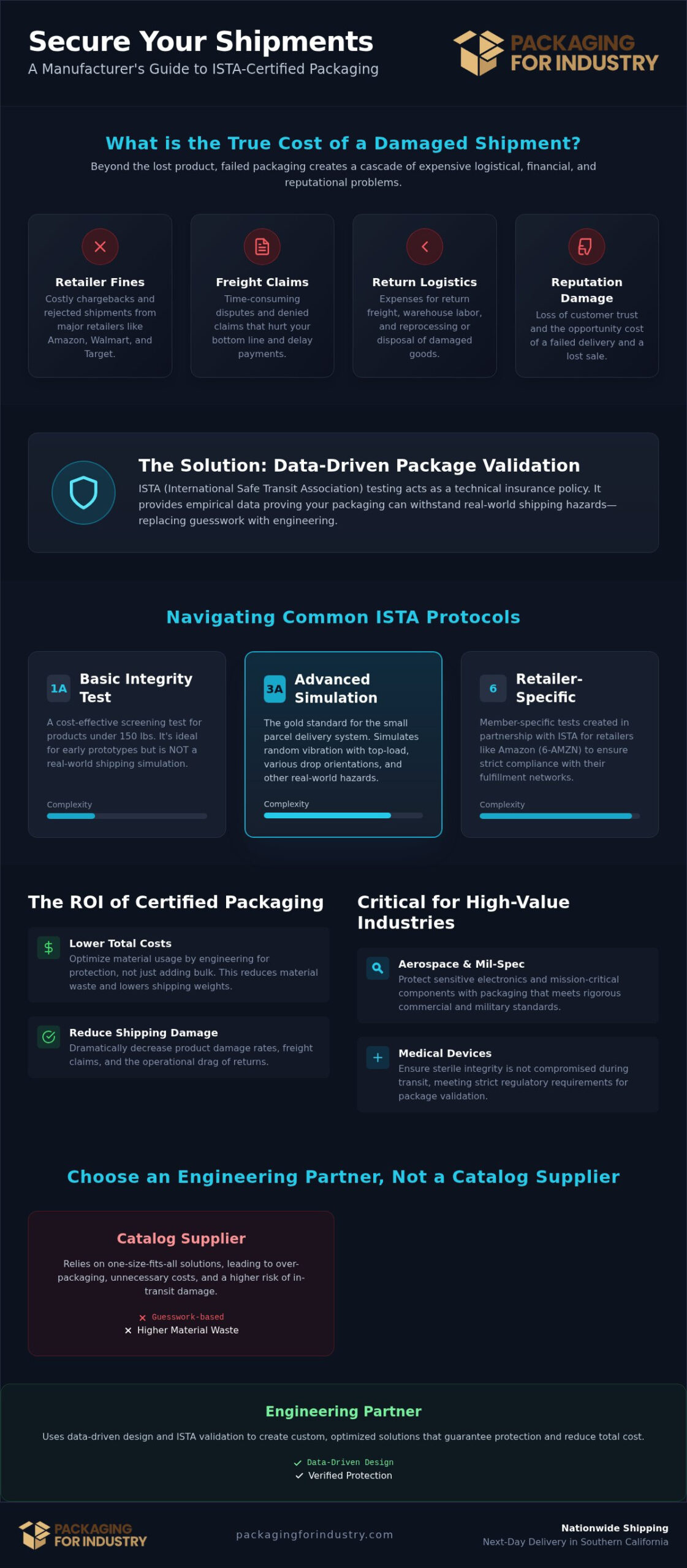
ISTA isn’t just a technical acronym; it’s the International Safe Transit Association, the organization that defines how your products survive the rigors of global logistics. For a manufacturer, an ISTA test report acts as a technical insurance policy. It proves that your packaging design can withstand the vibrations, drops, and atmospheric changes typical in a modern supply chain. Without this validation, you’re essentially guessing whether your product will arrive intact. Choosing a packaging supplier that can provide ISTA test reports ensures that your shipping strategy is based on empirical data rather than hope.
Major retailers like Amazon, Walmart, and Target now frequently mandate certified transit testing to minimize their own operational friction. If your packaging doesn’t meet their specific standards, you risk costly chargebacks or outright shipment rejections. Beyond retailer compliance, validated testing is your best defense against high insurance premiums and freight surcharges. When you can prove your packaging is engineered to a global standard, you’re in a much stronger position to negotiate freight rates and resolve damage claims quickly. It removes the ambiguity that often leads to denied claims and logistical delays.
Understanding the ROI of Certified Packaging
The true cost of shipping damage includes much more than the value of the broken item. You have to account for return freight, warehouse labor to process the return, and the opportunity cost of a lost sale. Data-driven design helps you find the “sweet spot” between protection and price. Many businesses over-package their goods to compensate for poor design, which leads to unnecessary material waste and higher shipping weights. ISTA testing identifies exactly where you can strip away excess material while maintaining structural integrity. This optimization allows you to lower packaging costs without increasing your risk profile during transit.
Compliance Standards for Aerospace and Medical Devices
High-value sectors require an even higher level of precision. In aerospace packaging, components often feature sensitive electronics or heavy, oddly shaped metal parts that require custom foam inserts and heavy-duty double-wall corrugated boxes. For medical devices, transit validation is often a regulatory requirement to ensure sterile integrity isn’t compromised during a drop or impact. Many of these industrial applications also intersect with Mil-Spec protocols, requiring a supplier who can navigate both commercial and military standards. Validated reports provide the transparency needed to satisfy auditors and ensure your mission-critical parts arrive ready for use, every time.
Navigating Common ISTA Test Protocols: 1A, 3A, and Series 6
Not all transit tests provide the same level of security. When you search for a packaging supplier that can provide ISTA test reports, it’s vital to understand which protocol actually fits your distribution channel. ISTA categorizes its tests into “Series” based on the complexity of the simulation. Series 1 and 2 are non-simulation integrity tests. They’re useful for establishing a baseline of package strength through simple drop and vibration cycles. Series 2 adds atmospheric conditioning, which is essential if your corrugated boxes travel through high-humidity environments where material strength can degrade by nearly 50%.
Series 3 represents the gold standard for general simulation. These tests mimic the actual hazards of the distribution chain, including random vibration and multi-axis shock. For manufacturers of sensitive electronics, Series 3 protocols are indispensable. They verify that internal components remain seated and functional after enduring the repetitive “road buzz” of long-haul trucking or the chaotic movements of automated sorting facilities.
ISTA 1A vs. 3A: Which Does Your Product Need?
The choice between 1A and 3A often depends on your shipping volume and risk tolerance. ISTA 1A is a basic integrity test for products weighing less than 150 lbs. It’s a cost-effective way to screen prototypes, but it doesn’t simulate the real-world parcel environment. In contrast, ISTA 3A is a high-level simulation designed specifically for the small parcel delivery system. It includes random vibration with top-load simulation, mimicking how packages are stacked in a delivery van. If you primarily ship palletized loads via less-than-truckload (LTL) carriers, you’ll need to look at 3B protocols instead. These focus on tip-and-tip-over tests and fork-lift handling simulations to ensure your pallets don’t collapse under pressure.
Retailer-Specific Standards and ISTA 6
If you’re selling through major digital channels, you can’t ignore ISTA 6-Amazon.com. This protocol is mandatory for manufacturers seeking Frustration-Free Packaging (FFP) or Ships in Own Container (SIOC) certification. Amazon’s APASS program requires these specific test reports to prove your goods can survive their fulfillment centers without additional over-boxing. Utilizing validated ecommerce packaging isn’t just about protection; it’s about financial survival. Non-compliant packaging often triggers per-unit chargebacks that quickly erase your profit margins. Before you finalize your next production run, request a custom packaging quote to see how an engineered solution can pass these rigorous Series 6 requirements and protect your bottom line.
Evaluating Packaging Suppliers: Engineering Capabilities vs. Catalog Sales
Buying from a catalog is convenient for standard office supplies, but it’s a high-risk strategy for high-value industrial goods. Stock boxes aren’t engineered for the specific G-force impacts or vibration frequencies your particular product will face during transit. When you partner with a packaging supplier that can provide ISTA test reports, you’re moving beyond guesswork. These suppliers don’t just sell containers; they understand the specific lab requirements needed to pass a Series 3 or Series 6 test. This technical insight allows them to engineer a solution that passes the first time, preventing the delays and extra costs associated with repeated lab failures.
The most effective protection often comes from integrated material solutions. By combining precision-cut foam packaging with heavy-duty corrugated boxes, you create a system where each component serves a specific protective role. The foam absorbs initial shock and prevents internal movement, while the corrugated provides the structural integrity needed for pallet stacking. PFI bridges the gap between design and manufacturing by offering free prototyping. This allows you to validate the fit and protection of your industrial components before you commit to a full production rollout.
CAD/CAM Design and Prototyping
Modern industrial protection relies on CAD/CAM technology to create custom design packaging that mirrors the exact geometry of your product. This digital precision facilitates a rapid “Design-Test-Refine” loop. We create a digital model, cut a physical prototype, and subject it to internal stress tests before it ever reaches a certified lab. This process ensures that every sensitive sensor or heavy mechanical part is perfectly cradled. It eliminates the internal shifting that is the leading cause of damage in complex industrial shipments.
Material Expertise: Double-Wall, Triple-Wall, and Custom Foam
Selecting the right material density is a financial decision as much as an engineering one. For heavy industrial machinery, standard corrugated often fails under the stress of long-haul vibration. You may require custom wooden crates or triple-wall corrugated to handle extreme weights. For electronics, the focus shifts to anti-static and ESD foam requirements to prevent static discharge. A seasoned supplier evaluates your entire shipping environment to recommend the leanest material that still guarantees an ISTA pass. This prevents “over-packaging” and keeps your shipping weights low without compromising the safety of your high-value assets.
How to Request and Review an ISTA Test Report from Your Supplier
Securing a certified transit report is a methodical process that requires tight coordination between your production team and your packaging partner. It begins with a clear definition of your distribution channel. You must identify if your product travels via small parcel, less-than-truckload (LTL), or through specific retailer fulfillment centers like Amazon. Once these variables are set, you should engage a packaging supplier that can provide ISTA test reports to conduct a comprehensive design review. This initial step ensures your custom corrugated boxes and foam inserts are engineered for the specific fragility of your product before physical testing begins.
The process then moves into engineering and sample production, where CAD designs are converted into physical prototypes. At PFI, we provide free prototyping to validate these designs early in the cycle. After the prototypes are ready, they undergo the formal testing phase, which typically includes a sequence of atmospheric conditioning, compression, vibration, and drop tests. The final stage is the analysis of the test report. This document serves as your technical proof of compliance, allowing you to move into full-scale production with the confidence that your shipments are protected against the known hazards of your supply chain.
What Should Be Included in Your ISTA Report?
A professional ISTA report is much more than a simple pass or fail certificate. It must include a detailed breakdown of the test parameters, the specific equipment used, and the exact sequence of the trials. High-quality reports provide photographic evidence of the package and its contents in both pre-test and post-test conditions. This transparency is vital for identifying “near-misses” where a package might have passed but showed signs of structural fatigue that could lead to future failures. If a design fails, the report should include specific engineering recommendations for material adjustments or structural reinforcements to ensure a pass on the next attempt.
Questions to Ask Your Packaging Supplier
When evaluating potential partners, you need to look beyond their ability to manufacture boxes. Ask direct questions about their technical integration and commercial scalability. You should confirm if they handle the full coordination with the ISTA-certified lab or if you’re expected to manage that logistics gap yourself. It’s also important to ask about their capacity for custom sizes available and bulk packaging pricing. Since industrial lead times are critical, verify how quickly they can produce certified prototypes for your review. A supplier that can deliver local packaging delivery across Southern California while maintaining these technical standards is a significant asset for maintaining a lean, reliable inventory.
Packaging For Industry (PFI): Your Partner for ISTA-Certified Solutions
Choosing a packaging supplier that can provide ISTA test reports shouldn’t just be about checking a compliance box. At PFI, we approach every project as industrial consultants focused on the intersection of engineering and economics. Our expertise in manufacturing packaging allows us to design solutions that protect high-value assets while simultaneously stripping out unnecessary logistical costs. We don’t just provide a report; we provide a validated system that ensures your product survives the distribution chain without the burden of over-packaging.
Our process involves a deep-dive cost-reduction analysis for your recurring industrial needs. We evaluate your current damage rates, material usage, and shipping weights to identify areas for optimization. By integrating custom foam and heavy-duty corrugated into a single, cohesive design, we help you lower packaging costs and reduce shipping damage. This methodical approach is why aerospace and medical device manufacturers trust us to handle their most sensitive transit validation projects.
Southern California Logistics and Nationwide Shipping
Reliability is the backbone of any successful supply chain. From our facility in Anaheim, we provide local packaging delivery across Orange County, Los Angeles, and the Inland Empire. This proximity allows us to support lean operations with vendor managed inventory (VMI) and just-in-time management. We hold your ISTA-certified stock so you don’t have to waste valuable warehouse space, delivering exactly what you need when your production line requires it.
While our local roots are deep, our reach is nationwide. We offer fast nationwide shipping for bulk corrugated and foam orders, ensuring that your facilities outside of California maintain the same standard of protection and supply reliability. Whether you need a local packaging delivery or a cross-country logistics partner, our team ensures your lead times remain short and your inventory stays replenished.
Request a Packaging Quote Today
If your current supplier is just a catalog vendor, you’re likely leaving money on the table through shipping damage or material waste. PFI offers a technical alternative that prioritizes your bottom line. We specialize in custom mil-spec and industrial solutions tailored specifically to the geometry and fragility of your product. Don’t risk your reputation on unvalidated designs that might fail in the field or trigger retailer chargebacks.
Our team is ready to help you navigate the complexities of transit testing and logistical optimization. Take the first step toward a more reliable, cost-effective shipping strategy by contacting our specialists. Request a packaging quote for your ISTA-validated project today and see how engineered protection can transform your operational efficiency.
Secure Your Supply Chain with Validated Packaging Solutions
Choosing a packaging supplier that can provide ISTA test reports is a strategic move that protects your high-value inventory and your professional reputation. Validated transit testing proves your custom corrugated boxes and foam inserts are engineered to withstand the specific rigors of your distribution channel. This data-driven approach eliminates the financial drain of retailer rejections, freight claims, and high damage rates.
By partnering with a specialist in aerospace, medical, and defense packaging, you gain access to free prototyping that ensures your designs pass lab tests on the first attempt. Manufacturers across Southern California can leverage local next-day delivery to maintain lean inventory levels while ensuring 100% compliance with global standards. It’s time to move beyond the limitations of generic catalog solutions and invest in a protective system that prioritizes both engineering precision and fiscal responsibility.
Our team is ready to help you eliminate shipping damage and lower your total logistical costs. We look forward to building a reliable partnership that supports your operational goals.
Frequently Asked Questions
Does every industrial package need an ISTA test report?
Not every shipment requires a formal report, but it’s highly recommended for high-value industrial goods or fragile components. If you’re shipping via LTL or parcel systems where handling is unpredictable, a report provides the technical validation needed to avoid claims. Retailers like Amazon or Walmart often mandate these reports for compliance. For standard warehouse supplies with low damage risk, a report might be an unnecessary expense.
How much does it cost to get an ISTA test report?
Testing costs are determined by the specific protocol required and the number of samples being tested. Simple integrity tests like ISTA 1A are generally more affordable than complex simulations like Series 3 or Series 6. While lab fees are a separate investment, choosing a packaging supplier that can provide ISTA test reports through a managed process reduces the risk of expensive re-testing. PFI provides free prototyping to ensure your design passes the first time.
Can PFI help with Amazon APASS or ISTA 6 compliance?
Yes, PFI specializes in engineering solutions that meet Amazon APASS and ISTA 6 requirements. We design custom corrugated boxes and foam inserts that qualify for Frustration-Free Packaging (FFP) or Ships in Own Container (SIOC) status. These designs are engineered to survive the Amazon fulfillment network without the need for additional over-boxing. This optimization helps you avoid per-unit chargebacks and reduces material waste across your entire e-commerce operation.
What is the difference between ISTA and ASTM testing?
ISTA and ASTM D4169 are both respected standards for transit testing, but they differ in their simulation approaches. ISTA protocols are often more specific to certain distribution channels, such as small parcel or palletized freight. ASTM D4169 is a broader, multi-component standard used frequently in medical device validation. Our team helps you determine which standard your specific industry or retailer requires before we begin the custom engineering and prototyping phase.
How long does the ISTA testing process take with a supplier?
The timeline for transit validation typically depends on the complexity of the custom design. Initial CAD engineering and physical prototyping usually take a few business days at our Anaheim facility. Once the prototype is finalized, the formal lab testing phase can take between one and two weeks depending on the lab’s current schedule. We manage this entire feedback loop to ensure your production schedule stays on track without unexpected delays.
Can you provide ISTA reports for custom wooden crates and pallets?
Yes, we provide engineering support and test report coordination for heavy-duty wooden crates and pallets. High-value machinery and industrial equipment often require specialized shock and vibration testing to ensure internal components aren’t damaged by “road buzz” during long-haul transit. We combine custom wood packaging with specialized foam cushioning to meet the rigorous requirements of Series 3 protocols, ensuring your heavy assets arrive in perfect working condition.
What industries require ISTA certified packaging the most?
Aerospace, medical device manufacturing, and electronics sectors are the primary drivers for certified packaging. These industries deal with high-value, sensitive components where a single failed shipment can cost thousands in lost revenue and logistical friction. Additionally, any manufacturer selling through major e-commerce platforms now requires ISTA 6 certification to maintain compliance. PFI has deep expertise in these sectors, providing the specialized engineering required for mil-spec and industrial standards.
Does PFI offer local delivery for ISTA-certified bulk orders in Orange County?
PFI provides local next-day delivery for bulk packaging orders throughout Orange County and the surrounding Southern California region. This includes Anaheim, Irvine, Santa Ana, and Huntington Beach. Our local presence allows us to support your operation with Vendor Managed Inventory (VMI) programs. We can stock your ISTA-certified custom boxes and foam inserts in our warehouse and deliver them exactly when your production line needs replenishment.