
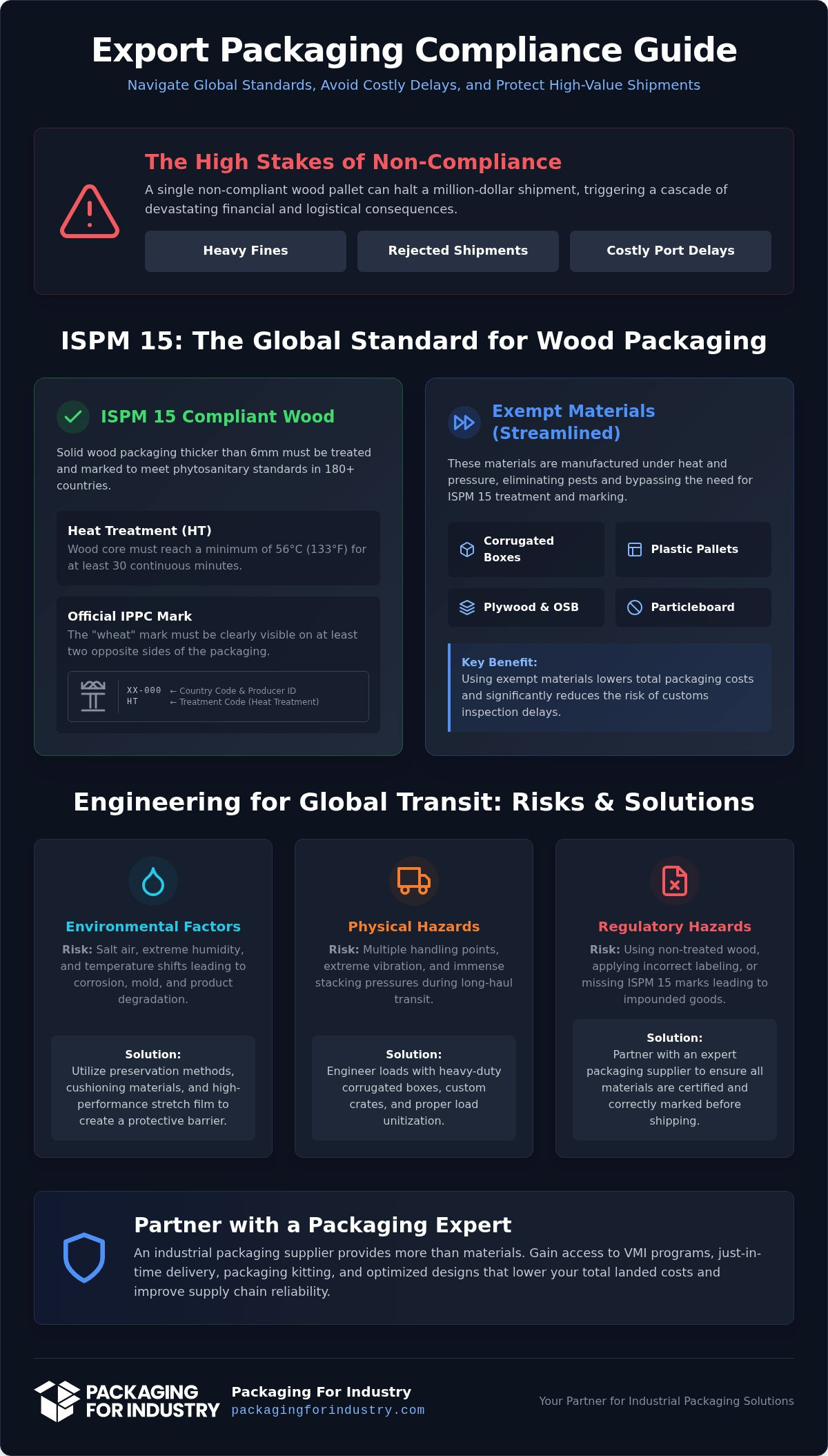
A single non-compliant wood pallet can halt a million-dollar industrial shipment at a global port, triggering cascading delays and massive storage fees. You know that international logistics is no longer just about moving freight; it’s an engineering and regulatory gauntlet. With the 2026 EU Packaging and Packaging Waste Regulation (PPWR) now in full effect and ISPM 15 enforcement tighter than ever, finding a reliable export packaging compliance guide is essential to maintaining your supply chain. The margin for error has disappeared, and the confusion between Mil-Spec and commercial standards only adds to the operational stress of shipping high-value goods.
This article provides the technical roadmap you need to navigate these complexities while lowering packaging costs and improving supply reliability. You’ll learn how to master the latest global standards to ensure your cargo passes through customs without friction. We will examine the core requirements for heat-treated pallets and custom crates, compare specific preservation methods under MIL-STD-2073-1E, and provide a clear checklist to reduce the risk of rejected shipments at international borders. By the end of this guide, you’ll have the insights necessary to implement cost-effective, engineered packaging solutions that protect both your products and your bottom line.
Key Takeaways
- Understand the mandatory requirements of ISPM 15 to prevent customs delays and ensure your wood packaging meets global phytosanitary standards.
- Identify material exemptions like plywood, plastic, and heavy-duty corrugated boxes that can streamline international logistics and reduce compliance overhead.
- This export packaging compliance guide clarifies the critical differences between commercial standards and Mil-Spec requirements for aerospace and defense shipments.
- Learn how to engineer your loads using triple-wall boxes and high-performance stretch film to minimize product damage during long-haul transit.
- Discover how partnering with a local Southern California industrial packaging supplier can lower total landed costs through optimized design and VMI programs.
What is Export Packaging Compliance?
Export packaging compliance refers to the strict set of international regulations and engineering standards that govern the materials used to transport industrial goods across borders. It isn’t just about paperwork; it’s a critical operational framework designed to prevent the introduction of invasive species and ensure that high-value equipment arrives intact. The ISPM 15 Standards, established by the International Plant Protection Convention (IPPC), represent the baseline for wood packaging used in global trade. For manufacturers, following a comprehensive export packaging compliance guide is the difference between a successful delivery and a logistical nightmare.
National customs agencies enforce these rules with zero tolerance. The primary goal is twofold: protecting local ecosystems from pests like the emerald ash borer and ensuring the structural integrity of the load during long-haul transit. When your packaging fails to meet these benchmarks, the financial impact is immediate. You face heavy fines, rejected shipments, and costly port delays that can erode the profitability of an entire contract. At Packaging For Industry (PFI), we view compliance as a strategic advantage that stabilizes your supply chain.
Why Compliance Matters for Your Supply Chain
Adhering to international standards protects your brand’s standing with global distributors. Consistent, damage-free delivery builds professional trust, whereas a rejected shipment suggests a lack of operational oversight. Insurance providers often require proof of adherence to proven transit standards to honor claims. Proper compliance helps you avoid the “emergency order” trap. This occurs when you’re forced to manufacture and air-freight replacement parts at a massive loss because your original sea-freight shipment was seized or damaged due to substandard materials.
Common Export Risks: Beyond the Paperwork
International transit introduces hazards that domestic shipping rarely encounters. Your cargo must withstand three primary risk categories:
- Environmental Factors: Salt air, extreme humidity, and temperature shifts inside sea containers can lead to corrosion or mold.
- Physical Hazards: Multiple handling points at transit hubs expose goods to extreme vibration and stacking pressures.
- Regulatory Hazards: Using non-treated wood or applying incorrect labeling can lead to the immediate impounding of your goods by customs officials.
Addressing these risks requires an engineered approach. Using heavy duty corrugated boxes or custom-designed wood crates ensures your equipment remains secure regardless of the destination or transit method.
ISPM 15 Standards for Wood Packaging and Pallets
ISPM 15 is the mandatory global standard regulating wood packaging material (WPM) in international trade. If your shipment utilizes solid wood thicker than 6mm, it must comply with these phytosanitary measures to pass through customs in over 180 countries. This section of our export packaging compliance guide focuses on the technical requirements for wood materials and how to identify compliant solutions that prevent costly border seizures.
It is important to recognize that not all packaging materials fall under these strict rules. Corrugated boxes, plastic pallets, and manufactured wood products like plywood, OSB, and particleboard are exempt. These materials undergo significant heat and pressure during their manufacturing process, which naturally eliminates wood-boring pests. For many manufacturers, switching to these exempt materials is a pragmatic way to lower packaging costs and bypass the complexities of wood inspections entirely.
To identify compliant solid wood packaging, you must look for the official IPPC mark. This stamp, often referred to as the “wheat” mark, must be visible on at least two opposite sides of the pallet or crate. It contains a unique country code, the producer’s identification number, and the treatment code. Without this mark, customs officials may quarantine your cargo or order the immediate destruction of the packaging at your expense.
The Heat Treatment Process Explained
Heat treatment (HT) is the most reliable method for achieving ISPM 15 compliance. The process requires the wood’s core temperature to reach at least 56 degrees Celsius for a minimum of 30 continuous minutes. While chemical fumigation using Methyl Bromide was once a standard practice, it is increasingly restricted or banned in many regions due to environmental concerns. Most modern logistics chains now rely exclusively on HT wood to meet the rigorous demands of international customs agencies. You should always maintain the heat treatment certificates provided by your supplier to serve as secondary proof of compliance during audits.
Selecting Compliant Wood Packaging
Determining whether to use standard pallets or custom wooden crates depends on the fragility and weight of your industrial equipment. While pallets are efficient for stackable goods, heavy machinery often requires the superior lateral stability provided by heavy-duty skids and fully enclosed crates. Always verify that your packaging distributor is a certified provider of ISPM 15 materials to ensure the integrity of your supply chain. If you need to verify the best material for your specific destination, you can request a packaging quote to receive a compliant, engineered solution tailored to your shipping lane.
Industry-Specific Compliance: Mil-Spec and Aerospace
High-stakes industries like aerospace and defense require a layer of protection that goes far beyond standard ISPM 15 wood crates. For these sectors, an export packaging compliance guide must account for both environmental hazards and extreme physical forces. Military packaging involves strict adherence to MIL-STD-2073-1E, which dictates preservation methods based on the item’s sensitivity and the expected duration of storage. These regulations ensure that mission-critical hardware remains operational even after months of exposure to salt air and high-vibration transit.
Aerospace components often require a balance between weight reduction and extreme protection. While shipping costs are sensitive to weight, the cost of a single damaged turbine blade or avionics suite is astronomical. During sea freight, moisture barrier bags and desiccants are non-negotiable for preventing corrosion on precision-machined surfaces. International electronics shipping also demands ESD compliance to prevent electrostatic discharge from ruining sensitive circuitry during handling at multiple transit points.
Mil-Spec vs. Commercial Export Packaging
Commercial export packaging often focuses on the “last mile,” but military-grade solutions prioritize long-term preservation. A commercial exporter might adopt military-grade foam or crates when shipping to regions with primitive infrastructure or extreme climates. Navigating MIL-STD-2073 requires a deep understanding of preservation levels, ranging from Level A for maximum protection to Level B for moderate conditions. Adopting these higher standards can significantly reduce insurance claims and improve your reputation for reliability with international distributors.
Custom Engineering for Sensitive Components
Engineering custom foam inserts allows manufacturers to meet specific G-force requirements during air or sea deployment. Prototyping and fit-testing are critical steps in aerospace compliance. This process ensures that every component is immobilized and protected from the shocks of turbulence or rough handling. We apply these same rigorous prototyping standards when protecting high-value medical devices for global transit, ensuring that delicate optics arrive calibrated and ready for use. This engineered approach eliminates the guesswork and ensures your high-value goods meet the most demanding international standards.
Engineering for Global Transit: Material Selection
While regulatory adherence is the baseline, the physical engineering of your shipment determines whether it survives the journey. An effective export packaging compliance guide must prioritize structural integrity alongside legal paperwork. This guide helps you choose between double-wall and triple-wall heavy-duty corrugated boxes based on the stacking pressures of your specific shipping lane. Triple-wall corrugated offers a cost-effective alternative to wood crates for heavy industrial parts, providing high crush resistance while reducing overall tare weight.
Optimizing box sizing is a direct way to lower packaging costs. Oversized containers don’t just waste space; they trigger dimensional weight surcharges from carriers. By engineering custom-sized boxes, you eliminate the need for excessive void fill and ensure a tighter, more secure fit for your products. This precision reduces shipping damage and improves supply reliability for your international distribution centers. It’s a proactive step that protects your bottom line.
Corrugated Solutions for International Freight
Sea freight containers are prone to “container rain,” where temperature shifts cause internal condensation. Using weather-resistant corrugated materials is essential for protecting against humidity. Regular Slotted Carton (RSC) boxes remain the export workhorse because they’re efficient to manufacture and easy to secure. For brand consistency and safety, custom printing allows you to include international handling instructions directly on the box. This ensures dock workers understand the fragility of the contents immediately.
Load Stabilization and Cushioning
Securing a palletized load requires high-performance stretch film. Selecting the right micron level is crucial for containment. Machine-grade film offers superior containment force for heavy industrial loads compared to hand-wrap. To prevent impact damage at the most vulnerable points, we integrate engineered corner and edge protection. These stabilizers prevent straps from cutting into boxes and maintain the load’s vertical strength when stacked inside a container.
Internal protection is equally vital for a successful export packaging compliance guide strategy. We utilize polyethylene foam for heavy equipment that requires high-load bearing, whereas polyurethane foam is better suited for lighter items. The strategic use of cushioning materials prevents internal shifts. These shifts often lead to product-on-product damage during the vibration-heavy environment of ocean transit.
Partnering with a Southern California Export Specialist
Navigating international regulations requires more than just a vendor; it requires a partner who understands the intersection of engineering and economics. As a premier industrial packaging supplier based in Anaheim, Packaging For Industry (PFI) provides the local expertise necessary to manage complex global supply chains. We serve manufacturers across Orange County and Los Angeles with local next-day delivery, ensuring that your production lines never stall due to a lack of compliant materials. For businesses with a broader footprint, our nationwide shipping support maintains consistency across all your US locations.
Efficiency in the warehouse is just as critical as compliance at the port. By utilizing our Vendor Managed Inventory (VMI) and just-in-time (JIT) programs, you can significantly reduce your warehouse footprint and free up valuable floor space. We take on the burden of inventory management, allowing you to focus on production while ensuring you always have the right triple-wall boxes or heat-treated pallets on hand for your next export shipment. This proactive approach stabilizes your supply chain and eliminates the stress of last-minute procurement.
The PFI Advantage: From Design to Delivery
Our approach begins with free prototyping and advanced CAD/CAM support. We don’t just sell crates; we engineer custom protection systems for aerospace and high-value industrial goods. This fit-testing process ensures that your components are immobilized and protected against the specific G-forces of international transit. By integrating custom foam and heavy-duty corrugated solutions, we help you lower packaging costs without compromising on the safety of your cargo. Our goal is to provide a seamless transition from the design phase to the final delivery at your customer’s international dock.
How to Start Your Compliance Review
Before your next international shipment, it’s vital to conduct a thorough audit of your current materials. Many procurement teams make the mistake of choosing the cheapest box from a catalog, only to face thousands of dollars in shipping damage or customs fines later. When you compare packaging pricing, you must look at the total landed cost, including insurance premiums and potential port delays. This export packaging compliance guide serves as your starting point, but a professional review can identify specific vulnerabilities in your current process.
To protect your high-value assets and streamline your logistics, contact us today for a comprehensive review of your packaging strategy. Our team of specialists will help you implement an export packaging compliance guide tailored to your specific shipping lanes and regulatory requirements. You can also request a packaging quote to see how our custom-engineered solutions can lower your overall operational costs while improving supply reliability.
Securing Your Global Supply Chain for 2026 and Beyond
Mastering international logistics requires a proactive approach to both regulatory standards and material engineering. This export packaging compliance guide has outlined the critical importance of ISPM 15 heat treatment and the specialized requirements of Mil-Spec and aerospace standards. By integrating custom-engineered solutions like triple-wall corrugated boxes and precision foam inserts, you can significantly reduce shipping damage while maintaining full compliance at international borders.
As specialists in aerospace, military, and industrial equipment, Packaging For Industry offers the technical oversight needed to protect your high-value assets. We provide free prototyping for all custom-engineered solutions to ensure a perfect fit before your rollout. Whether you require local Southern California delivery or fast nationwide shipping, our team is ready to stabilize your supply chain and lower your total landed costs.
Let’s work together to ensure your industrial goods arrive safely and on time, every time.
Frequently Asked Questions
What is the difference between ISPM 15 and heat treatment?
ISPM 15 is the regulatory standard, while heat treatment is the primary method used to comply with it. Heat treatment involves heating the wood’s core to 56 degrees Celsius for at least 30 continuous minutes. This process eliminates wood-boring pests without the environmental impact of chemical fumigation. Most international shipping lanes now mandate HT wood, making it a cornerstone of any effective export packaging compliance guide for industrial manufacturers.
Do I need a certificate of compliance for my export crates?
The official IPPC mark stamped directly on your crates is the primary proof of compliance required by customs. While the stamp serves as the legal mark of entry, you should also maintain heat treatment (HT) certificates provided by your packaging supplier. These documents are essential for internal audits and help resolve disputes if a stamp is ever illegible. PFI provides full documentation for our custom-engineered crates to ensure smooth passage through international ports.
Can I use standard corrugated boxes for international shipping?
You can use corrugated boxes for exports, but standard domestic containers often lack the structural integrity for long-haul transit. International shipments face extreme stacking pressures and humidity. We recommend switching to heavy-duty double-wall or triple-wall boxes to prevent crushing. Since corrugated material is manufactured using heat and pressure, it is naturally exempt from ISPM 15 wood regulations, offering a cost-effective way to bypass phytosanitary inspections.
What are the labeling requirements for international hazardous materials?
International hazardous materials require standardized GHS (Globally Harmonized System) labeling and specific UN-certified packaging. Under the 2026 EU Packaging and Packaging Waste Regulation (PPWR), you must also include harmonized labels that identify material composition and disposal instructions. Failure to apply correct markings can lead to immediate shipment rejection. We help Southern California manufacturers select the correct labels and ribbons to ensure their hazardous goods meet these evolving global standards.
How do I avoid UPS or FedEx dimensional weight surcharges on exports?
Avoiding dimensional weight surcharges requires optimizing your box dimensions to match the product’s actual size. Carriers calculate costs based on the space a package occupies rather than just its weight. By using custom-engineered corrugated boxes instead of oversized stock sizes, you eliminate wasted space and the need for excessive cushioning. PFI specializes in designing right-sized packaging that lowers total landed costs and prevents these expensive freight penalties for our distribution partners.
Is plastic packaging exempt from ISPM 15 regulations?
Plastic packaging is fully exempt from ISPM 15 regulations because it doesn’t harbor the wood-boring pests that the standard targets. This exemption applies to plastic pallets, bins, and stretch film. Many exporters choose plastic as a pragmatic alternative to wood to simplify customs clearance. While plastic pallets often carry a higher initial price, they are reusable and help manufacturers avoid the risk of rejected shipments due to non-compliant wood pallets.
How can a VMI program help with my export packaging supply?
A Vendor Managed Inventory (VMI) program ensures you never run out of critical export supplies like heat-treated pallets or custom foam inserts. We monitor your usage levels and replenish stock automatically, which eliminates the need for emergency rush orders. This is particularly beneficial for managing long-lead-time items like custom-engineered crates. By utilizing a VMI program, Anaheim manufacturers can free up warehouse floor space while maintaining a reliable supply for recurring export needs.
What foam is best for protecting electronics during sea freight?
ESD (Electrostatic Discharge) foam is the best choice for protecting sensitive electronics from static damage during handling. For the physical hazards of sea freight, we often recommend polyethylene foam because it provides superior cushioning for heavier components. Because sea containers are prone to high humidity, you should combine these foam inserts with moisture barrier bags and desiccants. This integrated approach ensures your electronics arrive fully functional and free from corrosion at their final destination.