
The convenience of a massive national catalog often feels like the safest bet for a busy purchasing manager, but for high-volume industrial operations, that “buy now” button can actually be a liability. When evaluating Uline vs local supplier for just-in-time delivery, you’ve likely felt the frustration of a sudden shipping surcharge or the stress of a production line sitting idle because a critical shipment of corrugated boxes is stuck in transit. Managing inventory shouldn’t feel like a gamble against carrier schedules and rising freight rates.
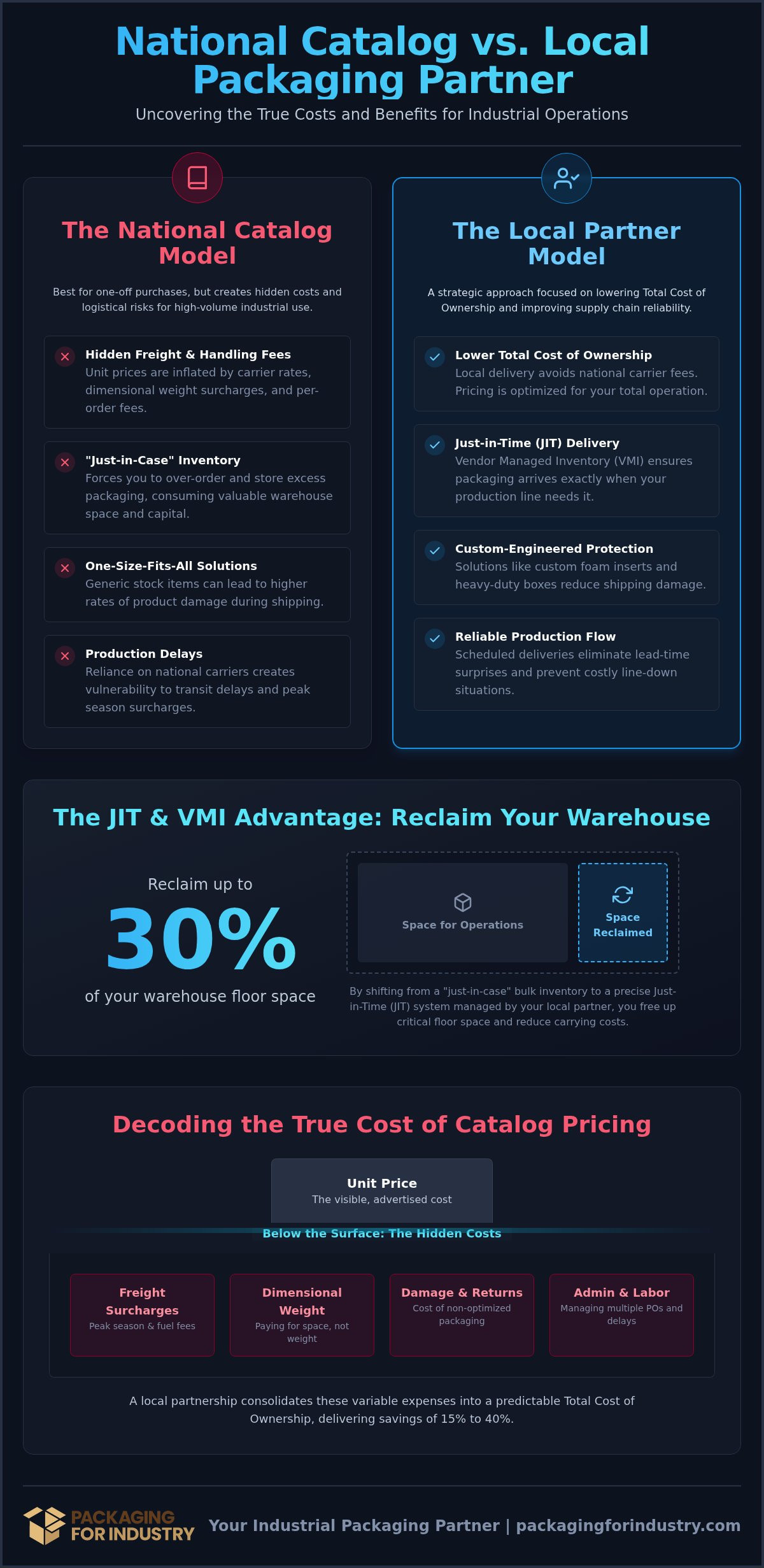
This guide demonstrates how moving away from national catalogs toward local partnerships can eliminate the hidden costs that erode your margins. You’ll discover how to avoid lead-time surprises and reclaim up to 30% of your warehouse floor space by switching from a “just-in-case” inventory model to a more precise system. We’ll outline a blueprint to help you lower your total cost of ownership, reduce the administrative burden on your team, and establish reliable, scheduled deliveries that match your specific production cycles. By the end, you’ll understand why a local partnership offers the logistical stability that a generic catalog cannot match.
Key Takeaways
- Identify the hidden freight fees and dimensional weight surcharges that don’t appear in the initial unit price of national catalog items.
- Evaluate Uline vs local supplier for just-in-time delivery to see how local Vendor Managed Inventory can reclaim up to 30% of your warehouse floor space.
- Understand how custom-engineered foam inserts and heavy-duty corrugated boxes provide superior protection compared to one-size-fits-all stock options.
- Eliminate production stops caused by lead-time surprises through scheduled delivery cycles that align with your specific manufacturing schedule.
- Reduce your total cost of ownership by utilizing local trucking to avoid the rising peak season surcharges common with national carriers.
Catalog Convenience vs. JIT Reliability: The Packaging Conflict
The “Catalog Trap” is a common operational hurdle for purchasing teams. It’s tempting to browse a massive, 800-page book and assume that every item is ready to support your specific workflow. For industrial manufacturers, this convenience is often a mirage that leads to over-ordering. When you’re forced to buy in bulk just to ensure you don’t run out, you aren’t practicing lean logistics. Instead, you’re paying for a “just-in-case” buffer that consumes your floor space and ties up your capital. When evaluating Uline vs local supplier for just-in-time delivery, the primary conflict is between transactional convenience and actual supply chain reliability.
Modern manufacturing and fulfillment operations rely on Just-in-Time (JIT) manufacturing to minimize waste and maximize throughput. In this environment, a “ships today” promise from a website isn’t enough. You need the assurance that your packaging will arrive in the right quantity at the exact moment your production line is ready for it. Stock availability on a website doesn’t guarantee a reliable production flow if the shipment is subject to standard carrier delays or peak-season surcharges. There’s a fundamental difference between a transactional supplier that simply fulfills an order and a logistical partner that understands your production cycles.
The National Catalog Model
National catalogs offer a massive variety of generic SKUs and user-friendly web interfaces. This model is ideal for one-off purchases or low-volume office supplies where specific engineering isn’t required. However, these companies often lack deep logistical integration with your facility. You’re typically subject to high markups on custom requirements and have zero visibility into the actual delivery window beyond a tracking number. When your operation scales, this lack of coordination becomes a bottleneck that can stop a production line.
The Local Industrial Supplier Model
A local industrial supplier prioritizes long-term operational efficiency over one-time transactions. By focusing on packaging cost savings, these partners look beyond the unit price to lower your total cost of ownership. They offer deeper specialization in industrial materials, such as heavy-duty corrugated boxes and precision-engineered foam packaging. For recurring manufacturing, aerospace, and high-volume distribution, this model provides a more resilient Uline vs local supplier for just-in-time delivery strategy. It transforms your packaging supply from a recurring headache into a synchronized component of your manufacturing process.
Decoding the True Cost: Catalog Pricing vs. Local Partnerships
Unit price is a deceptive metric when comparing Uline vs local supplier for just-in-time delivery. While a catalog price might look competitive on a screen, the total cost of ownership often balloons once freight is calculated. Shipping bulky corrugated boxes from a national hub involves high carrier rates and a $1.50 handling fee per order. These costs eat into your margins before the materials even reach your warehouse. Beyond base shipping, national carriers like UPS and FedEx apply a dimensional weight (DIM) divisor of 139 for domestic shipments. This creates a “hidden tax” on lightweight, high-volume items like protective foam, where you pay for the space the package occupies rather than its actual weight.
Administrative and damage costs further widen the gap. Managing 50 individual purchase orders through a transactional website creates a significant clerical burden compared to a single, automated Vendor Managed Inventory (VMI) cycle. Additionally, generic catalog packaging is designed for the lowest common denominator. When sensitive industrial components are shipped in one-size-fits-all boxes, the resulting shipping damage costs often far outweigh any perceived savings on the packaging itself. You can compare packaging pricing to see how a localized approach stabilizes these variables.
Where the 15% to 40% Savings Come From
The 15% to 40% savings typically realized with a local partner come from eliminating the “catalog premium” and optimizing logistics. National suppliers must bake massive marketing and overhead costs into every stock item. By using local delivery across Southern California cities like Anaheim, Irvine, and Los Angeles, you bypass the national carrier network entirely. This eliminates peak season surcharges and large package surcharges, which trigger if a package’s longest side exceeds 96 inches. A local distributor uses their own fleet to deliver right-sized materials, ensuring you don’t pay for air or unnecessary carrier fees.
Hidden Costs of Stockouts
A halted production line in manufacturing is an expensive failure that often stems from lead-time surprises. Relying on a national catalog for Just-in-Time (JIT) inventory management leaves you vulnerable to carrier delays and stockouts. When a critical size goes out of stock, the “emergency order” cycle begins, forcing you to pay for overnight air freight on cardboard just to keep your facility running. PFI prevents these costly rush orders through a proactive, scheduled replenishment system that monitors your usage levels in real time. This level of oversight ensures that your Uline vs local supplier for just-in-time delivery strategy actually supports your production goals rather than hindering them.
Solving the JIT Puzzle with Vendor Managed Inventory (VMI)
Procurement teams often struggle with the delicate balance of inventory levels. Vendor Managed Inventory (VMI) is a strategic model where the supplier takes full responsibility for maintaining the buyer’s stock levels. Instead of your team manually placing orders on a website, we monitor your actual usage and replenish supplies automatically. It’s a pragmatic shift that moves the logistical burden away from your internal purchasing department and places it on the experts who handle your supply chain.
Industrial rents in Los Angeles averaged between $1.30 and $1.41 per square foot in 2026. Storing stacks of bulk-ordered corrugated boxes is an expensive use of that premium space. A VMI program can help reclaim 20% to 30% of warehouse floor space by moving inventory from your floor to ours. You only pay for what you use, which immediately improves cash flow and eliminates the need to store months of “just-in-case” supplies. We use a “Min-Max” strategy to trigger replenishment; when your stock hits a predefined minimum, our system automatically schedules a delivery to bring it back to the maximum.
How VMI Supports Just-In-Time Production
A successful Uline vs local supplier for just-in-time delivery strategy relies on consistent, physical oversight. Our team performs weekly or bi-weekly site visits to audit your packaging levels in person. This proactive approach ensures that long lead-time items, such as custom heavy-duty boxes or precision foam inserts, are always in the production queue. It removes the “safety stock” burden from your logistics team, allowing them to focus on core manufacturing tasks without worrying about packaging shortages.
Case Study: SoCal Manufacturing Efficiency
Consider an aerospace supplier in Carson that struggled with a bloated packaging footprint and frequent production delays. By implementing packaging kitting, they received pre-assembled sets of boxes and protective foam ready for the assembly line. This simplified their JIT process and reduced their administrative overhead. Because we provide local next-day delivery across Orange County and Los Angeles, they no longer had to worry about the Uline vs local supplier for just-in-time delivery trade-off. Their supply chain became a synchronized extension of their production floor.
Custom Engineering: Why Catalogs Fall Short for Industrial Protection
National catalogs excel at providing generic supplies for office environments, but they often struggle to meet the rigorous demands of industrial protection. When you rely on stock items, you’re forced to choose the “closest fit” rather than a precise solution. This reliance on off-the-shelf sizing leads to excessive void fill usage and, more critically, increased product damage. For manufacturers of high-value components, the Uline vs local supplier for just-in-time delivery choice often comes down to engineering depth. A local partner provides integrated solutions that combine custom foam inserts with heavy-duty corrugated materials to create a unified protective system.
Specialized sectors like Aerospace and medical device manufacturing require packaging that meets strict mil-spec and industrial standards. A catalog cannot provide the technical documentation or material certifications necessary for these high-stakes environments. We offer free prototyping to allow your team to test the fit and durability of a design before committing to a full production rollout. This pragmatic approach ensures that your protective system performs as expected, eliminating the guesswork associated with standard catalog ordering.
The Custom Design Advantage
Our engineering team utilizes CAD/CAM support to develop precise foam packaging designs tailored to your specific product geometry. This precision eliminates the need for messy bubble wrap or peanuts, which reduces both labor costs and waste. For heavy machinery that exceeds the capacity of a standard pallet, we design and build wooden crates that provide structural integrity during transit. By engineering the box to the product, we help you avoid the dimensional weight surcharges mentioned earlier while significantly lowering your total cost of ownership.
Prototyping vs. Catalog Guesswork
Choosing a box that is “close enough” is an expensive compromise. Excess space inside a container allows products to shift, which is the primary cause of shipping damage. Our free sample program ensures that your packaging is optimized for protection before you place a bulk order. We also analyze your palletization strategy, incorporating custom corner and edge protection to stabilize loads and prevent crushing. This level of technical oversight is a defining factor in the Uline vs local supplier for just-in-time delivery comparison, as it directly impacts your bottom line through reduced insurance claims and higher customer satisfaction.
The Verdict: When to Switch to a Local Packaging Partner
Choosing between a Uline vs local supplier for just-in-time delivery is a strategic decision that directly impacts your operational resilience and your bottom line. A national catalog supplier is often the correct choice for low-volume office supplies or infrequent, non-critical items. However, when packaging becomes a recurring component of your production line, the inefficiencies of a transactional model begin to surface. For manufacturers in Anaheim, Los Angeles, and the Inland Empire, the “Local Advantage” means eliminating the variables of national carrier networks and replacing them with a predictable, synchronized supply chain.
Signs that your current supplier is costing you more than the unit price include frequent “emergency” orders, high freight-to-product cost ratios, and an administrative team buried in individual purchase orders. If you’re managing multiple vendors for corrugated boxes, foam inserts, and pallets, you’re likely losing money through fragmented logistics. A local partnership consolidates these needs into a single, managed flow, providing the stability needed for true JIT production without the hidden fees common in catalog ordering.
A Quick Decision Checklist
If you’re unsure whether it’s time to move away from a national catalog, consider these three operational benchmarks:
- Monthly Spend: Are you spending more than $2,000 per month on generic catalog supplies? At this volume, the “catalog premium” and freight costs typically justify a move to a custom-tailored local program.
- Supply Reliability: Have you experienced a production delay or a halted line due to a packaging stockout in the last 12 months? A single stockout can cost more in lost labor and throughput than a year’s worth of packaging savings.
- Facility Utilization: Is your warehouse floor space at a premium? If you’re using valuable square footage to store bulk cardboard rather than finished goods, your inventory strategy is working against you.
Requesting a Packaging Quote
To initiate a packaging cost-reduction analysis, start by gathering 6 to 12 months of usage data for your most common items. This allows a local supplier to identify patterns and suggest a more efficient replenishment cycle. You should also compare high-volume consumables like stretch film, tape, and labels. Often, the savings on these bulk items alone can offset the cost of transitioning to a more sophisticated JIT or VMI program. Moving to a local partner is about more than just finding a lower price; it’s about building a logistical system that supports your growth without increasing your overhead.
Transitioning to a Lean Packaging Model
Moving beyond the transactional catalog model allows your facility to treat packaging as a synchronized component of the production line rather than a recurring administrative headache. When you compare Uline vs local supplier for just-in-time delivery, the benefits of local oversight become clear through reduced shipping damage and optimized cash flow. PFI provides the engineering expertise and logistical stability that a generic catalog simply cannot offer. Our approach focuses on the intersection of economics and engineering to ensure your supplies support your growth.
Our clients often realize between 15% to 40% cost savings compared to national competitors by eliminating carrier surcharges and right-sizing their materials. We offer specialized VMI and JIT stocking programs that turn your warehouse into a lean, efficient operation. With local next-day delivery available throughout Southern California, you’ll have the reliable support needed to meet your most demanding production cycles. It’s time to stop paying for air and start investing in a packaging system that protects your bottom line.
Take the first step toward a more resilient supply chain by auditing your current usage and identifying where custom engineering can drive immediate efficiency.
Frequently Asked Questions
Is a local packaging supplier really cheaper than Uline?
Yes, local suppliers typically provide 15% to 40% cost savings for recurring industrial orders by eliminating the “catalog premium” and hidden freight surcharges. While national catalogs are convenient for one-off purchases, their shipping fees for bulky corrugated boxes often represent a significant portion of the total order cost. We use local trucking to bypass these carrier fees, providing a lower total cost of ownership for high-volume manufacturers.
How fast is local delivery for just-in-time packaging in Southern California?
We provide local next-day delivery across Southern California, including Anaheim, Irvine, Los Angeles, and the Inland Empire. This rapid response is critical for maintaining a reliable Uline vs local supplier for just-in-time delivery strategy. By utilizing our own fleet, we ensure that your production line never stops due to a packaging shortage or a delay in the national parcel carrier network.
Can a local supplier handle custom corrugated box sizes and printing?
Yes, we specialize in manufacturing custom corrugated boxes tailored to your specific product dimensions and branding requirements. We produce everything from standard RSC boxes to heavy-duty triple-wall containers and custom printed designs. Engineering a box to fit your product precisely reduces the need for expensive void fill and helps your business avoid the oversized package surcharges frequently triggered by stock catalog sizes.
What are the benefits of Vendor Managed Inventory (VMI) for manufacturers?
VMI programs stabilize your supply chain by automating the replenishment process based on your actual usage levels. Our team performs scheduled site visits to audit your inventory, which eliminates the administrative burden of manual ordering. This proactive management prevents production stops, frees up valuable warehouse floor space, and improves your cash flow by ensuring you only store and pay for the materials you need.
Does PFI provide nationwide shipping for companies with multiple locations?
Yes, we offer fast nationwide shipping across the United States through our established network of distribution and manufacturing partners. While we are the premier Southern California packaging supplier for local next-day needs, we also support multi-site operations that require consistent packaging standards across different regions. This allows your purchasing team to consolidate vendors while maintaining high-quality protection for all your distribution centers.
Can I get custom foam inserts designed for my specific product?
We provide full CAD/CAM support to engineer custom foam inserts that match the exact geometry of your industrial components. Our team offers free prototyping for polyethylene and polyurethane foam to ensure a perfect fit before a full production rollout. This level of technical precision is a major advantage when evaluating a Uline vs local supplier for just-in-time delivery for sensitive aerospace or medical equipment.
What industries benefit most from switching to a local packaging distributor?
Aerospace, medical device manufacturing, and high-volume electronics companies benefit most from the specialized support of a local distributor. these industries often require mil-spec packaging or ESD-safe materials that generic catalogs don’t stock in bulk. By partnering with a local expert, these businesses receive custom-engineered solutions that meet strict regulatory standards while significantly reducing their administrative overhead and shipping damage rates.
How do I reduce my shipping damage rates with custom-engineered packaging?
You reduce shipping damage by replacing generic “close enough” stock boxes with packaging designed for your product’s specific fragility and weight. We conduct packaging reviews to identify why products are failing in transit and then engineer integrated solutions using custom foam and corner protection. This pragmatic approach eliminates internal movement during shipping, which is the primary cause of damage for high-value industrial parts.