
The convenience of a national catalog giant might be the most expensive line item in your warehouse budget. While it’s easy to order from a massive online store, the hidden fees associated with bulk shipping and off-the-shelf sizing often erode your margins. A detailed cost comparison Uline vs local packaging company SoCal reveals that what you gain in ordering speed, you lose in exorbitant freight surcharges and wasted material. In 2026, with California diesel prices reaching as high as $7.87 per gallon, shipping air in oversized boxes is a luxury your bottom line can’t afford.
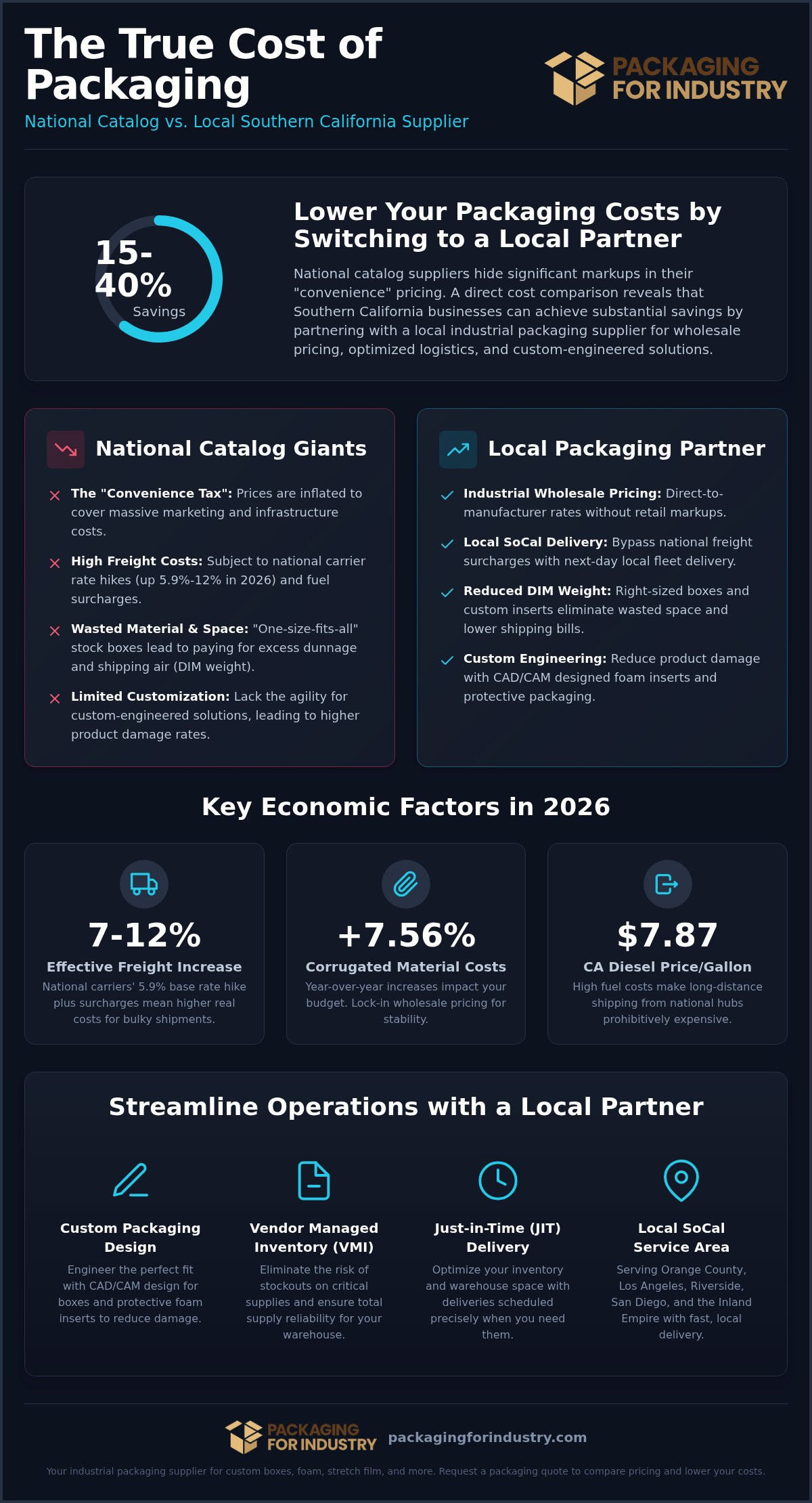
We understand that reliability and speed are non-negotiable for your fulfillment center or manufacturing floor. You shouldn’t have to overpay for stock solutions that don’t actually fit your products or protect them during transit. This guide demonstrates how transitioning to a local Southern California packaging partner can help you lower packaging costs by 15% to 40%. We’ll examine the impact of 2026 carrier surcharges, the engineering benefits of custom foam inserts to reduce shipping damage, and how local packaging delivery via VMI eliminates the risk of stockouts for your warehouse.
Key Takeaways
- Identify the “convenience tax” hidden in national catalog pricing and learn why it’s inflating your procurement budget.
- See why a cost comparison Uline vs local packaging company SoCal reveals 15% to 40% savings when you switch to wholesale industrial pricing.
- Reduce your freight expenses by utilizing local next-day delivery across Orange County and the Inland Empire to bypass national carrier surcharges.
- Explore how custom-engineered foam packaging and right-sized boxes lower your billable dimensional weight while preventing costly shipping damage.
- Streamline your warehouse operations with Vendor Managed Inventory programs that ensure you never face a stockout on critical supplies.
The Convenience Tax: Understanding the Real Cost of National Catalogs
The “Convenience Tax” is the premium your business pays for the ability to checkout with a single click. National catalog giants maintain massive infrastructures, including thousands of employees, multi-million dollar marketing budgets, and millions of square feet in high-rent distribution centers. These operational expenses aren’t absorbed by the supplier; they’re baked into the unit price of every corrugated box and roll of stretch film you buy. For a small office, this markup is manageable. For a high-volume manufacturing plant or distribution center, it’s a structural cost that erodes your competitive edge.
Performing a cost comparison Uline vs local packaging company SoCal reveals the stark difference between retail-tier pricing and true industrial wholesale. Local partners don’t rely on expensive printed catalogs or national television ads. Instead, they focus on optimized logistics and direct-to-manufacturer pricing. This transition often identifies immediate savings on high-volume items like stretch film and corrugated cardboard boxes. When your margins are under pressure, switching from a catalog to a personalized wholesale structure is a logical financial move.
Sticker Price vs. Total Cost of Ownership
The price you see on a screen is rarely the final cost of getting that material to your floor. National carriers have implemented a 5.9% rate increase for 2026, but compounding surcharges for bulky items mean many shippers see effective increases between 7% and 12%. When you order from a national giant, you’re often paying to ship air because stock box sizes don’t match your product dimensions. Adhering to professional packaging and labeling standards requires precision that off-the-shelf solutions can’t provide. Hidden fees like handling charges and long-distance freight quickly negate any perceived convenience.
Why National Giants Struggle with Custom Engineering
Stock sizes are designed for generalists, not specialists. If your operation handles specialized industrial components, “near-enough” sizing is a recipe for shipping damage. National giants lack the flexibility to provide custom design packaging that accounts for the specific fragility of your goods. By contrast, a local partner offers CAD/CAM design and free prototyping for protective foam packaging. This engineering-first approach eliminates the empty space that triggers expensive dimensional weight surcharges. It ensures every unit is protected by a custom-fit solution, significantly lowering your total procurement costs and reducing your damage rate.
Unit Pricing and Bulk Discounts: Wholesale vs. Catalog
National catalogs rely on tiered pricing that appeals to small businesses buying by the bundle. However, for a facility in the Inland Empire or Orange County, these tiers often represent a significant markup compared to local industrial wholesale rates. A comprehensive cost comparison Uline vs local packaging company SoCal shows that while catalog pricing might look competitive for a few bundles, it fails to scale for high-volume production needs. Industrial suppliers operate on a different financial model. They focus on high-volume efficiency rather than retail-style convenience. This shift in perspective allows for more aggressive unit pricing that reflects the actual cost of manufacturing and distribution.
Local suppliers leverage lower overhead by eliminating the need for massive national advertising budgets and printed catalogs. These savings are passed directly to the buyer through lower per-unit costs on recurring orders. Additionally, local partners often offer “locked-in” pricing for long-term production runs. This protection is vital in 2026, as corrugated material costs have risen by 7.56% year-over-year. Securing a stable price point ensures your manufacturing margins remain predictable even as global supply chains fluctuate.
Breaking Down the 15-40% Savings
These savings aren’t the result of a single discount. They’re achieved through a combination of reduced markups, localized logistics, and precision engineering. National suppliers must cover the cost of national distribution networks. By contrast, a local partner uses proximity to reduce freight expenses. For example, a manufacturer switching from stock sizes to custom corrugated boxes often realizes a 20% reduction in material waste alone. You can explore more specific examples of these efficiencies in our guide to Packaging Cost Savings. Engineering a box that fits your product perfectly reduces the amount of cushioning materials required, further driving down the total cost per shipment.
Wholesale Advantage for High-Volume Manufacturers
Buying packaging materials per-bundle is inefficient for a scaled operation. Industrial businesses benefit from buying per-pallet, where the price per unit drops significantly. This is especially true for specialized sectors like aerospace, where precision and cost-predictability are paramount. PFI specializes in providing bulk corrugated box quotes that account for specific engineering requirements while maintaining wholesale pricing structures. Managed stocking programs allow you to take advantage of these volume discounts without sacrificing valuable warehouse floor space. Your supplier holds the inventory and delivers it as needed, ensuring you always have supplies for your next shift. If you’re looking to optimize your procurement budget, it’s time to compare packaging pricing for your specific volume requirements.
Southern California Logistics: Shipping Costs and Lead Times
Logistics in the Southern California corridor require a precise strategy to mitigate rising transportation expenses. While national catalog giants ship from regional hubs, they often rely on common carriers that pass volatile fuel and handling surcharges directly to the customer. A detailed cost comparison Uline vs local packaging company SoCal highlights a critical logistical divide. National suppliers typically charge standard freight rates that don’t account for the proximity of a local manufacturing hub. By contrast, a local partner utilizes a dedicated delivery fleet to serve the industrial heart of the Inland Empire and Los Angeles without the heavy markup of national LTL freight.
Proximity also dictates your operational agility. Custom local production eliminates the 3 to 5 day transit delays common with national shipping networks. When your production line in Ontario or Irvine needs immediate supplies, a local supplier provides the responsiveness required to maintain your schedule. This geographical advantage ensures that your supply chain remains resilient even when national logistics networks face congestion or disruptions.
Eliminating the Freight Burden
Shipping air in empty, stock-sized boxes is a financial drain that many warehouses overlook. In September 2026, California diesel prices reached record highs between $7.71 and $7.87 per gallon. This spike directly increases the cost of every mile a package travels. By utilizing a local delivery fleet in Orange County, you effectively bypass the compounding fuel surcharges of national carriers. PFI’s local presence in Anaheim allows us to provide next-day delivery to Los Angeles County and surrounding areas, helping you avoid the “Large Package” surcharges—which average $115 per package in 2026—that UPS and FedEx trigger for bulky corrugated shipments.
Just-In-Time (JIT) and Local Reliability
Warehouse floor space in Southern California is among the most expensive in the country. Storing months of packaging inventory ties up capital and limits your operational capacity. Transitioning to local Just-In-Time inventory management allows you to reduce your warehouse footprint significantly. Instead of dedicating hundreds of square feet to stacks of pallets, you can rely on frequent, smaller deliveries that match your daily production needs. This model enhances your local reliability across San Bernardino and Riverside, ensuring that your fulfillment center never faces a stockout due to a delayed shipment from a distant national distribution center. Our local delivery capabilities provide a steady flow of materials, allowing you to focus on manufacturing rather than inventory management.
Custom Packaging Engineering: Reducing Damage and Surcharges
The engineering of your packaging is as critical to your bottom line as the unit price of the materials. While national catalogs provide “custom” boxes, these are typically just stock styles cut to specific dimensions. They lack the internal protective architecture required for complex industrial components. A professional cost comparison Uline vs local packaging company SoCal reveals that local engineering often pays for itself by eliminating damage claims and reducing billable shipping weight. By integrating multiple materials, such as foam packaging, wood crates, and heavy-duty corrugated, into a single solution, you ensure maximum protection with minimum volume.
Engineering for Aerospace and Electronics
Sensitive sectors like aerospace and medical device manufacturing require rigorous protection standards that off-the-shelf catalog items cannot meet. Stock packaging often fails to provide the necessary vibration dampening or electrostatic discharge protection. We specialize in Military Packaging and custom ESD foam inserts designed to cradle delicate components during transit. For manufacturers in Anaheim and Irvine, we offer a free prototyping service to test these designs before full production begins. This proactive engineering approach prevents the surcharge issues often associated with heavy industrial equipment by ensuring the final package is as compact as possible.
Reducing Dimensional Weight Costs
When performing a cost comparison Uline vs local packaging company SoCal, the impact of dimensional weight (DIM) becomes a primary differentiator. Carriers like UPS and FedEx use a unified DIM divisor of 139, which penalizes shippers for using oversized boxes. Exceeding a 96-inch length or a 130-inch combined length and girth triggers a Large Package Surcharge of approximately $115 per unit in 2026. Right-sizing is the most direct path to lowering your expenses. Custom corrugated boxes engineered for your specific product dimensions eliminate the empty space that triggers these massive surcharges. This precision ensures your freight costs are based on actual weight rather than box volume.
Transitioning to a Local Partner: The Path to 40% Savings
Transitioning away from a national catalog giant isn’t just about changing a vendor; it’s a strategic shift toward operational efficiency. While the immediate checkout of a massive supplier feels convenient, it often masks thousands of dollars in wasted material and freight fees. A data-driven cost comparison Uline vs local packaging company SoCal serves as the roadmap for this transition. By moving to a localized model, you stop paying for a national infrastructure and start investing in your own supply chain reliability. This shift moves your procurement strategy from a reactive expense to a proactive asset.
The Packaging Audit Process
The first step in capturing these savings is a comprehensive packaging audit. This involves more than just looking at unit prices. You need to evaluate your total spend over the last quarter, specifically focusing on your high-volume SKUs and shipping damage reports. Identifying “low-hanging fruit” often reveals that you’re using stock sizes where a custom-fit solution would eliminate excess material and carrier surcharges. We recommend comparing your last three national catalog invoices against a tailored quote from a local specialist. This comparison usually highlights immediate opportunities to lower packaging costs by 15% to 40% through right-sizing and wholesale pricing structures.
Seamless Integration with Your Production Line
A local partner acts as an extension of your procurement team, not just a distant warehouse. One of the most effective ways to stabilize your operations is through a Vendor Managed Inventory (VMI) program. In this model, we monitor your stock levels and replenish supplies automatically, ensuring you never face a stockout. For manufacturers looking to optimize labor, implementing packaging kitting can significantly reduce the time your team spends assembling materials on the floor. Instead of pulling from multiple pallets, your workers receive ready-to-use kits tailored to specific production runs. This level of integration is impossible with a national catalog model that prioritizes volume over individual client needs.
Ultimately, the choice between a national giant and a local partner is a choice between convenience and long-term profitability. While the catalog offers a fast checkout, the local partner offers a system designed to protect your product and your margins. For industrial businesses in Anaheim, Brea, or Irvine, the proximity of a local supplier provides a layer of security that a cross-country logistics network simply cannot match. If you’re ready to move beyond the “convenience tax,” we invite you to contact us for a local SoCal consultation to review your current warehouse needs and compare packaging pricing for your specific industrial volume.
Optimize Your Southern California Supply Chain
Optimizing your Southern California supply chain requires a move away from the high overhead and hidden fees of national catalogs. A thorough cost comparison Uline vs local packaging company SoCal demonstrates that localized logistics and precision engineering are the most effective levers for protecting your industrial margins. By transitioning to a local partner, you eliminate the standard freight burdens that have escalated in 2026 and gain the advantage of next-day delivery across Anaheim, Irvine, and Ontario.
Our expert CAD/CAM engineering and free prototyping services ensure your products are protected by right-sized solutions. This approach prevents the material waste and dimensional weight surcharges that erode profitability. You can achieve documented cost savings of 15% to 40% while simultaneously improving the reliability of your warehouse operations and reducing shipping damage. It’s time to stop paying a convenience tax and start investing in a packaging strategy that rewards your bottom line.
We’re ready to help you transition to a more efficient, cost-effective packaging strategy that supports your long-term operational goals.
Frequently Asked Questions
How much can I save by switching from Uline to a local SoCal packaging supplier?
Manufacturers and warehouses typically realize 15% to 40% cost savings when transitioning from national catalog giants to a local industrial supplier. These savings result from eliminating the catalog retail-tier markups and high overhead costs. A detailed cost comparison Uline vs local packaging company SoCal also highlights significant reductions in freight expenses. By sourcing materials locally, you avoid the compounding fuel surcharges and handling fees that national carriers often apply to bulky corrugated shipments.
Does a local packaging company offer next-day delivery like national catalogs?
Yes, Packaging For Industry provides local next-day delivery across the Southern California region, including Orange County, Los Angeles, and the Inland Empire. We maintain our own delivery fleet to ensure that your production lines remain operational without the delays associated with national logistics networks. This proximity allows us to respond faster than out-of-state distributors while providing a higher level of service for custom items that require careful handling during transit.
Can local suppliers handle custom box sizes that are not in a standard catalog?
Local industrial suppliers specialize in custom corrugated boxes that national catalogs cannot provide. While catalogs focus on stock sizes, we use CAD/CAM engineering to design packaging specifically for your product dimensions. This precision reduces the need for excess cushioning materials and prevents products from shifting during transit. We also offer free prototyping, allowing you to test the fit and durability of your custom design before committing to a full production run.
What are the typical shipping costs for local SoCal packaging delivery compared to national freight?
Local delivery costs are significantly lower because we eliminate expensive LTL freight charges and national carrier surcharges. In 2026, national carriers often trigger a Large Package Surcharge of approximately $115 for bulky items. By using a local delivery fleet in Anaheim or Ontario, you avoid these fees entirely. This logistical advantage is especially critical given that California diesel prices have reached record highs, directly inflating the cost of long-haul shipping for catalog orders.
How does Vendor Managed Inventory (VMI) help reduce my total packaging spend?
A VMI program reduces your total spend by optimizing inventory levels and eliminating emergency rush orders. We monitor your actual usage and replenish stock based on agreed-upon minimum and maximum levels. This process improves your cash flow by preventing over-ordering and frees up valuable warehouse floor space. By managing the supply chain for you, we ensure that your production team always has the right materials at the right time without the stress of manual ordering.
Is there a minimum order quantity (MOQ) for wholesale packaging supplies in Southern California?
Our focus is on supporting recurring industrial needs, so we typically structure orders around bulk quantities and pallet-level shipments. While we don’t focus on small, one-time retail purchases, we offer flexible MOQ structures for our manufacturing and distribution partners. This approach allows high-volume users in sectors like aerospace and electronics to secure wholesale pricing while maintaining a steady flow of materials. We tailor our stocking programs to match your specific production cycles.
Can a local company provide custom foam inserts and military-spec packaging?
Yes, Packaging For Industry specializes in custom foam inserts and mil-spec packaging for highly regulated industries. We work with various materials, including polyethylene, polyurethane, and ESD foam, to protect sensitive electronics and aerospace components. Unlike catalog suppliers that only offer stock styles, we engineer integrated solutions that combine boxes, foam, and custom crates. This ensures your high-value goods meet all necessary protection standards while minimizing the total volume of the package.
How do I request a packaging quote to compare against my current Uline pricing?
You can request a custom packaging quote by visiting our website or contacting our Anaheim office for a consultation. We recommend providing your last three invoices from your current supplier so we can perform a detailed cost analysis. Our team will review your high-volume SKUs, damage reports, and shipping dimensions to identify specific areas for cost reduction. This audit process provides a clear cost comparison Uline vs local packaging company SoCal for your specific warehouse requirements.