
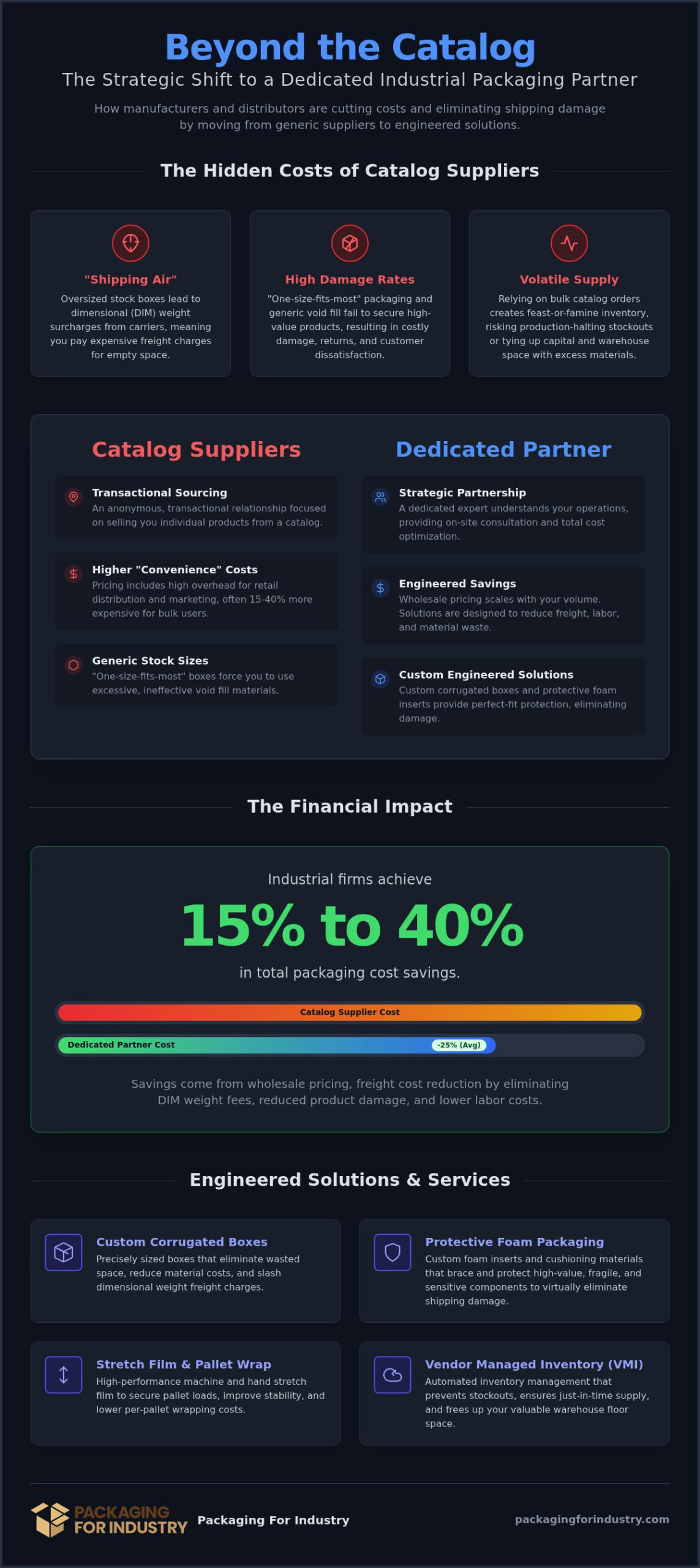
The convenience of a catalog supplier like Uline might actually be the most expensive line item in your warehouse operations. While the “buy now” button is simple, industrial manufacturers often find themselves paying for shipping air in oversized stock boxes and dealing with the high cost of product damage from generic cushioning. If you’re tired of seeing freight surcharges eat your margins, switching from Uline to a dedicated packaging partner is the strategic move that addresses these systemic inefficiencies. It’s a shift from buying products to investing in an engineered system designed for your specific logistics profile.
We understand that reliability and speed are non-negotiable for your production line. This guide demonstrates how moving to a specialized industrial packaging supplier can help you reduce costs by 15% to 40% while eliminating the waste of bulk-ordered catalog inventory. You’ll discover how custom corrugated boxes and protective foam packaging reduce shipping damage and how vendor managed inventory (VMI) programs free up valuable warehouse floor space. We’ll walk through the transition from off-the-shelf to tailor-made, focusing on the fiscal responsibility and operational peace of mind that comes with a true packaging partnership, including local next-day delivery options across Southern California.
Key Takeaways
- Compare catalog pricing to engineered solutions to uncover how industrial firms achieve 15% to 40% cost savings on high-volume items.
- Understand why switching from Uline to a dedicated packaging partner eliminates “shipping air” and reduces dimensional weight surcharges through custom-sized corrugated boxes.
- Learn how protective foam packaging and custom inserts outperform generic void fill to virtually eliminate product damage for high-value industrial goods.
- Discover how Vendor Managed Inventory (VMI) programs streamline warehouse operations by removing the manual ordering process and preventing stockouts.
- Follow a zero-downtime roadmap to transition your supply chain without interrupting production or fulfillment schedules.
Beyond the Catalog: Why Industrial Firms Outgrow Uline
Catalog suppliers like Uline serve a vital purpose for office managers needing a single roll of tape or a few shipping boxes for a one-time project. However, industrial manufacturers eventually reach a scale where the convenience of a catalog becomes a financial liability. A dedicated industrial packaging partner differs because they focus on the engineering and economics of your specific production line. For many growing companies, switching from Uline to a dedicated packaging partner is the only way to scale operations without ballooning costs.
The “convenience tax” associated with catalog pricing often results in material costs 15% to 40% higher than what a specialized partner provides for bulk users. For industries like aerospace and medical device manufacturing, the limitations of off-the-shelf sizes are even more restrictive. High-precision components require exact tolerances that generic boxes can’t meet. While catalog suppliers are practical for one-off office needs, switching from Uline to a dedicated packaging partner is necessary when your packaging volume starts impacting your operational margins.
The Hidden Costs of Generic Packaging
Using generic box sizes is a primary driver of logistics waste. When a box is even an inch too large, it often triggers dimensional (DIM) weight surcharges from carriers like UPS and FedEx. You end up paying the carrier to ship air. To fill that extra space, your team must use additional void fill, which increases material costs and packing time. This “one size fits most” approach also leads to higher shipping damage rates because products aren’t properly secured. Custom-engineered solutions eliminate these hidden fees by matching the container exactly to the product’s dimensions.
The Shift from Transactional to Strategic Sourcing
Moving beyond the catalog means shifting from transactional buying to strategic supply chain oversight. Instead of simply buying boxes, you’re managing a critical logistical asset. A dedicated partner provides a single point of contact who understands your specific lead times and warehouse constraints. This is a significant upgrade over the anonymous interaction of a call center.
This strategic approach often involves Vendor-Managed Inventory (VMI) to ensure you never face a stockout during a production peak. By seeking local expert support from PFI, you gain access to on-site consultations and engineered solutions that catalog suppliers simply don’t offer. It’s a move toward total accountability for your packaging’s performance and cost-effectiveness.
Financial Comparison: Catalog Pricing vs. Engineered Solutions
Purchasing decisions for industrial supplies often stall at the unit price level. However, the true economic impact of your packaging strategy extends far beyond the invoice. Switching from Uline to a dedicated packaging partner allows manufacturers to move away from generic price lists and toward a model based on Total Cost of Ownership. While catalog suppliers provide convenience, their pricing structure includes high overhead for marketing and retail distribution that bulk users shouldn’t have to subsidize.
When you analyze the per-unit costs for industrial corrugated boxes, the disparity becomes clear. Catalog bulk rates typically plateau at a few hundred units. In contrast, an industrial partner offers manufacturing wholesale rates that continue to scale with your production volume. These hard savings are often accompanied by significant freight optimization. By matching box dimensions exactly to your product, you eliminate the dimensional weight penalties that carriers charge for oversized parcels. You can request a packaging quote to compare these direct costs against your current catalog spending.
Custom vs. Stock: The ROI of Precision
It’s a common misconception that custom boxes are always more expensive than stock sizes. In reality, custom design packaging pays for itself in freight savings by reducing the volume of every shipment. Using precise CAD/CAM design, we reduce corrugated waste and eliminate the need for excessive void fill. This precision also creates soft savings in the warehouse. Your team spends less time tape-wrapping oversized flaps or stuffing bubble wrap into empty corners, which reduces labor costs per unit shipped.
Volume Discounts and Contract Pricing
Market volatility can disrupt manufacturing budgets when you rely on fluctuating catalog prices. Dedicated partners offer the stability of contract pricing, often locking in rates for 6 to 12 months. This protection against paper and resin price spikes allows for more accurate financial forecasting. Unlike the transactional nature of catalog buying, these agreements treat your packaging as a strategic asset. You aren’t just buying supplies; you’re securing a stable price point for your entire supply chain, ensuring that your margins remain protected even when material costs rise globally.
Engineering for Protection: Custom Foam vs. Generic Fill
Catalog suppliers often suggest that generic bubble wrap or packing peanuts provide sufficient protection for most items. This assumption fails when applied to heavy industrial equipment or high-value fragile components. Generic void fill shifts during transit, leading to a phenomenon known as bottoming out, where the product strikes the side of the container after the cushioning compresses. By switching from Uline to a dedicated packaging partner, you move from reactive damage control to proactive, engineered protection. This transition provides access to custom foam packaging that is specifically calculated based on the fragility and weight of your goods.
PFI streamlines this transition through a comprehensive prototyping process. Our team provides free CAD/CAM support to design custom foam inserts that lock products into a fixed position. We don’t just sell materials; we integrate foam, corrugated boxes, and crates into a single, cohesive protective system. This holistic engineering approach is what eliminates the high shipping damage rates that catalog-bought supplies often cause. It ensures that every component of the packaging works together to absorb shock and vibration during long-haul transit.
Specialized Protection for Sensitive Industries
Certain sectors require more than just physical cushioning. Electronics manufacturers must adhere to strict ESD and anti-static requirements to prevent latent component failure caused by static discharge. Similarly, defense contractors require mil-spec packaging compliance to meet rigorous federal standards for durability and environmental resistance. By utilizing aerospace packaging solutions, companies ensure that their high-precision instruments are protected from both physical shock and environmental hazards. This level of technical oversight and material certification is unavailable through a standard catalog order.
Custom Crates and Heavy-Duty Skids
There are instances where even a heavy-duty triple-wall box is insufficient for the task. For oversized machinery or international shipments, the transition to wooden crates is a critical safety requirement. Generic pallets often lack the structural integrity to support unevenly distributed industrial loads, which can lead to catastrophic failure during loading. Custom-engineered industrial skids and crates provide the necessary base for heavy-duty transit. One client recently faced recurring international transit damage while using catalog-sourced supplies. After switching from Uline to a dedicated packaging partner for custom foam-lined crates, they reduced their damage claims to zero and significantly improved their supply reliability.
Logistics and Inventory: VMI vs. Bulk Storage
Inventory management is often the most overlooked cost in industrial packaging operations. Catalog ordering relies on manual inventory checks. If a warehouse lead misses a reorder point, production stops. You then face a choice between halting the line or paying exorbitant emergency rush fees for overnight shipping. Switching from Uline to a dedicated packaging partner transitions your facility from a reactive bulk storage model to a dynamic, automated flow model. This shift is centered around Vendor Managed Inventory (VMI), which effectively eliminates the manual ordering step from your daily operations.
A strategic partnership allows for Just-In-Time (JIT) delivery, which is essential for maximizing warehouse efficiency. Many manufacturers bulk-order catalog inventory to avoid shipping fees, but this wastes valuable floor space that could be used for production machinery. By switching from Uline to a dedicated packaging partner, you gain the ability to store only what you need for the immediate week or month. This improves your logistical flow and ensures that your capital isn’t tied up in stacks of unused corrugated boxes or stretch film rolls.
Eliminating Shortages with Stocking Programs
PFI manages inventory review cycles on a consistent schedule, whether that’s weekly or monthly, based on your specific burn rate. We take accountability for your stock levels so you don’t have to. This proactive oversight prevents production stops caused by missing essential supplies like heavy-duty boxes or protective foam. The financial benefit is immediate. You improve your cash flow by reducing on-hand inventory while maintaining the security of a guaranteed supply. It’s a pragmatic solution for high-volume manufacturers who can’t afford the downtime associated with supply chain gaps.
Local Support in Southern California
Proximity is a strategic asset for any just-in-time packaging strategy. We serve Orange County and Los Angeles with our own local fleet of trucks. This reliability is far superior to relying on third-party LTL carriers, who often struggle with transit delays and scheduling conflicts. Our local presence allows us to offer next-day delivery in Anaheim, Irvine, and surrounding industrial hubs. When your supplier is only minutes away, your lead times shrink, and your ability to respond to production spikes increases. This local advantage ensures that your packaging supply remains as agile as your production line.
Transitioning to PFI: A Zero-Downtime Roadmap
Transitioning your supply chain shouldn’t result in operational downtime. Many manufacturers hesitate to move away from catalog suppliers because they fear a gap in supply or the complexity of changing SKUs. However, switching from Uline to a dedicated packaging partner is a structured process designed to integrate seamlessly with your existing production schedule. We follow a four-step roadmap to ensure your facility remains fully operational throughout the changeover.
The process begins with a comprehensive Packaging Review. We audit your current catalog orders to identify where you’re paying for “shipping air” or using excessive void fill. Once we’ve identified these inefficiencies, we move into Engineering and Prototyping. Our team uses CAD/CAM support to create custom boxes and foam inserts that fit your products perfectly. The third step involves Setting Up Your VMI by determining precise minimum and maximum inventory levels for your recurring items. Finally, the Rollout phase allows you to burn through your remaining catalog stock while we gradually introduce PFI solutions, preventing any disruption to your fulfillment cycle.
The 30-Day Transition Plan
A successful shift requires careful coordination to avoid duplicate inventory. We recommend a 30-day window where we establish recurring delivery schedules for high-volume supplies like stretch film and packaging tapes. During this period, we conduct an initial assessment of lead times for custom-engineered items to ensure your first batch arrives exactly when your old stock runs out. This phased approach allows your warehouse team to adapt to new packing workflows without the stress of a sudden “hard cut” between suppliers.
Requesting Your Custom Packaging Quote
To provide an accurate analysis, we recommend having your usage history and current box dimensions ready for review. Understanding your annual volume is critical for locking in manufacturing wholesale rates rather than standard catalog bulk pricing. While digital quotes are a starting point, we prioritize on-site visits for industrial operations. Seeing your production line and warehouse layout firsthand allows us to identify logistical bottlenecks that a catalog order form would miss. Our goal is to ensure your new system is as efficient as possible from day one.
Contact us today to start your cost-reduction analysis and discover how a dedicated partnership can stabilize your supply chain.
Strengthen Your Supply Chain Through Strategic Partnership
Moving from a transactional catalog model to a strategic partnership is a necessary evolution for scaling industrial manufacturers. You shift from paying for “shipping air” and dealing with transit damage to an engineered system that prioritizes fiscal responsibility and operational reliability. Switching from Uline to a dedicated packaging partner allows you to achieve 15% to 40% cost savings by accessing manufacturing wholesale rates and eliminating dimensional weight surcharges.
PFI supports this transition with free CAD/CAM prototyping to ensure your custom corrugated boxes and protective foam packaging fit your products perfectly. Our local fleet provides next-day delivery across Anaheim, Orange County, and Los Angeles, ensuring your production line never stalls. By integrating Vendor Managed Inventory (VMI), you can reclaim warehouse floor space and focus on your core operations while we manage your supply levels. It’s an efficient way to stabilize your overhead and protect your margins.
Request a Custom Packaging Quote and Compare Pricing
We look forward to helping you optimize your logistical flow and improve your bottom line through precision engineering and reliable local support.
Frequently Asked Questions
Is there a minimum order quantity when switching from Uline to PFI?
PFI focuses on bulk quantities and repeat industrial orders rather than small, retail-style purchases. While we don’t have a universal minimum, our programs are designed for manufacturers and warehouses with recurring packaging needs. This approach allows us to provide wholesale pricing that catalog suppliers can’t match. If you have a specific project in mind, we can review your volume to determine the most cost-effective solution for your facility.
How much can I actually save by moving away from catalog packaging suppliers?
Industrial manufacturers typically realize 15% to 40% cost savings by switching from Uline to a dedicated packaging partner. These savings come from moving to manufacturing wholesale rates and eliminating the retail overhead built into catalog prices. Additionally, custom-engineered boxes reduce dimensional weight surcharges and minimize the need for expensive void fill. By matching the packaging exactly to your product, you lower both material costs and freight expenses simultaneously.
Can a dedicated partner handle my nationwide shipping needs?
Yes, we provide nationwide support through an extensive network of distribution and manufacturing partners. While our local fleet handles Southern California, our regional partners ensure consistent supply for customers with multiple locations across the United States. This network allows us to maintain the same high standards for custom corrugated boxes and protective foam packaging regardless of where your fulfillment centers are located. We manage the logistics to ensure supply reliability.
What is the lead time for custom corrugated boxes compared to Uline stock sizes?
Custom corrugated boxes require an initial design and production phase that stock sizes don’t. However, once your custom design is finalized, our stocking programs eliminate lead-time anxiety. We maintain your specific inventory on our floor so it’s ready for immediate release. This means you get the protection of a custom-engineered box with the same availability as a catalog stock item. It’s a strategic way to manage long lead-time custom products.
How does Vendor Managed Inventory (VMI) work for a manufacturing facility?
Our Vendor Managed Inventory (VMI) program begins with an assessment of your usage history and production schedule. We establish minimum and maximum stock levels for your recurring items. Our team then performs scheduled inventory reviews at your facility on a weekly, biweekly, or monthly basis. We handle the replenishment orders automatically based on actual usage. This process prevents stockouts and frees your purchasing team from the burden of manual inventory tracking.
Do I need to pay for packaging prototypes and CAD designs?
We provide free CAD/CAM support and prototyping for our industrial partners. It’s essential that custom foam inserts and crates fit your products perfectly before full-scale production begins. Our engineering team creates physical samples for testing to ensure the packaging meets your protection requirements. This service is part of our commitment to reducing shipping damage and optimizing your packaging design. You don’t pay for the design phase of your custom solution.
Does PFI offer next-day delivery for stock items in Southern California?
We offer local next-day delivery for stock items throughout Southern California using our own fleet of trucks. This service area includes Anaheim, Los Angeles, Orange County, the Inland Empire, and San Diego. Proximity allows us to respond quickly to production spikes and maintain just-in-time inventory for our VMI customers. By using our own drivers instead of third-party carriers, we provide a higher level of reliability and more predictable delivery schedules.
Can PFI handle military-spec and aerospace packaging compliance?
PFI specializes in mil-spec packaging and aerospace compliance. We understand the rigorous federal standards required for defense contracts and high-precision aviation components. Our offerings include weather-resistant corrugated materials, moisture barrier bags, and specialized anti-static foam. We provide the material certifications and technical oversight necessary to meet these strict industry requirements. This ensures your high-value components are protected from both physical shock and environmental hazards during transit.