
What if the convenience of a national catalog is actually the most expensive hidden leak in your operations budget? Many procurement managers at warehouses and distribution centers in Los Angeles or Anaheim default to big-name suppliers for the sake of simplicity. However, a close look at Uline pricing vs Southern California packaging company alternatives reveals that the “Catalog Tax” of high freight charges and oversized stock boxes often outweighs any perceived convenience. You shouldn’t have to choose between fast delivery and fiscal responsibility.
We know that managing rising shipping costs and warehouse space is a constant challenge for industrial businesses. It’s frustrating to watch your margins shrink due to carrier surcharges or product damage from poorly fitting packaging. This article provides a practical cost-benefit analysis to help you lower your total packaging spend. We’ll explore how switching to a local Southern California partner eliminates expensive LTL shipping fees, reduces transit damage through custom engineering, and optimizes your inventory through reliable next-day delivery. Discover how a tailored approach to industrial packaging can streamline your supply chain while protecting your bottom line.
Key Takeaways
- Identify the “Catalog Tax” by calculating your total landed cost, which includes hidden freight surcharges that national suppliers often pass on to the customer.
- Comparing Uline pricing vs Southern California packaging company rates reveals that local next-day delivery in LA and Orange County can significantly reduce your logistics overhead.
- Switching from stock sizes to custom corrugated boxes helps eliminate dimensional weight (DIM) penalties and reduces the financial impact of shipping damage.
- Implementing a Vendor Managed Inventory (VMI) program with a local partner frees up valuable warehouse space and ensures a reliable supply for recurring bulk orders.
- Move beyond a transactional relationship to a strategic partnership where custom engineering and logistical optimization drive long-term cost reductions.
The Hidden Cost of Convenience: Understanding the ‘Catalog Tax’
The “Catalog Tax” is a term used to describe the hidden premium industrial buyers pay for the convenience of stock inventory and multi-zone shipping. While a national catalog offers an immediate solution, it frequently ignores the economic realities of supply chain management. When analyzing Uline pricing vs Southern California packaging company options, the initial unit cost is rarely the final price. National suppliers prioritize SKU volume and catalog breadth over the individual return on investment (ROI) of their customers. This leads to a transactional “order-and-forget” mentality that misses significant cost-saving opportunities found through tailored logistics.
Strategic packaging procurement identifies three main pillars of hidden costs that erode your bottom line:
- Freight: Shipping bulky, air-filled boxes across multiple zones from centralized hubs. In 2026, rising fuel surcharges and LTL rate hikes make shipping distance a critical cost factor.
- Wasted Material: Paying for excess corrugated material and the expensive void fill required to stabilize products in oversized containers.
- Damage: Increased risk when heavy or fragile items don’t fit securely in standard sizes, leading to costly returns and replacement cycles.
Why Industrial Buyers Default to National Catalogs
The primary appeal of a national supplier is the massive product range and the ability to place orders 24/7. It feels reliable. However, the reality often involves high-volume shipping delays at major distribution hubs. Relying on “standard” sizes for non-standard industrial components creates a trap. You end up buying more material than you need just because it’s available on a webpage, rather than what’s right for your specific product and shipping requirements.
When ‘Stock’ Becomes a Liability for Manufacturers
Using oversized stock boxes leads to excessive void fill costs and triggers dimensional weight (DIM) penalties from carriers. These fees are rising faster than base rates, making “one-size-fits-all” boxes a major liability. This is especially problematic for manufacturers of high-value aerospace or medical gear where precision is mandatory. Poorly fitting packaging increases the likelihood of movement during transit, which causes expensive shipping damage. Ultimately, the Catalog Tax is the total price gap between stock supplies and engineered custom corrugated boxes that actually protect your margins and your products.
Uline Pricing vs. Southern California Packaging Company: A Direct Comparison
Analyzing Uline pricing vs Southern California packaging company options requires moving beyond the sticker price on a catalog page. National suppliers typically utilize rigid, tiered pricing models designed for the average consumer or low-volume user. These tiers provide a sense of transparency but often fail to account for the specific economic needs of high-volume industrial operations. A localized wholesale approach builds pricing around your annual usage and operational flow rather than a single transaction. This allows for a more accurate assessment of how packaging expenses impact your overall manufacturing or distribution budget.
Unit Price vs. Total Landed Cost
The most common procurement error is focusing solely on the unit price. A lower price per box in a catalog often results in a higher final invoice once you add the components of the total landed cost: material, freight, handling, and storage. In 2026, with UPS and FedEx implementing average 5.9% general rate increases alongside significant surcharge hikes, the freight component often exceeds the material cost itself. By utilizing custom packaging solutions, we reduce the physical footprint of the shipment. This technical optimization directly lowers the total landed cost by minimizing both material weight and dimensional weight (DIM) penalties that stock boxes frequently trigger.
Scalability and Bulk Ordering Strategies
PFI provides bulk packaging pricing tailored to the high-volume needs of Southern California manufacturers and distribution centers. Unlike the transactional nature of catalog purchases, regional contracts offer price stability and predictable supply. A local account manager understands your specific warehouse constraints and production cycles, whereas a national call center operates on a general script. This proximity allows for agile adjustments to order volumes as your demand fluctuates, preventing the common problem of over-ordering stock sizes to meet a volume discount threshold.
Comparing these two models is about more than just a line item on an invoice; it’s about the efficiency of your entire logistics system. A local partner acts as a consultant to identify where material is being wasted and where freight costs can be trimmed through better engineering. If you’re ready to see how these differences impact your bottom line, you can request a packaging quote to compare your current catalog spend with a localized wholesale strategy.
The Freight Factor: Why Local Delivery Wins in SoCal
Shipping bulky industrial supplies across multiple states is an inefficient use of capital. When evaluating Uline pricing vs Southern California packaging company logistics, the most significant disparity appears in freight zone charges. National catalog suppliers rely on third-party LTL carriers or parcel networks that categorize shipments into zones. As a shipment moves from a centralized hub to a facility in Los Angeles or Orange County, the costs compound. These expenses aren’t limited to base rates; they include fuel surcharges that reached nearly 50% for LTL carriers in mid-2026 and “Large Package” fees that now exceed $96 per box for standard parcel deliveries outside of peak windows.
PFI operates its own fleet of delivery vehicles, which fundamentally changes the cost structure for our partners. By handling our own logistics, we eliminate the “last mile” surcharges and “Additional Handling” fees that national carriers impose on industrial shipments. This localized control ensures that your delivery schedule remains predictable even when national logistics networks face disruptions or seasonal port congestion at LA and Long Beach. Relying on a regional fleet means your procurement team isn’t at the mercy of national carrier capacity shifts or general rate increases that target bulky, low-density freight.
Proximity and the Reduction of Transit Damage
In a national hub-and-spoke system, a single pallet might be loaded, unloaded, and cross-docked four or five times before reaching its destination. Each “touch” increases the statistical probability of fork truck damage or crushed edges. Our model focuses on proximity. By providing local packaging delivery from our regional hubs, we minimize the handling of your materials. Your corrugated boxes and foam inserts travel directly from our facility to yours, ensuring product integrity and reducing the administrative burden of filing damage claims with third-party freight companies.
Eliminating the ‘Bulky Item’ Freight Penalty
Certain industrial supplies are simply too heavy or voluminous to ship through national networks cost-effectively. Items like pallets and wooden crates are prohibitive to source from a catalog because the freight often matches or exceeds the value of the product itself. Sourcing from a local packaging supplier in Santa Fe Springs or the Inland Empire allows you to bypass these penalties. We provide wholesale rates on heavy-duty supplies with the added benefit of regional logistics expertise, serving manufacturers from San Diego to the high desert without the “Catalog Tax” on freight.
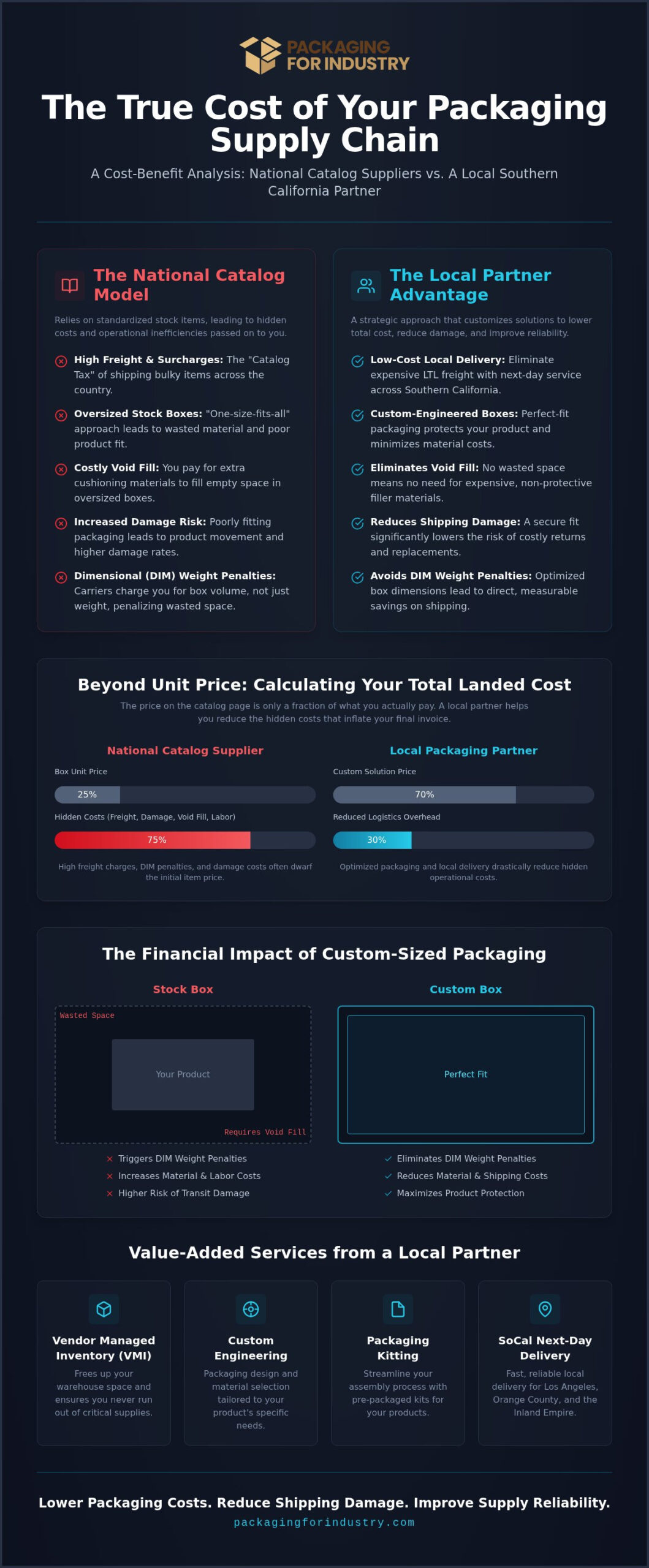
Beyond the Invoice: How Custom Engineering Lowers Packaging Costs
The most common objection procurement officers raise is that custom packaging sounds more expensive than stock options. This is a misunderstanding of total procurement spend. While a stock box might have a lower unit price on paper, the lack of engineering creates a ripple effect of hidden expenses. When evaluating Uline pricing vs Southern California packaging company services, you must look at the “air” you’re shipping. Engineered solutions are designed to fit your product exactly, which reduces material waste, labor time, and freight penalties that stock sizes simply cannot avoid.
Defeating Dimensional Weight (DIM) Surcharges
Carriers use a dimensional weight formula that punishes empty space. They calculate the volume of a box and divide it by a DIM factor to determine the billable weight. If you ship a lightweight industrial component in an oversized stock box, you’re paying for weight that doesn’t exist. For example, reducing a box size by just two inches in each dimension can drop a package below a carrier’s “Large Package” threshold. In 2026, avoiding the UPS Large Package surcharge of $96.25 is a priority for any high-volume shipper. CAD/CAM support at PFI ensures a perfect fit for industrial components, ensuring you never pay to ship air. This precision prevents the $1,875 “Over Maximum Limits” fee that UPS now applies to packages exceeding size limits.
Integrated Solutions: Boxes, Foam, and Crates
Sourcing your supplies from a single industrial packaging supplier allows for a level of integration that catalogs can’t match. Instead of purchasing generic bubble wrap and stock boxes, we design custom corrugated boxes with matching custom foam inserts. This integrated approach protects high-value aerospace or medical gear through material science rather than just adding more “stuff” to the box. It also streamlines your assembly line. Through packaging kitting, your team receives pre-assembled kits that are ready for the product. This reduces warehouse handling time and eliminates the labor costs associated with measuring, cutting, and taping excessive void fill. By engineering the solution from the start, we protect your margins as effectively as we protect your products.
Strategic Partnership: Switching to a Local SoCal Supplier
Transitioning from a transactional catalog model to a strategic partnership represents a fundamental shift in how you manage your operational overhead. While the convenience of a web portal is attractive, it lacks the consultative depth required to solve chronic logistics issues. When you analyze Uline pricing vs Southern California packaging company service models, the most significant long-term gains aren’t found in a discount tier. They’re found in the elimination of the “order-and-react” cycle that causes stockouts and emergency freight expenses. A partnership with a local supplier focuses on your total procurement lifecycle rather than a single box purchase.
The VMI Advantage for Manufacturers
A Vendor Managed Inventory (VMI) program ensures your production line never stops due to a lack of supplies. Instead of your procurement team monitoring stock levels, we take accountability for your inventory. This prevents the need for expensive, last-minute orders from national catalogs that often carry high transit costs. It also improves your cash flow. You pay for the packaging as you use it, rather than tying up capital in months of supplies sitting on your warehouse floor. This just-in-time delivery model allows your operation to remain agile and responsive to market demand.
Industrial real estate in Anaheim, LA, and Orange County is a premium asset. Dedicating vast sections of your facility to pallets of oversized stock boxes is an inefficient use of space. Our stocking programs allow you to reclaim that square footage for production or revenue-generating activities. By shifting the storage burden to our regional hubs, you maintain a reliable supply without the footprint of a massive inventory.
How to Evaluate Your Current Packaging Spend
You can begin this transition by performing a self-audit of your current procurement habits. Look beyond the unit price and track your annual freight surcharges, damage claim frequencies, and the volume of void fill your team consumes. If your current catalog supplier isn’t providing engineering support to reduce these numbers, you’re paying a premium for materials that don’t fit your needs. Comparing Uline pricing vs Southern California packaging company capabilities often reveals that the local option provides far more than just materials; it provides a system of fiscal protection. A packaging cost-reduction analysis is the most effective way to identify these leaks.
We encourage you to request a packaging quote for a direct side-by-side cost analysis. Our team will review your current specs and demonstrate how a localized, engineered approach reduces your total landed cost. Contact PFI for a custom packaging quote today to secure a more reliable and cost-effective supply chain.
Optimize Your Procurement with a Local Packaging Partner
Industrial procurement managers are often surprised by the total landed cost once third-party freight and carrier surcharges are applied to catalog orders. Shifting from national stock options to an engineered approach eliminates the “Catalog Tax” and dimensional weight penalties that erode your margins. By choosing a local Southern California packaging partner, you gain access to next-day delivery and VMI programs that reclaim warehouse space and stabilize your supply chain. Evaluating Uline pricing vs Southern California packaging company service models is the first step toward a more efficient, cost-effective operation.
Our team provides the custom engineering and free prototyping necessary to ensure your products are protected without the waste of oversized boxes. We’re ready to help you lower your total packaging spend and eliminate shipping damage through precision logistics and local reliability. It’s time to move beyond the transactional catalog and build a partnership that prioritizes your bottom line.
Frequently Asked Questions
Is there a cheaper alternative to Uline for bulk shipping boxes in California?
Yes, local industrial suppliers like Packaging For Industry provide a cost-effective alternative for bulk shipping boxes by eliminating multi-zone freight charges. When you compare Uline pricing vs Southern California packaging company rates, the savings are found in the total landed cost rather than just the unit price. We offer wholesale pricing on heavy-duty corrugated boxes and pallets, specifically designed for recurring industrial needs in Anaheim and Los Angeles County.
How much can I save by switching from stock boxes to custom-sized corrugated packaging?
Switching to custom-sized corrugated packaging reduces costs by eliminating dimensional weight (DIM) penalties and reducing the need for expensive void fill materials. Stock boxes often contain excess air, which carriers charge for at a premium. By engineering a box to fit your specific product, we reduce the physical footprint of every shipment. This optimization lowers your total procurement spend while providing superior protection for high-value industrial components.
Does Packaging For Industry offer next-day delivery in Los Angeles and Orange County?
Packaging For Industry provides local next-day delivery throughout Southern California using our own fleet of vehicles. This service covers Los Angeles County, Orange County, the Inland Empire, and San Diego. By managing our own logistics, we bypass the “last mile” surcharges and additional handling fees that third-party carriers often apply to bulky industrial orders. This ensures your production lines remain moving with a dependable, local supply chain.
What is the ‘catalog tax’ and how does it affect my packaging budget?
The “catalog tax” is the hidden premium paid for the convenience of a national supplier’s stock inventory and multi-zone shipping. It affects your budget through higher unit prices and significant freight markups on bulky items. When analyzing Uline pricing vs Southern California packaging company options, this tax becomes evident in the carrier surcharges and wasted material costs associated with using oversized stock boxes for non-standard industrial parts.
Can a local packaging company handle high-volume industrial orders?
Yes, PFI is specifically engineered to manage high-volume industrial orders and recurring packaging needs for large-scale manufacturers and distribution centers. Our facility handles bulk quantities of custom corrugated boxes, stretch film, and protective foam inserts. We focus on building long-term partnerships through regional contracts that provide price stability and predictable lead times, which is often more reliable than the transactional nature of high-volume catalog ordering.
How do custom foam inserts help reduce my total shipping costs?
Custom foam inserts reduce total shipping costs by allowing for a smaller outer box, which directly lowers the dimensional weight of the package. These engineered inserts provide better shock absorption than generic bubble wrap or loose fill; this means you can use lighter materials without sacrificing protection. This reduction in package volume leads to lower freight charges and significantly fewer expenses related to transit damage and product returns.
What are the benefits of a Vendor Managed Inventory (VMI) program for packaging?
A Vendor Managed Inventory (VMI) program optimizes your supply chain by ensuring you never face a packaging shortage that halts production. PFI manages your stocking levels based on actual usage, which frees up valuable warehouse space in Southern California. This program improves your cash flow because you only pay for materials as they are used. It also eliminates the administrative burden of managing lead times for custom-engineered packaging items.
Do you provide mil-spec or aerospace-compliant packaging in Southern California?
We provide a full range of mil-spec and aerospace-compliant packaging solutions for defense and aviation manufacturers across Southern California. This includes weather-resistant corrugated boxes, ESD foam packaging, and custom wood crates that meet international shipping standards. Our team understands the rigorous documentation and material requirements for military packaging, ensuring that your high-value components are protected and compliant with all relevant industrial and government specifications.