
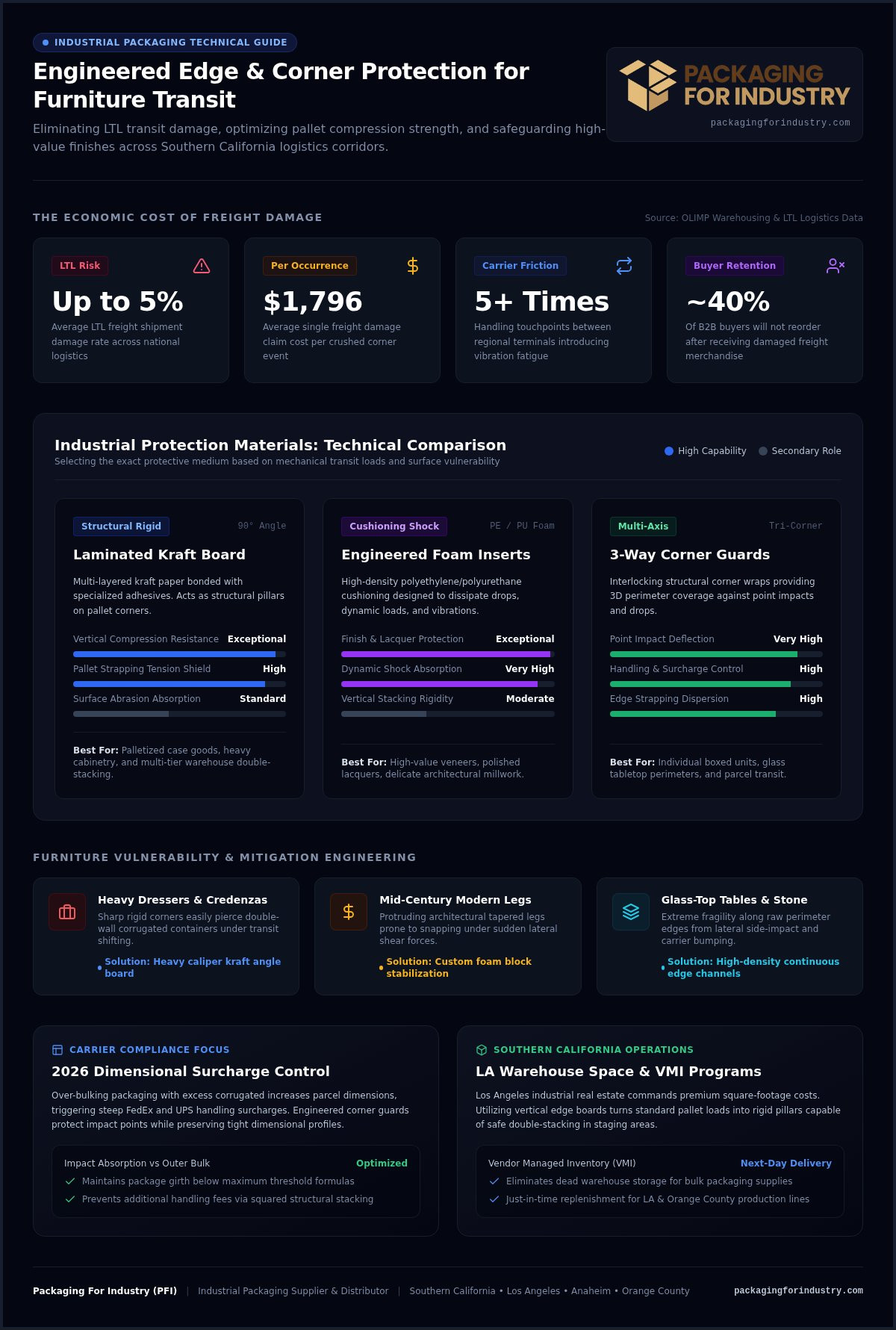
With Less-Than-Truckload (LTL) damage rates averaging up to 5%, the average furniture manufacturer loses nearly $1,800 every time a single piece of freight arrives with a crushed corner. You’ve likely seen how a single mishandled pallet can result in a total loss, especially when high-value veneers or lacquered finishes are involved. Securing the right corner protectors for furniture shipping Los Angeles manufacturers require is about more than just padding; it’s about engineering a system that withstands the rigors of five or more carrier touchpoints.
We understand that inconsistent supply and rising freight surcharges make operational efficiency difficult to maintain. This guide will help you select industrial-grade corner protection that eliminates shipping damage while keeping your packaging dimensions within the strict 2026 FedEx and UPS surcharge thresholds. We’ll explore the technical differences between high-density foam and laminated kraft board, explain how to optimize your packaging for LTL transit, and show you how a local Los Angeles supplier can reduce your warehouse waste through managed inventory.
Key Takeaways
- Learn how to mitigate the financial impact of LTL shipping damage and high return rates by implementing industrial-grade edge and corner protection.
- Discover the distinct functional advantages of cardboard edge boards versus foam corner protectors for furniture shipping Los Angeles businesses use to safeguard delicate finishes.
- Identify strategies to select corner guards that provide maximum impact absorption while avoiding 2026 carrier dimensional surcharges and additional handling fees.
- Understand the operational benefits of utilizing a local Southern California supplier for next-day delivery and Vendor Managed Inventory (VMI) to streamline your production line.
- Evaluate the return on investment for custom-engineered packaging solutions compared to stock protectors for high-value or non-standard furniture dimensions.
Protecting High-Value Furniture: Why Corner Guards Matter for LA Manufacturers
Los Angeles remains the second largest furniture manufacturing corridor in the United States. This concentration of production means regional logistics networks are constantly moving high-value case goods and architectural millwork. For these businesses, “corner crush” is more than a minor shipping error; it’s a systemic drain on profitability. Research from OLIMP Warehousing shows the average freight damage claim costs approximately $1,796 per occurrence. This figure doesn’t even account for the damage to your brand’s reputation. Nearly 40% of B2B buyers won’t reorder after receiving damaged merchandise.
Transitioning from retail-grade supplies to industrial-strength corner and edge protection is a strategic move to lower these costs. While standard corrugated boxes provide a basic barrier, they lack the vertical compression strength required for heavy furniture. High-quality corner protectors for furniture shipping Los Angeles manufacturers utilize act as structural pillars. They allow for tighter strapping and better pallet stability without compromising the finished product.
The Economic Impact of Shipping Damage in Southern California
LTL shipping in Southern California involves freight being handled five or more times between terminals. Each touchpoint introduces transit vibrations that can fatigue standard packaging. By applying package cushioning principles, manufacturers can use high-density foam or laminated kraft board to absorb these shocks. This engineering approach does more than just protect the product; it improves stacking strength. Higher stackability allows you to maximize vertical warehouse space, reducing your overall storage footprint in expensive LA industrial real estate.
By integrating the right corner protectors for furniture shipping Los Angeles distributors can significantly reduce the volume of returns entering their warehouse. Effective edge board quality ensures that pallets remain squared, which is essential for reducing insurance premiums and successfully contesting freight claims. It provides the stability needed for double-stacking without risking the structural integrity of the bottom units.
Furniture-Specific Vulnerabilities: Beyond the Box
Certain designs possess inherent vulnerabilities that a simple box cannot address. Standard containers often fail because they lack internal reinforcement at the points of highest impact. High-risk furniture categories include:
- Mid-century modern legs: Prone to snapping under lateral pressure during transit.
- Heavy dressers: Sharp veneers can pierce through standard double-wall boxes without rigid edge boards.
- Glass-top tables: Require specialized edge guarding to prevent shattering from side-impact forces.
Using a local Los Angeles packaging supplier allows for rapid prototyping and damage analysis. We can identify whether a piece needs 3-way corrugated corners or specialized foam inserts to prevent finish abrasion. This localized support ensures that your specific products arrive in showroom condition, protecting your bottom line and your professional standing in the market.
Types of Corner and Edge Protection for Industrial Furniture Shipping
Selecting the correct material for transit protection depends on the furniture’s weight, finish, and the logistics method used. Los Angeles manufacturers often require a combination of rigid support and soft cushioning to survive the high-volume shipping environment. Using the wrong material can lead to surface abrasions or structural failure during palletizing. We categorize industrial protection into three primary materials: laminated paperboard, protective foam, and heavy-duty plastic.
Cardboard Edge and Angle Boards
Cardboard edge boards are the industrial workhorse for palletized furniture. These protectors are manufactured from multi-layered kraft paper bonded with specialized adhesives to create a rigid 90-degree angle. An edge board is a high-strength laminated paperboard product used to reinforce shipping containers and stabilize palletized furniture loads. By placing these along the vertical corners of a pallet, you distribute vertical pressure evenly. This reinforcement prevents box collapse when units are double-stacked in a warehouse or trailer.
For heavy case goods, calipers ranging from .160 to .400 inches provide the necessary rigidity to withstand high-tension strapping. This ensures the straps don’t cut into the corrugated container or the furniture piece itself. If you’re shipping standardized dimensions, stock sizes offer a cost-effective solution. However, custom-engineered lengths are often necessary for oversized architectural millwork to ensure total edge coverage.
Protective Foam Corner Guards
Delicate finishes like high-gloss lacquers or soft wood veneers require non-abrasive protection. Foam packaging solutions, specifically polyethylene (PE) and polyurethane (PU), offer varying levels of impact absorption. Polyethylene foam is preferred for furniture because its closed-cell structure is non-scratch and resistant to moisture. Densities typically range from 1.2 to 2.2 pounds per cubic foot (PCF), providing a predictable response to transit shocks.
Custom foam end caps are superior for high-end furniture because they suspend the item within the box. This creates a buffer zone that prevents the product from touching the outer walls of the container. These designs are often validated against ISTA packaged furniture testing standards to ensure they meet Procedure 2C requirements for atmospheric conditioning and vibration. If you need to verify which material fits your specific product line, you can compare packaging pricing and material specs with our engineering team.
Plastic corner protectors serve a specific niche in heavy industrial loads. These are typically used as “strap guards” to prevent polyester or steel banding from crushing the edges of unboxed furniture or raw wood slabs. While they don’t provide the impact cushioning of foam or the vertical stackability of cardboard, they’re essential for maintaining the integrity of the load under extreme tension. Choosing the right corner protectors for furniture shipping Los Angeles businesses rely on involves matching these material properties to your specific transit risks.
Custom vs. Stock Corner Protectors: Finding the Right Fit
Determining the optimal protection strategy requires a balance between unit price and total operational efficiency. For many Los Angeles manufacturers, the decision isn’t binary; it often involves a hybrid approach across different product lines. Utilizing stock corner protectors for furniture shipping Los Angeles operations require is efficient for standard dimensions, but high-value or complex designs demand a more precise engineering focus to eliminate transit damage. A tailored approach ensures that your protection system matches the specific fragility of your merchandise.
The Case for Custom-Engineered Protection
Standard catalog guards often leave gaps on irregular shapes such as L-shaped desks, curved sofas, or oversized headboards. These complex geometries create specific pressure points that generic items can’t address. Investing in custom design packaging allows you to specify exact lengths and thickness, which directly reduces material waste and labor time on the packing line. Your team won’t spend hours cutting down oversized boards or taping multiple pieces together. For international transit, custom guards integrate seamlessly into custom shipping crates, providing a rigid internal skeleton that prevents shifting. Our engineering team validates these designs using ASTM D4169 performance testing specifications. This prototyping phase ensures your protection system withstands real-world drops and vibrations before you invest in a full production run.
Stock Solutions for High-Volume Fulfillment
Stock solutions provide a cost-effective baseline for high-volume fulfillment centers handling standardized product lines. These pre-sized edge protectors allow for immediate application and consistent results across thousands of shipments. However, managing bulk quantities can overwhelm warehouse space in high-rent areas like Santa Fe Springs or Commerce. We mitigate this logistical burden through Vendor Managed Inventory (VMI). This program allows our local partners to maintain lean warehouse operations while ensuring they never run out of critical supplies. By shifting the storage and management responsibility to your supplier, you improve supply reliability and can focus on production throughput. Bulk purchasing for stock items remains the most efficient way to lower packaging costs for recurring, high-volume production runs.
Selection Criteria: Matching Protection to Furniture Weight and Material
Selecting the right corner protectors for furniture shipping Los Angeles manufacturers manage requires a systematic evaluation of your specific logistical risks. You shouldn’t treat a 200-pound oak dresser the same as a lightweight mid-century modern chair. The first step involves assessing the total weight and footprint of the piece. Heavier items exert more pressure on the bottom corners, demanding higher caliper materials (.225 to .400 inches) to prevent “bottoming out” during a drop. Conversely, lighter pieces may only require light-duty .120-inch boards for basic stabilization.
Your shipping method also dictates your selection. Direct-to-consumer parcel shipping via UPS or FedEx requires internal corner reinforcement to survive high-velocity sorting systems. LTL freight, however, demands vertical stacking strength. If your warehouse operations require double-stacking pallets to save on high LA real estate costs, your edge boards must provide enough rigid support to carry the load of the units above without buckling. Once you’ve determined the load and transit method, you can select the appropriate leg length (typically 2×2 or 3×3 inches) to ensure the protector stays seated under tension.
Material Compatibility and Surface Protection
Identifying the fragility of your furniture’s finish is critical to preventing “finish marring.” While rigid cardboard provides excellent structural support, it can be abrasive to wood veneers or high-gloss lacquers. In these cases, we recommend using non-abrasive cushioning materials like polyethylene foam wraps underneath your edge boards. This multi-material approach combines the impact absorption of foam with the structural rigidity of paperboard. Additionally, consider moisture resistance if your furniture is stored in varied warehouse environments. Laminated boards with moisture-resistant coatings prevent the protection from softening in humid conditions, ensuring long-term reliability.
Load Stabilization and Strapping
Corner protectors act as a buffer between high-tension strapping and delicate furniture surfaces. Without this barrier, polyester or steel banding will bite into the edges of your product, causing irreversible structural damage. When applying stretch film or strapping, edge boards provide a squared-off surface that keeps the load from shifting. We recommend securing edge boards to the pallet corners before wrapping to ensure they remain vertically aligned throughout the transit cycle. This technique maximizes load stabilization and prevents the “diamonding” effect that often leads to pallet failure in LTL trailers.
Bulk Corner Protectors in Los Angeles: Partnering with PFI
Los Angeles furniture hubs require more than just a vendor; they need a partner capable of optimizing their entire logistical flow. PFI operates as a premier industrial packaging supplier by integrating your entire bill of materials into a single, reliable stream. Sourcing corrugated containers, custom foam inserts, and corner protectors from one source reduces administrative friction and ensures material compatibility. This holistic engineering approach is why many manufacturing teams trust us to eliminate the “corner crush” issues that plague high-volume shipping. By consolidating your packaging procurement, you gain better oversight of your supply chain and can more effectively implement cost-saving initiatives across your organization.
Local Delivery and Rapid Response
Our strategic location provides a distinct advantage for warehouse managers across Southern California. We offer local next-day delivery for stock corner protectors for furniture shipping Los Angeles businesses depend on, covering a service area that includes Anaheim, the Inland Empire, and Orange County. Being situated near industrial centers like Vernon and Commerce allows us to respond to production surges with speed that nationwide catalog companies simply can’t offer. We reduce lead times for custom-engineered guards through localized prototyping and design support. Working with a partner who understands the specific nuances of the SoCal logistics landscape means you don’t have to worry about the stockouts or shipping delays that disrupt your fulfillment schedule.
Ready to Secure Your Furniture Shipments?
Securing your shipments is about more than just adding layers of material; it’s about engineering a system that balances protection with economic efficiency. We help you streamline your process through Vendor Managed Inventory (VMI) and just-in-time delivery models that free up valuable warehouse floor space. If you’re ready to lower your packaging costs and reduce shipping damage, the first step is a professional evaluation of your current methods. Our team is prepared to conduct a thorough packaging review to identify where material waste can be eliminated and where protection can be strengthened.
We invite you to request a packaging quote for bulk corner protectors and schedule a consultation with our engineering team. PFI provides free prototypes and material analysis to ensure your high-value furniture arrives in showroom condition every time. Our commitment to the Los Angeles manufacturing community is built on reducing damage, lowering total packaging spend, and providing the supply reliability your business demands to scale effectively.
Optimizing Your Furniture Logistics for Zero-Damage Delivery
Securing your furniture for transit is an engineering challenge that directly impacts your bottom line. By selecting the right corner protectors for furniture shipping Los Angeles manufacturers require, you’re investing in both brand reputation and operational efficiency. We’ve discussed how industrial-grade materials like high-density foam and laminated paperboard prevent the structural failures that lead to expensive LTL returns. These systems do more than pad edges; they provide the vertical stacking strength necessary for modern warehouse operations.
PFI is ready to serve as your local logistics partner. Our team provides expert damage reduction analysis and custom prototyping to ensure your protection system is optimized for your specific product line. We prioritize your supply chain reliability with local next-day delivery across Southern California and specialized inventory management programs that keep your production line moving.
We’re prepared to help you eliminate professional stress and achieve zero-damage delivery for every high-value piece you ship.
Frequently Asked Questions
What is the best corner protector for heavy wood furniture shipping?
Heavy-duty laminated paperboard edge boards provide the best protection for heavy wood furniture. These products offer the structural rigidity needed to withstand high-tension strapping without biting into the wood finish. For items like solid oak dressers or dining tables, we recommend a higher caliper board, typically between .160 and .400 inches. This ensures the corners remain intact even when the pallet is subjected to the vibrations of LTL freight transit.
Do I need cardboard or foam corner protectors for my furniture?
Your choice depends on whether you need structural support or surface protection. Laminated cardboard edge boards are essential for vertical stacking strength and load stabilization on pallets. Protective foam corner guards are superior for preventing scratches on delicate veneers or high-gloss lacquers. Many manufacturers use a hybrid approach, placing foam against the finish and cardboard on the exterior. This combination provides the impact absorption and rigidity required for corner protectors for furniture shipping Los Angeles distributors manage.
Can corner protectors help reduce UPS or FedEx shipping surcharges?
Proper edge protection helps you avoid expensive dimensional weight surcharges. By squaring off your package, corner protectors prevent the “bulging” that often pushes boxes past the 2026 FedEx and UPS Additional Handling thresholds. Keeping your girth and length within standard tiers is a critical strategy for businesses looking to lower packaging costs. Well-engineered protection ensures your furniture stays compact and compliant with carrier rules, reducing the risk of non-standard packaging fees.
Where can I find a bulk corner protector supplier in Los Angeles?
Packaging For Industry (PFI) is a leading bulk supplier headquartered in Anaheim. We specialize in providing both stock and custom corner protectors for furniture shipping Los Angeles manufacturers rely on for recurring production. Unlike catalog vendors, we offer localized support and Vendor Managed Inventory (VMI) programs to streamline your supply chain. Our facility is positioned to serve industrial hubs like Commerce, Vernon, and the City of Industry with rapid replenishment and competitive wholesale pricing.
How do edge protectors improve pallet stacking strength?
Edge protectors function as vertical columns that reinforce the corners of your shipping containers. This reinforcement allows you to stack pallets higher in your warehouse without risking a “box collapse” on the bottom tier. By distributing the downward pressure of the upper load evenly across the pallet’s perimeter, edge boards maintain the structural integrity of your furniture. This capability is vital for maximizing vertical storage space in high-rent Southern California industrial districts.
Are custom-sized corner guards worth the investment for furniture manufacturers?
Custom-sized guards are often more cost-effective than stock options for non-standard furniture. They eliminate the labor time your team spends cutting down oversized boards and reduce the material waste generated by ill-fitting protectors. For complex items like L-shaped desks or curved headboards, custom-engineered lengths provide total edge coverage that stock items cannot match. This precision reduces shipping damage and ensures your high-value pieces arrive in showroom condition, protecting your brand’s reputation.
How do I prevent strapping from damaging my furniture edges during transit?
You can prevent strap damage by placing rigid edge protectors between the banding and the furniture surface. These protectors act as a buffer that absorbs the compression force of high-tension polyester or steel strapping. Without this layer, the straps will cut directly into the corrugated box and the furniture edges underneath. Using heavy-duty corner board ensures that your load remains tight and stable on the pallet without compromising the integrity of the product’s finish.
Does PFI offer local delivery for corner protectors in Southern California?
PFI provides local next-day delivery across the entire Southern California region. Our fleet services Los Angeles County, Orange County, the Inland Empire, and San Diego daily. This local presence allows us to offer faster response times than national catalog suppliers. Whether your facility is in Anaheim, Irvine, or Santa Fe Springs, we ensure you have a reliable supply of corner protection and other industrial materials to keep your production lines moving without interruption.