
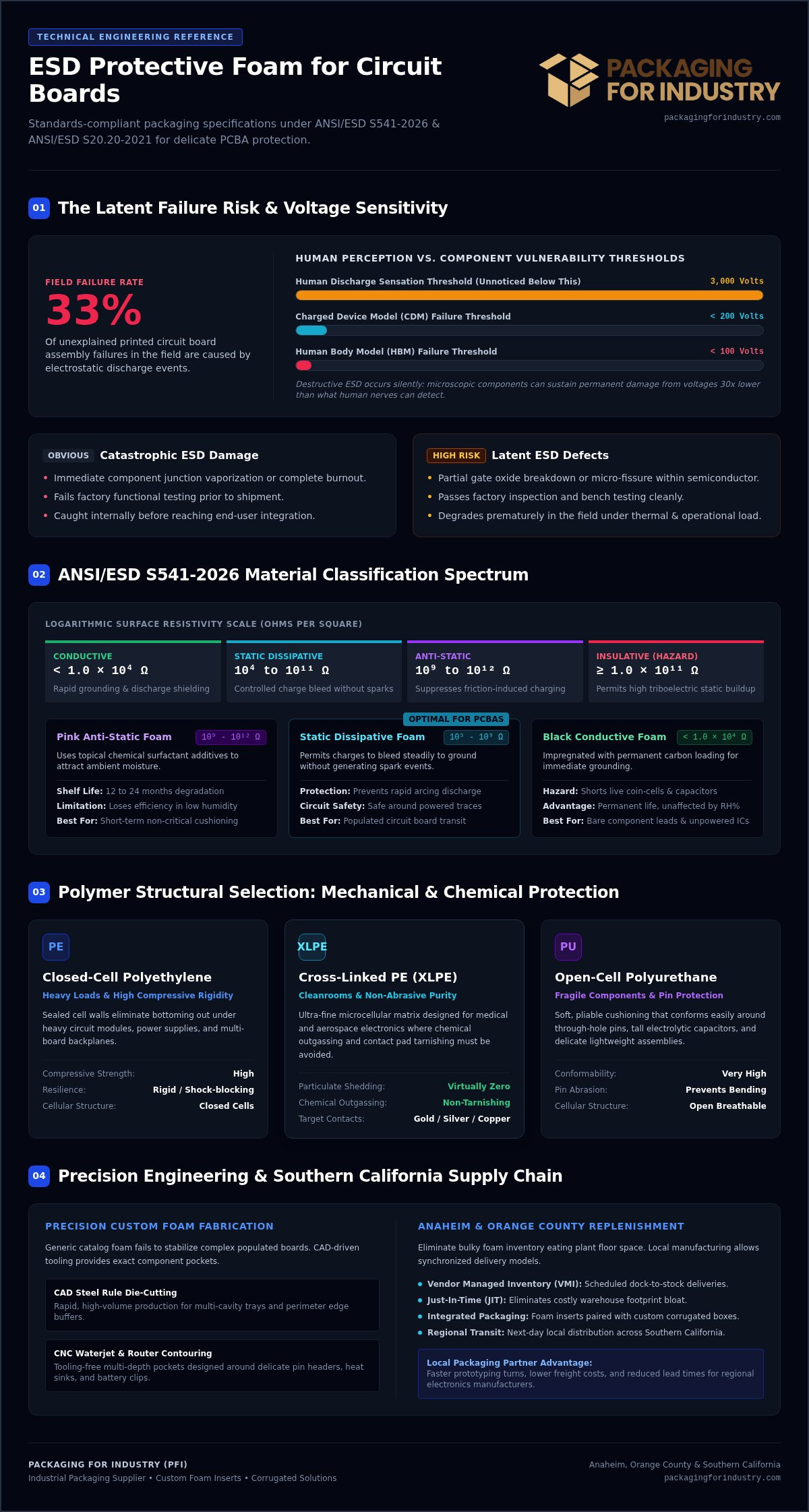
Electrostatic discharge accounts for up to 33% of unexplained printed circuit board assembly failures in the field, with latent defects often striking long after initial factory testing. If you manage electronics manufacturing or procurement, you already know the frustration of watching populated boards pass bench inspection, only to fail during end-user assembly because standard packaging failed to prevent pin abrasion or dissipate charge. Sourcing dependable ESD protective foam for circuit boards Orange County operations build shouldn’t force your team to gamble on generic catalog foam or absorb costly freight delays from distant distributors.
In this guide, you’ll discover how to specify, select, and source custom ESD protective foam for delicate circuit boards with Orange County local delivery. We’ll explore how matching surface resistance under ANSI/ESD S541-2026 standards shields sensitive microchips, how precision die-cut cushioning eliminates physical transit shock, and how scheduled local replenishment programs stop bulky packaging inventory from consuming your valuable plant floor space.
Key Takeaways
- Learn how matching surface resistivity specifications shields sensitive microelectronics from silent discharge events while avoiding accidental short circuits on live boards.
- Understand the structural performance differences between closed-cell polyethylene and open-cell polyurethane to stop component pin abrasion and mechanical drop damage.
- Discover how CAD-driven precision die-cutting and CNC waterjet routing create multi-cavity inserts tailored to intricate printed circuit board geometries.
- Find out how sourcing ESD protective foam for circuit boards Orange County facilities rely on through local Vendor Managed Inventory programs eliminates bulky warehouse clutter and avoids production line shutdowns.
- Explore the strategic and financial advantages of partnering with an Anaheim-based converter for rapid prototyping, integrated corrugated packaging, and fast regional delivery.
Understanding ESD Protective Foam Specifications for Circuit Boards
Modern surface-mount technology places microscopic circuitry closer together than ever before. Under ANSI/ESD S20.20-2021 standards, many sensitive components can sustain damage from electrostatic discharges under 100 volts across the Human Body Model and 200 volts across the Charged Device Model. Because humans rarely feel static discharges below 3,000 volts, these destructive events occur silently. Sourcing the correct grade of ESD protective foam for circuit boards Orange County manufacturers assemble is the only reliable barrier against rapid charge transfer and physical abrasion during transit.
Surface resistivity governs how charges move across cushioning materials. Standard insulative packaging materials exhibit a surface resistance equal to or exceeding 1.0 x 10¹¹ ohms, which permits severe triboelectric charge buildup whenever transit vibration creates friction. Governing standards like ANSI/ESD S541-2026 define three distinct material classifications based on electrical performance:
- Anti-Static Materials: Resist triboelectric charging through chemical additives, typically exhibiting surface resistivity between 109 and 1012 ohms per square.
- Static Dissipative Materials: Allow charges to bleed off steadily to ground without sparking, operating between 104 and 1011 ohms per square (commonly specified from 105 to 109 ohms for circuit boards).
- Conductive Materials: Provide rapid grounding and electrostatic shielding, maintaining a surface resistance under 1.0 x 10⁴ ohms.
Anti-Static vs. Static Dissipative vs. Conductive Foam
Pink anti-static foam uses topical chemical surfactants that pull moisture from ambient air to suppress triboelectric charging. However, its effectiveness drops in low relative humidity and degrades over a 12 to 24 month shelf life. Black conductive foam uses permanent carbon loading to bleed charge instantly. While ideal for component leads, conductive foam can short-circuit populated circuit boards containing live coin-cell batteries or backup capacitors. Static dissipative foam provides the ideal middle ground, preventing sparks while safeguarding powered traces.
The Hidden Costs of Latent Component Damage
Direct ESD events cause obvious catastrophic failures that fail factory functional testing. In contrast, latent defects are far more expensive. A low-voltage static discharge can cause partial oxide breakdown or microscopic gate ruptures inside a semiconductor without triggering immediate board failure. The assembly passes factory inspection, ships to the client, and degrades prematurely under thermal and electrical stress. Specifying certified foam packaging tailored to exact component thresholds prevents premature field failures and protects your production budget from costly warranty disputes.
Evaluating Foam Materials: Polyethylene vs. Polyurethane for PCBA Protection
Selecting protective packaging requires balancing three distinct operational demands: electrostatic control, physical shock absorption, and chemical purity. When specifying ESD protective foam for circuit boards Orange County electronics assemblers manufacture, matching the polymer cellular structure to board mass and component fragility is essential. If the foam is too rigid, impact shock transfers directly into delicate solder joints; if it is too soft, heavy assemblies bottom out upon impact.
Chemical composition matters just as much as cushioning performance. Low-grade foams can outgas volatile plasticizers that tarnish silver, gold, or copper contact pads over time, ruining board conductivity. For high-reliability medical and aerospace circuit boards, cross-linked polyethylene (XLPE) delivers a high-purity, closed-cell substrate. XLPE features a fine, non-abrasive microcellular structure that resists chemical attack and exhibits virtually zero particulate shedding, making it fully compatible with cleanroom handling protocols.
Closed-Cell Polyethylene Foam Properties
Closed-cell polyethylene (PE) delivers high compressive strength and resilient load-bearing capabilities. Because its cell walls remain sealed, PE doesn’t bottom out under dense power modules or populated backplanes. It is impervious to moisture, industrial oils, and airborne humidity during extended storage cycles. This rigid structure makes PE ideal for custom-routed edge trays and slotted partition sets that lock board margins in place, preventing boards from colliding during transit.
Open-Cell Polyurethane Foam Cushioning
Open-cell polyurethane (PU) offers soft, highly conformable cushioning with rapid recovery after compression. Its interconnected cell matrix allows air to circulate, yielding a flexible texture that gently encapsulates tall electrolytic capacitors and sensitive surface-mount packages. PU is the primary material choice for convoluted (egg-crate) lid inserts, applying uniform downward pressure to hold populated boards in position without placing damaging physical loads on protruding connector pins.
Most high-yield shipping kits pair these polymers strategically, using a dense PE base tray to absorb bottom drops and a soft dissipative PU upper pad to secure components. If you want to determine the optimal density combination for your board geometries, you can request a custom packaging evaluation to evaluate your board weight, pin clearance, and drop requirements.
Engineering Custom Die-Cut and CNC Foam Inserts for Circuit Boards
Generic foam sheets cut with utility knives or pulled apart from pre-perforated catalog blocks rarely protect populated circuit boards properly. Modern circuit board assemblies feature uneven mass distribution, fragile surface-mount packages, and rigid headers that require precise support. Engineering custom ESD protective foam for circuit boards Orange County tech firms ship ensures that mechanical shock bypasses sensitive solder joints, dispersing transit energy safely into the outer packaging structure.
Precision manufacturing techniques achieve this performance through tight dimensional control. CNC routing and abrasive waterjet cutting slice intricate board edge geometries, heat sink reliefs, and fragile connector margins without compressing or distorting cell walls. For scalable mass production, steel-rule die tooling cleanly stamps multi-cavity inserts that hold multiple boards per container. Thermal lamination bonds high-density polyethylene base planks to precision-cut cavity trays without insulative hot-melt adhesives, forming rigid modular stacking inserts that maximize carton density.
Sourcing foam as an isolated component forces your packing crew to manually configure boxes, pads, and bags on the line. Integrating precision-cut foam directly into custom-sized conductive or anti-static corrugated boxes provides full Faraday cage electrostatic shielding and unified drop protection in one step, eliminating excessive freight volume and line bottlenecks.
The CAD Prototyping and Tooling Workflow
Transforming complex board requirements into functional packaging follows a structured engineering workflow:
- Data Capture: Packaging engineers ingest your 3D STEP files or use optical 3D scanners on physical PCBA assemblies to map height variations and fragile components.
- Cavity Design: Specialists engineer clearance pockets, trace reliefs, and ergonomic finger cutouts, ensuring operators lift boards by their perimeter without touching surface traces.
- Physical Validation: CNC equipment cuts physical prototypes for test fitting, connector verification, and drop shock testing before production tooling begins.
Partnering with our custom design packaging team accelerates this development cycle, verifying tolerances before full production runs commence.
Turnkey Kitting: Integrating Foam with Outer Packaging
Assembling packaging components manually on your production floor consumes valuable time and increases labor costs. Pre-assembled packaging kits deliver custom ESD foam inserts already glued or nested inside dedicated corrugated shippers. Combining ESD foam cushions, static-shielding film barriers, and custom identification labels under a single master part number streamlines warehouse receiving, speeds up order fulfillment, and ensures your team packs delicate circuit assemblies correctly every time.
Procurement Strategy: Solving Lead Times and Storage in Orange County
Real estate overhead creates a major logistical bottleneck for Southern California electronics plants. Industrial lease rates across Orange County average between $1.44 and $1.49 per square foot monthly NNN, while vacancy rates remain compressed between 5.5% and 6.5%. Dedicating hundreds of square feet of expensive plant floor space to pallets of bulky foam inserts drains capital that belongs in active manufacturing operations. Sourcing ESD protective foam for circuit boards Orange County facilities build shouldn’t mean turning high-value production space into a packaging warehouse.
Ordering palletized foam planks from distant catalog distributors forces purchasing teams into an inefficient compromise. You either buy excessive bulk to dilute inflated freight costs, cluttering your aisles, or you order in smaller batches and risk line shutdowns when contract runs spike. Shifting to a localized supply model resolves this friction by aligning packaging delivery directly with your weekly PCBA build schedules.
Implementing Vendor Managed Inventory for Packaging
A structured inventory strategy eliminates stockouts and manual purchase orders. Packaging specialists evaluate your historical burn rates, physical staging areas, and production forecasts to establish rigid minimum and maximum stock levels. Replenishment arrives on scheduled weekly or biweekly cycles, ensuring static-safe inserts sit beside the assembly line exactly when technicians need them. Learn more about streamlining supply through our vendor managed inventory programs.
Local Distribution vs. Distant Catalog Suppliers
National catalog houses ship standard-sized foam from distant fulfillment hubs, billing heavy dimensional freight surcharges on lightweight, high-cube packaging. Their generic sheets often force line operators to slice and tear foam manually at assembly benches. Sourcing ESD protective foam for circuit boards Orange County operations require from an Anaheim converter replaces catalog markups with dedicated local truck delivery, turnkey kitted assemblies, and direct access to packaging engineers who adjust tooling as your board revisions evolve.
Sourcing ESD Protective Foam in Orange County: The PFI Advantage
Packaging For Industry (PFI) operates directly out of Anaheim, delivering engineered packaging solutions tailored to Southern California’s high-tech manufacturing corridors. Electronics assemblers across Irvine, Santa Ana, Huntington Beach, and Costa Mesa need packaging partners that offer both engineering precision and operational agility. Rather than treating static mitigation as a generic catalog transaction, PFI combines custom die-cut foam, specialized corrugated cartons, and cleanroom-grade cushioning into cohesive, production-ready kits. Sourcing ESD protective foam for circuit boards Orange County manufacturers depend on means partnering with consultants who analyze your assembly lines to uncover real cost-saving efficiencies.
Our packaging specialists conduct on-site evaluations of your current packing workflows, container dimensions, and transit routes. By identifying over-packaging, consolidating carton sizes, and right-sizing multi-cavity inserts, we help local operations reduce shipping volume and slash material waste across every production cycle.
Rapid Next-Day Delivery Across Southern California
Routing sensitive electronics through national freight networks exposes palletized foam and delicate assemblies to multi-terminal LTL handling, severe transit vibration, and Southern California highway delays. PFI operates a dedicated local fleet that provides dependable next-day replenishment directly to loading docks in Anaheim, greater Orange County, and Los Angeles County. Dedicated local routes keep high-reliability contract manufacturers, cleanroom facilities, and aerospace suppliers running smoothly without unpredictable supply chain disruptions or freight damage.
Start Your Custom ESD Packaging Project
Upgrading your circuit board packaging begins with an engineering assessment of your populated boards. Simply send your physical board dimensions, component height maps, or 3D CAD files to our design specialists. Our team evaluates pin clearance, board mass, and electrostatic sensitivity thresholds before producing physical CAD/CAM prototypes for hands-on drop and fit testing. You verify that components seat firmly, sensitive leads remain protected, and packing staff can handle boards efficiently before committing to full production runs. When you need certified ESD protective foam for circuit boards Orange County operations can rely on day after day, our team is ready to deliver. Request a packaging quote today to begin your design consultation.
Optimize Your Circuit Board Protection and Logistics
Protecting delicate assemblies demands more than generic padding. It requires packaging engineered specifically for your component layout and electrical dissipation thresholds. Combining the right density of closed-cell polyethylene with soft polyurethane eliminates physical shock, prevents pin abrasion, and stops latent electrostatic discharge before boards leave your dock. As a proven supplier to Southern California aerospace, medical device, and electronics manufacturers, PFI backs every design with in-house CAD/CAM prototyping to verify board protection before production begins. Sourcing dependable ESD protective foam for circuit boards Orange County operations build doesn’t require risking long lead times or sacrificing valuable floor space. Our Anaheim manufacturing and staging facility provides next-day local delivery across Orange County, keeping your lines supplied with scheduled replenishment.
Take control of your assembly transit safety and build a packaging workflow designed for long-term manufacturing reliability.
Frequently Asked Questions
What is the main difference between anti-static and conductive ESD protective foam?
Anti-static foam suppresses triboelectric charge generation, whereas conductive foam rapidly bleeds charges to ground and provides electrostatic shielding. Pink anti-static foam generally exhibits surface resistance between 109 and 1012 ohms per square. Black conductive foam maintains surface resistance below 104 ohms per square. Populated boards with live backup batteries need static dissipative or anti-static materials instead of conductive foam to avoid short circuits across battery contacts.
How do I determine whether my circuit boards require open-cell or closed-cell foam?
Board weight and component height dictate whether open-cell or closed-cell foam is appropriate. Closed-cell polyethylene foam provides rigid structural support and high compressive strength, making it ideal for heavy assemblies, multi-board divider trays, and perimeter edge blocking. Open-cell polyurethane foam delivers softer, conformable cushioning that compresses gently over delicate surface-mount components, through-hole pins, and uneven solder points without putting excessive physical stress on connections.
Can custom ESD foam inserts be integrated directly into corrugated shipping boxes?
Yes, integrating custom die-cut foam inserts directly into static-dissipative or conductive corrugated shipping boxes creates a turnkey packaging solution. Packaging For Industry designs and pre-assembles these kitted containers in Anaheim. Combining laminated polyethylene base trays, polyurethane top pads, and matched corrugated shippers into a single SKU speeds up assembly packing lines, simplifies receiving, and ensures comprehensive physical shock and electrostatic discharge protection during transit.
How quickly can custom die-cut ESD foam prototypes be produced in Orange County?
Packaging For Industry produces precision CAD/CAM physical prototypes within days at our Anaheim facility. Local engineers review your 3D STEP files or scan physical circuit board assemblies to develop initial cavity designs. Fabricating test samples locally allows Orange County operations teams to verify connector fit, drop shock performance, and operator handling ergonomics before committing to full-scale production tooling, preventing expensive revisions later.
Does ESD protective foam degrade, lose surface resistivity, or expire over time?
Topical pink anti-static foam degrades over time, typically losing effectiveness within 12 to 24 months or in low-humidity environments below 15% relative humidity. In contrast, carbon-loaded conductive and intrinsically static-dissipative foams maintain permanent electrical properties that never expire or wash away. Sourcing permanent ESD protective foam for circuit boards Orange County facilities manufacture ensures multi-year reliability without off-gassing chemical surfactants that could corrode exposed board contacts.
What industries in Orange County typically require certified ESD protective packaging?
Aerospace, defense contractors, medical device manufacturers, automotive electronics suppliers, and commercial contract assemblers throughout Orange County require certified ESD packaging. Facilities in Irvine, Anaheim, and Santa Ana build mission-critical printed circuit board assemblies that must comply with strict ANSI/ESD S20.20 and ANSI/ESD S541 standards. These regulated sectors demand documented surface resistivity performance to prevent catastrophic component failures and costly warranty claims.
How does a Vendor Managed Inventory program reduce electronics packaging costs?
A Vendor Managed Inventory program reduces costs by eliminating bloated warehouse storage and preventing emergency freight surcharges. When sourcing ESD protective foam for circuit boards Orange County plants operate, PFI monitors agreed min/max levels and delivers scheduled replenishment from Anaheim. This approach keeps bulky packaging off high-cost plant floors, frees up working capital, and ensures packing lines never halt due to unexpected material shortages.