
More cushioning isn’t always safer or more cost-effective. A package can still expose a product to damaging shock and vibration, while excess material can increase parcel dimensions and weight. For manufacturers and distributors, shock absorbing packaging design Southern California should start with the shipment’s risks, not a default foam insert. Existing cushioning may overlook a risk or add bulk without addressing the cause of damage.
Reliable protection matters, but so do material use, shipping space, and the work required to pack each order. This guide explains how to assess product and transit risks, compare foam, corrugated structures, and combined designs, and account for shipping dimensions and recurring orders. Packaging For Industry, based in Anaheim, offers custom design support, CAD/CAM capabilities, prototypes, and samples, and can integrate foam, corrugated boxes, and crates to suit a product and shipping operation.
Key Takeaways
- Start a packaging review with product details, damage history, shipping routes, and packing workflow to identify the risks a design needs to address.
- Compare foam, corrugated structures, and crates based on product fit and shipment conditions, not material preference alone.
- Prepare details about order patterns, shipping dimensions, and packing constraints before comparing packaging options.
- Evaluate shock absorbing packaging design Southern California with a supplier that can consider protection needs and operational fit.
- PFI’s CAD/CAM support, prototypes, and samples can help manufacturers review a product-specific design before broader rollout.
Shock-Absorbing Packaging Design in Southern California: What Buyers Need to Assess
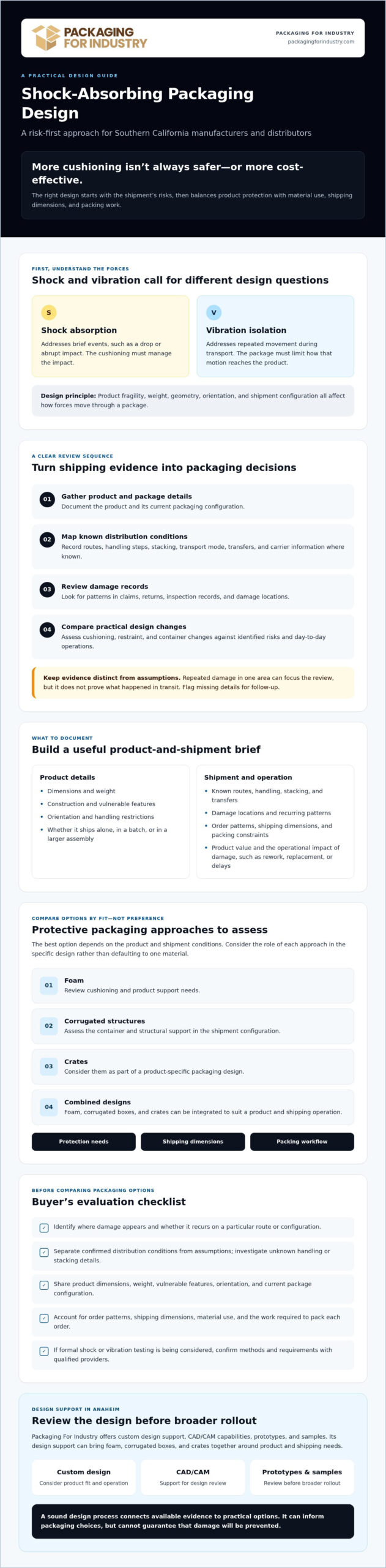
Protective packaging design matches a product’s cushioning and structural support to handling, transport, and storage risks, while accounting for packing and shipping requirements. Shock absorption addresses brief events such as a drop or abrupt impact. Vibration isolation addresses repeated movement during transport. They pose different design questions: cushioning must manage an impact, while the package must limit how repeated motion reaches the product.
There’s no universal insert or box for every shipment. Product fragility, weight, geometry, and orientation affect how forces move through a package. Shipment configuration matters too: an item shipped alone may need different support from the same item packed in batches or secured inside a larger assembly. Package cushioning provides an overview of the basic concepts behind cushioning design.
For buyers evaluating shock absorbing packaging design Southern California, the goal is to reduce damage while managing material use, package dimensions, and warehouse handling. A design should address a documented risk without adding bulk or packing steps that don’t serve the operation. PFI offers custom packaging design and foam packaging solutions as part of product-specific packaging reviews.
Which shipment risks should a packaging review consider?
Start with what has happened, not what the team assumes might happen. Record where damage appears, the product’s orientation when packed, and whether failures recur on a particular route or shipping configuration. A damaged corner, shifted component, or repeated scuff pattern can help focus the review, but it doesn’t establish the cause on its own.
Map the known distribution steps, including handling, stacking, transport mode, and transfers between facilities. Separate confirmed conditions from assumptions. If details such as stacking or handling are unknown, flag them for investigation rather than designing around guesswork.
What product information helps specify shock protection?
Provide the product’s dimensions and weight, identify vulnerable features, and note any handling restrictions. Describe whether it ships individually, in a batch, or as part of a larger assembly. These details help a packaging supplier assess how the product sits in the package, where support may be needed, and how packing fits into daily operations.
Also document product value and the operational impact of damage, such as rework, replacement, or shipment delays. This helps purchasing and operations teams weigh protection needs against material use and package size. It supports a more informed design discussion, but can’t guarantee a particular shipping outcome.
How Shock and Vibration Analysis Informs a Packaging Design
A useful packaging review turns shipping evidence into design decisions. Gather product and package details, map known distribution conditions, review damage records, and then compare possible changes. This sequence helps teams distinguish a recurring, observed failure from a risk that has not yet been confirmed.
- Gather: Document the product and current packaging configuration.
- Map: Record known routes, handling steps, stacking, and carrier information.
- Review: Check claims, returns, inspection records, and damage locations for patterns.
- Compare: Assess cushioning, restraint, and container changes against the identified risks.
Field records can narrow the review. For example, repeated damage in the same area may prompt a closer look at product support or package orientation, but it doesn’t prove what happened in transit. Keep observed damage separate from assumptions, and list missing information for follow-up. If formal shock or vibration testing is being considered, confirm appropriate methods and requirements with qualified providers. The International Safe Transit Association (ISTA) publishes transport packaging resources that can help inform that discussion.
Analysis informs packaging choices, but it does not guarantee that damage will be prevented. A sound design process connects available evidence to practical options, then considers how those options affect shipping and daily operations.
Which inputs belong in a shock and vibration review?
Record product dimensions, mass, construction, sensitive areas, and the current package configuration. Add route, handling, stacking, and carrier details available to the shipping team. Ask whether relevant test data already exists. Mark missing measurements for verification instead of estimating them, so design decisions reflect known conditions rather than guesswork.
How should analysis translate into packaging changes?
Link each identified risk to a possible design response. A review may examine cushioning placement, product restraint, or container structure, then compare options for package size, packing steps, and warehouse handling. PFI offers custom packaging design services, including CAD/CAM support, prototypes, and samples to help assess fit before broader rollout.
For a product-specific review, buyers can request a packaging quote and share available shipment details. That gives the supplier a practical starting point for discussing shock absorbing packaging design Southern California operations can use.
Foam, Corrugated, and Crate Designs: Compare Protection Options
Choose materials based on the product and shipment requirements, not habit. Compare how each option supports the item, fits the shipping configuration, and works with the packing process. A material that addresses one need may still require another structure to contain, position, or handle the product.
| Option | Potential use | Design considerations |
|---|---|---|
| Custom foam | Supporting products with vulnerable surfaces, irregular forms, or specific positioning needs. | Review fit, contact points, product removal, and loading steps. Confirm the foam choice against project specifications. |
| Corrugated structures | Containing products and organizing them with partitions, pads, or inserts. | Consider box configuration, internal movement, stacking, and assembly. Assess the complete package, not only the outer box. |
| Crates | Project-specific shipments involving large, heavy, or high-value industrial goods. | Evaluate product support, handling needs, shipment configuration, and warehouse workflow. |
When might custom foam or foam-lined packaging fit?
Custom foam can be shaped to support a product’s contours or maintain its position inside a container. This may suit equipment with exposed features or surfaces that need separation from other components. Polyethylene or polyurethane foam can be considered when project specifications support the selection. Don’t assume a particular density or cushioning capacity without verified material data. PFI offers protective foam packaging for industrial applications.
When should buyers compare corrugated boxes and crates?
Corrugated structures can combine containment with internal partitions, pads, or inserts. Crates may suit other handling or shipping needs, including shipments involving large industrial goods. Compare packing steps and finished package dimensions as well as materials. PFI’s custom packaging design services can help assess an integrated configuration, and buyers can review its wooden crate options for relevant projects.
A combined design may use foam to position the product, corrugated packaging to contain or organize it, and a crate to address shipment handling requirements. The USDA’s United States Standards for Condition of Food Containers covers container condition for food commodities; it is not a shock-performance specification. Compare the complete packaging configuration against project needs and available evidence before selecting materials or planning a broader rollout.
A Southern California Buyer’s Checklist for Evaluating Protective Packaging
A useful packaging review gives suppliers enough detail to compare protection, package dimensions, packing effort, and replenishment needs. Prepare a focused project brief before requesting pricing or discussing a design change.
What should buyers prepare before requesting a quote?
- Product details: Share dimensions, weight, photographs, vulnerable areas, handling restrictions, and current packaging details when available.
- Damage history: Summarize where damage appears and any patterns in claims, returns, or inspections. Separate observed facts from suspected causes.
- Shipping information: List destinations, routes, carrier practices, and known handling or stacking conditions.
- Packing and storage constraints: Describe pack-out steps, available workspace, and limits on storing packaging supplies.
- Order patterns: Note approximate usage, recurring order needs, and whether products ship individually, in batches, or as part of an assembly.
These details help a supplier assess the operation rather than quote around a material alone. Flag missing information so the team can determine what needs confirmation.
How can buyers compare designs beyond material choice?
Compare product fit, pack-out steps, finished package dimensions, and compatibility with warehouse handling. Consider whether workers can assemble the design consistently and whether it supports storage and replenishment needs. Ask whether prototypes or samples can help your team review the proposed fit and workflow before broader rollout. Confirm lead times, order quantities, and delivery arrangements directly with the supplier.
PFI serves industrial buyers across Southern California, including manufacturers in aerospace, electronics, and medical device production, as well as other industrial operations. Based in Anaheim, the company serves Orange County, Los Angeles County, the Inland Empire, and San Diego County. Its custom and stock packaging offerings can support product-specific requirements and recurring supply needs.
Use the checklist to compare the complete proposal, including protection needs, package dimensions, packing labor, and replenishment requirements. A clear brief keeps the discussion focused on a workable packaging solution.
Work with PFI on Custom Shock-Absorbing Packaging in Southern California
Packaging For Industry (PFI) is an Anaheim-based industrial packaging supplier serving manufacturers and other industrial buyers across Southern California. PFI offers custom and stock packaging, including foam, corrugated boxes, and crates. Reviewing these options together can help match protection needs with packing workflow, package dimensions, and recurring supply requirements.
What can PFI contribute to a custom packaging project?
PFI’s custom packaging design services include CAD/CAM support, prototypes, and samples. These resources help teams review product fit and packing steps before broader rollout. Depending on the shipment, a design may combine foam to position an item, corrugated packaging for containment, and a crate for handling needs.
Purchasing teams can compare packaging pricing across suitable configurations, considering material use, package size, and order patterns. For recurring or larger-volume requirements, ask about bulk packaging pricing and how custom or stock options fit your replenishment plan. A practical design can help businesses work toward lower packaging costs without sacrificing product protection or supply reliability.
What should happen before a packaging design is approved?
Review a prototype or sample for product fit, assembly steps, and handling requirements. Get feedback from the employees who pack, move, and receive the shipment. If formal shock or vibration testing is needed, confirm the method, qualified provider, and project scope. Don’t treat a sample review as formal testing or as a guarantee against damage.
Before rollout, confirm specifications, order quantities, lead times, and local packaging delivery arrangements with the supplier. This connects the packaging decision to warehouse operations and ongoing purchasing needs.
For shock absorbing packaging design Southern California, share product dimensions and weight, current packaging, damage history, shipping destinations, and recurring order needs. These details give PFI a practical starting point for discussing a custom solution and quote.
Build a Packaging Plan Around Your Shipping Needs
Reliable protection starts with the shipment, not a default material choice. Document product characteristics and damage history, then compare foam, corrugated structures, and crates against transit conditions, package dimensions, and packing workflow. The design should address known risks while fitting warehouse operations and recurring supply requirements.
For businesses evaluating shock absorbing packaging design Southern California, Packaging For Industry offers product-specific custom packaging design with CAD/CAM support, prototypes, and samples. Its Anaheim team can consider integrated options across foam, corrugated boxes, and crates, with service coverage across Southern California.
Share your product details, current packaging, shipping destinations, and order needs to begin a focused review.
A practical packaging solution can support careful handling, efficient packing, and more dependable supply planning. Start with the details you have, and refine the design with a packaging partner.
Frequently Asked Questions
What is shock-absorbing packaging design?
Shock-absorbing packaging design is the process of selecting and arranging cushioning and package structures to help manage impacts and movement during shipment. The design depends on the product, shipping route, handling conditions, and packaging configuration. It isn’t a universal material choice or a guarantee against damage. Before specifying a solution, review actual damage records and shipment details, including where failures occur and how the product is packed and transported.
How do I choose packaging for shock and vibration risks?
Start with the product’s dimensions, weight, vulnerable areas, current packaging, and known damage patterns. Add available information about carriers, routes, handling, and stacking. Then compare foam, corrugated structures, crates, or combinations based on fit, packing effort, and package dimensions. For shock absorbing packaging design Southern California, base choices on confirmed shipment information. If formal analysis or testing is needed, confirm the appropriate method and qualified provider for the specific shipment.
Is foam always the best choice for shock protection?
No, foam isn’t the best choice for every product or shipping operation. It may suit a product that needs shaped support or separation, while corrugated structures can provide containment and internal organization, and crates may fit other industrial shipping needs. Compare the complete package, including how it’s packed and handled. Before selecting a foam type, verify its properties against project requirements rather than assuming all foam materials provide the same performance.
Can custom packaging reduce shipping damage and costs?
Custom packaging can address product fit, cushioning placement, and package dimensions more directly than a generic option. That may help a business respond to damage concerns or avoid inefficient packaging, but results depend on the product and shipping process. Don’t assume a specific reduction in damage or costs. Review damage history, freight considerations, and packing steps, then assess a proposed design with a prototype or sample before considering a wider rollout.
What information should I provide for a shock-absorbing packaging quote?
Share product dimensions and weight, photographs, vulnerable areas, and details about the current packaging, if available. Include examples of damage, shipment destinations, carrier or handling information, and recurring order needs. Note warehouse, packing, and storage constraints too. These details help a supplier consider whether foam, corrugated packaging, crates, or a combined design may fit the project. Ask what additional information or samples would help assess the proposed solution.
Does PFI perform shock and vibration testing?
PFI offers custom packaging design support, CAD/CAM support, prototypes, and samples, but formal shock and vibration testing is not part of its stated design support. If testing is required, describe it when requesting a quote and ask whether PFI can support or coordinate the requirement. Before relying on results or performance claims, confirm the testing method, responsible provider, and project scope for your shipment.
Does PFI serve manufacturers in Southern California?
Yes. Packaging For Industry is headquartered in Anaheim and serves businesses across Southern California, including Orange County, Los Angeles County, the Inland Empire, and San Diego County. Its industrial packaging offerings include custom and stock packaging, protective foam, corrugated boxes, and crates. Manufacturers should confirm product availability, delivery arrangements, and project requirements when requesting a quote, particularly for custom designs or recurring packaging supply needs.