
What if a returnable container is doing its job, but the parts inside still shift, collide, or arrive damaged? For manufacturers searching for custom dunnage for returnable containers Los Angeles, the key is a fit that accounts for the product’s geometry, container dimensions, handling process, and return loop. An insert that no longer matches the product or workflow can leave parts exposed to contact and make replacement orders harder to manage consistently.
Reusable dunnage should be designed around the full transport cycle, not just the part. This guide covers what to gather before specifying an insert, how to compare material options, and what to include in a quote request. It also explains how to assess repeat supply needs and discuss the application with a local packaging supplier. Packaging For Industry, headquartered in Anaheim and serving Los Angeles County, offers custom packaging design support, reviews, and prototypes. Ask the team to confirm whether your dunnage format and returnable-container requirements fit its capabilities.
Key Takeaways
- Specify custom dunnage for returnable containers Los Angeles applications around the part, container, handling process, and return loop, not material alone.
- Gather product dimensions, weight, orientation, fragile areas, and handling constraints before comparing designs.
- Assess foam, corrugated components, or combinations for cushioning, separation, durability, cleanability, weight, and replacement needs.
- Before requesting a quote, prepare product and container details, recurring quantities, workflow requirements, and the delivery destination. Ask about prototypes and custom-item lead times.
- PFI offers packaging design support and serves Los Angeles County from its Anaheim headquarters. Confirm that its capabilities suit your specific dunnage application.
Custom Dunnage for Returnable Containers in Los Angeles: What Buyers Need to Solve
In a returnable packaging system, the container provides the outer structure, while dunnage organizes and protects the parts inside. The dunnage may travel with the container for repeated use or be replaced during the packaging process. That distinction affects design and replenishment. Even a sound container can allow components to shift if the insert does not match the product or loading method. For a neutral overview of the term, see Dunnage.
Dunnage is internal packaging designed to locate, separate, and protect products inside a transport container while supporting repeatable handling. A useful design connects product protection with the work operators do at every stage, from loading and transit to unloading and container return.
How dunnage supports a returnable-container loop
A repeatable insert gives each component a defined position, helping operators load and unload in a consistent sequence. A well-matched layout can also help limit contact between parts and the container during movement. Design around the actual product, container dimensions, transport route, and handling steps. Consider how parts are placed, removed, stacked, or transferred, and identify any cleaning requirements. Review expected reuse and cleaning needs for the specific application rather than assuming one design will suit every return loop.
When custom dunnage is preferable to an improvised fit
Look for recurring signs that the current setup is not working: parts shift in transit, operators arrange them differently from load to load, finished surfaces show contact damage, or loading takes longer because components need repeated adjustment. Loose fillers or makeshift dividers may fill empty space, but they can move, wear, or vary between shipments. That inconsistency can make handling less predictable and disrupt production or receiving workflows.
A custom fit gives the team a repeatable layout to assess under real operating conditions. The right design depends on what the part needs and how the container moves through the return loop. Adding material without a defined purpose does not resolve a poor fit.
What Los Angeles buyers should solve first
For buyers sourcing custom dunnage for returnable containers Los Angeles, start supplier discussions with the application, not a presumed material. Share product and container details, explain where handling problems occur, and describe how inserts are used and replenished. Ask how the approved design will be identified for repeat orders and whether the supplier can support the required dunnage format. Packaging For Industry serves Los Angeles County from its Anaheim headquarters and offers custom packaging design support. Confirm that the specific returnable-container application is within scope.
How to Engineer Dunnage Around Your Product and Container
A dependable design starts with operating details, not material selection. The same part may need different support depending on its weight, orientation, contact-sensitive areas, container layout, and how employees load and remove it. For custom dunnage for returnable containers Los Angeles projects, documenting these conditions helps a supplier assess the application and identify questions before recommending a design.
Information to prepare for a custom dunnage design
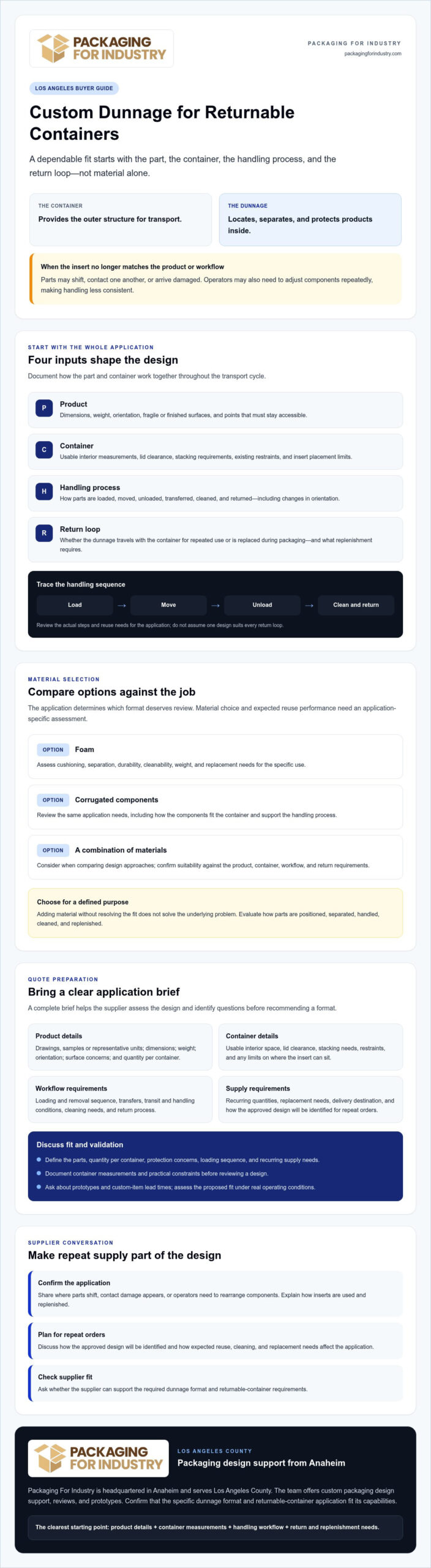
Gather drawings, product samples, or representative units when available. Measure the container’s usable interior space, including lid clearance, and note existing restraints or features that limit insert placement. Record product dimensions and weight, preferred orientation, fragile or finished surfaces, and any points that must remain accessible.
Describe the full workflow: how parts are loaded, moved, unloaded, cleaned, and returned. Include relevant transit and handling conditions, such as transfers between work areas or changes in orientation. These details help a design team evaluate fit and use. Material choice and expected reuse performance still require an application-specific review.
Steps from requirements to fit check
- Step 1: Define the requirements. Identify the parts, quantity per container, protection concerns, loading sequence, and recurring supply needs.
- Step 2: Document the container. Provide interior measurements, usable space, lid clearance, stacking requirements, and any existing restraints or access limits.
- Step 3: Review the handling cycle. Explain the route, handling points, cleaning process, and return procedure so the design reflects actual use.
- Step 4: Assess design and material options. Ask the supplier to review formats and materials for the product and operating conditions. Confirm suitability and expected reuse performance for the application rather than relying on general material assumptions.
- Step 5: Evaluate a prototype or sample. If available, test representative parts in the actual returnable container before approving production.
Prototypes and fit checks before production
During a fit check, confirm that parts sit in the intended position, load without unnecessary adjustment, and can be removed without catching or interfering with adjacent components. Check lid closure and stacking requirements, too. Observe the setup during representative handling, then record movement, contact points, and operator difficulties. PFI provides CAD/CAM support, packaging reviews, prototypes, and samples. Ask whether it can support the specific returnable-container dunnage format. Its custom packaging design service may also be relevant when reviewing the wider packaging requirements.
With product and container details in hand, you can request a packaging quote. Ask the supplier to clarify prototype options, how repeat orders will match the approved design, and what custom-item lead times apply.
Compare Dunnage Materials and Designs for Los Angeles Operations
For custom dunnage for returnable containers Los Angeles projects, compare options against the part, container, and handling cycle rather than choosing by material name alone. Foam, corrugated components, or a combination may be worth evaluating, but suitability depends on the application and should be confirmed with the supplier. Also distinguish a reusable insert from consumable protective packaging, since the intended replacement cycle affects what your team needs to assess.
Foam dunnage for shaped or sensitive components
Custom foam inserts and assemblies may suit parts that need defined pockets or separation, subject to design review. Assess the product’s geometry, contact points, surface sensitivity, and how operators will place and remove each component. A close-fitting design still needs to work with the container and loading process. PFI offers protective foam packaging, including inserts and assemblies. Confirm whether the proposed material and format fit your returnable-container requirements.
Corrugated and mixed-material dunnage
Corrugated dividers, pads, or inserts may be considered when the product layout and application support their use. A mixed-material design may also be worth reviewing if the system needs both cushioning and structural organization. Do not assume either option has a particular service life, load capacity, or cleaning performance without project-specific information. Confirm whether the dunnage is intended for repeated use or replacement and how that choice fits the replenishment process.
Use the comparison below to guide supplier discussions. Assess each option against the actual parts and container conditions.
- Foam: Evaluate cushioning needs, shaped contact areas, part separation, removal, cleaning, and expected reuse. Ask whether the proposed foam and design suit the product’s surfaces and handling cycle.
- Corrugated components: Evaluate layout, separation, container fit, weight, cleaning needs, and whether the design is intended for reuse or replacement. Ask how the proposed construction suits the application.
- Combined design: Evaluate how the components work together, including fit, handling, cleaning, and replacement. Ask the supplier to explain why a combination is appropriate for the product and workflow.
Compare options using the same criteria: cushioning, separation, durability for the intended use, cleanability, weight, and replacement needs. Los Angeles-area buyers should also clarify how the selected design will be specified for repeat orders. Reviewing protection and replenishment together helps purchasing and operations assess the whole process, rather than treating material choice as a substitute for application review.
Specify and Validate Returnable-Container Dunnage Before Requesting a Quote
A useful quote request gives the supplier enough detail to assess the application, identify open questions, and clarify what needs testing. For manufacturers, warehouses, and distribution centers, share both product and container requirements, along with purchasing needs and the delivery destination. Clear specifications also help the supplier determine whether custom sizes are appropriate for the application.
A practical quote-request checklist for Los Angeles buyers
Gather the information your team already has and flag anything still unknown. That makes it easier to identify what needs to be confirmed before a design is approved.
- Product: Drawings or representative samples, dimensions, weight, orientation, fragile areas, and known damage or contact concerns.
- Container: Interior measurements, usable space, lid clearance, photos, existing restraints, and details of the current insert or packaging setup.
- Quantities and use: Parts per container, usage frequency, expected order volumes, and whether the insert is intended for reuse or replacement.
- Workflow: Loading and unloading steps, handling bottlenecks, cleaning needs, storage considerations, and changes needed to the current process.
- Supply and delivery: Production or shipping schedules, delivery locations, and the Los Angeles-area destination for the custom order.
Share specific examples of current issues, such as finish damage, inconsistent loading, or frequent insert replacement. These details help the supplier evaluate the design against your workflow and discuss bulk packaging pricing. If cushioning materials are part of the proposed solution, ask how their suitability will be assessed for the product and handling cycle.
Questions to resolve during design review
Confirm that the proposed design fits the existing container and product configuration. Ask whether a prototype or sample is available and how your team should assess fit, loading consistency, removal, and part movement. Agree on evaluation criteria before production. To compare packaging pricing and consider opportunities to lower costs, review the design alongside replacement frequency, storage needs, and workflow requirements.
Ask how repeat orders will match the approved design, what information will be retained for reordering, and what custom-item lead times apply. Confirm delivery availability and timing for your specific Los Angeles County destination. Do not assume standard delivery timing applies to custom work.
After implementation, track damage reports, loading consistency, storage requirements, and replacement frequency. These observations help purchasing and operations assess how well the design supports ongoing use and replenishment.
Work With a Los Angeles-Area Supplier on Custom Dunnage
For manufacturers and operations teams, a packaging partner can help assess how product protection fits into the wider supply process. Packaging For Industry (PFI) serves industrial and manufacturing buyers, including aerospace, electronics, and medical device companies, as well as warehouses and distribution operations. Headquartered in Anaheim, PFI serves Los Angeles County and the wider Southern California region.
What to expect when discussing a custom project with PFI
A project discussion can cover product fit, container requirements, use conditions, order volume, and recurring supply needs. PFI offers corrugated products, foam packaging, crates, and cushioning materials, and can combine materials into integrated solutions where appropriate. This range may help buyers review protection and purchasing needs together. PFI also provides CAD/CAM support, packaging reviews, prototypes, and samples for custom packaging projects. Confirm whether the team can support your returnable-container dunnage format, material requirements, and production needs.
For a separate transport packaging application, see Engineering Custom Crates for International Transit. Crate needs should be reviewed independently from returnable-container dunnage.
Request a custom dunnage quote for Los Angeles
Share product drawings and dimensions, container measurements, photos, sample availability, and your target delivery location. Describe the current return-container process, known handling issues, order volume, and repeat-order expectations. Ask PFI to confirm project fit, prototype options, material suitability, production capability, and custom-order delivery timing. This information helps your team assess whether PFI can support the application and its ongoing supply needs.
Put Your Returnable-Container Design Into Practice
Reliable dunnage starts with a clear understanding of the part, container, and return loop. Document product and container details, compare material options against operating needs, and evaluate fit and handling before approving production. These steps give teams a practical way to address shifting parts, inconsistent loading, and replacement challenges with a design based on their workflow.
For custom dunnage for returnable containers Los Angeles projects, Packaging For Industry serves Los Angeles County and the wider Southern California region from its Anaheim headquarters. PFI provides CAD/CAM support, packaging reviews, prototypes, and samples for custom packaging projects. Discuss your application with the team to confirm whether its design and supply capabilities suit your dunnage requirements.
To get started, share your product and container information with PFI and request a review of your custom dunnage application.
Frequently Asked Questions
What is custom dunnage for a returnable container?
Custom dunnage is internal packaging designed to position, separate, or cushion products inside a transport container. Unlike a generic insert, it is planned around the product’s shape and the container’s usable space. Material choice and suitability for reuse depend on the application. For a project review, provide product and container dimensions, details about sensitive contact points, and information about loading, handling, cleaning, and return procedures.
How do I choose dunnage for an existing returnable container?
Start with accurate measurements of the container interior and product, including weight, orientation, and areas that need protection. Describe how operators load and unload it, relevant handling conditions, and any damage history. A prototype or sample fit check can help assess access, product movement, and repeatability in the actual container. Ask the supplier what design, prototype, and testing support is available for your application.
Can custom dunnage reduce damage during repeated shipping?
Correctly specified dunnage can help separate components and limit unwanted movement, but it cannot guarantee a particular reduction in damage. Results depend on the product, container, route, and handling process. Document current damage patterns, including where parts contact one another or the container. Then assess a representative product in the intended container to determine whether the proposed design addresses those failure points during loading, transit, and unloading.
Which materials are used for custom returnable-container dunnage?
Foam and corrugated components may be options, and a combination may be considered after design review. The right choice depends on product sensitivity, contact areas, cleaning expectations, handling, and whether the insert will be reused or replaced. Do not select by material name alone. Share the actual part and container details with the supplier, then ask for a recommendation and confirmation that the proposed material suits the application.
What information should I send to request a custom dunnage quote in Los Angeles?
For a custom dunnage for returnable containers Los Angeles quote, share product drawings or samples, product and container dimensions, photos, and details of the current packaging. Include usage volume, loading and handling steps, known damage concerns, recurring supply expectations, and the delivery location. Confirm the supplier’s capability for your project, along with prototype availability, order quantities, and custom-item lead times. Do not assume these details from a general service-area statement.
Does PFI provide custom dunnage delivery in Los Angeles?
Packaging For Industry serves Los Angeles County and Southern California from its Anaheim headquarters, but delivery timing for custom dunnage should be confirmed for each project. General local delivery information does not establish timing for a custom order. When requesting a quote, provide the exact destination, project requirements, and schedule. Also confirm whether PFI can design and supply the specific dunnage format and returnable-container application you need.