
The lowest-cost package on a purchase order can become the most expensive choice after a shipment is damaged. To assess the cost of shipping damage vs custom packaging investment, look beyond the product’s replacement value. Include claim administration, repacking and reshipping labor, return freight, and the time spent resolving customer issues.
That comparison can be difficult when damage costs are recorded across operations, finance, customer service, and shipping. It’s also reasonable to question an upfront packaging change when damage happens inconsistently. The answer isn’t to customize every package. Instead, identify the products and shipping routes with recurring problems, then compare the documented cost of damage with the full cost of changing the packaging.
This 2026 guide offers a practical framework for building that comparison from your shipment and cost records. You’ll learn what to include, how to prioritize products for review, and how to assess options such as custom corrugated boxes, protective foam, and crates. Packaging reviews, custom designs, prototypes, and samples can help your team evaluate product-specific needs before considering a broader rollout.
Key Takeaways
- Build a complete damage-cost picture by checking records across shipping, operations, customer service, and finance.
- Compare the cost of shipping damage vs custom packaging investment by accounting for design, prototypes, implementation, and ongoing packaging use.
- Review current packaging, a targeted redesign, and a custom protective solution side by side to understand practical trade-offs.
- Evaluate changes using shipment data, while keeping product, route, handling, and volume differences visible.
- Consider a packaging review when damage recurs or product dimensions make standard packaging a poor fit. Prototypes and samples can help inform next steps.
Cost of Shipping Damage: Which Costs Belong in the Comparison?
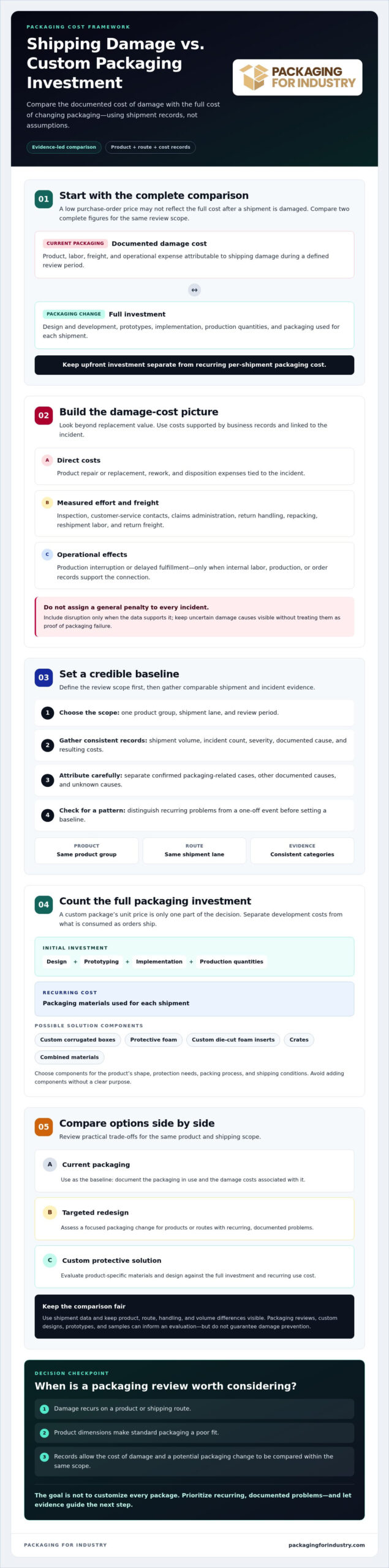
A useful comparison starts with two complete figures: the cost of damage under current packaging and the full cost of changing that packaging. Product replacement is only one part of the first figure. Inspection, rework, claims handling, reshipment, and operational disruption can add effort and expense across several teams. To keep the analysis credible, include costs supported by business records and linked to the incident.
Total damage cost is the documented product, labor, freight, and operational expense attributable to shipping damage during a defined review period. This shared definition helps finance, operations, and purchasing compare the cost of shipping damage vs custom packaging investment. Packaging functions vary by application. This packaging and labeling overview provides background, but your own incident records should drive the calculation.
Which direct and indirect damage costs should buyers count?
Start with direct costs your records connect to damage: product repair or replacement, rework, and disposition. Then account for the work required to resolve each incident. Depending on what your systems track, that may include inspection time, customer-service contacts, claims administration, return handling, and labor to prepare and ship a replacement.
Check for operational effects, too. A damaged component may interrupt production, or a replacement shipment may delay fulfillment. Use internal labor, production, and order records to assess these effects. Don’t assign a general penalty to every incident. Include disruption only when your data supports the connection.
How can a team establish a credible baseline?
Define the scope before calculating. Select a product group, shipment lane, and review period, then gather shipment and incident records for that same scope. Track shipment volume alongside incident count, severity, documented cause, and resulting costs. Consistent categories make it easier to compare packaging options later.
Review the evidence before labeling an incident packaging-related. Damage may result from handling, product condition, loading, or another cause. Separate confirmed packaging-related cases from incidents with another documented cause and those with an unknown cause. Keep uncertain cases visible, but don’t treat them as proof that packaging failed.
- Direct: Repair, replacement, rework, and disposition expenses tied to the incident.
- Indirect: Measured inspection, service, claims, reshipment, and operational effort.
- Baseline: Shipment volume, incident details, and attribution for a defined product and lane.
Finally, distinguish a one-off event from a recurring pattern. A single unusual incident may warrant investigation, but it shouldn’t automatically set the baseline for a packaging change. If the review points to a protection issue, PFI’s custom packaging design services can help assess product-specific needs as you build the next-stage comparison.
Custom Packaging Investment: What Does the Full Cost Include?
A custom package’s unit price is only one part of the investment. A fair comparison also accounts for design and prototyping, production quantities, implementation, and the recurring cost of packaging used for each shipment. The right scope depends on the product, how it ships, and how often the packaging is reordered.
Initial packaging investment covers the work and materials needed to develop and introduce a packaging change; recurring per-shipment packaging cost covers the packaging consumed each time an order ships. Keep these figures separate in your cost of shipping damage vs custom packaging investment analysis. This makes it easier to compare upfront decisions with ongoing operating costs.
Which custom packaging components may affect the investment?
A solution might use custom corrugated boxes, protective foam, custom die-cut foam inserts, crates, or a combination of materials. The design should respond to the product’s shape, protection needs, packing process, and shipping conditions. Avoid adding components without a clear purpose.
Design and prototyping provide a way to review fit and packing steps before a broader rollout. They help teams assess an option, but they don’t guarantee damage prevention. PFI offers custom packaging design services, with prototypes and samples available to support evaluation.
What operational trade-offs belong in the calculation?
Compare more than material consumption. A package that takes longer to assemble or requires extra handling can affect packing labor. A design that stores efficiently may ease space constraints, while a bulky package can create a different warehouse burden. Note whether the new format supports consistent packing across shifts and locations.
Review order volume and replenishment patterns before selecting production quantities. Larger runs may change the per-unit comparison, but they can also leave excess packaging if demand shifts, products change, or packaging becomes obsolete. Include expected usage, reorder frequency, storage requirements, and the risk of unused stock in the evaluation.
Custom dimensions may affect billed shipment dimensions or carrier handling charges, but the outcome depends on the carrier, service, package, and current rate rules. Compare the proposed package with actual shipment details and verify potential impacts with the carrier or shipping provider. Don’t assume right-sizing will change freight charges until the relevant rules and shipment data confirm it.
For a product-specific review, share shipment patterns, current packaging details, and anticipated order quantities when you request a custom packaging quote. That gives your team a clearer basis for comparing the initial investment with recurring packaging and operating costs.
Shipping Damage vs. Custom Packaging: How to Compare the Options
Compare packaging alternatives against the same product group, shipment lane, and review period. Use your incident records and supplier quotes, not industry averages. If an input is missing, mark it unknown and verify it before relying on the comparison. Review each option using the same operating factors:
- Current packaging: Record damage evidence, material use per shipment, packing time, storage footprint, freight details, and the existing process. This establishes the operating baseline.
- Targeted redesign: Identify the documented failure point the change is intended to address. Check how a focused change could affect material consumption, assembly time, storage, freight dimensions, and rollout effort.
- Custom protective solution: Assess whether added or combined materials address a specific protection need. Include all components, packing steps, storage requirements, confirmed freight effects, and implementation work.
This side-by-side view keeps the cost of shipping damage vs custom packaging investment tied to measurable differences. Prioritize products with recurring damage, high protection needs, or costly handling consequences. Incident records may point to product movement, edge impact, or inadequate cushioning. Where product geometry and the evidence support it, custom foam inserts or foam-lined packaging may be worth evaluating, but shouldn’t be assumed to be the answer.
Compare the options with a break-even method
Set a review period, then compare the incremental cost of a proposed change with documented damage-related costs it may help avoid during that same period. Include initial design and implementation, recurring packaging materials, and relevant labor or storage changes. Count freight effects only when shipment records or verified carrier information support them.
Break-even occurs when documented avoided costs equal or exceed the incremental packaging investment over the selected period. Don’t count projected damage reduction as a saving before shipment results support it. Keep assumptions and unknowns separate from confirmed inputs.
Match the packaging approach to the product
Assess corrugated box configurations against product weight, dimensions, and shipping conditions. Protective foam may suit fragile or sensitive components, but the appropriate material and fit depend on the product. For suitable heavy or complex shipments, compare crates with box-and-foam approaches. PFI offers custom wooden crates. A prototype or sample can help teams review fit and packing steps before deciding whether to expand a change.
How to Evaluate a Packaging Change With Shipment Data
A controlled review helps your team determine whether a proposed package addresses the damage pattern without creating new warehouse or shipping issues. Keep the comparison focused on one product group, and make shipment conditions visible. The goal is to gather evidence, not assume a prototype will perform better.
- 1. Select a product. Choose an item with a clear reason for review, such as repeated damage reports or a specific protection concern. Define the product configuration and shipment lane so the team knows which orders belong in the evaluation.
- 2. Document the baseline. Record product dimensions, fragility concerns, current packaging materials, packing steps, shipment volume, and incident history. For each damage report, note the damage location and severity, the package’s condition, handling context, and any evidence of packaging failure. Record freight characteristics and carrier requirements only after confirming them for the shipments being reviewed.
- 3. Build and review a prototype. Assess a prototype before wider rollout so teams can identify fit, movement, packing, and handling issues on a limited basis. Review the sample with the employees who pack, handle, and receive the product. Confirm any relevant test plan or standard with appropriate technical resources for the product and shipping conditions.
- 4. Monitor comparable shipments. Track shipments using the prototype and record the same information used for the baseline. Keep differences in product configuration, route, handling, and shipment volume visible. A route or order mix change can affect the results, so avoid attributing a difference to the packaging alone when conditions aren’t comparable.
- 5. Decide with the evidence. Review damage incidents alongside packing consistency, labor, material use, and freight outcomes. Operations, procurement, and logistics should agree in advance on the measures that matter and when they’ll review results. If the evidence is limited or mixed, extend the evaluation or refine the design rather than treating an uncertain result as proof.
Useful packaging reviews bring product, shipment, and process details together. PFI offers custom packaging design, prototypes, and samples to help assess product-specific options before broader implementation. Evaluate the cost of shipping damage vs custom packaging investment using consistent records and clearly defined success measures.
PFI’s custom packaging design services can support a product-specific review. A prototype is a decision tool, not a guarantee. Evaluate it under relevant packing and shipping conditions before expanding the change.
When to Request a Custom Packaging Quote From PFI
A packaging review is worth considering when damage recurs, a product’s dimensions make standard packaging a poor fit, or the consequences of damage warrant a closer look. Use shipment records to identify which products, routes, or packing steps show a consistent concern. That evidence can help your team assess the cost of shipping damage vs custom packaging investment without assuming a packaging change will guarantee a particular result.
PFI supports manufacturers and other B2B operations with custom and stock packaging, packaging reviews, design, prototypes, and samples. A product-specific solution could involve protective foam packaging, corrugated boxes, crates, or a combination of materials. Reviewing options together can help your team consider protection, packing workflow, and supply needs as part of the same evaluation.
For businesses in Orange County, Los Angeles, San Diego, and Riverside, PFI provides local packaging support. PFI also supports customers nationwide, with delivery timing depending on the specific order and destination.
What should buyers prepare before requesting a packaging quote?
Share enough detail for a useful review. Exact measurements and operating context help a packaging supplier assess whether stock packaging, a custom design, or a combined solution is worth exploring. Include:
- Product dimensions, weight, and known protection requirements.
- Shipping method, destinations or lanes, and relevant shipment conditions.
- Current packaging materials and the steps employees follow to pack the product.
- Available damage records, order volumes, and repeat-order patterns.
- Storage constraints, such as limited space for packaging inventory or components.
If some details aren’t available, identify what’s missing. Clear unknowns help keep the review grounded in evidence rather than assumptions.
How can PFI support a product-specific packaging review?
PFI’s custom packaging design services can help assess product-specific needs, while prototypes and samples give your team a way to review fit and packing steps before considering a broader rollout. Packaging reviews can also consider whether custom or stock materials, including boxes, foam, and crates, fit the application. These resources support evaluation, not a promise of damage reduction or savings.
To compare options, prepare your product and shipment information and request a custom packaging quote from PFI. Include the damage pattern you’re investigating and the packaging approach you want reviewed so the discussion can focus on your operation.
Make Your Packaging Decision With Evidence
A reliable packaging decision starts with a clear baseline. Track damage-related expenses across teams, then compare them with the full cost of a packaging change, including ongoing materials and operating needs. Keep the cost of shipping damage vs custom packaging investment tied to the same products, shipment conditions, and review period.
Not every item needs a custom solution. Prioritize products with recurring damage or specific protection concerns, and use shipment records to guide the review. A prototype or sample gives your team a chance to assess fit and packing steps before considering a broader rollout.
PFI supports industrial customers in Orange County, Los Angeles, San Diego, Riverside, and nationwide with custom packaging design, prototypes, and samples. Corrugated boxes, foam, crates, and other materials can be combined into an integrated solution for evaluation, without assuming a particular outcome.
Prepare product dimensions, current packaging details, shipment information, and any available damage records to start a focused discussion.
A measured review can help your team choose its next step with greater confidence and strengthen packaging performance across your operation.
Frequently Asked Questions
How much does shipping damage cost a business?
There’s no single figure that applies across products and shipping operations. Use your own records to total repair or replacement, rework, reshipment, claims handling, staff time, and documented disruption. Define the review period and shipment group, then separate confirmed damage-related expenses from estimates. For example, distinguish a recorded replacement and reshipment from staff time that hasn’t been tracked. This creates a more useful baseline for evaluating a packaging change.
Is custom packaging worth the investment for shipping damage reduction?
It may be worth evaluating when records show recurring damage, high protection needs, or costly handling consequences. Compare the full custom packaging investment with documented damage-related costs and operational effects. The cost of shipping damage vs custom packaging investment depends on the product and its shipping conditions, so use your own records rather than a general benchmark. A prototype followed by a monitored shipment review can help assess performance, but a redesign doesn’t guarantee damage elimination or a particular saving.
What costs should be included when comparing custom packaging with shipping damage?
Include design and prototype work, materials, packing labor, storage, and implementation on the packaging side. For damage, count documented repair or replacement, rework, reshipment, claims administration, and measurable staff effort. Add freight effects only after confirming the relevant carrier rules for your shipments. Keep unknown costs visible instead of treating estimates as confirmed savings or certain future expenses. Use the same review period and shipment group for both sides of the comparison.
Can custom packaging reduce UPS or FedEx surcharges?
Package dimensions can affect shipping calculations, but surcharge rules depend on current carrier terms and shipment details. Don’t assume a custom box will reduce charges. Compare the current package dimensions with the proposed design, then verify applicable UPS or FedEx requirements for the specific shipment. If a freight effect is confirmed, include it alongside material use, product protection, and packing workflow. Recheck carrier terms when routes, services, or package dimensions change.
How do you calculate the break-even point for custom packaging?
Compare the proposed packaging’s incremental costs over a defined period with documented damage-related costs the change may help avoid. Include materials, design, implementation, and relevant operational costs. Then review shipment records to assess results. If damage reduction hasn’t been measured, treat it as an assumption to test, not a guaranteed benefit. State the period, shipment group, and inputs clearly so purchasing, operations, and finance can evaluate the same calculation.
What information does a packaging supplier need to recommend custom packaging?
Share product dimensions and weight, protection concerns, current packaging, shipping method, packing process, and available damage records. Include shipment quantities, storage constraints, and repeat-order needs. This helps a supplier assess whether stock packaging, custom corrugated boxes, protective foam, crates, or a combined solution merits review. Packaging For Industry supports customers in Orange County, Los Angeles, San Diego, Riverside, and nationwide. Confirm special handling and carrier requirements for your shipments rather than assuming them.
Should a business test a custom package before rolling it out?
Yes. A prototype or sample gives relevant teams a chance to assess product fit, movement, packing consistency, and handling before wider implementation. Set the evaluation plan and success measures in advance, then compare monitored shipment results with a suitable baseline. Keep route, product, handling, and volume differences visible. A test can support a better-informed decision, but it doesn’t guarantee that future shipments will have the same outcome.
To review a product-specific packaging option, request a custom packaging quote from PFI with your product dimensions, current packaging, shipment details, and available damage records.