
What if the package with the lowest unit price is costing your operation more overall? A box that takes longer to pack, uses excess space, or allows products to shift can add labor, freight, and damage costs. For Anaheim manufacturers, packaging design for cost reduction should account for these expenses alongside material use.
Rising packaging spend can make redesign worthwhile, but changing a proven pack-out also carries operational risk. The goal is to reduce total costs without weakening product protection or making supply less dependable. That means evaluating packaging against real shipping conditions, handling steps, and replenishment needs, not just comparing material prices.
This guide explains how to identify cost drivers and assess practical design changes using operational and shipping evidence. It also covers how custom corrugated boxes, protective foam, and integrated packaging designs can support a more efficient pack-out. Packaging For Industry helps Anaheim businesses evaluate fit through custom design support, prototypes, and samples, with recurring inventory programs to help maintain supply.
Key Takeaways
- Assess packaging by its total operating impact, including freight, labor, damage, storage, and replenishment, rather than unit price alone.
- Right-sizing or changing materials can help reduce waste, but validate each design against product protection and handling needs.
- Compare current and proposed packaging using shipment, pack-out, damage, storage, and supply evidence before making a change.
- Use a step-by-step review and sample evaluation to help manage rollout risk and support dependable operations.
- Packaging design for cost reduction Anaheim projects can bring custom corrugated boxes, foam, crates, and recurring supply planning into one practical evaluation.
Packaging design for cost reduction in Anaheim starts with total cost
Packaging design for cost reduction means lowering the total operating cost of a package while maintaining the protection the product needs. A lower unit price is only a material saving. It is a total cost improvement only if it also accounts for packing time, shipping, product damage, storage, and replenishment.
That distinction matters to Anaheim manufacturers, warehouses, and distributors with recurring packaging needs. A stock box may cost less per unit but require extra cushioning or take longer to pack. A package that fits the product and workflow better may change several cost factors at once. Packaging also serves functions beyond containment, as outlined in Packaging and labelling. PFI’s Anaheim packaging services include custom design support to help evaluate packaging against protection and operational needs.
Which packaging costs should Anaheim buyers assess?
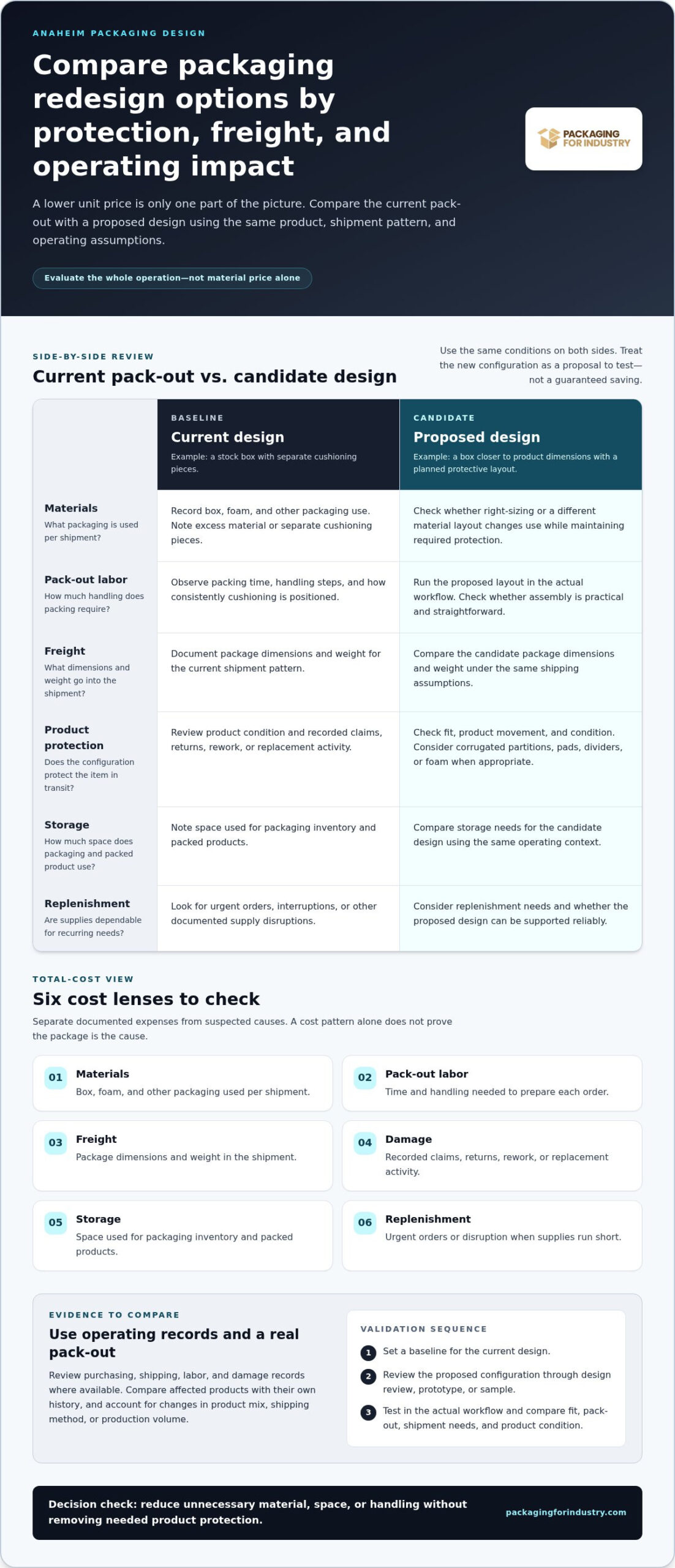
Review the full cost picture, then separate documented expenses from suspected causes:
- Materials: box, foam, and other packaging use per shipment.
- Pack-out labor: time and handling required to prepare each order.
- Freight: the package’s dimensions and weight in the shipment.
- Damage: recorded claims, returns, rework, or replacement activity.
- Storage: space used for packaging inventory and packed products.
- Replenishment: urgent orders or disruptions when supplies run short.
Use purchasing, shipping, labor, and damage records where available. Dimensions and protection requirements can affect how a shipment is packed, handled, and transported, but a cost pattern alone doesn’t prove the package is the cause.
When is a packaging redesign worth evaluating?
Repeated damage, awkward pack-out, excess material, or inconsistent packaging supply can justify a review. First, distinguish a design problem from a change in product mix, shipping method, or production volume. Compare affected items with their own history rather than assuming every increase points to packaging. Prioritize products with recurring cost or workflow issues, then evaluate those designs before changing the full packaging program. This focused approach gives teams a clearer basis for comparing current and proposed options.
How packaging design changes can reduce costs without sacrificing protection
Effective redesign targets unnecessary material, space, or handling without removing protection the product needs. Right-sizing a box, selecting a suitable material, or changing how components are arranged may reduce waste and make pack-out more straightforward. But using less material isn’t automatically an improvement. If a change increases product movement, damage, or handling time, the apparent material saving may be offset elsewhere.
Consider a simple before-and-after review. The current design uses a stock box with several separate cushioning pieces, and employees need extra time to position them consistently. A proposed design might use a box closer to the product’s dimensions and a more deliberate protective layout. Compare both options for fit, pack-out steps, shipment requirements, and observed product condition. Treat the new design as a proposal to evaluate, not a guaranteed cost reduction.
Match corrugated box design to the product and shipping method
Stock corrugated boxes can suit products with standard dimensions and straightforward handling needs. Custom corrugated boxes may be worth evaluating when a product’s shape, shipment pattern, or existing pack-out creates excess space or repeated adjustments. Depending on the product and handling requirements, partitions, pads, dividers, or heavy-duty box construction may help organize or protect contents. Choose a configuration through project review, not by assuming that a smaller or lighter box is always better.
Use foam and integrated materials where the risk justifies them
Custom foam inserts can position fragile or high-value components and help keep them separated within a package. The design should reflect the item’s shape and protection needs, while keeping assembly practical for the people packing it. For some shipments, corrugated boxes and foam may be evaluated together; for others, crates or additional materials may be part of a coordinated solution. The right combination depends on the product and shipping conditions.
PFI’s custom packaging design services use CAD/CAM support, design reviews, prototypes, and samples to help assess fit and pack-out before broader rollout. This gives teams a practical way to compare a proposed configuration with the current one. For packaging design for cost reduction Anaheim operations can put to work, assess material use alongside packing steps, product condition, and shipment needs.
Once a candidate design is identified, test it in the actual packing workflow and review the result against the original baseline. Anaheim businesses can request a packaging quote for a project-specific design review.
Compare packaging redesign options by protection, freight, and operating impact
A side-by-side review makes trade-offs visible before a new package reaches routine production. Compare the current design with a proposed option using the same product, shipment pattern, and operating assumptions. Lower material use matters only if the new configuration still protects the item and works reliably for the people packing it.
Compare current packaging with a proposed design
Record every packaging component and pack-out step for both options. Use your own purchasing, labor, shipping, storage, and damage records where available. Mark estimates separately from verified information so an assumption doesn’t get mistaken for a result.
| Review area | Current design | Proposed design | What to check |
|---|---|---|---|
| Protection | Existing box, cushioning, and observed product condition | Proposed materials and configuration | Product fit, protection needs, and damage history |
| Labor | Pack-out steps and handling | Expected steps and handling | Whether the process is practical and consistent |
| Freight | Shipment dimensions and weight | Expected dimensions and weight | Actual shipment patterns and applicable carrier charges |
| Storage | Space used by packaging and packed goods | Expected storage needs | Inventory and warehouse fit |
| Supply | Current components and replenishment pattern | Proposed components and supply needs | Availability planning and continuity of supply |
Damage records and inconsistent pack-out are useful signals, not automatic proof of a design flaw. Review what else changed, including product mix, shipping method, or production volume. If information is missing, flag it and decide how to validate it before comparing total impact. Project-specific savings depend on the item, materials, shipping pattern, and operating process, so the comparison should not assume a predetermined result.
Set decision criteria before approving a change
Agree on the requirements first: acceptable product protection, a workable pack-out, fit with production and warehouse routines, and dependable replenishment. Include freight and damage concerns, but don’t treat lower material use as success if protection or handling becomes less reliable.
For changes that affect product fit, handling, or protection, evaluate a prototype or sample in the real pack-out process before broader use. PFI’s custom packaging design services support design review, prototypes, and samples. This gives Anaheim teams a practical way to assess a proposed option against agreed criteria. A packaging design for cost reduction Anaheim project should advance only when evidence supports the balance of protection, operating fit, and total cost.
A practical Anaheim packaging redesign process, from audit to rollout
A controlled review helps teams move from a recurring packaging problem to a tested design without disrupting routine operations. For packaging design for cost reduction Anaheim projects, use a defined sequence and compare each decision with the same baseline.
- 1. Identify priority items. Start with products that have repeated damage, difficult pack-out, high packaging use, or supply interruptions. Focus the review rather than redesigning every package at once.
- 2. Gather baseline information. Record product dimensions, current packaging components, shipment patterns, damage history, packaging usage, and relevant purchasing or operating costs. Note what is verified and what still needs investigation.
- 3. Review the design and process. Consider product fit, protection needs, packing steps, shipping method, and recurring supply requirements. A design review can help identify options to evaluate without assuming that a change will produce a specific result.
- 4. Evaluate a sample. Use a prototype or sample to check fit, protection, and pack-out with the actual product and workflow before a broader change.
- 5. Monitor the rollout. Compare the new design with the agreed baseline. Track the same measures, such as packaging use, pack-out consistency, damage records, and replenishment needs, so the team can assess results on a like-for-like basis.
Prepare a packaging brief for an Anaheim supplier
A useful brief describes the product, handling risks, shipping method, and expected packaging volumes. Include photos or a sample of the current package when practical, along with its components, the costs or workflow issues prompting the review, and how often supplies are needed. This gives a design partner the context to consider fit, pack-out, shipping, and ongoing supply together. PFI provides packaging support in Anaheim for local manufacturers, warehouses, and distributors.
Evaluate prototypes and manage the rollout
Test the sample with the people and process that will use it. Check whether the product fits as intended, whether protection needs are addressed, and whether employees can complete the pack-out consistently. Compare observations with the baseline and document any assumptions that still need validation.
Before wider implementation, plan the transition around existing packaging inventory, production needs, and replenishment expectations. A staged rollout can help the team observe how the design performs in normal operations and address issues before expanding use.
Work with PFI on packaging design for cost reduction in Anaheim
Packaging For Industry helps Anaheim businesses assess packaging as a complete operating system, from product fit and protection to pack-out, shipping, and recurring supply. Custom design support, prototypes, and samples help teams evaluate a proposed approach before broader use. PFI can bring corrugated boxes, foam, crates, and other packaging materials together when an integrated solution fits the project.
A project-specific review connects design choices to the way your operation actually packs and ships products. This keeps the focus on practical goals: protect the item, support consistent handling, and identify opportunities to lower packaging costs without assuming a fixed savings outcome. PFI serves Anaheim and the wider Southern California region. Learn more about packaging support in Anaheim.
What to include when requesting a packaging quote
Share the product or component, its current packaging, and the shipping context. Include the concerns prompting the review, such as damage records, difficult pack-out, excess material use, or freight and handling issues. Estimated usage, order patterns, and current packaging components help shape a useful project evaluation. Note any recurring supply or inventory challenges, too, so the review can account for replenishment as well as design.
Connect packaging design to dependable supply
A packaging change should work beyond the sample stage. If your operation uses packaging repeatedly, include expected demand and replenishment needs in the design discussion. Vendor-managed inventory or just-in-time packaging programs may be relevant when usage patterns and inventory planning call for recurring coordination. The right approach depends on how your operation consumes supplies and manages stock.
For packaging design for cost reduction Anaheim operations can evaluate against real requirements, bring product details, current packaging, shipping information, and usage patterns into the conversation. A clear project brief helps connect protection, pack-out, and supply planning from the start.
Put a practical packaging review into motion
Packaging design for cost reduction Anaheim projects should weigh total operating impact, not material price alone. Compare current and proposed designs against product protection, pack-out, freight, storage, damage records, and replenishment needs. A change is worth advancing when the evidence supports a better balance for your operation, not simply a lighter package.
Packaging For Industry brings custom packaging design, CAD/CAM support, prototypes, and samples into the review process. Teams can assess custom and stock packaging across relevant industrial materials, including corrugated boxes, foam, and crates. That project-specific evaluation helps connect product fit and shipping needs with day-to-day pack-out and recurring supply requirements. Local next-day delivery is available across Southern California, according to client-provided information.
Bring your current package, product and shipping details, usage patterns, and operational concerns to the next step. A clear brief helps focus the review on the requirements that matter to your Anaheim operation.
With a measured design review and a practical rollout plan, your team can make informed packaging decisions and build a dependable path forward.
Frequently Asked Questions
How can packaging design reduce costs for an Anaheim manufacturer?
Packaging design can help reduce total operating costs by addressing material use, packing time, freight, damage, storage, and replenishment together. For packaging design for cost reduction Anaheim projects, start with products that have recurring cost or workflow issues. Compare current packaging with a proposed option using purchasing and shipping records, pack-out observations, and damage history. This helps identify where a design change may improve efficiency without compromising the product’s protection needs.
Can custom packaging cost less than stock packaging?
Custom packaging can be more cost-effective overall, but it depends on the product, shipment pattern, material choices, and operating process. A custom box may improve fit or simplify packing, while a stock box may remain the better option for a product it already protects efficiently. Compare the full impact, including materials, labor, freight, damage, storage, and supply needs. Don’t assume either option will cost less based on unit price alone.
What should I include in a packaging design quote request?
Include the product’s dimensions, current packaging components, shipping context, and the problems prompting a review. Useful details include shipment patterns, damage records, pack-out steps, packaging usage, and recurring inventory concerns. If available, share photos or a sample of the existing package. These details help shape a project-specific evaluation of protection, handling, and supply needs, rather than relying on assumptions about where costs or operational issues originate.
How do you reduce packaging costs without increasing shipping damage?
Evaluate material or configuration changes against the product’s actual protection requirements before broader use. Review damage history, shipment conditions, and pack-out consistency, then compare a proposed design with the current package. A prototype or sample can help assess product fit and packing steps. Reducing material isn’t an improvement if damage, rework, or handling effort rises. Track the same measures before and after a change to assess its effect.
Is a packaging prototype useful before changing a production line?
Yes. A prototype or sample lets your team check fit, protection, and pack-out using the actual product and operating process before wider implementation. Employees can review whether the package is practical to assemble and whether each step can be performed consistently. PFI provides custom packaging design support, CAD/CAM assistance, prototypes, and samples to help evaluate a proposed design. Plan the review around production needs and existing packaging inventory.
Can changing box dimensions help lower shipping costs?
It can, depending on the shipment and carrier pricing. Box dimensions affect the space a package occupies, so a better-fitting design may be worth evaluating alongside weight, protection, and the shipping method. Compare current and proposed dimensions using your own shipping records, and account for any cushioning or handling requirements. A smaller box isn’t automatically a better choice if it compromises product protection or makes pack-out less practical.
Does PFI provide packaging design support in Anaheim?
Yes. Packaging For Industry is headquartered in Anaheim and provides custom packaging design and industrial packaging products for businesses. Support can include design reviews, CAD/CAM assistance, prototypes, and samples, along with custom and stock packaging such as corrugated boxes, foam, and crates. PFI also serves businesses across Orange County, Los Angeles, San Diego, and Riverside, with local next-day delivery across Southern California according to client-provided information.