
What happens when a packaging change reaches production, but purchasing and the warehouse are working from different specifications? A packaging supplier that helps with documentation can make it easier to keep requirements, design approvals, and repeat orders aligned. For industrial buyers, packaging isn’t just a box or protective material. It’s a purchasing decision that affects product protection, warehouse workflows, and supply continuity.
Clear, consistent information matters, especially when custom packaging changes or replenishment needs shift. This guide explains how to compare suppliers on specification clarity, design communication, and repeat-order planning, so your teams can make informed decisions and reduce purchasing friction. You’ll also see how PFI’s custom design support, including CAD/CAM, prototypes, and samples, helps clarify requirements before rollout, and how Vendor Managed Inventory uses scheduled reviews and actual usage to plan replenishment. From corrugated boxes and foam to stretch film and crates, the right process helps keep packaging requirements practical and orders predictable.
Key Takeaways
- Use packaging information that helps purchasing, production, and warehouse teams follow the same requirements, rather than assuming every supplier provides a formal compliance package.
- Assess a custom design in sequence: define the application, review design information, evaluate a sample, approve it, and track later changes.
- Compare a packaging supplier that helps with documentation on specification clarity, design support, sample review, change communication, and replenishment planning.
- Make quote requests easier to evaluate by including packaging type, quantities, product use, and known constraints, plus any existing drawings or samples you have.
- Connect design decisions with repeat supply by using PFI’s CAD/CAM support, prototypes, samples, packaging reviews, and usage-based VMI planning.
What documentation should a packaging supplier provide to industrial buyers?
For industrial purchasing, packaging documentation is the usable information that helps teams define, review, approve, and reorder a packaging solution. It can include product and design details, sample feedback, approval responsibility, change communication, and replenishment information. Useful packaging documentation makes requirements clear enough to approve and reorder.
That doesn’t mean every packaging supplier provides a standard certification package or owns every record a buyer may need. Supplier-generated design information supports packaging decisions; the customer remains responsible for identifying any contract, internal quality, or regulatory documentation their project requires. The broader functions of packaging and labeling are summarized in Packaging and labelling, but each buyer’s documentation needs depend on the product and its use.
Clear, shared specifications help procurement compare and reorder the right item, production follow the intended configuration, and warehouse teams handle and stage it consistently. For packaging for manufacturers, aerospace businesses, or electronics operations, vague descriptions can leave different teams interpreting the same order in different ways.
Which packaging details should buyers document?
Capture the details that affect fit, protection, handling, and repeat purchasing. Depending on the application, that may include:
- Dimensions and materials: Record relevant product and packaging dimensions, material choices, and construction details.
- Configuration: Describe whether the solution uses a corrugated box, foam, crate, or a combination of materials, and how components fit together.
- Protection requirements: Note the product’s handling and shipping conditions, along with known damage concerns the design should address.
- Approval and change process: Identify who approves the design and how teams will be told when an approved detail changes.
These details give purchasing and operations a common reference without implying that one set of records satisfies every customer or regulatory requirement.
Why does documentation matter for repeat orders?
A clear approved specification reduces interpretation differences between people, departments, and order cycles. If a custom box and foam insert are approved together, retaining their configuration and sample-review decisions helps purchasing communicate the intended solution and gives production and warehouse teams a consistent reference. That can make handoffs smoother and help avoid preventable ordering confusion.
Samples and design information are especially useful before a custom solution moves into regular purchasing. PFI’s custom packaging design services include CAD/CAM support, prototypes, and samples to help clarify requirements before rollout. For repeat packaging needs, PFI’s VMI program uses scheduled reviews and planned replenishment based on actual usage, connecting packaging requirements with a clearer reorder workflow. A packaging supplier that helps with documentation supports that continuity by making design decisions and supply planning easier for teams to follow.
How to evaluate packaging specifications, samples, and design approvals
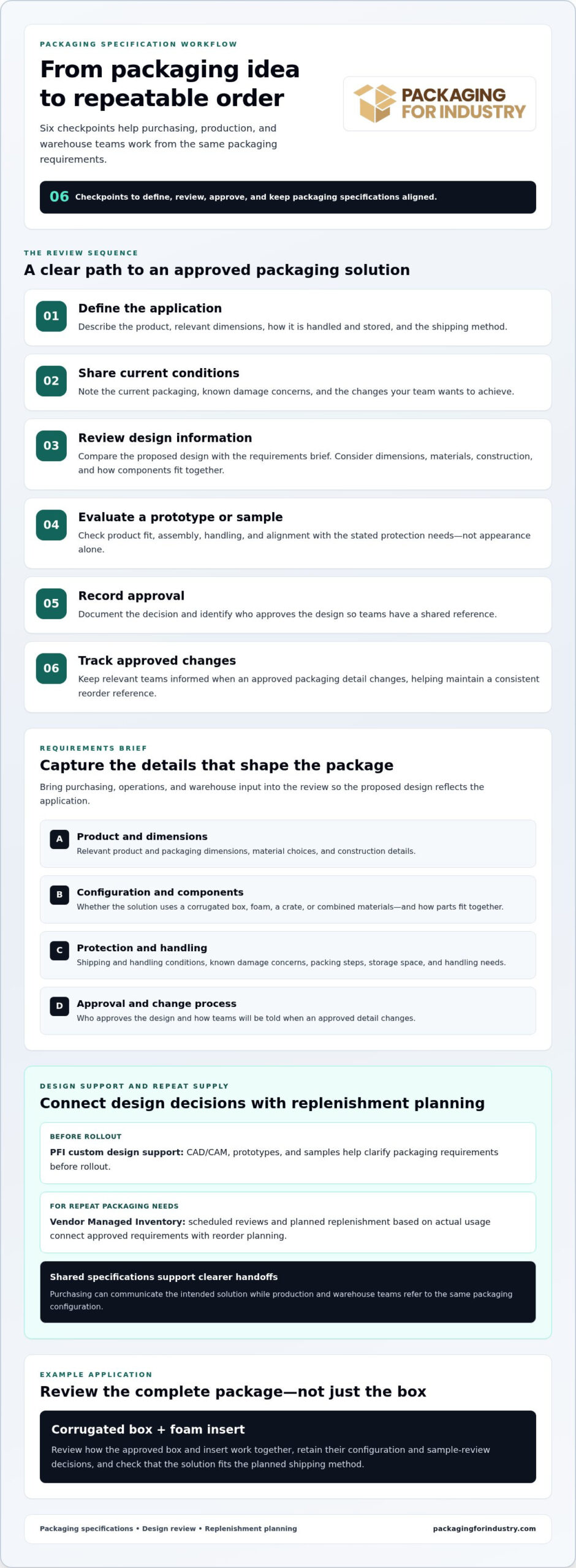
A reliable review process turns a packaging idea into requirements teams can use consistently. Define the application, share the relevant product and shipping details, review the design information, assess a sample, approve the solution, then record any changes. Each step helps catch mismatches before a custom package becomes part of a repeat order.
Start with the product’s dimensions and how it will be handled, stored, and shipped. Note the shipping method, current packaging, known damage concerns, and the changes you want to achieve. For example, if a product arrives with damaged corners, describe where damage occurs and how the item is packed now. This gives the design review a practical focus without assuming a particular test standard.
Prepare a packaging requirements brief
Keep the brief specific enough for the design team to understand the application, but focused on facts your team can provide. Include the product, relevant dimensions, operating context, shipping method, and current packaging. Identify stakeholders in purchasing, operations, and the warehouse who should review the proposed solution. Their input can reveal constraints such as packing steps, storage space, or handling needs that a drawing alone may not show.
Use design reviews and samples to resolve ambiguity
Review the proposed design against the brief, then assess a prototype or sample for fit, assembly, handling, and alignment with the stated protection needs. PFI’s CAD/CAM support, prototypes, and samples help teams evaluate custom packaging before rollout. For a box project, corrugated box solutions can be considered as part of the design review, including how the box works with any foam or other protective components.
Use the sample review to identify gaps, not just to approve appearance. Ask whether the product fits as intended, whether warehouse staff can pack it correctly, and whether the configuration suits the planned shipping method. Record the decision, the approver, and any agreed changes in the buyer’s own process. The exact technical records needed depend on the project; don’t assume a supplier provides a particular test report or formal compliance document unless that deliverable has been established.
For teams assessing packaging and labeling requirements, the NIST packaging and labeling resource offers a reference point. Keep applicable customer, contract, and regulatory requirements distinct from supplier design information. A packaging supplier that helps with documentation can support clearer review and handoffs, while your organization determines which requirements apply to its products.
Once the design is approved, define how changes will be reviewed and shared so purchasing, production, and warehouse teams use the current version. If you’re developing a custom solution, you can request a packaging quote with your requirements and sample or drawing details, if available.
How to compare packaging suppliers on documentation and communication
A product catalog shows what a packaging company sells. It doesn’t show how clearly teams can specify, approve, change, and reorder those items. Compare the clarity of the process, not just the number of packaging products. Use the same criteria for each supplier, and distinguish demonstrated capabilities from assumptions based on broad claims.
| Comparison area | What to look for | PFI’s approach |
|---|---|---|
| Specification clarity | Can requirements for dimensions, materials, construction, and intended use be discussed clearly? | Custom packaging design support helps align packaging requirements with the application. |
| Design support | Is there a practical process for addressing custom sizes or combined-material needs? | CAD/CAM support helps develop custom packaging solutions. |
| Sample review | Can teams assess a prototype or sample before adopting a custom design? | Prototypes and samples support evaluation before rollout. |
| Change communication | Can your team identify approved changes and share them across purchasing, operations, and warehouse functions? | Packaging reviews help teams examine requirements and design decisions. |
| Replenishment | Does the supply approach account for recurring quantities and actual usage? | VMI uses scheduled reviews and planned replenishment based on actual usage. |
Use the table to compare information and processes you can identify, not promises you infer. A general statement about “quality” or “custom service” doesn’t establish that a supplier provides a particular record, certification, or test document. Keep project-specific technical and compliance requirements separate from the supplier’s stated design and supply capabilities.
Compare custom packaging support with your actual requirements
For a standard item, a straightforward specification may be enough. If it doesn’t fit the product or process, compare how the supplier addresses custom sizes, materials, and integrated solutions such as corrugated boxes paired with foam. PFI supports custom design with CAD/CAM, prototypes, samples, and packaging reviews, giving teams practical ways to assess a proposed solution without assuming unlisted documentation deliverables.
Compare supply continuity and order communication
Stock packaging and custom items may need different planning. Consider how approved item details connect to repeat purchasing, and how recurring quantities are managed. PFI’s vendor-managed inventory program uses scheduled reviews and replenishment planning based on actual usage. This can help connect packaging requirements with a defined reorder workflow.
A packaging supplier that helps with documentation should make it easier to understand what’s been designed and how recurring needs are handled. For a practical comparison, share your packaging requirements and evaluate the proposed fit, design support, and supply approach together.
What to include in a packaging supplier quote request
A clear quote request helps an industrial packaging supplier scope the right materials, quantities, and design work. It also gives purchasing and operations a shared starting point for comparing packaging pricing. Include the information you have, and note where you need support developing a custom solution.
Information that helps scope a custom packaging quote
Use this checklist to describe the application and purchasing need:
- Product and dimensions: Identify the item being packed and provide relevant measurements. Note fragile areas or other protection concerns that affect the packaging choice.
- Use and shipping: Describe how the item will be packed, handled, stored, and shipped, including the intended shipping method.
- Packaging type: Specify whether you need corrugated boxes, foam packaging, crates, or a combined solution. If the current package is causing damage or slowing packing, describe the issue and the change you want.
- Quantities and timing: Include the initial order quantity, expected recurring use, and whether the requirement is ongoing or project-based. For bulk packaging pricing, share relevant inventory concerns and usage patterns.
- Available references: Attach existing drawings, packaging details, or a sample if they’re available. These can help clarify requirements, but they aren’t necessary for every quote request.
For custom packaging, these details help focus design discussions on fit, protection, and workflow. If a proposed item has a longer lead time, include your purchasing plan and replenishment needs so the supply approach can account for it.
Questions to resolve before approving a supplier
Before moving ahead, make sure your team understands how the proposed specifications will be shared, how sample feedback will be incorporated, and how approved changes will be communicated. Identify who needs to review the solution internally and what information those approvers need. Don’t assume a quote includes formal certifications or other regulatory documents; define project-specific requirements separately.
For recurring orders, clarify how approved item details connect to reordering and inventory planning. PFI’s Vendor Managed Inventory program uses scheduled reviews and planned replenishment based on actual usage, with review cycles set weekly, biweekly, or monthly. This can help align recurring packaging needs with a more structured replenishment workflow.
A packaging supplier that helps with documentation should make it easier to carry quote details into design review, purchasing, and repeat orders. Sharing clear quantities, use conditions, and known constraints gives the supplier a practical basis for scoping the request.
How PFI connects packaging design documentation with dependable supply
Packaging decisions need to work beyond the design stage. A solution must fit the product and shipping application, support the teams who pack and handle it, and remain practical to reorder. Packaging For Industry (PFI) connects custom design support with supply planning for manufacturers and other industrial buyers seeking clearer requirements and dependable packaging availability.
From packaging requirements to a reviewed solution
Share product, shipping, handling, and protection requirements to guide a tailored design discussion. PFI’s custom design support includes CAD/CAM, prototypes, samples, packaging reviews, and cost-reduction analysis. Buyers can evaluate how a proposed configuration fits before broader rollout. Depending on the application, PFI can bring together corrugated boxes, foam packaging, and crates as an integrated solution.
These packaging options serve varied industrial needs, including aerospace and aviation, electronics, and medical device manufacturing. Reviewing how materials work together can help teams address product protection and packing workflows while considering opportunities to simplify packaging or lower costs.
From approved packaging to managed replenishment
After packaging requirements are established, recurring supply needs a clear connection between usage and replenishment. PFI’s Vendor Managed Inventory program uses scheduled inventory reviews and planned replenishment based on actual usage. Review cycles can be weekly, biweekly, or monthly. This supports repeat packaging needs by giving buyers a regular process for reviewing inventory and planning supply.
PFI supplies custom and stock industrial packaging for ongoing business requirements. Linking design decisions with supply planning can help purchasing teams coordinate custom items and regularly used packaging, while supporting production and warehouse operations. Packaging reviews and cost-reduction analysis also help buyers consider practical ways to improve protection and purchasing efficiency.
A packaging supplier that helps with documentation can support clearer decisions from design through repeat supply. Share your packaging requirements, recurring needs, and supply concerns to start a focused discussion.
Build a clearer path from packaging design to replenishment
A dependable packaging process starts with requirements your teams can understand and use. Clear specifications, sample reviews, and recorded approvals help purchasing, production, and warehouse staff stay aligned. A packaging supplier that helps with documentation also makes it easier to connect approved custom designs with repeat supply planning.
PFI supplies custom and stock industrial packaging for recurring business needs. Custom design support includes CAD/CAM, prototypes, and samples to help clarify requirements before production. For ongoing demand, Vendor Managed Inventory (VMI) uses scheduled inventory reviews and planned replenishment based on actual usage. Together, these capabilities support practical packaging decisions from design review through reorder planning.
Share your product, packaging, quantity, and recurring supply requirements to start a focused quote discussion. Clear input gives your team a stronger basis for comparing options, managing approvals, and maintaining packaging availability.
With the right requirements and a steady supply plan, your team can move forward with greater confidence.
Frequently Asked Questions
What documentation should I request from a packaging supplier?
Request clear information about packaging dimensions, materials, construction, intended use, and configuration, along with details your team needs for approval and repeat ordering. For custom packaging, retain design information and sample-review feedback in your own records. Identify any customer, contract, or regulatory documents your organization requires separately. Supplier product information can support internal reviews, but don’t assume it replaces your company’s specific documentation requirements.
Can a packaging supplier provide CAD drawings or samples?
A supplier may offer design support, prototypes, and samples for custom packaging projects. PFI provides CAD/CAM support, prototypes, and samples to help industrial buyers evaluate a proposed package before rollout. Use these resources to review fit, assembly, handling, and how packaging components work together. The specific design information needed depends on the project, so align the review with your team’s approval process and packaging goals.
How do I compare packaging suppliers for documentation support?
Compare how clearly suppliers discuss specifications, custom design, sample reviews, change communication, and replenishment. Distinguish demonstrated capabilities from assumptions based on broad service claims. A packaging supplier that helps with documentation should make its process clear to purchasing, operations, and warehouse teams. For businesses serving Orange County, Los Angeles, San Diego, and Riverside, also consider whether local packaging delivery and supply planning fit your operating needs.
What should I include in a custom packaging quote request?
Describe the product, relevant dimensions, packaging type, shipping method, known protection concerns, and target quantities. Note whether the requirement is recurring or project-based, and include inventory concerns that may affect bulk packaging pricing. Specify whether you’re considering corrugated boxes, foam, crates, or a combined solution. Existing drawings, samples, or packaging details can help explain the application, but you can request a quote without them.
Can a packaging supplier help manage recurring packaging inventory?
Yes. PFI’s Vendor Managed Inventory program uses scheduled inventory reviews and planned replenishment based on actual usage, with review cycles that can be weekly, biweekly, or monthly. This can help purchasing teams plan recurring packaging supply and avoid relying on last-minute orders. It can support packaging for warehouses and packaging for distribution centers where consistent material availability matters to ongoing operations.
Does packaging documentation include compliance certificates or test reports?
Not necessarily. Product specifications and design information differ from certificates, declarations, or test reports, so don’t assume a supplier includes formal documents with every packaging order. Identify the records your organization needs based on its product, customer, contract, or applicable requirements. PFI supports packaging design with CAD/CAM, prototypes, and samples. These design resources can help clarify packaging requirements, but they shouldn’t be treated as a substitute for project-specific compliance records.
How can documented packaging specifications help with repeat orders?
Clear specifications give purchasing, production, and warehouse teams a shared reference for ordering the intended packaging. They can reduce confusion about dimensions, materials, configurations, and approved changes across order cycles. Consistent packaging details can also help teams assess design adjustments that may reduce shipping damage or lower packaging costs. For recurring demand, connect the approved requirements with usage and replenishment planning to support dependable supply.