
A corrosion-control material can protect a machined surface, but it can’t prevent a part from shifting, rubbing, or taking an impact inside an unsuitable package. Effective anti-corrosion packaging for machined components must account for both surface protection and the journey from production to delivery.
Moisture exposure during handling, storage, or transit can be a concern, and generic packaging may not keep precision parts separated and secure. The right approach depends on the component, its surface requirements, and the shipping conditions. This guide compares common corrosion-control options and explains how to coordinate them with cushioning and an appropriate outer package.
A repeatable packaging specification also helps purchasing and operations teams pack parts consistently. PFI supports manufacturers with custom packaging design, protective foam, cushioning materials, corrugated boxes, and crates tailored to the component and its shipping method. CAD/CAM support, prototypes, and samples can help teams evaluate fit before putting a design into regular use.
Key Takeaways
- Match corrosion-control methods to the part’s surface requirements, geometry, storage context, and shipping conditions.
- Compare VCI and moisture-control approaches by their intended role and the information needed to select them. Neither replaces cushioning or an outer package.
- Specify anti-corrosion packaging for machined components as a layered system, with separate functions for corrosion control, part separation, cushioning, and containment.
- Gather component dimensions, surface requirements, shipping route, and known damage examples to build a clear packaging specification.
- Use custom packaging design, protective foam, corrugated boxes, or crates to create a repeatable fit around the selected corrosion-control approach.
Why Machined Components Need Purpose-Designed Anti-Corrosion Packaging
Anti-corrosion packaging is a planned system for limiting a component’s exposure to conditions that may contribute to corrosion during storage and shipment. Start with the part and its journey, rather than selecting a box or protective material by default. For buyers specifying anti-corrosion packaging for machined components, the key is to define corrosion-control needs separately from the physical protection required to deliver parts in usable condition.
Machined components can have exposed surfaces, tight tolerances, distinct edges, bores, or irregular profiles. These features affect how a part can be wrapped, supported, separated, and packed. A material that suits a simple block may not fit a shaft or a component with delicate features. Base the packaging plan on the actual geometry and handling process, not on the assumption that one solution fits every part.
Where corrosion risk enters the packaging decision
Assess the part’s condition before packing, the route it will travel, and its storage context. Moisture exposure is one factor to consider, but it is not a universal explanation for every corrosion issue. Review where and when parts are handled, how long they may be stored, and what conditions are known along the shipping route. Document observed damage patterns and operational constraints so the specification addresses real issues.
For example, record whether marks or surface changes appear after a particular handling step, during storage, or upon receipt. Note packing and unpacking practices, including any requirements for keeping surfaces clean or accessible. If corrosion-control materials such as Volatile Corrosion Inhibitor (VCI) are being considered, list them as a defined requirement rather than assuming that cushioning provides corrosion protection.
Why machined parts need more than a shipping box
An outer container holds the shipment and contains its contents. It does not automatically prevent parts from moving, touching, or rubbing against one another. Poor fit can leave room for movement, while inadequate separation can expose adjacent surfaces to contact. These are physical damage risks, distinct from corrosion exposure, and they require separate packaging functions.
Corrosion control addresses surface exposure; cushioning and separation help protect parts from movement, impact, abrasion, and contact. Keep those objectives distinct when reviewing a design. Internal supports may need to locate each component, while cushioning helps manage handling forces. PFI’s custom packaging design can coordinate cushioning and the outer package with part dimensions and shipping methods for manufacturers in Orange County, Los Angeles, San Diego, Riverside, and beyond.
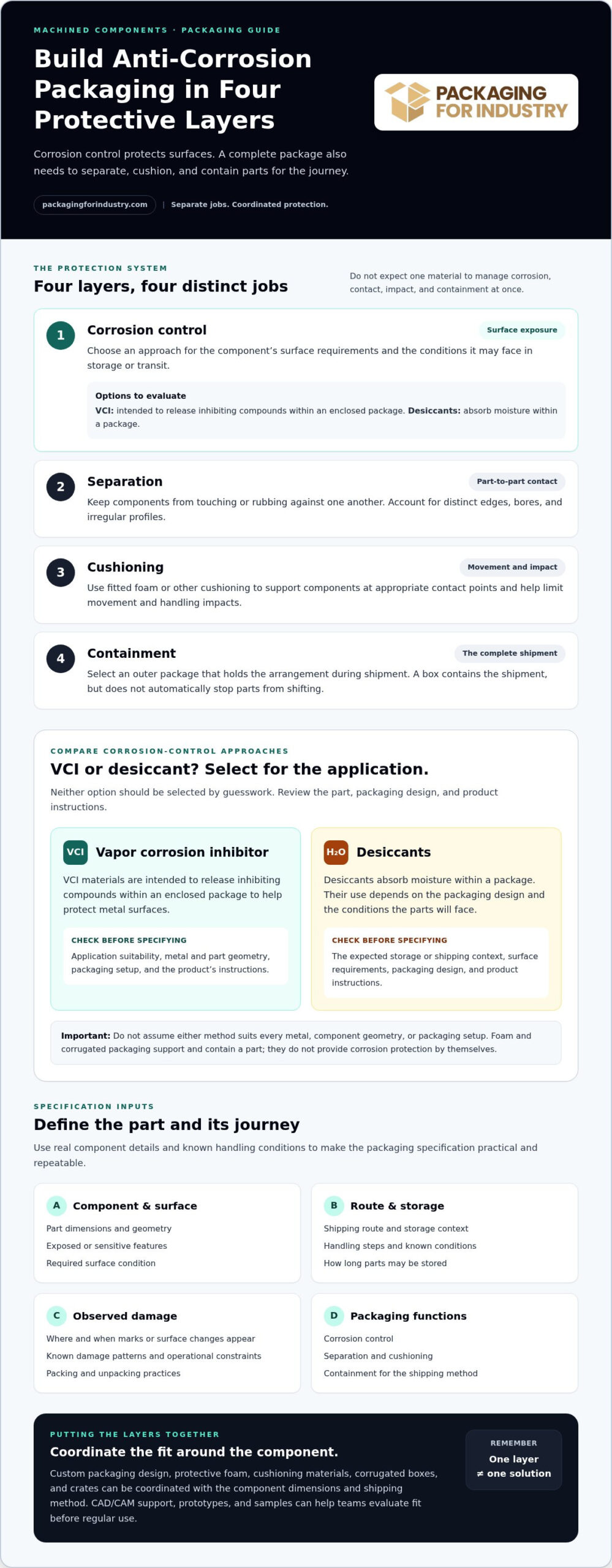
- Record part dimensions, exposed or sensitive features, and the required surface condition.
- Describe the shipping route, storage context, handling steps, and known damage patterns.
- Specify corrosion control, separation, cushioning, and containment as distinct needs.
This information gives purchasing and operations teams a practical starting point for reviewing fit and documenting a repeatable packing process. It can also help prevent overbuilding a package or relying on one material to solve different protection problems.
How Anti-Corrosion Packaging Works as a Layered Protection System
A reliable packaging plan assigns a separate job to each layer. Corrosion control addresses the part’s exposure to conditions that can contribute to corrosion. Separation keeps components from contacting one another. Cushioning helps limit movement and handling impacts, while the outer package contains the complete arrangement during shipment. Separating these functions helps buyers specify a system without expecting one material to do everything.
For anti-corrosion packaging for machined components, that distinction matters. A corrosion-control approach may protect a metal surface, but it does not automatically prevent abrasion or impact. Foam and corrugated packaging can support and contain a part, but they do not provide corrosion protection by themselves. Design the layers to work together around the component’s condition, handling route, and storage requirements.
What VCI and moisture-control approaches are intended to do
VCI, or vapor corrosion inhibitor, is a category of corrosion-control packaging. In broad terms, VCI materials are intended to release inhibiting compounds within an enclosed package to help protect metal surfaces. Performance depends on the application and the product’s instructions. Do not assume that any VCI material is suitable for every metal, part geometry, or packaging setup.
Desiccants are another approach. They absorb moisture within a package, but their use depends on the packaging design and the conditions the parts will face. Select neither VCI nor desiccants by guesswork. Review material compatibility, product instructions, surface requirements, and the expected shipment or storage context before adding a method to the specification.
How cushioning and outer packaging complete the system
Once corrosion control is defined, the package still needs to hold the parts securely. Fitted foam or other cushioning can support components at appropriate contact points and separate parts to reduce rubbing or part-to-part contact. The fit should reflect the component’s shape and leave clearance around features that need protection. PFI’s protective foam packaging can be incorporated into a design around those physical requirements.
The outer container holds the protected arrangement through handling and shipment. Corrugated boxes suit many shipping needs, while a crate may fit a different load or shipping method. Select the container for the complete packed assembly, not just the bare component. A container that is too large or poorly arranged can leave room for movement; a package designed around its contents supports a more consistent packing process.
Surface protection manages corrosion exposure; structural packaging separates, cushions, and contains parts during handling and transit. That is the practical basis of a layered system. For a machined-part packaging design, request a packaging quote with the component dimensions, defined corrosion-control requirement, and shipping method.
Compare Anti-Corrosion Packaging Options for Machined Components
Compare packaging options by function, rather than assuming one material is best for every part. Corrosion-control materials address a different need from foam, corrugated boxes, or crates. The right combination depends on the component, its surface requirements, documented exposure and storage conditions, and how it will be handled in transit.
| Option | Intended role | Buyer considerations | Information to gather |
|---|---|---|---|
| VCI packaging | A corrosion-control approach intended to protect metal surfaces within a package. | Material compatibility, part geometry, packaging instructions, and how the material fits the packing process. | Metal and surface requirements, known exposure conditions, handling steps, and supplier instructions for application. |
| Moisture-control materials | Desiccants are used to absorb moisture within a package as part of a moisture-control approach. | Storage context, package arrangement, and instructions for the selected material. Don’t assume a desiccant alone meets every corrosion-control need. | Documented moisture concerns, shipping and storage conditions, and the package design under consideration. |
| Protective foam | Separates and supports components to address movement, contact, and handling impacts. | Fit around the part, contact points, clearance for sensitive features, and repeatability during packing. | Part dimensions, shape, areas requiring clearance, and observed physical damage. |
| Outer containers | Corrugated boxes or crates contain the packed arrangement during shipment. | Shipping method, packaged size, load arrangement, and whether the parts remain secure inside. | Shipment route, handling conditions, quantity per package, and the dimensions of the complete packed assembly. |
When to evaluate VCI or moisture-control materials
Start with documented exposure and storage conditions, not an assumed universal risk. Identify the metals and surface requirements, then review compatibility and the material’s use instructions for the application. Consider how operators will pack and unpack the components. Avoid specifying a protection duration or expected result without application-specific guidance from the material supplier.
When custom foam, boxes, or crates matter most
Physical packaging matters when a component has distinctive contact points, delicate features, or a shipping method that may allow movement. Custom foam inserts can give parts defined positions and help operators repeat the same packing arrangement. PFI’s custom packaging design can coordinate inserts with the outer package. Corrugated boxes and crates provide containment, not standalone corrosion treatment.
A practical review asks whether each layer has a clear job: corrosion control, moisture management where required, part separation, cushioning, or containment. A part shipped alone may need a different internal layout from several components packed together. The shipping method also affects container selection and how securely the internal arrangement needs to be held.
For purchasing and operations, record the selected materials, part orientation, separation method, outer container, and packing steps in one repeatable specification. Check compatibility and application requirements for corrosion-control materials rather than ranking VCI, moisture-control options, foam, or containers universally. This keeps decisions tied to the part and shipment, and makes the specification easier to review if damage patterns or operating conditions change.
How to Specify Anti-Corrosion Packaging for a Machined Part
A useful packaging specification gives purchasing, production, and shipping teams the same instructions. Define the part and its surface requirements, describe its route and storage context, then review how the package will be assembled and reordered. This workflow helps buyers compare options based on operating needs instead of relying on a general description such as “rust protection.”
Information to collect before requesting a packaging quote
Gather the part dimensions and weight, quantity per shipment, sensitive contact areas, and required surface condition. Add the shipping method and route, known storage conditions, current packaging, and examples of recurring damage. Include packing steps, outer-package size or handling constraints, order frequency, and production or replenishment needs. These details connect the packaging design to both the component and the operation.
Use this planning aid to organize the specification. It is not a technical standard.
- Document the part. Record dimensions, weight, quantity per shipment, orientation, and features that need clearance or careful support.
- State the surface requirement. Describe the condition parts must maintain and any corrosion-control method already defined for the application.
- Map the journey. Note the shipping route, transport method, handling steps, expected storage context, and known exposure concerns.
- Describe current results. Identify existing packaging, recurring corrosion or physical damage, and where in the process the issue appears.
- Set operational constraints. Include packing space, operator workflow, outer-container limits, shipment quantity, and order or replenishment frequency.
- Define the repeat-order record. Capture the approved materials, pack arrangement, part orientation, and packing instructions for purchasing and operations.
How to review a proposed packaging design
Review the design with the people who pack, handle, and receive the components. Check that parts remain separated, sensitive areas have appropriate clearance, and operators can load and remove each part without disrupting the arrangement. Confirm that the selected corrosion-control approach follows its application instructions, then assess whether the outer package suits the shipment method.
PFI’s custom packaging design includes CAD/CAM support, prototypes, samples, and packaging reviews. Use a prototype or sample to evaluate fit and the packing sequence before applying the specification to repeat orders. Record adjustments, including changes to the part, shipping route, or production process.
After approval, keep the specification accessible to purchasing and packing teams. Clear instructions support consistent assembly, simplify replenishment planning, and help teams identify when a packaging review is needed. For anti-corrosion packaging for machined components, the repeat-order record should distinguish the defined corrosion-control requirement from cushioning and outer-container details.
Build a Custom Packaging Solution for Machined Components with PFI
Corrosion-control requirements define how a machined surface needs to be protected. The cushioning and outer package must preserve the arrangement through handling and shipment. PFI helps manufacturers coordinate custom packaging design, foam, cushioning materials, corrugated boxes, and crates around part dimensions and shipping methods.
This keeps the design focused on each material’s role. A corrosion-control material or process defined for the application remains part of the packaging requirement, while the package is designed to hold the component securely and support a repeatable packing routine. PFI’s packaging design, foam, boxes, and crates address separation, cushioning, and containment as part of the overall solution.
Coordinate component protection with the shipping package
Start with the component’s shape, sensitive features, and intended position in the package. Custom foam or other cushioning can support the part and limit unwanted movement, while a corrugated box or crate contains the packed arrangement. The design should also reflect how operators load, close, handle, and unpack the package. PFI’s custom packaging design service can account for those details alongside the shipping method and defined corrosion-control requirement.
For example, a component with projecting features may need clearance at specific points, while several parts packed together may need individual locations to prevent contact. Those details influence the insert layout and the space needed inside the outer container. PFI supplies protective foam, cushioning materials, corrugated boxes, and crates, including custom options tailored to product dimensions and shipping needs.
Prototypes and samples let teams assess fit before broader implementation. Operators can evaluate how parts sit in the cushioning, whether the package is practical to assemble, and whether the arrangement is consistent during packing. A packaging review can identify adjustments before the design becomes a repeat-order specification.
Move from packaging requirements to a quote
For a useful project review, gather the part dimensions, quantity per shipment, surface requirements, and corrosion-control approach defined for the application. Include current packaging, shipping method, handling steps, outer-package constraints, order frequency, and examples of known damage. Clear inputs connect design decisions to production and shipping operations.
PFI tailors cushioning and the outer package to project requirements. Manufacturers near Anaheim and across Orange County, Los Angeles, San Diego, and Riverside can work with PFI on Southern California packaging needs. Nationwide support is also available through distribution and manufacturing partners. The goal is a practical package that fits the part, supports a consistent packing process, and addresses physical shipping risks without confusing cushioning with corrosion treatment.
A clear specification for anti-corrosion packaging for machined components gives design, purchasing, and operations teams a common reference. Share the part and shipping details to define a suitable combination of packaging components for evaluation.
Make the Packaging Specification Work for Your Operation
A packaging design should remain useful as production volumes, handling routines, and shipping routes change. Assign responsibility for keeping the approved specification current, and record revisions when a part, process, or shipment requirement changes. This makes anti-corrosion packaging for machined components easier to manage across purchasing and production, rather than turning every reorder into a new packaging decision.
PFI works with industrial buyers to tailor packaging around component requirements and shipping methods. Bring together part information, current packing methods, and known damage patterns to guide the project discussion.
A clear next step can turn packaging concerns into a defined, repeatable process. PFI can help you develop a package that fits your parts and workflow.
Frequently Asked Questions
What is anti-corrosion packaging for machined components?
Anti-corrosion packaging for machined components is a planned way to protect parts from corrosion-related exposure during storage and shipment. The specification should state the part’s surface requirements and identify the corrosion-control approach selected for the application. For example, a purchasing team can document the required condition at receipt, then coordinate packing instructions with the people who prepare and unpack the shipment.
How do I choose anti-corrosion packaging for machined parts?
Choose based on the component’s surface requirements, material compatibility, shipment route, handling process, and storage context. Compare the condition of parts before packing with their condition upon receipt. If damage occurs, note where it appears and whether the affected parts share a route, packing step, or storage pattern. That record helps focus packaging decisions on observed needs instead of assumptions.
Is VCI packaging suitable for every machined component?
No. VCI packaging should not be treated as a universal choice. Suitability depends on the application, including the component’s metal and surface requirements, the packaging material, and its use instructions. A part with multiple materials or existing surface treatments may need careful compatibility review. Use the VCI supplier’s application guidance as part of the selection process, and do not assume the same setup fits every component.
Can foam packaging prevent corrosion on machined components?
Foam packaging provides physical support and separation, but foam alone should not be specified as corrosion treatment. It can help keep components in position and reduce contact or rubbing during handling. If the part also has corrosion-control requirements, identify that need separately and coordinate the foam design around it. An insert can locate a component while the selected surface-protection method serves its intended role.
What information should I provide for a machined-component packaging quote?
Provide part dimensions and weight, shipment quantity, surface requirements, shipping method, and storage context. Include a drawing or clear photos if available, along with details about current packaging, packing steps, outer-container limits, and recurring damage. Order frequency and replenishment needs help plan repeat purchasing. With these inputs, PFI can review the packaging requirements and tailor a design around the component and shipping process.
Do machined components need both corrosion protection and cushioning?
They may need both if the part has corrosion-control requirements and also faces movement or contact during shipment. These address different risks. A selected surface-protection approach, for instance, does not automatically keep two components from rubbing together inside a package. Identify each requirement separately, then make sure the packing arrangement accommodates both without interfering with the component or packing workflow.
Can custom packaging help reduce shipping damage to machined parts?
Custom packaging can address physical damage risks by fitting supports and separation to the component’s shape and shipping method. A shaft, for example, may need different support points from a flat machined plate. PFI’s custom design work can use prototypes or samples to assess fit and packing steps before broader use. Review the design against actual damage patterns rather than treating it as a performance guarantee.