
Packaging design can raise freight costs even when the product stays the same. Warehouse packaging optimization services in SoCal assess practical factors that affect shipping efficiency, including pallet layouts, container capacity, dimensional weight, assembly steps, and protective inserts. Poor use of space or extra handling can add friction throughout packing and transport.
Look beyond the box. Packaging needs to protect the product, fit warehouse workflows, and suit the way shipments move. This article explains how packaging choices affect freight and shipping costs, and why assembly and custom inserts merit attention alongside pallet and container layouts.
You’ll learn what an optimization review can examine, which design decisions influence costs, and how custom inserts and packaging kitting can support consistent packing. The aim is to help you evaluate packaging changes for your warehouse or distribution operation.
Key Takeaways
- Review pallet layouts against inventory mix and movement patterns to identify space and handling improvements.
- Compare how package dimensions and container fill affect shipment efficiency, not just the product’s weight.
- Assess packaging assembly steps and custom inserts together to support product protection and a smoother packing workflow.
- Track packaging dimensions, materials, and handling requirements to pinpoint opportunities to reduce avoidable freight costs.
- Match packaging support to your operation’s needs, from foam packaging and stretch film to inventory management.
Pallet configuration and warehouse efficiency
A pallet plan affects more than freight space. It also shapes how products move through receiving, storage, picking, and loading. Record each shipment’s product dimensions, weight, pallet footprint, and handling needs. Then compare the current load pattern with available racking and handling equipment. Cartons that overhang a pallet, for example, can complicate storage and make loads harder to handle. A stable, repeatable pattern helps teams stage and move shipments consistently.
When comparing warehouse packaging optimization providers in Southern California, look at their assessment methods. Do they review pallet patterns, racking, product mix, and shipment movement, then test changes in real operations? The U.S. Bureau of Labor Statistics notes that industrial engineers assess work through observation, time studies, and staff surveys.
Racking should suit how inventory moves. Selective pallet racks provide direct access to varied products, while drive-in racks suit bulk inventory with lower turnover. Cantilever and stackable modular racks can accommodate unconventional inventory. These layouts also affect packaging decisions: a pallet may fit a rack position yet block access or create an unstable load. Review each product family separately, especially in warehouses with mixed case sizes or changing shipment volumes.
Plan capacity by measuring each load, not by assuming every pallet needs the same pattern. Record layers per pallet, cases per layer, total load height, and handling space. A warehouse shipping small components and bulky equipment, for example, may need distinct pallet patterns. Test each against rack openings, aisle movement, and loading requirements before applying it across a product line. The U.S. Environmental Protection Agency identifies tracking baseline measures as a critical first step in waste reduction.
California packaging and waste requirements can vary by material, waste-handling practices, and local jurisdiction. Track corrugated, plastic film, and other packaging waste streams separately, then align handling practices with applicable state and local requirements.
A practical assessment follows a clear sequence: observe receiving and packing, measure pallet loads and travel paths, review staff feedback, then trial a revised layout. Track handling time, space use, load stability, and damage reports before adopting the change. A warehouse packaging resource can help frame this review around storage and shipping needs.
Changing pallet patterns can disrupt picking, replenishment, or loading if teams adopt them without testing. Pilot a pattern with one product family, brief operators, and monitor congestion, handling errors, and shipment damage during the transition.
Warehouses in Orange County, Los Angeles, and San Diego serving aerospace, food, medical, electronics, manufacturing, and distribution operations can benefit from reviewing pallet flow. Because inventory varies by facility, assess each site’s product mix, racking, and shipment profile instead of copying one layout everywhere.
Pacific Coast Warehouse consolidated two warehouse spaces into one larger space to improve efficiency and control over product movement. Its approach pairs selective pallet racks with high-SKU-diversity storage needs and drive-in racks with low-turnover bulk storage. This aligns warehouse planning with product variety and inventory turnover, while keeping movement and storage decisions tied to operational needs.
Container capacity and dimensional weight
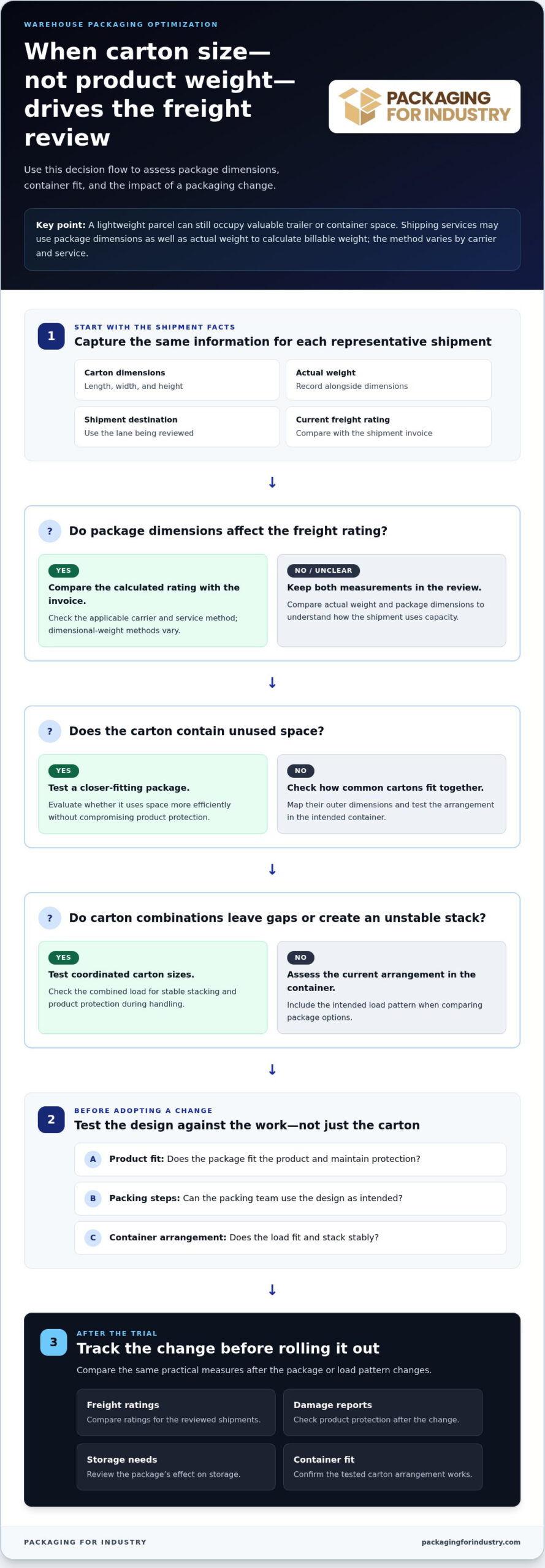
A package can take up valuable trailer or container space without weighing much. Consider a lightweight replacement part shipped in a large carton with unused void space. Its dimensions can affect freight charges even when its scale weight is low. Review package length, width, and height alongside actual weight to understand how each shipment uses capacity. This can identify products where a closer-fitting package may use space more efficiently without compromising protection.
Dimensional weight reflects the space a parcel occupies in transit. Shipping services may use package dimensions as well as actual weight to calculate billable weight. The method varies by carrier and service. For warehouse analysis, record both measurements for representative shipments, then compare the resulting rating with the invoice. A bulky, light package may be rated differently from a compact, dense one, even if both contain similar inventory.
Container capacity also depends on how cartons fit together. Long, narrow cartons combined with short, wide ones can leave gaps and reduce usable space. Map the outer dimensions of common package types, then test how they stack in the intended container. A warehouse shipping several components together, for example, can assess whether coordinated carton sizes create a more consistent load. Check that stacking is stable and the packaging protects products during handling.
Use a repeatable review for each shipping lane or product family:
- Capture: Record carton dimensions, actual weight, shipment destination, and current freight rating.
- Compare: Identify packages where empty space increases dimensions without adding useful protection.
- Test: Evaluate a right-sized design against product fit, packing steps, and container arrangement.
- Track: Compare freight ratings, damage reports, and storage needs after the change.
Inventory patterns matter, too. A high-volume item may warrant a dedicated carton size, while irregular orders may call for flexible packaging. Review shipment frequency before changing stock. A revised package may streamline storage if it nests or stacks more effectively, but adding carton variations can complicate picking. Involve the packing team, since a design must work at the packing station as well as fit the container.
For a practical review, gather recent shipment records and package measurements before requesting a packaging quote for your requirements. Share the product dimensions, protection needs, and shipping patterns. Those details help frame packaging changes around container use, dimensional weight, and daily warehouse handling.
DIM-weight and packaging optimization
Once package designs are selected, keep dimensional-weight performance visible in routine shipping reviews. Assign an owner to review freight invoices, flag unexpected charge changes, and link each exception to its order and packaging specification. If a recurring product starts drawing higher freight charges, for example, trace its shipment history and recent packing changes before revising the process. This creates a useful feedback loop without assuming every charge difference is a packaging issue.
For warehouse packaging optimization services in SoCal, prioritize products by shipment frequency and freight exceptions. A rarely shipped item may need attention after a costly billing issue, while a high-volume product may warrant routine monitoring. Group exceptions by product family, destination, and service type to distinguish isolated issues from recurring patterns that purchasing and operations teams can address together.
Keep packaging specifications current as products and order mixes change. A product revision, new component, or different order configuration can alter how an item is packed and shipped. Maintain an approved specification identifying the intended materials, packing sequence, and responsible team. When staff encounter a legitimate exception, record the reason and route it for review instead of letting informal substitutions become standard practice.
Build a simple review around these operational signals:
- Charge exceptions: Track invoices that differ from the expected freight treatment for a product.
- Pack deviations: Record when staff depart from the approved packaging specification.
- Damage feedback: Connect customer or receiving reports to the relevant shipment and pack configuration.
- Change control: Document who approved a packaging revision and when teams adopted it.
Growth makes this discipline even more important. New customers, order profiles, or product variants can expose gaps in a specification that once worked well. Before scaling a packaging change across the operation, review exceptions with purchasing, shipping, and warehouse leads. This keeps local decisions aligned with supply chain needs and reduces confusion between teams handling the same product.
Use the review to decide which issue deserves action first, then assign a clear owner and record the result. Warehouse packaging optimization services in SoCal can support a structured examination of recurring packaging and freight concerns. To start a product-specific discussion, share the relevant shipment and packaging details in a packaging quote request.
Packaging assembly and custom inserts
Assembly design affects how consistently staff can pack, protect, and prepare each order. Match the process, materials, and equipment to the product and warehouse workflow.
Packaging Assembly
Packaging assembly covers the steps that turn separate materials into a shipment-ready pack. For a multi-part equipment order, this might involve positioning components for protection, adding paperwork, closing the carton, and preparing it for palletizing. Map each task from the product’s arrival at the packing station through dispatch. This can reveal unnecessary handling, unclear work instructions, and steps that interrupt order flow.
Assess repeatability as well as speed. If employees arrange the same parts differently, a clear sequence and fitted compartments can help standardize packing. Document the component order, placement of protective materials, and final inspection, then trial the process with warehouse staff. Their feedback can show whether an insert is difficult to load or a closure step slows the station.
Materials and Automation Options
Choose materials based on product shape, fragility, and handling needs. Corrugated cartons provide an outer shipping package, while foam inserts can separate parts and limit movement inside. Stretch film can secure palletized cartons during storage and outbound handling. Evaluate the complete pack rather than considering one material in isolation.
Automation options range from manual fixtures and guided packing stations to carton-sealing and powered stretch-wrapping equipment. The right choice depends on order consistency, packing volume, available floor space, and how much work remains manual. A warehouse shipping varied products may benefit more from a well-organized station than from equipment designed for repetitive packs.
Run a controlled trial before changing a full packing line. Choose a recurring order, document the current assembly steps, and record material use, handling points, and packing errors. Test the revised insert or station layout with the same product. Compare the finished pack for fit, closure, handling, and product condition after shipment. This keeps packaging design connected to daily operations while helping teams assess practical improvements.
- Fit: Check that each component sits securely in its intended position.
- Workflow: Confirm staff can assemble the pack in a clear, repeatable sequence.
- Equipment: Match automation to recurring tasks and available station space.
- Results: Review packing consistency, material use, and damage observations.
For a product-specific review, share its dimensions, protection needs, and current packing steps in a packaging quote request. These details help focus the discussion on assembly, insert fit, and materials suited to the warehouse process.
Which SoCal providers offer warehouse packaging audits and consulting?
Southern California businesses can turn to industrial packaging suppliers, packaging engineers, and warehouse operations consultants for packaging reviews. Their scopes differ: a supplier may assess materials and package design, while an operations consultant may focus on workflow, storage, and handling. A distribution center with excess void fill and slow packing, for example, may need both packaging analysis and a process review.
Compare providers by what their audit covers, not by a broad optimization label. A useful assessment connects packaging choices to warehouse activity and shipment requirements. Ask whether it reviews current materials, product protection, packing-station steps, storage practices, and outbound handling. A facility in Anaheim shipping fragile electronics, for instance, needs a different review emphasis from a Riverside warehouse handling durable industrial parts.
Look for a clear process that moves from observation to a practical trial. The assessment should identify a product or order type, document its current pack, and note where labor and materials are used. The provider can then recommend a change, such as a fitted insert or revised assembly sequence, and define how the warehouse will evaluate it. This makes recommendations easier to compare with the existing process.
Before choosing support, prepare examples from your operation. Recent shipment records, representative packages, damage observations, and packing instructions can focus the discussion. Include staff involved in receiving, packing, and dispatch. Their input may reveal constraints a floor plan or materials list misses, such as awkward product handling or limited packing-station space.
Use these points to compare consulting approaches:
- Scope: Does the review include packaging, workflow, storage, and shipment handling?
- Evidence: Will recommendations relate to observed processes and actual package examples?
- Trial: Is there a practical way to evaluate a proposed change before broader adoption?
- Follow-through: Can the warehouse track material use, packing consistency, and product condition?
For a SoCal operation, location and facility type also shape the review. A Los Angeles manufacturer may prioritize production-line handoffs, while an Orange County fulfillment center may focus on order variation and pack-station flow. Choose support that addresses the products, staff tasks, and shipping patterns involved. A well-defined scope helps operations teams assess recommendations without disrupting routine work.
Industrial packaging suppliers and packaging engineers typically focus on materials and package design, while warehouse operations consultants concentrate more on workflow, storage, and handling. Some facilities may benefit from both perspectives. Compare providers by whether they use actual packages and observe processes, offer a practical trial, and support follow-through on material use, packing consistency, and product condition.
Packaging For Industry (PFI): Foam Packaging
Packaging For Industry (PFI) helps manufacturers assess foam packaging when products need cushioning or a more consistent fit in transit. Share the item’s shape, protection needs, and current packaging setup to discuss custom sizing for the application. This gives purchasing teams a practical basis for comparing options and reviewing costs against their requirements.
PFI also offers stretch film and Vendor Managed Inventory (VMI) for Packaging, helping businesses manage recurring packaging needs and plan local delivery. Explore PFI’s foam packaging options for your operation.
Contact Packaging For Industry (PFI) to discuss your warehouse packaging requirements and packaging for manufacturers.
Make your next packaging change measurable
Turn the review into a focused operating plan. Choose a product family or shipping lane, assign an owner, and define the outcome your team wants to improve, such as smoother packing, more consistent protection, or clearer purchasing decisions. A practical baseline helps teams judge whether a change works in daily warehouse operations, not just on paper.
For warehouse packaging optimization services in SoCal, bring purchasing, warehouse, and shipping teams together before changing specifications. Their shared input can reveal constraints early and keep the next steps aligned with actual order requirements. Start with one manageable priority, then use what the team learns to guide future packaging decisions.
Frequently Asked Questions
How Does Packaging Design Affect Freight and Shipping Costs?
Packaging design can affect freight costs through how consistently teams follow specifications and how accurately they review shipment charges. An outdated packing instruction, for example, may lead staff to use an unapproved carton and create avoidable billing exceptions. Keep the approved specification tied to the product and order type, and have shipping staff flag unusual carrier charges. This makes packaging decisions easier to manage as products or customer requirements change.
What Does Packaging Fulfillment and Assembly Include?
Packaging fulfillment and assembly can involve preparing coordinated components for a product or order, then organizing them for the warehouse workflow. A kit might include a carton, protective pieces, and product-specific packing instructions. To improve control, assign a storage location, define how staff replenish kit components, and confirm the correct set reaches the packing station with each order.
What warehouse packaging optimization services are available in Southern California?
Southern California businesses can use packaging design, foam packaging, stretch film, kitting and assembly, and packaging inventory management to meet different operational needs. Packaging For Industry (PFI) serves businesses in Orange County, Los Angeles, and San Diego. A manufacturer with recurring packaging demand, for example, may consider inventory management, while a product needing specialized protection may benefit from a packaging design review.
What metrics do packaging optimization services evaluate, such as material use, labor, and shipping costs?
Alongside packaging and freight measures, teams can monitor inventory accuracy, emergency purchases, obsolete stock, and substitutions during shortages. These indicators help show whether the right materials are available for scheduled production and shipping. Repeated substitutions for a custom carton, for example, may point to a replenishment-planning issue. Review those records with purchasing and warehouse staff to determine whether inventory controls need adjustment.
How can warehouse packaging optimization reduce dimensional-weight charges and shipping costs?
Start by reviewing carrier invoices for recurring adjustments, surcharges, or differences between quoted and billed services. Match each exception to its shipment record and confirm that package details, service selection, and shipping-system entries are consistent. This can reveal preventable billing errors without changing packaging. If exceptions persist for a product, use invoice history to guide a targeted review of its shipping setup and approved package specification.
How do leading Southern California warehouse packaging optimization providers compare?
Compare providers by whether they review pallet patterns, racking, product mix, and shipment movement, then test changes in actual operations. Effective assessments use observation, time studies, and staff surveys. Storage plans may pair selective racks with varied high-SKU inventory and drive-in racks with low-turnover bulk storage.