
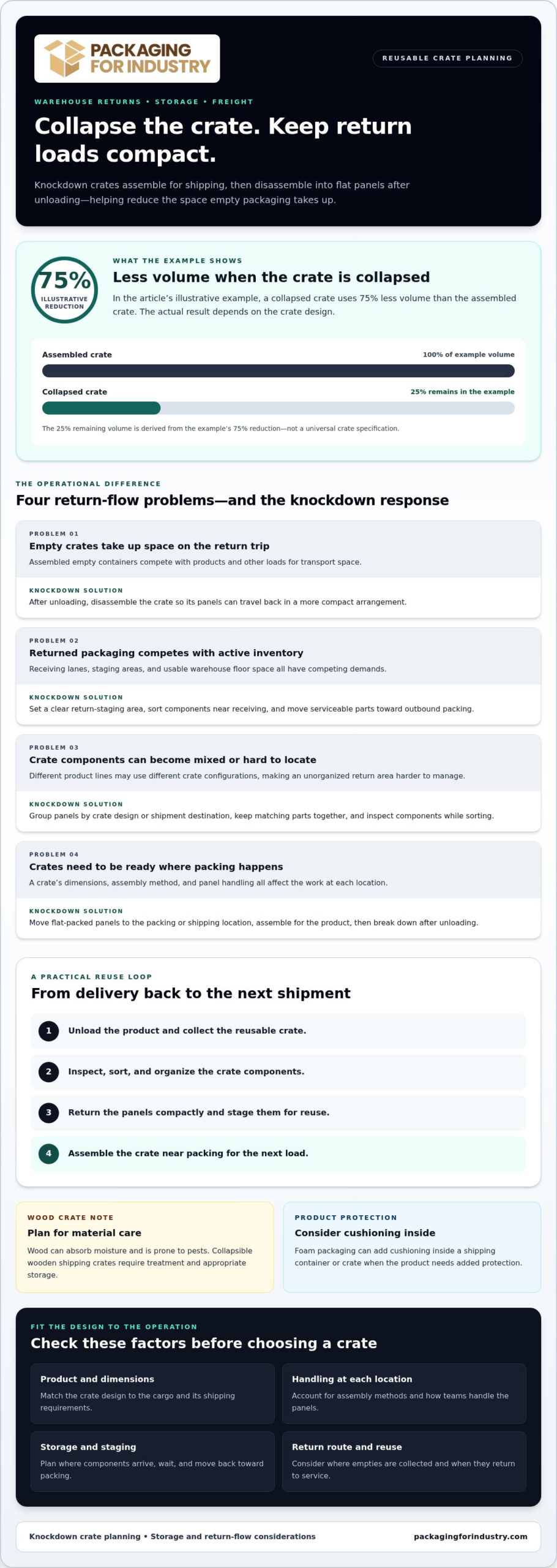
Empty crates can take far more room on the return trip than their contents did on delivery. Using knock-down crates to save storage space can reduce an illustrative crate’s volume by 75% when collapsed, because its panels pack flat instead of remaining assembled.
That difference matters when warehouses need room for active inventory or businesses return reusable packaging between facilities. For operations in Orange County, Los Angeles, and San Diego, return loads and warehouse space are practical parts of packaging planning. A knockdown crate is designed to be assembled when needed, then broken down for more compact storage and return freight.
This article explains how knockdown crate design works, what volume reduction means in practice, and how wood and plastic options compare. It also covers assembly, protective interiors, and the operational factors that can help determine whether collapsible crates suit your shipping cycle.
Key Takeaways
- Knockdown crates are designed to disassemble into flat panels, helping reduce the space needed for storage and return freight.
- In an illustrative scenario, collapsing a crate reduces its volume by 75%, which can make a substantial difference across repeated returns.
- Compare crate materials and designs based on reuse needs, handling conditions, and the protection the shipment requires.
- Crate pricing depends on project requirements; dimensions, materials, quantity, and protective features shape a quote.
- Foam packaging can add cushioning for products inside shipping containers and crates, helping address product-protection needs.
What is a Knockdown Crate?
A knockdown crate is an engineered shipping crate that can be assembled for use and disassembled afterward. It can suit shipping and warehouse operations when its design matches the product, handling process, and return route.
Freight Volume and Cost Reduction
Knockdown crates reduce freight volume by breaking down into panels instead of traveling empty and assembled. That can matter to manufacturers returning reusable packaging between facilities, where empty containers compete with products for transport space. A crate program also changes how teams plan storage and handling after delivery. Assessing both outbound cargo and the empty return route helps determine whether the design fits the operation.
Flat-Pack Shipping Savings
Flat-pack shipping moves crate panels compactly, with assembly near the packing or shipping location. This can suit an automotive supplier moving reusable packaging between a parts facility and an assembly operation. Staff receive the panels, assemble the crate for the product, then break it down after unloading. The workflow depends on the crate’s dimensions, assembly method, and how teams handle panels at each location.
Collapsible Bulk Shipping Containers
Collapsible crates serve as reusable bulk shipping containers for products that need a structured outer enclosure. Industrial manufacturers can use them to move equipment or components between production sites and warehouses. A custom crate design can account for product dimensions and shipping requirements, rather than relying on one container size for every load. The panel layout and assembly process should suit the cargo and the teams handling it.
Reduced Return Shipping Costs
Collapsing reusable crates reduces the space needed to return empty packaging to its next point of use. This can help a medical-device operation coordinate reusable shipping containers between a production facility and a distribution warehouse. Return planning should account for where empty panels are collected, how they are organized, and when they re-enter service. Organized handling helps keep crate components together for the next shipment.
Emergency relief creates another use case: a non-profit agency needed compact, rapid-response crating for food and medical supplies. Flat-packed panels can be stored before deployment and assembled where shipments are prepared, including a warehouse or field location. Wooden crate designs depend on cargo and handling needs; wooden crate details offer a related example. Efficient return handling can keep reusable containers ready for later shipments.
Storage and return-freight space savings
Warehouse space planning involves more than the footprint of an empty crate. Receiving lanes, active inventory, and packaging staging all compete for usable floor area. A return process works better when teams assign a clear location for empty crate components and keep it separate from incoming products. This helps prevent returned packaging from blocking replenishment or outbound preparation.
Plan staging around daily warehouse flow
Map where crates arrive, where teams inspect them, and where components wait for reuse. For example, a distribution center can designate a return-staging area near receiving, then move serviceable crate parts toward outbound packing. This reduces unnecessary movement through the warehouse. Keep walkways and equipment routes clear, and arrange components so workers can identify matching panels without shifting unrelated stock.
Vertical storage can make better use of available warehouse space. Material-handling racks on wheels can also improve space use and product movement in a crating department. A team can move a rack between work areas as packing demand changes, rather than carrying components across the floor for each shipment. The rack layout should suit the facility’s handling equipment, access routes, and crate-preparation process.
Keep the return area organized
Separate components by crate design or shipment destination when different loads use different configurations. For instance, a warehouse handling several product lines can label staging locations by program so teams don’t combine panels from unrelated crate sets. Consistent organization helps reduce time spent locating components and supports a reliable handoff between receiving and packing staff. Inspection during sorting also helps identify damaged parts that need attention.
Wooden crate components need storage appropriate to their material. Because wood can absorb moisture and is prone to pests, collapsible wooden shipping crates require treatment. Where storage conditions vary, keep crate components organized and protected from exposure that could affect their condition. Include inspection and treatment in the warehouse handling process, so teams account for these needs before returning components to service.
Align inventory with actual demand
A vendor-managed inventory program can use a minimum-maximum plan monitored by the supplier. This can reduce on-hand crating volumes and replenish supplies in time for use. For a production operation with recurring shipments, inventory levels can be planned around usage, replenishment needs, and available storage. This approach helps avoid filling warehouse space with excess crating while keeping materials aligned with the shipping schedule.
For a space and return-flow review, request a packaging quote with crate configurations, storage constraints, and handling needs. These details help connect warehouse layout to packaging replenishment and return planning.
Collapsible crate types and materials
Collapsible shipping crates commonly use wood or plastic, and each material affects handling, reuse, and storage. Choose based on the shipping environment, return cycle, and product protection needs. Wooden and plastic crates can both fold or break down, but their care requirements differ. Comparing these factors helps match the crate to its job, rather than choosing only by how compact it becomes.
Wooden collapsible crates suit shipments that need a rigid enclosure and panels assembled for transport. Wood can absorb moisture and is prone to pests, so collapsible wooden shipping crates require treatment. This matters for storage and transit planning: a crate moving through damp conditions needs suitable protection and handling. Consider where the crate will be stored between uses, not just the route carrying the loaded product.
Plastic collapsible shipping crates offer another reusable format. The reviewed information states that these crates are 100% recyclable, but older plastic crates can become brittle and are prone to breakage. Inspecting returned crates helps teams identify damaged components before another shipment. For example, a warehouse receiving plastic crates from several facilities can separate serviceable units from cracked ones before they return to circulation. Reuse depends on the crate’s condition and handling over time.
Design also affects durability and assembly. Some knockdown crates use spring steel clips to join panels instead of nails or screws. The clip system avoids damaging crate panels and allows repeated reuse. Other wooden collapsible crates may require tools and fasteners for assembly and breakdown, so the handling process should fit the receiving team’s workflow. The design, material, and assembly method work together; evaluating only one feature can overlook practical demands at the shipping location.
Custom construction can match a crate to product dimensions and shipping requirements. Protective foam interiors can cushion a product, while moisture barriers can address exposure concerns. For example, a delicate component may need a fitted interior, while a shipment moving through moisture-prone conditions may need a barrier. These additions affect the crate’s interior layout and preparation process. Define the cargo, shipping route, and handling needs before choosing a reusable crate configuration.
- Wood: Consider treatment and moisture exposure during storage and transit.
- Plastic: Include condition checks because older crates can become brittle and break.
- Custom design: Match dimensions, foam protection, or moisture barriers to the shipment.
These distinctions help narrow the material and design choices for knock-down crates to save storage space. A crate’s collapsed form is only one part of the decision; its condition for reuse, protection requirements, and handling process also shape its usefulness.
Knockdown crate definition and design
To assemble a knockdown crate, fit its panels together using the design’s clips, fasteners, and tools. To collapse it, remove the connections and separate the panels, then stack them in a stable, organized pile for storage. Wooden designs may require tools and fasteners, while some use spring steel clips.
The defining feature is a shipping crate engineered to come apart and then reassemble around a product. Its panels form the base, sides, and top, creating an enclosure for transport. Unlike a fixed crate, a knockdown crate can be dismantled after delivery. This makes it useful for recurring shipments between a production site and a warehouse.
Panel dimensions and connection points determine how the crate fits together. A custom design can match the product’s measurements and shipping requirements, so the enclosure supports the specific load rather than relying on a general-purpose shape. For example, equipment with an uneven profile may need a planned interior layout to prevent movement. Strength depends on the crate’s construction and intended handling, not simply on whether it collapses.
Assembly methods vary. Wooden collapsible shipping crates may use tools and fasteners during assembly and breakdown. Other knockdown designs use spring steel clips instead of nails or screws. With a clip system, workers connect the panels at designated points; for breakdown, they release the clips and separate the panels. The connection method affects the tools, labor steps, and handling process required at each facility.
Design choices also shape the crate’s interior. Foam can cushion a product, while a moisture barrier can help address exposure concerns. A delicate machine part, for instance, may need a fitted interior that limits shifting during transport. These features must work with the panel layout so the crate can still be assembled and collapsed as intended. Plastic is another option for collapsible crates, though each material has different handling and reuse considerations.
- Panel fit: Match crate dimensions to the product and shipping requirements.
- Connections: Plan for clips or the tools and fasteners used by the design.
- Interior: Consider foam or a moisture barrier where the shipment needs it.
- Storage: Keep separated panels organized and stack them in a stable arrangement.
Before choosing a design, map the assembly and breakdown process at the shipping and receiving locations. A warehouse team that handles repeated returns benefits from a consistent way to identify panels and keep each crate’s components together. This practice supports accurate reassembly and helps prevent missing pieces from interrupting the next shipment.
What are typical prices for knock-down crates in the United States?
There is no single price that fits every knock-down crate in the United States. The price depends on the project and is provided after a quote request, based on crate dimensions, material, order quantity, assembly design, and protective features. A crate for a compact component has different requirements from one designed for large equipment. Those requirements shape the build and the quote.
What shapes the quoted price?
Start with the product’s dimensions and shipping requirements. A crate built for a specific load may need a different panel layout from a general-purpose container. Material also matters: wood and plastic have different properties and handling considerations. Order quantity is another factor, since a single custom crate and a production quantity involve different purchasing needs.
Assembly design affects the components and work involved. Some wooden collapsible crates use tools and fasteners, while other designs use spring steel clips. Protective foam interiors and moisture barriers can add design requirements. For example, a shipment needing a fitted interior calls for different preparation than a product shipped without added cushioning. Include these needs when requesting a quote.
Include freight planning in the comparison. A lower purchase price alone does not show the full operating cost of a reusable crate program. Consider storage space, return handling, and how often crates can re-enter the shipping cycle. The return example elsewhere in this article shows why collapsed volume matters: the return load affects transport space, not just the crate’s initial purchase.
Compare the cost with recurring savings
A knock-down crate program’s payback period in months can be estimated by dividing the purchase cost per crate by the monthly savings per crate. This calculation gives purchasing and operations teams a framework for reviewing a reusable design. Use savings associated with the actual return cycle, storage needs, and freight plan. The result depends on those operating inputs, not on the crate price alone.
For a useful price comparison, describe the shipment and include the details that drive the design:
- Product dimensions and shipping requirements
- Preferred material and expected reuse cycle
- Assembly method, such as clips or fasteners
- Foam interiors or moisture barriers, if needed
- Order quantity and return-shipping pattern
These details help align the quoted crate with warehouse handling and freight planning. Comparing quotes based on the same design requirements makes purchasing decisions more meaningful than comparing different crate specifications. For example, confirm that each option addresses the same product fit, interior protection, and return process.
Packaging For Industry (PFI): Foam Packaging
Packaging For Industry (PFI) helps manufacturers pair shipping containers with protective foam packaging for products that need cushioning during transit. Foam inserts can be designed around a product’s shape and the space inside its crate, helping limit movement during handling. This is a practical next step when the crate design alone doesn’t provide the interior protection a shipment requires.
For operations managing repeat shipments, PFI also offers stretch film, Vendor Managed Inventory (VMI) for Packaging, and Just-In-Time (JIT) Inventory Management for Packaging. These services can support packaging supply planning alongside protective packaging needs. Share your product protection and inventory requirements with PFI to discuss a suitable approach.
Contact Packaging For Industry (PFI) to discuss foam packaging for your shipments.
Build the Next Packaging Decision Around Your Workflow
A plan for using knock-down crates to save storage space should also account for product protection and packaging supply across the shipment cycle. Foam Packaging can address cushioning needs, while Stretch Film helps secure packaged loads. Vendor Managed Inventory (VMI) for Packaging can help coordinate packaging inventory with operational demand.
Consider how the crate fits into your complete packing process: the product’s protection needs, how staff prepare shipments, and how packaging is replenished. Aligning these details can help your team make a practical decision for its shipping and warehouse workflow. Packaging For Industry (PFI) can discuss these packaging requirements with your team.
A clear plan can make packaging decisions easier to manage. Take the next step when you’re ready.
Frequently Asked Questions
What are knock-down crates and how do they save storage space?
Knock-down crates are reusable shipping enclosures designed to come apart after use. Their panels can be stored separately instead of leaving empty crates assembled in a warehouse. For example, a shipping team can designate a panel-staging area near receiving, then assemble crates as products are prepared for outbound shipments. This can free up room otherwise occupied by empty containers and make return packaging easier to organize.
What types of collapsible or knock-down crates are available?
Common options include wooden knock-down crates and collapsible plastic shipping crates. Designs differ in panel connections and breakdown methods: some wooden models use tools and fasteners, while clip-based designs connect panels with spring steel clips. Custom layouts can also include foam interiors or moisture barriers for particular cargo needs. Compare how each crate assembles, stores, and moves through your operation before selecting a format.
How much storage space do knock-down crates save when collapsed?
An illustrative crate design reduces volume by 75% when collapsed, leaving it at one-quarter of its assembled volume. For your own planning, compare the assembled and collapsed footprints of the specific crate, then account for panel stacking and access space. The usable warehouse-space reduction depends on how returned crates are arranged, how much clearance staff need, and whether panels can be stored together efficiently.
How do plastic, metal, and wooden knock-down crates compare?
Wooden crates may need care to help protect them from moisture and pests. Plastic collapsible crates are 100% recyclable, while older plastic crates can become brittle and break. For metal options, compare the stated load rating, dimensions, panel connections, and storage arrangement against your shipment needs. Across all three materials, the right comparison includes handling, return logistics, and the condition needed for continued reuse.
What load capacity and dimensions should I look for in a knock-down crate?
Start with the product’s packed dimensions, total loaded weight, and how the shipment will be handled. Choose interior dimensions that accommodate the item and any protective inserts without leaving unnecessary room for movement. Then compare the crate’s stated load capacity with the shipment requirements, including how the load is supported. For a custom component, provide a drawing or measurements to guide the crate layout.
What safety risks or durability issues should I consider with collapsible crates?
Inspect panels, joints, clips, and fasteners before each reuse cycle. Damaged connections or cracked plastic can affect assembly and crate condition; older plastic may become brittle and break. Wooden crates also need treatment because of moisture absorption and pest concerns. During stacking, keep panels stable and accessible, and follow the crate’s intended assembly method. Consistent checks help teams identify wear before components return to service.