
Keeping packaging work in-house can take floor space and labor away from production. Aerospace, food, medical, electronics, construction, and other manufacturing businesses can benefit from contract packaging and kitting services in SoCal when they need components assembled into ready-to-ship sets or products packed consistently. The right setup connects assembly, packaging, warehousing, and distribution to keep goods moving through the supply chain.
It makes sense to look beyond the packing step alone: kitting, multipacks, and finished packaging each serve a different purpose, but they can work together as part of one operating process. This guide explains which industries commonly use these services, what kitting and assembly involve, and how packaging, storage, and distribution fit together. It also covers the factors that shape an effective arrangement, so you can assess where outside support may help free production space and improve workflow.
The details depend on the product, order pattern, and handling needs, whether you are bundling related items for shipment or preparing products for distribution. Understanding those requirements helps you decide which tasks to keep in-house and which may fit a coordinated packaging process.
Key Takeaways
- Separate product assembly from contract packaging to identify which work should be handled at each stage.
- Map packaging tasks to storage and distribution needs so prepared products move smoothly through fulfillment.
- Set clear kit and multipack contents, quantities, and packing instructions to support consistent order preparation.
- Assess how aerospace, food, medical, electronics, construction, and other industrial operations can benefit from outsourced support.
- When evaluating a packaging partner, consider engineering capability, reporting transparency, and quality at scale.
What industries benefit most from industrial kitting and assembly services?
Industries with varied components, repeatable assembly steps, or shipment-specific kits can benefit from outsourced kitting. Aerospace teams may group parts and protective materials for an order, while electronics manufacturers can combine components into a ready-to-ship set. Food, medical, construction, and industrial businesses also use assembly and packaging workflows to prepare goods for distribution. Moving these tasks outside the production area can free floor space for core manufacturing work.
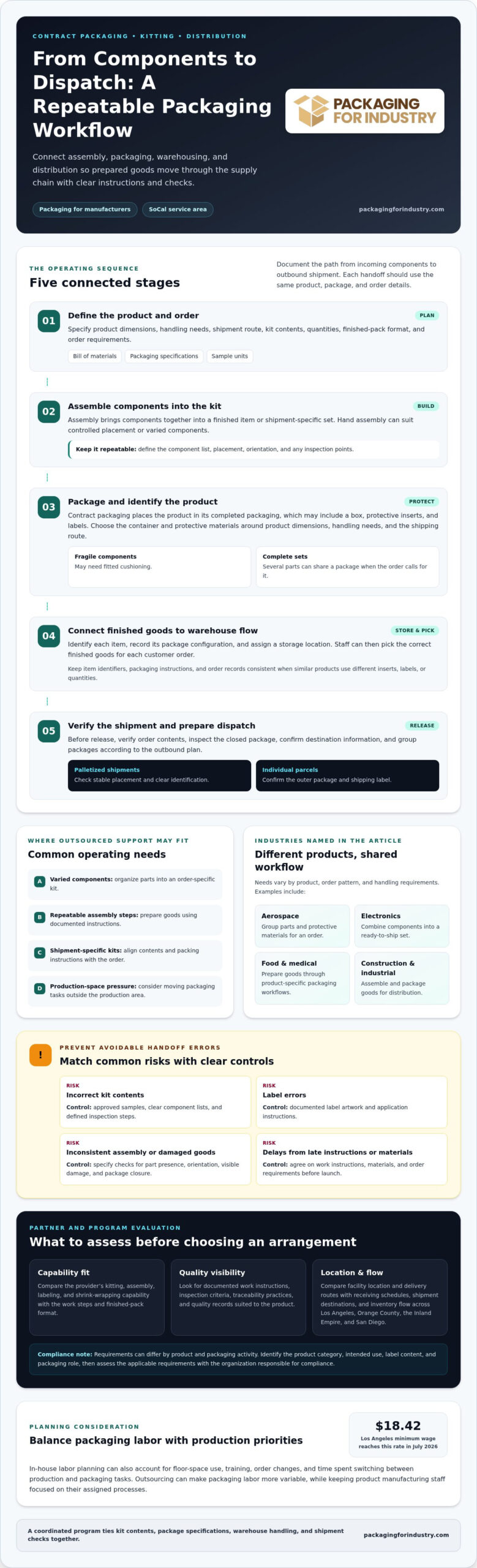
Assembly can involve bringing components together into a finished item. Contract packaging places a product in its completed packaging, which may include a box, protective inserts, and labels. For example, an industrial supplier might assemble a hardware kit, inspect its contents, then pack and label it for a distribution center. Retail multipacks and business-to-business shipments may require different kit contents and packing instructions.
Labor planning can influence the decision. The City of Los Angeles states that the minimum wage reaches $18.42 per hour in July 2026. Manufacturers weighing in-house labor should also consider floor-space use, training, order changes, and the time workers spend switching between production and packaging tasks. Outsourcing can make packaging labor more variable, while keeping product manufacturing staff focused on their assigned processes.
When evaluating contract packaging, look for documented work instructions, inspection criteria, traceability practices, and quality records suited to the product. Certification requirements depend on the customer’s industry and contract, so assess the process against the standards specified for the job.
Food, cosmetics, supplements, and medical-device packaging may be subject to different federal and California requirements, depending on the product and packaging activity. First identify the product category, intended use, label content, and packaging role, then determine the applicable requirements with the organization responsible for compliance.
SoCal providers differ in the combination of services they handle. To compare kitting, assembly, labeling, or shrink-wrapping capability, define the work steps, finished-pack format, inspection points, and order flow. A packaging kitting and assembly service can be relevant when components need organized assembly and preparation for shipment.
Contract packaging and kitting companies serve Los Angeles, Orange County, the Inland Empire, and San Diego. Their facility locations and delivery routes differ, so compare the operating site with your receiving schedule, shipment destinations, and inventory flow across those regions.
Outsourcing risks include incorrect kit contents, label errors, inconsistent assembly, damaged goods, and delays when instructions or materials arrive late. Reduce these risks with approved samples, clear component lists, documented label artwork, defined inspection steps, and a process for reporting discrepancies. Specify what inspections must cover, such as part presence, orientation, visible damage, or package closure.
Hand assembly suits tasks requiring controlled placement or varied components. Label design and application should follow the approved artwork and suit the product’s destination. Before launch, share a bill of materials, packaging specifications, sample units, and order requirements. These steps establish a repeatable workflow and help determine whether outsourced assembly fits your production and distribution needs.
Packaging, warehousing, and distribution
Packaging affects more than how a product leaves the production line. It shapes how finished goods are identified, stored, picked, and prepared for distribution. A coordinated program connects packaging specifications with warehouse procedures and shipment requirements. For example, a device going to multiple destinations may need protective materials, destination labels, and order-specific documentation before boxing. Defining these details together helps avoid repacking goods at the warehouse.
Boxing starts with the product’s dimensions, handling needs, and shipping route. Teams select a suitable container, position the product, add protective materials, and close the package according to documented instructions. Fragile components may need fitted cushioning, while several parts can share a package when the order calls for a complete set. Outsourcing packaging can also reduce the need to invest in equipment for custom foam cutting or corrugated box assembly.
Next, align the finished package with warehouse flow. Identify each item, record its package configuration, and assign it a storage location. Staff can then pick the correct finished goods for each customer order and prepare them for dispatch. Keep packaging instructions, item identifiers, and order records consistent across projects. This helps prevent confusion when similar products require different inserts, labels, or quantities.
Prepare distribution around the actual shipment. Before release, staff can verify order contents, inspect the closed package, confirm destination information, and group packages according to the outbound plan. Palletized shipments need stable placement and clear identification; individual parcels need the correct outer package and shipping label. These checks connect packaging with warehouse picking and dispatch, rather than treating each task as a separate handoff.
Before starting a program, document the sequence from incoming components to outbound shipment. Specify who supplies materials, how completed units are identified, where finished goods are stored, and how order changes reach the packing team. Include inspection points for package condition and order accuracy. Review the workflow when products, destinations, or packing instructions change. Clear responsibilities help manufacturers coordinate production with storage and distribution demands.
- Define package dimensions, protective materials, and labeling instructions.
- Match finished-goods identification to warehouse records and picking steps.
- Set inspection and order-verification points before shipment release.
- Document how packaging updates reach warehouse and distribution teams.
Use this workflow to identify where packaging, storage, or dispatch creates avoidable handling. If you’re planning a new packaging program, you can request a packaging quote based on the product, package requirements, and distribution needs.
Bundling and multipacks
Kitting places related items together in one container for shipping. A multipack groups multiple units of the same product for a single sale or order. The distinction matters: an equipment kit might contain a device, accessories, and instructions, while a multipack could group several identical replacement parts. Define the intended recipient and order use before choosing the pack format.
Start with a bill of materials listing every component, its required quantity, and its position in the package. A repair kit, for example, might list a device component, fasteners, and an instruction sheet in packing order. Note acceptable substitutions, labeling needs, and what staff should do if a component is missing. A controlled list gives assemblers a clear reference and helps receiving teams identify complete sets.
Choose packaging that fits the combined contents and how people will handle them. A compact bundle may use a carton with dividers, while a heavier group of parts may need cushioning to limit movement. Multipacks also need a clear outer label identifying the grouped product and quantity. The package should protect its contents without making opening, counting, or restocking unnecessarily difficult.
- Contents: Specify each item, quantity, orientation, and any inserts or instructions.
- Pack format: Select a container and closure suited to the combined product and handling path.
- Identification: Match labels and order references to the finished bundle.
- Inspection: Confirm contents and package condition before the unit enters inventory.
Volume and order patterns affect the packing method. Repeating the same multipack gives staff a consistent sequence, while changing kit contents requires clear version control. If one order needs a standard set and another needs an added component, identify each configuration separately in the work instructions. This helps prevent a similar-looking bundle from being picked for the wrong order.
Consider where bundles go next. A multipack for a warehouse shelf may need easy counting and replenishment; an order shipped to a worksite may need components arranged for convenient use. Map the route from packing station to storage, picking, and dispatch. This can reveal whether the container is practical to handle and whether labels stay visible during storage.
Before production begins, run a sample pack using the approved component list and packaging format. Check that staff can follow the sequence, identify the completed bundle, and spot a missing item. Record any changes to the packing instructions before repeating the run. This review helps assess whether the operation can handle the planned volume while keeping bundles consistent.
Industries served
Industry fit depends on the work pattern, not just the product category. Automotive suppliers may prepare replacement-part assortments for service channels, while contract manufacturers may need separate packing instructions for each customer program. In both cases, accurate bills of materials and controlled revisions help distinguish similar-looking orders. Map each configuration before production so staff can identify the correct components and packing sequence.
Plastics producers often handle products that vary by shape, size, or customer order. A practical workflow can separate components by SKU, apply the corresponding identification, and prepare quantities for the next production or distribution step. For textiles and roll goods, teams can organize rolls by size or order reference, then protect and identify them for handling. Clear item records matter when similar-looking products have different destinations.
Furniture and home-goods suppliers may need hardware or accessory packs matched to a specific finished item. For example, a component set can be linked to its product reference and kept separate from similar sets. This reduces confusion during order preparation and helps receiving teams identify the right package. Define how a product configuration change updates the packing instructions and component list.
Agriculture and produce businesses may face changing order patterns as customer requirements and shipment schedules shift. The packaging workflow should identify the relevant order, quantity, and destination before preparation begins. For repeat shipments, a consistent order record helps distinguish one customer’s configuration from another. Seasonal adjustments make it useful to track which instructions apply to each current order.
Industrial distributors may handle mixed-SKU orders assembled from stock supplied by different manufacturers. A defined pick sequence and package identification can link each grouped order to its purchase or customer reference. Contract manufacturers face a related challenge: one facility may manage several customer programs, each with different components and revisions. Separate work instructions and order records help prevent materials from crossing between programs.
- Automotive supply: Match replacement-part assortments to service orders and product references.
- Plastics and textiles: Distinguish similar products by SKU, dimensions, roll size, or destination.
- Furniture and home goods: Keep hardware or accessory packs associated with the correct finished item.
- Agriculture and distribution: Tie changing shipment configurations to customer orders and quantities.
To assess whether an operation could benefit, document product variations, order changes, and handoffs. Identify where teams sort, match, or prepare components, then record the information they use to prevent mix-ups. This gives purchasing and operations teams a specific basis for defining the work, assigning responsibilities, and deciding whether an outside packaging workflow fits their supply process.
Contract packaging services
Contract packaging and kitting services in SoCal can cover product assembly, packaging production, labeling, and shipment preparation. The scope depends on the product, finished-pack format, and handoff into fulfillment. A manufacturer might supply components and work instructions, then receive completed goods ready for its warehouse or distribution channel. Define the intended work before comparing packaging pricing, so each proposal reflects the same requirements.
Contract packaging, also called co-packing or co-packaging, places a product in its completed packaging. A project may include assembly, inspection, approved label application, and packing. Custom-sized packaging can be designed around a product and its handling needs. For example, a supplier may need a package tailored to a specific component rather than a standard configuration. Confirm the required tasks and materials at the outset.
The operating model should match the work. A repeatable program needs stable instructions, materials, and acceptance criteria. Projects with changing products need controlled revisions so staff use the right component list and packaging layout. Contract packaging and kitting services in SoCal can help manufacturers align packaging labor with changing order needs. Reviewing the workflow may also reveal opportunities to reduce packaging costs without compromising process requirements.
Set the service scope before production begins. Identify who supplies components and packaging materials, who approves artwork, and how teams inspect finished units. Document how the process handles damaged inputs, missing components, order changes, and rejected units. A quote request should clearly describe these responsibilities, expected volumes, and recurring requirements. That makes bulk packaging pricing easier to evaluate against the actual scope.
Evaluate the operation using practical evidence. Review packaging design and process engineering capabilities, transparency on production status and exceptions, and the ability to maintain quality at scale. A sample run can help assess assembly sequence, label placement, and finished-product condition before routine work begins. Keep approved samples and instructions aligned as requirements change, and compare providers using the same criteria.
A turnkey arrangement can connect assembly and packaging with storage or distribution preparation, but the scope must be clear. One order may end with finished cartons; another may require kits ready for dispatch. Define where responsibility transfers, what records accompany completed goods, and how supply interruptions are communicated. This keeps packaging connected to the supply chain while preserving accountability for each task.
- Scope: Identify assembly, packaging, labeling, inspection, and shipment-preparation tasks.
- Controls: Maintain approved work instructions, materials, and acceptance criteria.
- Visibility: Agree on reporting for completed orders, exceptions, and revisions.
- Quality: Assess process engineering and consistency as production scales.
Map the work, materials, and handoffs for your project, then request a contract packaging quote.
Packaging For Industry (PFI): Foam Packaging
Packaging For Industry (PFI) supports product protection and packaging supply with foam packaging, stretch film, Vendor Managed Inventory (VMI), and Just-In-Time (JIT) inventory management. Foam packaging can protect products inside shipping or storage packages, while stretch film helps secure goods for handling. For manufacturers in Orange County, Los Angeles, and San Diego, these services can support packaging workflows and recurring supply needs.
For recurring packaging needs, PFI’s VMI and JIT inventory management programs help coordinate supply with operating requirements. The right approach depends on your materials, usage patterns, and replenishment process. Share the packaging challenge and the workflow it affects to define a practical next step.
Contact Packaging For Industry to discuss your packaging needs.
Turn your packaging workflow into a practical next step
Before changing a packaging process, identify the handoff causing the most friction: component preparation, protective packing, or replenishing materials at the worksite. Then define the outcome your team needs, such as freeing production capacity, improving package consistency, or keeping supplies available. This gives your project a clear starting point for discussing contract packaging and kitting services in SoCal.
Packaging For Industry (PFI) offers foam packaging, stretch film, and VMI and JIT inventory programs to support product protection and recurring supply needs. For operations in Orange County, Los Angeles, or San Diego, bring your product details, packaging requirements, and current workflow to PFI to discuss a practical approach.
A well-defined next step makes packaging decisions easier to manage. Start with the operational need in front of you, then build a process that supports dependable production and delivery.
Frequently Asked Questions
Can a contract packager help with custom foam and corrugated design?
Yes. Packaging design can address how a product fits, stays positioned, and moves through shipping. Share product drawings or a sample, the package’s intended use, and any known damage points. A design review can consider the relationship between the foam insert and outer box rather than treating them separately. Packaging For Industry (PFI) offers custom packaging design and foam packaging.
How do VMI and JIT programs integrate with contract fulfillment?
VMI and JIT can coordinate packaging replenishment with the contract work schedule. VMI uses planned inventory reviews and replenishment, while JIT aligns deliveries with operating demand. To plan integration, identify who tracks consumption, communicates upcoming orders, and receives packaging materials. This connects inventory decisions with fulfillment activity without relying on last-minute requests or keeping unnecessary stock on-site.
How does a contract packaging partner in Los Angeles help reduce shipping costs?
A packaging partner can review shipment dimensions, package design, and product protection to identify opportunities to avoid unnecessary shipping expense. A box with substantial unused space, for example, may warrant a design review, while inadequate protection can contribute to damage and replacement shipments. Share carrier requirements, shipment destinations, and damage records so the review reflects actual transportation conditions, not just the product on a workbench.
What information is needed to get an accurate quote for contract packaging?
Provide the product description, scope of work, expected order pattern, packaging materials, and delivery requirements. Include drawings or samples, current packaging specifications, and relevant artwork or labeling instructions. Note how often configurations change and whether components arrive together or separately. These details help define the labor, materials, design work, and process controls needed for a project-specific quote.
What is product kitting?
Product kitting groups defined items for a specific use or order. Its value depends on matching the group to the right need, such as supplying a maintenance team with the parts assigned to a particular service task. Clear item references and revision control help distinguish kit configurations when product requirements change.
What products and industries do Southern California kitting providers serve?
Contract packaging and kitting providers may work with industrial components, replacement parts, accessories, and packaged materials across manufacturing and distribution operations. The right scope depends on product handling needs, how configurations vary, and where the completed package goes next. Rather than relying only on an industry label, describe the items, assembly requirements, and operating environment. This helps establish whether the process fits the job.
How much do contract packaging and kitting services cost in Southern California?
Pricing depends on the project and is provided after a quote request. Relevant factors include design complexity, materials, production volume, assembly steps, and whether configurations vary by order. A useful estimate starts with a clear scope and representative product information. Provide the same requirements when comparing proposals so differences in included work, materials, and process responsibilities are clear.
What are typical minimum order quantities and setup fees for kitting services?
Minimum quantities and setup fees vary with the project’s materials, work instructions, and preparation requirements. A new configuration may need different setup work from an established repeat order, while several kit variations can affect how the work is organized. Include expected order frequency, configuration changes, and design or sample needs in the quote request. The resulting scope can then reflect the actual job.