
A snug fit alone doesn’t make foam the right choice for an electronic device. Choose custom protective foam packaging in Los Angeles according to the device’s fragility, performance needs, case dimensions, and the precision required to fabricate its cavities. A well-designed insert cushions impact and shock, limits movement in transit, and can be shaped to support delicate components or vulnerable points.
It’s easy to focus on the case and overlook how the device fits inside it. An insert that’s too loose can let equipment shift, while a poorly designed cavity may fail to support areas that need protection. This guide explains how to match foam design to the product and its handling needs.
Learn what to assess before choosing a material, how case fit and fabrication affect the design, and what to prepare for a packaging quote. The goal is a practical fit for the electronics, shipping process, and your operation.
Key Takeaways
- Start with the device’s fragile areas and how it will be handled, then design support around those needs.
- Assess the case’s interior dimensions and the space needed for each device, accessory, and protective layer.
- Match foam choice to the product’s protection and performance requirements rather than selecting by fit alone.
- Plan cavity shapes and cutting precision to keep equipment stable and make packing and unpacking more consistent.
- Prepare device dimensions, case details, and shipping requirements to make a foam packaging quote more useful.
What does a custom foam insert do inside an electronics case?
A custom foam insert creates shaped spaces for a device, its accessories, and vulnerable components. During transit, these spaces cushion impact and shock while helping limit movement inside the case.
Custom Inserts Versus Stock Cushioning
Stock cushioning can fill open space, but may not hold a specific device securely. A custom insert has cavities shaped around the product, such as a handheld instrument with a screen, controls, and a separate power adapter. Each item has a defined place, helping prevent components from striking one another.
Compare the options by considering product shape, loose accessories, and how often staff pack and unpack the case. If a kit includes a device, cables, and a sensor, separate cutouts make missing or misplaced parts easier to spot. Stock material may suit irregular voids, while custom foam inserts can better organize repeat shipments of consistent equipment.
Consider how the insert supports the device’s contact points. A screen or connector may need a shaped recess that avoids direct pressure, while a sturdy housing can rest against broader support areas. The design should hold the product securely without forcing it into the cavity.
Fit for Boxes and Cases
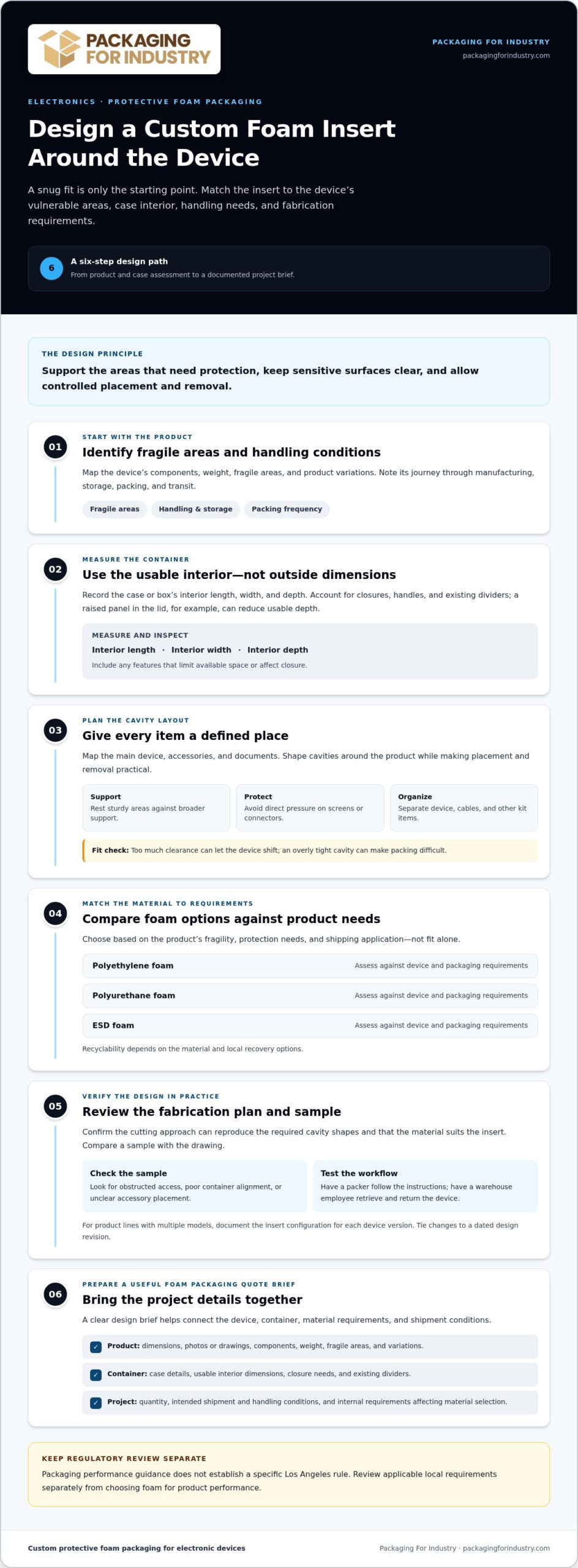
Fit starts with the usable interior of the box or case, not its outside dimensions. Measure the interior length, width, and depth, then account for closures, handles, and existing dividers. For example, a raised panel in the lid may leave less usable depth than the case’s exterior dimensions suggest.
A fitted insert can include separate spaces for the main unit, accessories, and documents. The device cavity should follow the product’s exterior while allowing controlled placement and removal. A cavity that grips too tightly can make packing difficult, while excess clearance may let the device shift.
Consider how the packed case will be handled and oriented during shipping. A custom foam insert can support the device and cushion it, while the outer box or case contains the assembled load. For shipments between Los Angeles and San Diego, a consistent layout also helps teams prepare repeat orders the same way.
Foam type and shape work together. Polyethylene foam is one material to assess against the device and packaging requirements, while the cavity layout determines where support meets the product. A practical design review follows three steps: measure the case interior, map every item, and check that each cavity supports the intended area without obstructing removal.
How do I choose foam packaging for an electronic device?
For Los Angeles packaging regulations, don’t assume foam or expanded polystyrene is either prohibited or universally permitted. This design guidance does not address a specific local rule. Treat regulatory review separately from choosing packaging for product performance.
Start with the device’s operating and handling conditions. Map its journey from manufacturing through storage, packing, and transit. A delicate optical instrument may need different packaging from a handheld service unit. Note how often staff will pack it, whether the case will be reused, and which surfaces must remain clear. These details shape the design brief more reliably than a generic foam choice.
Use a short design review to organize the requirements:
- Product information: List components, weight, fragile areas, and product variations.
- Operation: Describe who packs the device and how it is stored or shipped.
- Packaging constraints: Record case details, closure needs, and handling expectations.
Packaging engineering turns the brief into a workable layout and fabrication plan. A device with a screen, ports, and removable modules needs a layout that accounts for each feature. The design should show which areas provide support, which must remain free of contact, and how employees should orient the product. Clear instructions reduce differences in interpretation across design, purchasing, and production teams.
Check the fabrication plan against the design record. Confirm that the cutting approach can reproduce the required cavity shapes and that the material suits the insert. A sample lets the team compare the physical part with the drawing. Look for obstructed access, poor alignment with the container, or unclear accessory placement. Tie changes to a dated design revision so approved specifications remain easy to identify.
Review the prototype with people who perform different tasks. Ask a packer to follow the instructions, then ask a warehouse employee to retrieve and return the device. Their observations may reveal workflow issues that a design review alone misses. For a product line with multiple models, document which insert configuration belongs with each device version before production.
For a useful foam packaging quote, provide the design brief, product photos or drawings, container details, and project quantity. Include the intended shipment and handling conditions, plus any internal requirements that affect material selection. Keep the foam-performance decision distinct from regulatory review, so neither substitutes for the other. Request a packaging quote with the project details to begin that discussion.
Review applicable Los Angeles requirements separately from packaging performance before choosing foam or expanded polystyrene.
Foam selection based on product fragility and performance needs
Choose foam to support the product’s vulnerable areas and suit its shipping application. Options include polyethylene, polyurethane, and ESD foam. Recyclability depends on the material and local recovery options.
Product and Shipment Specifications
Define foam specifications using product and shipment details before selecting a material. Record the device’s weight, shape, delicate components, and handling requirements, then describe the shipping container and route. For example, an instrument with a protruding connector may need a cavity that supports its housing without putting pressure on the connector. Include accessories and storage needs in the review.
Compare those requirements with how the item will be packed, stored, and presented. An Orange County operation shipping the same test equipment repeatedly may prioritize a consistent layout that helps staff identify missing parts. A display unit stored between uses may need accessible cavities and clear separation from cables. These applications call for different insert layouts, even for the same product.
Shipping Protection and Shock Absorption
Fragile products need foam that cushions them and helps limit movement during shipping. Review where the insert contacts the product: support should surround sturdy areas, while delicate screens, switches, or lenses need clearance from direct pressure. If a compact sensor sits beside a power supply, separate cavities can help prevent the components from striking each other in transit.
Consider the complete package, not foam in isolation. The case, insert, and product form one protective system, so test how the packed device sits and moves when the container is handled. Excess space can allow shifting, while tight cavities can complicate removal or press against sensitive parts. Record observed movement and adjust support locations.
Available Protective Foam Types
Polyethylene, polyurethane, and ESD foam are options to evaluate for electronics packaging. Suitability depends on the device, handling demands, insert design, and performance requirements. ESD foam may be appropriate when the application calls for electrostatic protection. Match the material to the actual risk rather than assuming one foam type suits every product.
For eco-conscious specifications, identify the insert material and whether a suitable local recovery route accepts it. Recyclability can depend on the foam and available collection infrastructure. A right-sized layout can also avoid unnecessary packaging material while maintaining support. Consider material selection separately from end-of-life handling.
For repeat shipments, document the selected foam, cavity arrangement, product orientation, and pack-out sequence. That record helps purchasing and warehouse teams maintain a consistent process as orders move between Orange County facilities or into Los Angeles distribution. It also gives design reviews concrete criteria: product stability, accessible storage, and appropriate cushioning. To translate those requirements into a packaging plan, request a foam packaging quote with the device and shipment specifications.
Foam fabrication and precision cutting
Fabrication turns a packaging design into a physical insert that matches the approved layout. For an electronics kit, the design file can define cavities for the main unit, power supply, and cables. Cutting accuracy matters because each recess must align with its assigned component. A mismatch can complicate packing or leave a part unsupported. Review the drawing and sample together before approving production.
Common fabrication approaches include CNC routing, die cutting, and manual cutting. CNC routing follows programmed paths and suits layouts with shaped cavities or multiple component positions. Die cutting uses a shaped tool and can suit repeated outlines. Manual cutting can support adjustments during early design work. The right process depends on the foam material, insert geometry, order volume, and required manufacturing repeatability.
A prototype makes the design tangible. Place the actual device in the sample, then check cavity edges, access, and component placement. For example, a recessed connector may need a clear channel so the cable doesn’t press against its housing. Close the case and inspect contact points around the lid. Record each change, update the design, and review the revised sample before production.
Review the complete pack-out, not just the insert. Have an operator pack and remove each item in the intended sequence. Check whether labels, documents, or accessories obstruct another cavity. For a diagnostic kit with multiple components, separate spaces can make contents easier to identify during storage and return handling. A practical trial also reveals whether the insert works with the selected case.
Vibration and repeated handling can expose weaknesses that a tabletop fit check misses. Assess how the packed electronics move within the assembled container during the expected shipping process. If a component shifts, adjust the cavity geometry or support locations and repeat the review. This helps distinguish a cutting problem from a design issue, such as insufficient support near a heavy component.
Once the sample meets the documented fit and pack-out requirements, its design can guide higher-volume fabrication. Keep the approved drawing, material selection, and revision details together so later production follows the intended layout. For Orange County purchasing teams, this record can help align packaging orders with manufacturing schedules and warehouse storage practices. It also gives quality staff a clear reference for inspecting incoming inserts.
Prepare the design handoff with case dimensions, a component list, the approved sample, and marked changes. Include which surfaces must remain clear and how each item sits in the insert. These details connect prototype review with repeat fabrication, whether the project needs an initial sample or a production quantity. Clear documentation reduces avoidable differences in interpretation across design, purchasing, and packing teams.
Custom protective foam packaging
Custom packaging works best when it reflects the product, its journey, and the packing operation. For sensitive electronics, design around the device’s weight, contact points, accessories, and handling steps. A camera module shipped alone needs a different layout from a service kit containing the module, cables, and tools. Define the complete use case before settling on insert dimensions.
Begin with the package’s purpose. A foam insert may protect a product during shipment, organize parts in storage, or present equipment neatly when a case opens. Those goals affect cavity layout. A field-service kit, for example, can assign a distinct space to each component, helping technicians return items to the right locations. A shipping-only insert may instead prioritize support around exposed edges and clearance around sensitive controls.
Match foam properties to the product and packing environment. Consider the device’s weight, how it contacts the insert, and whether workers pack it repeatedly. A heavy power unit distributes load differently from a lightweight sensor. Mark areas that can bear contact and surfaces that must stay clear. This gives packaging design a functional map instead of a cavity that merely resembles the product.
The outer package also shapes the solution. A compact electronics case may need an insert that uses its interior efficiently while leaving room for the lid to close. A larger shipping carton may require a different arrangement, with support coordinated between the insert and container. For operations serving customers across Los Angeles, consistent layouts can make packing instructions easier to follow across shifts and locations. Document the chosen orientation and component placement for repeat orders.
Evaluate the design against daily work, not just shipment protection. Ask a packer to place and remove the device, accessories, and paperwork in the intended sequence. Note any cavity that catches a connector, any item that can be returned to the wrong space, and any unnecessary material around the load. This review can identify handling improvements without compromising support.
A complete design brief should include product dimensions, weight, sensitive areas, case or carton details, shipment conditions, and storage or presentation needs. If several device models share a package, identify each variation and its components. These details help define custom protective foam packaging in Los Angeles around real operating requirements and keep specifications clear for purchasing, packaging, and warehouse teams.
For an electronics packaging project, organize the product and package details into a design brief, then request a quote.
Packaging For Industry (PFI): Foam Packaging
Packaging For Industry (PFI) supplies foam packaging and stretch film for electronics and other industrial operations. Its products support manufacturers, warehouses, and distribution centers seeking packaging aligned with their shipping and handling workflows.
For custom requirements, PFI’s packaging design services help develop solutions around a business’s operational needs. Buyers can compare packaging pricing and consider bulk packaging pricing alongside protection, purchasing, and storage requirements. Foam packaging, stretch film, and Vendor Managed Inventory (VMI) for Packaging can also support supply planning and help businesses work toward lower packaging costs and improved supply reliability.
Los Angeles-area buyers can include local packaging delivery needs when planning their packaging supply. Contact Packaging For Industry (PFI) to discuss your requirements or visit packagingforindustry.com.
Put Your Electronics Packaging Plan Into Practice
Turn your packaging requirements into a defined purchasing plan. Share the device details, case or carton information, and how your team packs and handles each shipment. This gives Packaging For Industry (PFI) a practical starting point for discussing custom protective foam packaging in Los Angeles and related packaging needs.
PFI offers foam packaging and stretch film, along with Vendor Managed Inventory (VMI) for Packaging. These offerings can help teams coordinate product protection with supply planning. For electronics operations, aligning insert design with the shipping workflow can make packing more consistent and connect the packaging plan to day-to-day needs.
A clear project brief can move the conversation forward, whether you’re developing an insert for a new device or improving an existing pack-out. Bring your priorities and packaging requirements, and take the next step at your pace.
A well-defined packaging plan is a practical step toward smoother electronics shipments.
Frequently Asked Questions
How should buyers evaluate foam type, fit, and layout?
Evaluate the insert across the full work cycle, including packing, unpacking, storage, and return handling. For a reusable electronics case, check whether parts can be returned to their assigned spaces without forcing them into place. Consider whether operators can quickly identify the correct orientation. These checks help buyers assess usability alongside protection, especially when multiple teams handle the same equipment.
What information helps an electronics packaging quote?
Identify whether the request covers one device configuration or several product variants. A bill of materials, pack-out instructions, and current packaging drawing can clarify differences for purchasing and operations teams. Note revisions that could affect component shape or arrangement. Sharing these records helps align the quote discussion with the version of the electronics kit your facility actually ships.
What should Los Angeles-area buyers ask a packaging supplier?
Discuss how packaging requirements connect with recurring purchasing, warehouse storage, and local delivery planning. Packaging For Industry (PFI) serves businesses in Los Angeles, Orange County, and San Diego, offering foam packaging and supply-planning services. Share your production or shipping context to discuss how a packaging program can fit your purchasing workflow and replenishment needs.
Where can buyers find custom protective foam packaging suppliers in Los Angeles?
Headquartered in Anaheim, Packaging For Industry (PFI) serves customers in the Los Angeles area with foam packaging for industrial applications. Its custom packaging design services support projects that need a product-specific approach rather than a standard insert. Electronics teams can discuss their packaging requirements, including how the device is used and whether the packaging must support recurring shipments.
What is the custom foam packaging design and fabrication process?
Packaging For Industry (PFI) provides custom CAD-engineered packaging design, prototypes, and samples for review. Buyers can assess a proposed solution before a wider rollout. Involve purchasing, packaging operators, and the team responsible for the equipment in the review. Their feedback can help resolve internal approval questions and establish which design revision to use for production orders.
What are the minimum order quantities and lead times for custom foam packaging in Los Angeles?
Packaging For Industry (PFI) supports custom and stock packaging, bulk quantities, and repeat orders. For purchasing planning, include the quantity your operation expects to order and when the packaging is needed. This gives the request clear business context without relying on a universal minimum or turnaround assumption. Buyers can also note whether the project involves a new package or an established repeat order.
Which foam packaging materials suit fragile products during shipping?
Available formats include die-cut inserts, foam end caps, foam pads and planks, convoluted foam, and foam-lined boxes or crates. These formats suit different arrangements: an end cap supports an item at its ends, while a shaped insert organizes several components. For electronics with static-sensitive requirements, PFI also offers anti-static and ESD foam.
How do I request a quote for custom foam packaging in Los Angeles?
Submit a request through PFI’s quote process and identify the business and delivery location for the project. Note whether the request is for a new design, a repeat order, or stock packaging so the purchasing discussion starts in the right context. If multiple facilities will use the packaging, identify their locations and the team coordinating the order.