
A heavy-duty Gaylord doesn’t have one universal weight limit: capacity depends on its specific construction and rating. For heavy-duty Gaylord bulk containers in Orange County, one industrial 48 × 40 × 36-inch triple-wall example is designed for 1,100 lb of contents. That figure is model-specific, so wall count alone isn’t enough to determine a safe load.
When comparing containers, consider more than the weight rating. The material’s shape and density, handling method, stacking needs, and pallet setup all affect the right choice. Matching the container to these conditions helps avoid unnecessary material and cost, or a poor fit that puts products at risk of damage.
This guide explains how to assess load capacity, compare double-wall, triple-wall, and custom heavy-duty options, and plan order quantities and freight for an Orange County operation. It also covers the load and handling details to gather before requesting a bulk packaging quote, so your choice supports reliable warehouse and shipping workflows.
Key Takeaways
- Use the container’s specific load rating, not wall count alone, to judge how much material it can hold.
- Compare single-, double-, and triple-wall construction against the load, dimensions, and handling demands of your operation.
- Plan order quantities around how containers ship: knocked-down boxes use freight space differently from assembled, palletized boxes.
- Account for pallet fit, stacking stability, and handling conditions when selecting a container for warehouse or freight use.
- Build freight into your purchasing decision, then match your packaging requirements with the right supply and inventory approach.
Triple Wall, Double Wall or Custom Heavy-Duty Bulk Packaging?
Choose corrugated construction based on the required load rating, dimensions, and warehouse handling conditions. Wall count is only one part of a Gaylord’s specification. Check the rating for the exact container you plan to use.
Sizes and Quote Options
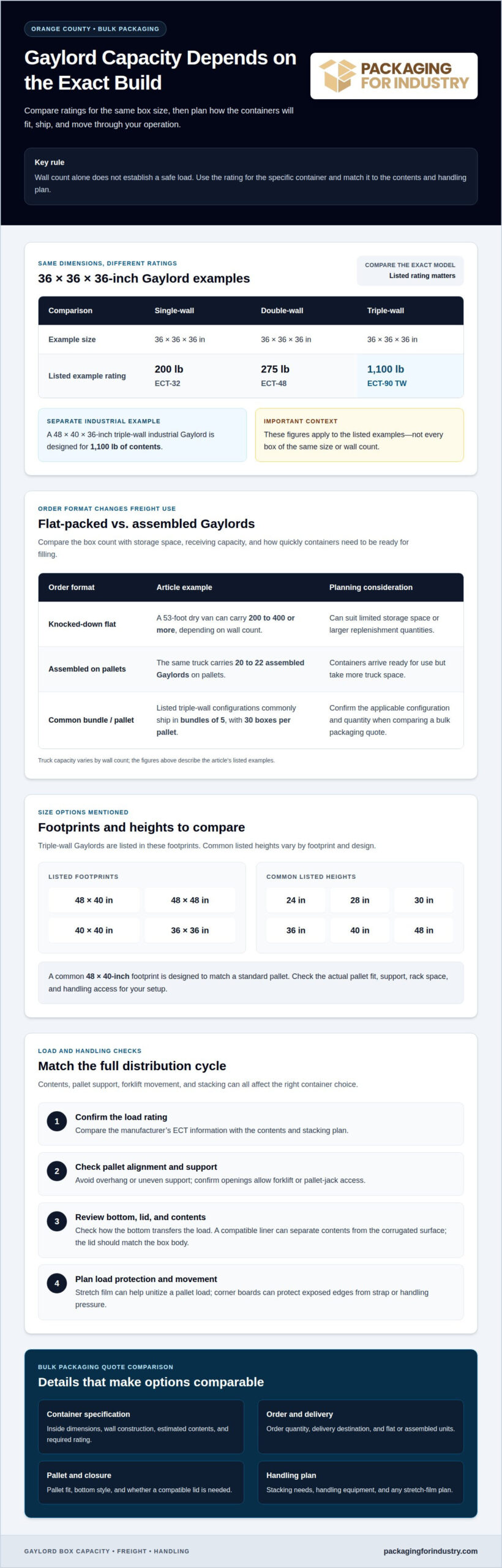
Triple-wall Gaylord boxes are listed in footprints such as 48 × 40 inches, 48 × 48 inches, 40 × 40 inches, and 36 × 36 inches. Common listed heights include 24, 28, 30, 36, 40, and 48 inches, depending on the footprint and design. These dimensions help match a container to the product and pallet area.
For a useful quote, provide the required inside dimensions, wall construction, estimated contents, order quantity, and delivery destination. Note whether you need a compatible lid and whether the boxes will arrive assembled or flat. These details help compare stock sizes with custom dimensions and account for freight requirements.
Dimensions and Weight Capacities
Weight capacity varies by model and board rating, not just by whether the container is single-, double-, or triple-wall. A 36 × 36 × 36-inch single-wall Gaylord is rated 200#/ECT-32, while a same-size double-wall example is rated 275#/ECT-48. A same-size triple-wall example is rated 1100#/ECT-90 TW.
A 48 × 40 × 36-inch triple-wall industrial Gaylord is designed for 1,100 lb of contents. Treat each number as specific to its listed construction and rating, not as a universal limit for that size or wall count. Match the rating to the actual contents and handling plan.
What container wall styles, liners, and pallet options are available? Common wall choices include single-, double-, and triple-wall corrugated, with custom dimensions considered for a particular load. A common 48 × 40-inch footprint is designed to match a standard pallet; a suitable liner can separate contents from the corrugated surface.
Do Orange County suppliers offer bulk discounts or wholesale pricing? Quote terms depend on order quantity, dimensions, construction, and freight. Share those details to compare bulk packaging quotes, rather than assuming every order receives the same discount.
Are there local recycling or disposal options for damaged Gaylord containers in Orange County? Separate clean, dry corrugated from containers contaminated by product residue or moisture, then follow your facility’s local recycling or waste program. Before reusing a damaged box, assess its condition to determine whether it remains suitable for service.
Buying Gaylord boxes by pallet or truckload
Order format affects warehouse space, freight planning, and how quickly containers are ready for use. Compare bundle, pallet, and truckload quantities with your storage capacity and expected use, not just the box count on a quote.
For example, listed triple-wall Gaylord configurations commonly ship in bundles of 5, with 30 boxes per pallet. A 53-foot dry van can carry 200 to 400 or more knocked-down flat Gaylord boxes, depending on wall count. The same truck carries 20 to 22 assembled Gaylords on pallets, so assembly state changes how many units fit.
Most Gaylord boxes use a 48 × 40-inch footprint designed to match a standard pallet. Before ordering, compare that footprint with your pallet dimensions, rack space, dock layout, and handling equipment. A box that overhangs its pallet or blocks fork access can complicate movement through a warehouse.
- Check pallet fit: Match the box footprint and pallet dimensions, then confirm the loaded unit fits warehouse aisles and storage locations.
- Plan handling: Confirm forklift or pallet-jack access to the pallet openings and avoid shifting a loaded container during movement.
- Protect the load: Stretch film can help unitize a pallet load; corner boards can protect exposed edges from strap or handling pressure.
- Confirm the rating: Compare the manufacturer’s edge crush test, or ECT, information with your load and stacking plan.
Bottom construction matters, too. Gaylord boxes may have pallet flanges or a bottom designed to sit on a pallet. Check how the container transfers its load before handling it. A lid must match the box’s dimensions and body; a poor fit can interfere with closing, stacking, or securing the container for shipment.
Flat-packed boxes can make sense when storage is limited or you need a larger replenishment quantity. Assembled, palletized boxes suit operations that need containers ready for filling, but they take up more truck space. For Orange County receiving teams, match delivery quantities to available dock space and staff capacity for assembly or use.
To compare pallet or truckload quotes, provide the box dimensions, wall construction, quantity, delivery location, and whether you need flat or assembled units. Include pallet and lid requirements, plus any stretch-film plan, so the quote reflects the complete handling setup. A Gaylord packaging quote can be based on those practical order details.
Choosing a Gaylord box for load and handling conditions
Match the container to the full distribution cycle, not only the weight of its contents. A warehouse load faces pressure from its contents, forklift movement, pallet support, and any boxes stacked above it. These forces affect packaging differently, so distinguish payload capacity from compression and stacking strength before choosing a box.
Start with the loaded footprint. Most Gaylord boxes fit a 48 × 40-inch pallet, but pallet alignment and even support still matter. If the box overhangs, sits unevenly, or shifts during handling, pressure concentrates along fewer contact points. Academic testing on single-wall stacking misalignment found that a 10% reduction in contact area can reduce compression strength by 11%.
Then consider how the load behaves in transit. Dense contents can put concentrated pressure on the bottom, while bulky contents may shift and load the walls unevenly. Forklift turns, pallet-jack stops, and uneven floors can add movement forces that a static capacity figure does not capture. Assess product weight, weight distribution, and handling route together.
- Two-wall: Common static load capacity ranges from 800-1,200 lb.
- Three-wall: Common static load capacity ranges from 1,000-1,600 lb.
- Four-wall: Common static load capacity ranges from 1,500-2,200 lb.
- Five-wall: Common static load capacity ranges from 2,000-3,000 lb.
Commonly listed static capacities are not universal payload ratings for every Gaylord. Use the manufacturer’s rating for the exact box. Wall count alone does not prove that a container can carry a particular load or support another loaded box.
Stacking strength is separate from the weight a box can hold. The lower container bears pressure from the tiers above, and misalignment can weaken its support. For tiered storage, keep containers aligned, blocked, and interlocked, and limit stack height to maintain stability. Use the intended pallet base, and avoid placing a loaded box on damaged or uneven support.
For a practical selection, record the contents’ total weight, whether they settle or shift, the pallet footprint, the handling equipment, and the planned stacking arrangement. Compare these conditions with the specific box rating. If loads vary between production runs, base the choice on the heaviest expected configuration and the distribution steps it must withstand.
Weight capacity and manufacturer ratings
A Gaylord’s safe load depends on its specific construction and manufacturer rating, not wall count alone. Distinguish the weight of the contents from the box’s compression strength, especially if containers will be stacked. Height, footprint, board grade, and load distribution all affect how the box performs in storage and shipment.
Edge Crush Test, or ECT, describes corrugated board strength under edgewise compression. According to TAPPI, ECT is measured using the TAPPI T 811 method. The rating helps compare board constructions, but it is not a direct statement of the weight a finished box can hold. Box dimensions, joints, bottom design, and handling conditions also matter.
Use the exact rating for the container under consideration. For example, a 36 × 36 × 36-inch single-wall Gaylord is rated 200#/ECT-32. A 36 × 36 × 36-inch double-wall version is rated 275#/ECT-48, while the triple-wall version is rated 1100#/ECT-90 TW. These examples show why the full manufacturer specification matters more than a general label such as “heavy-duty.”
- Single-wall: One construction example is rated 200#/ECT-32.
- Double-wall: Ratings vary by board grade; double-wall Gaylords have a maximum fill capacity of up to 180 lbs under ASTM D4727.
- Triple-wall: Common ECT ratings range from 90 ECT to 155 ECT.
Those figures describe different specifications, so don’t treat an ECT value as a payload allowance. A triple-wall Class CG specification uses an ECT-90 rating, while the finished container’s dimensions and design determine its applicable load rating. Confirm that the rating matches the box size, construction, and planned use. An octagon-style container may also have a different design from a rectangular standard Gaylord.
How can I check a used Gaylord container for damage and safe load capacity? Inspect the walls, corners, bottom, and seams for compression, tears, crushed edges, and moisture damage. Then consult the manufacturer’s certificate for that specific box to determine its rating. Compression or moisture damage may reduce a used container’s capacity.
For receiving or reuse, record the box’s dimensions, wall construction, visible condition, and rating before loading. Keep containers with damaged bottoms or softened panels out of heavy-load service. A new box’s rating does not establish the safe capacity of a used box, even if its dimensions and construction appear identical.
Regional availability and freight costs
For Orange County operations, availability depends on the requested Gaylord dimensions and wall construction. A listed 36 × 36 × 36-inch double-wall heavy-duty corrugated Gaylord has an availability lead time of 3-5 days. Treat that as an example for that configuration, not a schedule for every industrial container. If a production run depends on a particular box, include the required specification in purchasing plans early.
Plan freight around the order size, shipment format, and delivery destination. Share the receiving address, quantity, and required construction when comparing packaging quotes. Flat-packed boxes and assembled containers use truck space differently, while larger or heavier configurations affect loading and unloading. Comparing the delivered order, not just the per-box figure, helps purchasing teams assess total cost and identify practical savings.
Local delivery also depends on whether the receiving site can accept and stage the shipment. Confirm dock access, unloading equipment, and available floor space before scheduling delivery. A distribution center with limited staging room may need deliveries aligned with its usage schedule. Manufacturing sites should consider whether packaging will move directly to production or remain in storage before use.
Lead time and freight are separate planning factors. The listed 3-5-day availability applies to one 36 × 36 × 36-inch double-wall container. Other dimensions, wall constructions, or order quantities may involve different sourcing and production steps. For recurring packaging for distribution centers, align replenishment timing with consumption and receiving capacity so inventory arrives when teams can use and store it.
- Prepare the request: Provide dimensions, wall construction, order quantity, and delivery address.
- Describe receiving needs: Note dock access, unloading equipment, and staging constraints.
- Compare delivered options: Review packaging quantity and freight together when evaluating bulk packaging pricing.
- Plan order timing: Coordinate arrival with production demand and available storage space.
A complete request makes it easier to compare options against your operation’s needs. Include site-specific receiving limits alongside the Gaylord specification, then assess the delivery arrangement against your warehouse schedule and replenishment needs.
Packaging For Industry (PFI): Foam Packaging
Packaging For Industry (PFI) supports industrial teams with related packaging needs that bulk containers alone may not address. Its foam packaging can cushion sensitive or irregularly shaped components, helping reduce the risk of shipping damage. PFI serves manufacturers in aerospace, electronics, medical device production, food and beverage, and other industrial sectors.
For parts that move or abrade inside a Gaylord, foam packaging solutions can add protection suited to the item and its handling needs. PFI also offers stretch film for securing palletized loads. Its industrial focus and packaging design capabilities make it a practical fit when standard protection does not address a product’s shipping or storage requirements.
Contact Packaging For Industry (PFI) to discuss your packaging requirements.
Set Up Your Next Bulk Packaging Order
Use your next purchasing cycle to match container selection to the way materials move through your operation. For heavy-duty Gaylord bulk containers in Orange County, document the load, storage conditions, receiving setup, and shipping workflow in one specification. This gives purchasing and warehouse teams a shared reference for comparing options and planning replenishment.
Include details that affect daily use, not just container dimensions. Note how staff fill and move each unit, where containers wait before shipment, and how finished loads enter distribution. If products shift or need extra cushioning, include that alongside the bulk container requirements. A clear specification helps prevent avoidable packaging mismatches and keeps purchasing decisions tied to operational needs.
Packaging For Industry (PFI) can help assess related packaging needs as you plan your next order. Share your application and purchasing requirements to start a practical conversation about the right next step.
A clear order specification supports steadier packaging supply and smoother warehouse planning.
Frequently Asked Questions
How much weight can a Gaylord box hold?
There is no single capacity that applies to every Gaylord box. Use the rated contents limit for the exact model and compare it with the loaded product weight and how the contents are distributed. For procurement, record the model or specification shown on the container, then match it to the planned use. If the box will be reused, assess its current condition, too.
What size is a standard Gaylord box?
Gaylord dimensions vary, so “standard” may refer to a commonly stocked format rather than one universal size. Measure the required interior clearance for the product, including room for protective materials, and compare it with the container’s usable interior dimensions. Check the outer dimensions against warehouse doors, rack locations, and transport space as well. Sharing both product measurements and handling constraints helps identify a workable fit.
Do bulk boxes work with a forklift, and do I need two-way or four-way entry?
Yes. A bulk box can be moved by forklift when it sits on a compatible pallet. Two-way entry suits workflows where forks approach from the pallet’s designated sides; four-way entry allows access from each side. Review the pallet design and approach direction at receiving, storage, and dispatch. Restricted aisle access can make entry configuration important, even when the container dimensions fit.
What is a bulk box, and what else is it called?
A bulk box is a large industrial container used to hold or move consolidated materials. Buyers may also call it a Gaylord, Gaylord container, bulk bin, or pallet box. These terms can describe similar packaging, but they do not define the same construction or rating. Pair the familiar name with the intended use and required specification in a purchasing request so the container can be matched to the operation.
Where can I buy heavy-duty Gaylord bulk containers in Orange County, California?
Packaging For Industry (PFI) supplies Gaylord boxes for industrial packaging needs in Orange County. Start with the product dimensions, application, and planned order quantity, then request a quote for the required configuration. This is a practical option for manufacturers and warehouse teams sourcing bulk packaging for recurring shipping or storage. Include any space or handling constraints that could affect the selection.
Can Gaylord containers be delivered to businesses across Orange County, and what are the fees?
Yes, Packaging For Industry (PFI) provides local next-day delivery throughout Southern California, including Orange County. Delivery fees depend on the order and are provided after a quote request. Relevant factors include container dimensions, quantity, and delivery location. Share the receiving address and order requirements when requesting pricing so your purchasing team can assess delivery with the packaging order and plan receiving space.
What is the difference between single-wall, double-wall, and triple-wall Gaylord boxes?
The terms describe the number of corrugated wall layers in a container: one, two, or three. Construction affects box strength, but layer count alone does not provide the full load specification. Compare the manufacturer’s rating and board details for the size you plan to use. Also consider whether a lid, liner, or other component changes the complete packaging setup for your product and workflow.
How much do new and used Gaylord containers cost in Orange County?
Orange County quotes also depend on quantity, dimensions, construction, and freight.