
The largest box isn’t always the safest or most economical choice. A packaging supply store in Anaheim can help businesses select materials and coordinate delivery or pickup. Box size matters too: oversized packaging may trigger oversize charges on ground shipments or dimensional-weight charges on air shipments.
It’s reasonable to want a clear answer before arranging an order: what supplies can come to Anaheim, which specialty materials are available, and when pickup can happen. Delivery and pickup timing depends on the store’s hours and order arrangements, so planning those details alongside the packaging need can help prevent supply delays.
This guide covers packaging categories and specialty materials for business shipping, including electronic packaging designed to meet International Safe Transit Association drop test requirements. It also explains how to plan delivery and pickup, assess packaging fit, and match supplies to warehouse, manufacturing, and distribution needs.
Key Takeaways
- Identify the packaging supplies suited to your shipment and learn what to consider when arranging delivery to Anaheim.
- Compare cushioning and void-fill approaches to help protect products while avoiding excess packaging.
- See how kits, tubes, pallets, and crates can support different warehouse and shipping needs.
- Plan store pickup by understanding how hours, order timing, and location details affect your visit.
- Explore how Packaging For Industry’s foam packaging, stretch film, and inventory management services can support ongoing packaging needs.
Box and packing-supply delivery to Anaheim
Anaheim businesses can source packaging from industrial suppliers, packaging distributors, and shipping-supply retailers. For delivery, prepare the receiving address, requested materials, and quantities so the supplier can assess the order and delivery terms. Buyers managing multiple facilities should list each destination separately to keep purchase orders and receiving instructions clear.
Orange County delivery coverage varies by supplier and delivery arrangement. Check whether the Anaheim address falls within the supplier’s service area and note any receiving requirements. For example, a warehouse with a loading dock can provide access instructions, while a business receiving at a staffed office may need to specify delivery hours. The Anaheim service area gives local context for packaging delivery planning.
Online ordering can make repeat purchases easier to track. Enter the delivery address, select the items and quantities, then review the order summary and delivery terms. Save purchase records by item and destination. Procurement teams can use this history to plan replenishment orders and compare terms across purchases.
Organize each order around how the supplies will be used. A distribution center replenishing multiple packing stations, for example, can divide quantities by department or receiving area. This reduces confusion when materials arrive and helps staff route each item correctly. Include any special unloading or delivery instructions.
Anaheim businesses should sort discarded packaging according to the collection guidance for their location. Separate cardboard, plastic film, and cushioning when local instructions call for different handling. Sorting materials at the point of disposal helps warehouse staff follow the applicable process.
Bulk and Wholesale Pricing
Do Anaheim packaging stores offer bulk or wholesale pricing? Suppliers may offer quantity-based pricing for business orders. Compare unit cost, minimum quantities, and order size with actual usage so excess stock doesn’t take up warehouse space.
Free-delivery thresholds vary by supplier and may depend on order value, delivery zone, or product type. Review the stated threshold against your operation’s needs instead of adding supplies that won’t be used just to qualify.
Available Boxes and Shipping Supplies
Which stores sell boxes, bubble wrap, tape, mailers, and shipping supplies? Industrial packaging suppliers, packaging distributors, and shipping-supply retailers are the main options. Their product ranges may include corrugated boxes, bubble wrap, packaging tape, mailers, and other shipping materials.
For business purchasing, organize products by use: cartons for outbound orders, mailers for smaller shipments, and tape for sealing packages. Electronic shipments may require specialty materials designed to protect sensitive products in transit.
Cushioning, void fill, and packing peanuts
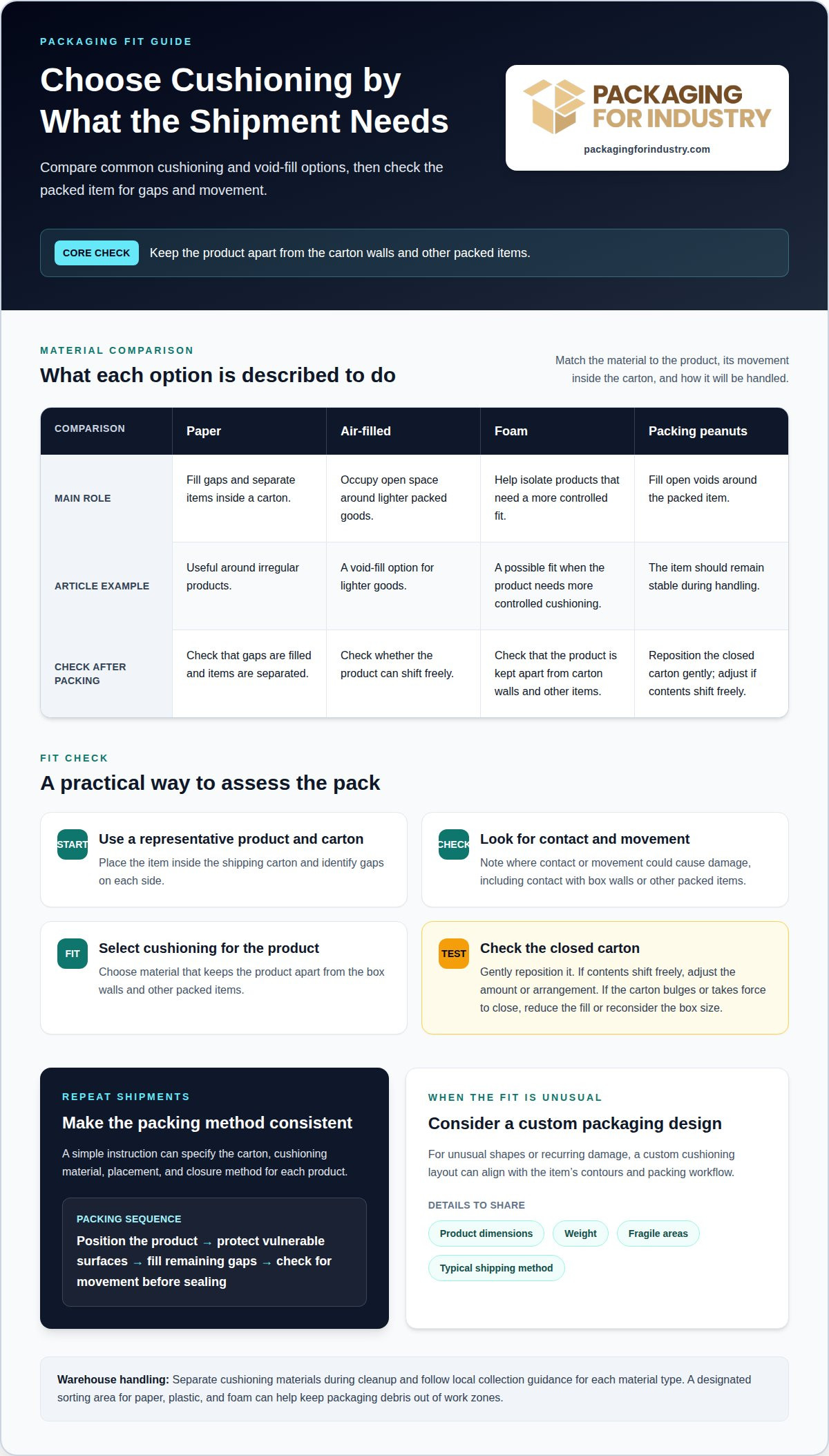
Choose cushioning based on the product, its movement inside the carton, and how it will be handled. A compact metal component may need a fitted barrier against scuffs, while a fragile instrument may need cushioning around several exposed surfaces. Void fill serves a different purpose: it limits shifting by filling unused space around the item.
Start with a representative product and its shipping carton. Place the item inside, identify gaps on each side, and note where contact or movement could cause damage. Select cushioning that keeps the product apart from the box walls and other packed items. For mixed orders, assess each product separately rather than assuming one material suits everything.
- Paper cushioning can fill gaps around irregular products and separate items inside a carton.
- Air-filled cushioning can occupy open space around lighter packed goods.
- Foam cushioning can help isolate products that need a more controlled fit.
- Packing peanuts can fill open voids, but the packed item must remain stable during handling.
Packing peanuts work best when they surround the product without leaving a large empty pocket. Add fill around the item, close the carton, and gently reposition it. If the contents shift freely, adjust the amount or arrangement. If the carton bulges or takes force to close, reduce the fill or reconsider the box size.
Keep packing consistent across repeat shipments. A simple instruction can specify the carton, cushioning material, placement, and closure method for each product. For example, staff packing the same electronic component can follow the same sequence: position the product, protect vulnerable surfaces, fill remaining gaps, and check for movement before sealing.
For unusual shapes or recurring damage, custom packaging design can align the cushioning layout with the item’s contours and packing workflow. Share the product dimensions, weight, fragile areas, and typical shipping method when requesting a packaging quote. Those details help the supplier assess a suitable design without relying on a generic fill approach. A custom packaging quote can help translate those requirements into a practical packing plan.
Consider what happens after delivery, too. Separate cushioning materials during warehouse cleanup and follow collection guidance for each material type. A designated sorting area for paper, plastic, and foam helps keep packaging debris out of work zones and makes disposal easier to manage.
Packaging kits, tubes, pallets, and crates
Custom boxes in Anaheim are available from packaging manufacturers and industrial suppliers that work from product dimensions and shipping requirements. Packaging-supply stores may also carry moving supplies such as cartons, tape, and protective materials, though stock varies by retailer.
A packaging kit groups the components needed for a particular product or order. For example, a kit might combine a carton, protective insert, and closure materials so staff can pack repeat shipments consistently. Before specifying a kit, list each item, the packing sequence, and the materials needed at the workstation. This helps purchasing teams estimate quantities and avoid gathering components from separate stock locations.
Tubes suit long, narrow products that do not fit standard cartons efficiently. They can hold rolled plans, posters, and other elongated materials. Measure the packed item’s length and diameter, then allow for end protection and closure space. A close-fitting tube can reduce excess package volume compared with a much wider carton.
- Mailing tubes hold rolled documents or narrow products.
- Cardboard cores support wound materials used in production or shipping.
- Pallets consolidate cartons for warehouse handling and freight movement.
- Crates provide an outer structure for products needing a more substantial shipping enclosure.
For palletized freight, plan the load before wrapping or staging it. Arrange cartons to keep the footprint stable, balance the load, and consider edge protection for corners that could be crushed. A warehouse shipping stacked cartons should check that the stack stays aligned on the pallet and does not extend beyond its edges.
Crates can suit irregular, heavy, or valuable industrial equipment when a standard box does not fit the product or handling plan. Share the product’s dimensions, weight, lifting points, and destination with the packaging supplier. These details inform the crate layout and help coordinate protection with loading and unloading needs.
Choose among kits, tubes, pallets, and crates based on product shape, packing workflow, and transport method. A manufacturer shipping long components may need tubes, while a distributor consolidating cartons may prioritize pallet configuration. Custom packaging design can bring the enclosure and protective components together around a specific product and repeatable process.
Before ordering, prepare a specification sheet with product measurements, quantities, shipment frequency, and handling requirements. Include a photo or sketch for unusual shapes. This gives a packaging supplier a practical basis for recommending a format and helps your team compare options instead of relying on a generic package size.
Custom boxes are available from packaging manufacturers and industrial suppliers that work from product dimensions and shipping requirements. For businesses managing broader supply chains or seeking durable polypropylene corrugated sheets, industrial specialists like Falcon Link TR offer materials tailored to demanding transport conditions.
Store hours and pickup times
Pickup timing depends on a store’s posted hours, order preparation, and the requested items. A buyer collecting cartons for an afternoon packing run should plan around the pickup window and the warehouse’s need-by time. Anaheim suppliers may have different schedules, so don’t assume one retailer’s hours apply elsewhere.
Start by identifying the order and collection date. List product types, dimensions, and quantities, then use the supplier’s ordering process to arrange pickup. An order for stocked tape differs from one requiring assembled packaging components. The details help establish whether the goods are ready for collection or need preparation first.
Before setting a vehicle or staff schedule, review the store’s current hours and pickup instructions. Check opening and closing times, any stated order cutoff, and the location or counter for collection. These details matter when coordinating a production shift, carrier, or warehouse receiving window.
Use this practical sequence to reduce avoidable pickup delays:
- Prepare the order. Record item names, specifications, quantities, and the person collecting them.
- Arrange collection. Follow the store’s process and select a pickup time that falls within its posted hours.
- Plan transport. Match the vehicle to the order’s size and volume, especially for bulk cartons or palletized supplies.
- Coordinate receiving. Tell the warehouse team when supplies are expected and where they should be stored.
For example, a distributor collecting several cartons should check vehicle capacity before leaving the warehouse. A small car may suit a few rolls of tape but not a large corrugated-box order. Palletized goods may also require a forklift or loading area.
For repeat purchases, keep a record of previous orders and collection arrangements. Purchasing teams can use it to prepare replenishment requests earlier and coordinate staff coverage. If a packaging line needs materials before a shift, schedule collection around the supplier’s posted hours and your internal receiving process.
Pickup is useful when a business wants direct control over transport or plans to combine a supply run with another Anaheim delivery. Delivery may suit a larger order or a warehouse without collection staff. Compare the options against order volume, vehicle capacity, labor availability, and when supplies need to reach the packing area.
Keep the pickup confirmation and order list together for the person collecting the goods. This handoff helps staff identify the correct materials, resolve quantity discrepancies at collection, and move supplies to the right Anaheim work area without disrupting the shipping schedule.
What are the addresses and phone numbers of packaging supply stores in Anaheim?
Packaging suppliers in Anaheim include industrial packaging businesses, distributors, and shipping-supply retailers. To find a store’s street address and phone number, use its current business listing or official contact page. Confirm the city and business name before planning a visit or dispatching a driver, especially when suppliers serve the wider Orange County area.
Keep supplier contact details in one purchasing record. Include the business name, Anaheim address, main phone number, and ordering contact channel. This helps procurement staff share accurate information with warehouse teams and drivers. If a supplier has multiple locations, record the specific site handling the order rather than relying on a general company listing.
Before calling, prepare the information needed to identify your request:
- Materials: name the packaging items required, such as cartons, tape, or protective supplies.
- Specifications: note dimensions, product identifiers, or other purchasing details.
- Quantity: provide the amount needed for each item.
- Destination: identify the Anaheim delivery site or intended pickup location.
A clear inquiry helps staff direct the request to the right department. For example, a purchasing manager can describe the materials and quantities needed for a scheduled production order. A warehouse coordinator can identify the receiving site and say whether the inquiry concerns delivery or collection.
For a planned visit, use the street address to map the correct entrance and route. Industrial sites may have separate receiving areas, offices, or shipping entrances. Give the driver the supplier name and destination details together so the visit doesn’t depend on a partial address or outdated contact record.
Phone details help teams distinguish ordering questions from delivery coordination. Record the number used for the original inquiry and the supplier’s name beside it. For repeat purchasing, this lets another team member follow up with the right business and reference the relevant order.
Review contact records when purchasing responsibilities change or supplier locations are updated. Keep one version accessible to procurement and operations, and label each entry by city. This makes it easier for Anaheim teams to coordinate supply runs, route inquiries, and maintain consistent vendor records across departments.
Packaging For Industry (PFI): Foam Packaging
Packaging For Industry (PFI) provides foam packaging for manufacturers whose products need application-specific protection. Aerospace, electronics, and medical device businesses can use foam solutions for parts with distinct shapes or handling needs. The aim is a fit suited to the product and shipping process, rather than a generic protective approach.
PFI also offers stretch film, Vendor Managed Inventory (VMI) for Packaging, and Just-In-Time (JIT) Inventory Management for Packaging. These services can help operations teams secure palletized loads and plan recurring supply needs. Consider PFI when packaging challenges affect product protection, purchasing workload, or the availability of materials for production and shipping.
Contact Packaging For Industry (PFI) to discuss packaging needs for your operation.
Build a packaging plan that fits your operation
Choosing a packaging supply store in Anaheim is part of a broader purchasing decision. The next step is to connect product protection with how your team orders, stores, and uses supplies. A clear packaging plan can help manufacturers and warehouse teams reduce avoidable damage, align materials with demand, and simplify purchasing.
Packaging For Industry (PFI) offers foam packaging for product protection and stretch film for securing loads. For businesses with recurring packaging needs, Vendor Managed Inventory (VMI) can support supply planning. Consider these options when packaging problems go beyond a single order, such as repeat damage or difficulty keeping essential materials available for daily operations.
Prepare product details, typical usage, and purchasing needs before requesting a quote. This keeps the conversation focused, whether you’re evaluating protective foam or planning a more consistent supply process.
A well-matched packaging plan can support a steadier workflow. Contact PFI when you’re ready to improve how your operation sources and uses packaging.
Frequently Asked Questions
What packaging supply stores serve the Anaheim area?
Anaheim buyers can look to industrial packaging suppliers, distributors, and shipping-supply retailers. Packaging For Industry (PFI) is an industrial supplier serving Orange County, Los Angeles, and San Diego businesses, including foam packaging and stretch film needs. When evaluating suppliers, compare the type of buyer they serve, the order quantities they handle, and whether they support recurring business requirements.
Which packaging stores serving Anaheim are open now, and what are their hours?
Opening status and store hours depend on each local location’s schedule and the day of your visit. Hours may differ on holidays or other special operating days, so use the business listing or official website to see whether it is open. Before driving over, note the listed address and pickup instructions, especially if you’re collecting a large order or coordinating a warehouse run.
Do packaging suppliers serving Anaheim offer delivery or online ordering?
Many packaging suppliers provide delivery or online ordering, but methods and terms vary by business. Packaging For Industry serves Orange County, Los Angeles, and San Diego businesses and offers local next-day delivery in Southern California. For online purchasing, look for an order form or product catalog that covers the materials and quantities your operation needs. Businesses with recurring orders can also consider whether managed inventory suits their purchasing process.