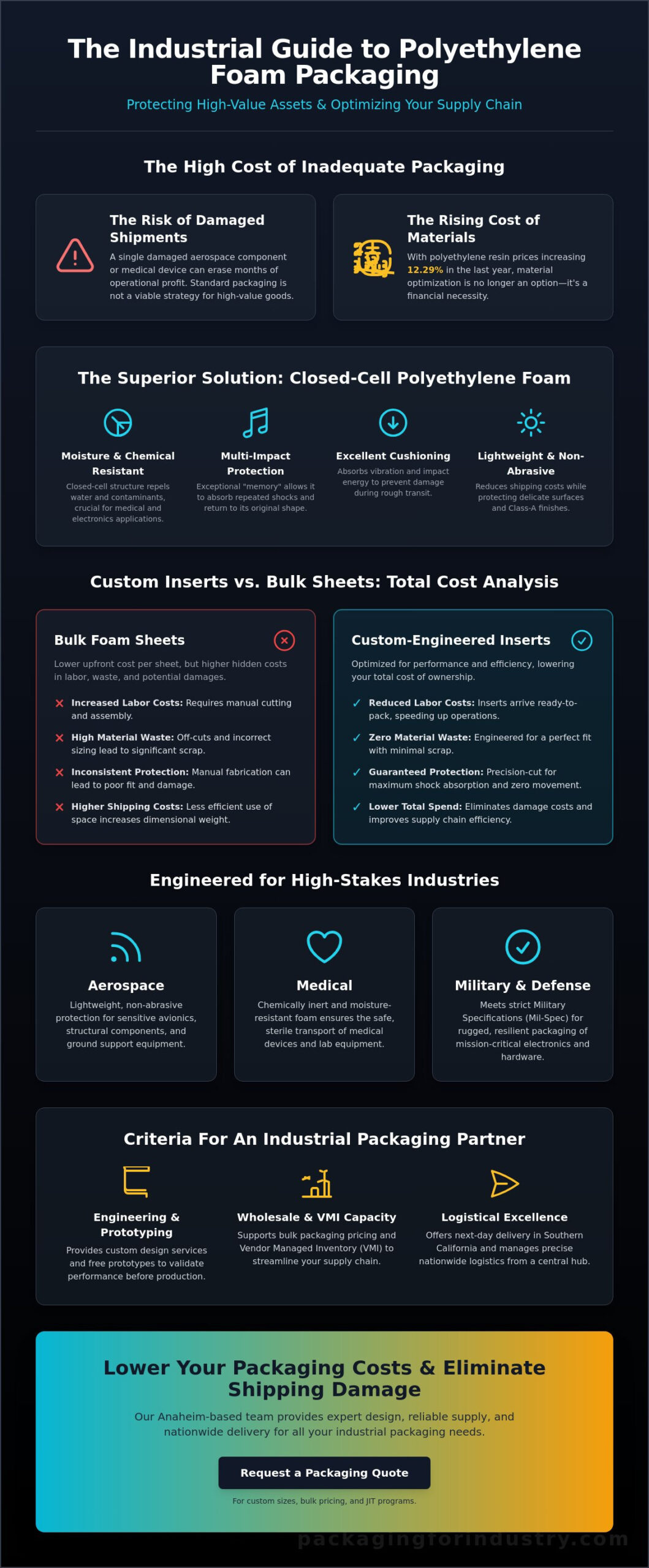
A single shipment of damaged aerospace components or medical devices can erase months of operational profit. If you’re currently struggling with inconsistent lead times or foam that fails to meet strict military specifications, you’ve likely realized that standard packaging isn’t a viable strategy. Finding a reliable polyethylene foam supplier Anaheim is about more than just buying material; it’s about securing a partner that understands the high stakes of industrial shipping. With polyethylene resin prices seeing a 12.29 percent increase over the last year, precision in material selection is now a financial necessity rather than an option.
We understand that procurement and operations teams need reliability and fiscal responsibility above all else. This guide provides a detailed roadmap for sourcing industrial-grade foam that ensures zero-damage shipping while reducing your overall packaging spend. We’ll examine how custom engineering and Vendor Managed Inventory (VMI) can streamline your warehouse operations. You’ll also see how localized support in Southern California combined with nationwide logistics creates a more resilient supply chain for your most sensitive components.
Key Takeaways
- Understand the performance advantages of closed-cell polyethylene foam for moisture resistance and shock absorption.
- Learn why choosing a polyethylene foam supplier Anaheim creates a logistical hub for your Southern California and national distribution needs.
- Evaluate the hidden costs of bulk foam sheets compared to the efficiency gains of custom-engineered inserts.
- Discover how to navigate strict military and aerospace specifications while maintaining consistent lead times.
- Find out how Vendor Managed Inventory and custom kitting can lower your total packaging spend and eliminate shipping damage.
Choosing a Polyethylene Foam Supplier in Anaheim for Nationwide Shipping
Expanded polyethylene (EPE) foam is a durable, closed-cell material that serves as the backbone for industrial protection. It’s resilient, non-abrasive, and capable of withstanding multiple impacts without losing its structural integrity. However, the effectiveness of the material depends heavily on the expertise of your partner. A professional polyethylene foam supplier Anaheim doesn’t just deliver raw material; they function as a logistical extension of your manufacturing floor. This involves balancing material engineering with procurement efficiency to ensure that your packaging costs remain predictable even when resin markets fluctuate.
There is a significant difference between a local retail foam shop and an industrial packaging partner. A retail shop might offer a quick solution for a small project, but they often lack the capacity for high-volume wholesale orders or the technical depth required for foam packaging in high-stakes industries. At Packaging For Industry (PFI), we prioritize the total cost of ownership. We evaluate how foam choice impacts labor during assembly and how it interfaces with corrugated boxes to provide maximum protection with minimum weight.
The Strategic Advantage of an Anaheim Distribution Hub
Anaheim is a critical logistics gateway for both Southern California and national distribution. Our proximity to major shipping lanes allows PFI to provide local next-day delivery across Orange County, Los Angeles, and San Diego. This geographic advantage isn’t just for local clients. By using our Anaheim headquarters as a centralized hub, we manage nationwide logistics with a level of precision that smaller regional suppliers can’t match. This setup allows us to support Vendor Managed Inventory (VMI) programs, keeping your stock levels optimized and reducing lead times across multiple facilities.
Criteria for Evaluating Industrial Foam Suppliers
When you compare packaging pricing, it’s vital to look beyond the initial quote. A superior polyethylene foam supplier Anaheim should offer comprehensive engineering capabilities, including the ability to provide free prototyping. You need to know that your supplier can scale from a single prototype to a massive production run without compromising quality. Key evaluation criteria include:
- Engineering Depth: The ability to create custom design packaging that minimizes waste and maximizes shock absorption.
- Wholesale Capacity: Infrastructure that supports bulk packaging pricing and consistent material supply.
- Prototyping: A commitment to testing designs before they reach the shipping dock to ensure they meet your specific performance standards.
By focusing on these industrial-grade capabilities, you move away from simple procurement and toward a strategy of logistical optimization. This approach ensures your high-value components arrive in perfect condition while your operations team benefits from a more reliable supply chain.
Performance Characteristics of Closed-Cell Polyethylene Foam
Closed-cell polyethylene (PE) foam is the industry standard for high-stakes shipping because its physical structure doesn’t absorb water or harbor contaminants. This makes it ideal for medical, food-related, and industrial applications where environmental exposure is a risk. Unlike open-cell foams that act like sponges, closed-cell PE foam maintains its shape and protective qualities even in humid conditions or when exposed to chemicals. Its inherent buoyancy and thermal insulation properties provide an extra layer of security for products that face unpredictable transit environments.
One of the biggest advantages of PE foam is its “memory.” It can take a significant hit, compress to absorb the energy, and return to its original shape. This makes it preferred for multiple-impact protection, especially for shipping routes with several transfer points or for returnable packaging programs. When you request a packaging quote, our team evaluates these durability factors to ensure your material choice survives the entire journey, not just the first mile.
Material Density and Load Bearing
Density is the most critical metric for shock absorption. Common industrial densities like 1.7lb or 2.2lb aren’t just arbitrary specs; they represent the foam’s ability to support specific static loads. If you use a foam that’s too light for heavy machinery, the material will “bottom out” during a drop, transferring the impact force directly to your equipment. High-density foam ensures superior vibration damping that prevents structural fatigue in sensitive components during long-haul transit. Matching foam density to product weight is a precise calculation that prevents both product damage and material waste.
Specialized Formulations: ESD and Mil-Spec
For electronics and aerospace, standard foam isn’t sufficient. Pink anti-static (ESD) foam is chemically treated to dissipate static charges that could destroy sensors or circuit boards. If you’re a defense contractor, your polyethylene foam supplier Anaheim must provide material that meets strict MIL-STD-2073 requirements for long-term storage and rugged transport. Polyethylene’s reliability is so well-established that it’s even referenced in FDA guidance on polyethylene in medical devices, highlighting the material’s stability in high-stakes orthopedic applications.
Chemical resistance is another factor that makes PE foam a staple for automotive and industrial parts. It resists oils, solvents, and fuels, ensuring that the packaging doesn’t degrade if a part leaks during shipping. By partnering with a dedicated polyethylene foam supplier Anaheim, you gain access to these specialized formulations that protect against more than just physical impact.
Custom Foam Inserts vs. Bulk Sheets: Cost-Benefit Analysis
Purchasing bulk foam sheets often appears to be the most cost-effective route on a procurement spreadsheet. However, this approach frequently masks significant operational inefficiencies. When your warehouse team must manually cut, trim, or layer stock sheets to fit a product, you’re paying for excessive labor and generating high levels of material waste. Inconsistent protection is another risk; hand-packed items rarely receive the uniform shock absorption that a precision-engineered insert provides. As a specialized polyethylene foam supplier Anaheim, we focus on eliminating these soft costs by moving clients toward custom-engineered solutions.
Custom foam inserts allow for a more compact footprint. By designing the packaging around the specific geometry of your component, we can often reduce the size of the required corrugated boxes. This reduction in package volume directly lowers dimensional weight (DIM weight) charges, which are a primary driver of modern shipping expenses. Precision-fit foam ensures that the product remains centered in the sweet spot of protection, regardless of how the box is oriented during transit. It’s a pragmatic shift from simply filling space to engineering a protective system.
Engineering for Total Cost Reduction
Effective engineering looks at the entire supply chain. When you implement custom inserts, you streamline the packaging kitting process, allowing workers to pack more units per hour with higher accuracy. This transition leads to measurable packaging cost savings by lowering both labor hours and product return rates. A single damaged shipment often costs more than the entire perceived savings gained from using cheaper, generic foam sheets. High-value components deserve a repeatable, engineered solution that removes human error from the packing station.
The Prototyping Process
Transitioning to custom packaging shouldn’t feel like a gamble. Our process begins with CAD design, where we map out the exact specifications of your part to ensure a perfect fit. We then move from digital models to physical foam samples for real-world testing. This step allows you to verify shock protection and ease of assembly before you commit to a full production run. PFI offers free prototyping to remove the financial risk from your design phase. This ensures that your final solution is optimized for both safety and speed, providing peace of mind before the first bulk order is placed with your polyethylene foam supplier Anaheim.
Don’t let stock material dictate your shipping reliability. Custom inserts provide a level of repeatability that bulk sheets simply can’t match. They turn your packaging from a variable expense into a controlled, predictable asset.
High-Stakes Applications: Aerospace, Medical, and Military
High-stakes industries like aerospace and defense operate under zero-tolerance policies for shipping damage. When transporting avionics or turbine parts, the margin for error is non-existent. As a specialized polyethylene foam supplier Anaheim, PFI provides the structural cushioning necessary to protect these multi-million dollar assets from the rigors of global transit. For medical manufacturers, we offer clean, non-dusting foam solutions that ensure sensitive diagnostic equipment remains sterile and functional. Electronics firms benefit from our ability to combine ESD protection with precision-cut structural support, preventing both physical impact and electrostatic discharge in a single packaging solution.
Aerospace and Defense Packaging Compliance
Navigating the complexities of aerospace packaging solutions requires a deep understanding of material certifications and traceability. Defense contractors must meet strict MIL-STD-2073 requirements, which dictate how items are preserved and packed for long-term storage and rugged transport. Polyethylene’s closed-cell structure is particularly valuable here. It provides superior moisture protection, ensuring that metal components don’t corrode while sitting in a warehouse or during overseas transit. We provide the necessary documentation to ensure your government contracts remain in full compliance from the design phase to final delivery.
Supply Chain Reliability: JIT and VMI
High-volume manufacturing facilities cannot afford to have their assembly lines stop because of a packaging stockout. This is why Just-In-Time inventory management is a cornerstone of our service model. By acting as your polyethylene foam supplier Anaheim, we take on the logistical burden of inventory management through Vendor Managed Inventory (VMI). This proactive approach ensures you always have the critical foam components you need without tying up excessive capital in warehouse space. We function as the logistical backbone for your national operations, delivering reliability that goes far beyond a simple transaction.
If your current supplier is failing to meet these strict compliance or delivery standards, it is time to request a packaging quote and secure your supply chain with a partner that understands the demands of high-value shipping.
Why PFI is the Preferred National Polyethylene Foam Supplier
Choosing a polyethylene foam supplier Anaheim is a decision that impacts your entire logistical framework. At PFI, we don’t just sell material; we provide a system of protection designed to lower your total operational costs. By combining custom engineering with wholesale pricing, we bridge the gap between expensive boutique design firms and low-service commodity vendors. Our national reach is supported by a Southern California service heart, ensuring that whether you need a local delivery in Orange County or a coordinated shipment to a facility on the East Coast, the quality and reliability remain consistent.
Our support extends from the initial design phase through to complex packaging kitting. This end-to-end oversight means we take total accountability for how your products are protected. We focus on the intersection of engineering and economics, ensuring that every piece of foam used is necessary and every process is optimized for speed and safety. We understand that in industrial procurement, peace of mind comes from knowing your partner has the capacity and the expertise to handle your most complex challenges.
Custom and Stock Solutions Under One Roof
We maintain an extensive inventory of stock PE foam rolls and sheets for immediate shipment, serving as a reliable resource for standard protective needs. However, our true strength lies in our scalable production for custom inserts and heavy-duty corrugated boxes. PFI provides custom design packaging for any industry, ensuring that your unique components receive a tailored fit that generic options cannot provide. This dual capability allows you to consolidate your vendors and simplify your procurement process.
Requesting a Quote and Getting Started
Our process is designed for speed and technical accuracy. When you are ready to request a quote, our team guides you through an engineering assessment to determine the ideal material density and design. Providing details such as product weight, fragility ratings, and typical shipping routes allows us to deliver a more precise and cost-effective recommendation. We offer bulk packaging pricing that remains competitive without sacrificing the engineering support your high-value shipments require.
Reliability in a supply chain is built on consistent performance and proactive problem-solving. As your polyethylene foam supplier Anaheim, we commit to a partnership that values your bottom line as much as your product’s safety. Contact our team today to begin optimizing your protective packaging strategy and securing your shipments for the long haul.
Securing Your Supply Chain with Engineered Protection
Reliable shipping for high-value industrial components requires a shift from commodity procurement to precision engineering. We’ve explored how custom foam inserts reduce dimensional weight and labor costs while ensuring zero-damage delivery. By prioritizing material density and specialized formulations like ESD and mil-spec foam, you eliminate the risks associated with inconsistent protection. As your dedicated polyethylene foam supplier Anaheim, PFI provides the technical expertise and logistical infrastructure to stabilize your operations.
Our commitment to your bottom line includes free custom prototyping for industrial orders. This ensures a perfect fit before production begins. We leverage our Southern California hub to provide next-day local delivery while maintaining the capacity for national distribution. Whether you need to meet strict military-spec compliance or implement a Vendor Managed Inventory program, our team is ready to serve as your proactive problem-solver. It’s time to move beyond generic packaging. Invest in a system that protects both your products and your profit margins.
Request a custom polyethylene foam quote from PFI today to optimize your shipping reliability.
Frequently Asked Questions
What is the difference between polyethylene and polyurethane foam?
Polyethylene (PE) is a firm, closed-cell foam known for its durability and moisture resistance, while polyurethane (PU) is a soft, open-cell material used for lightweight cushioning. PE foam provides superior structural support and remains resilient after multiple impacts. PU foam is better suited for fragile, low-weight items that require a gentle surface. Choosing the right material depends on your product’s weight and the specific environmental risks it faces during transit.
Can I get custom-cut polyethylene foam inserts for my existing boxes?
We can engineer custom-cut polyethylene foam inserts to fit your current corrugated boxes perfectly. This approach eliminates the need for manual wrapping, which reduces labor costs and ensures consistent protection across every shipment. Our team uses CAD design to map the interior dimensions of your existing containers, ensuring the foam provides a secure, non-shifting fit for your components. It’s an efficient way to upgrade your protection without discarding your current packaging inventory.
Do you provide anti-static (ESD) polyethylene foam for electronics?
PFI provides pink anti-static (ESD) polyethylene foam specifically designed to protect sensitive electronics and sensors. This material is chemically treated to dissipate static charges that could damage circuit boards or avionics during shipping. As a comprehensive polyethylene foam supplier Anaheim, we ensure these specialized formulations are available for both custom inserts and bulk sheets. Using ESD foam prevents the buildup of friction-generated electricity while maintaining the structural cushioning needed for high-value electronic components.
What are the typical lead times for custom foam prototypes?
Typical lead times for custom foam prototypes depend on the complexity of the design, but we prioritize a streamlined engineering process to keep your project moving. Once we receive your product specifications or CAD files, we work to produce a physical sample for your evaluation as quickly as possible. This prototyping phase is essential for verifying shock protection and fit before moving to a full production run. Contact our team to discuss your specific timeline and project requirements.
Is polyethylene foam suitable for heavy industrial machinery?
Polyethylene foam is an excellent choice for heavy industrial machinery because of its high load-bearing capacity and density ratings. High-density PE foam doesn’t “bottom out” under extreme weight, which ensures that vibration and impact forces are absorbed by the material rather than the equipment. This durability makes it a staple for shipping turbine parts, automotive engines, and manufacturing tools. We match the foam’s density to your machine’s static load to guarantee long-term structural integrity during transit.
Do you offer nationwide shipping for bulk foam orders?
We offer nationwide shipping for all bulk foam packaging orders from our centralized distribution hub. While we provide next-day local delivery in Southern California, our logistics network is capable of managing large-scale shipments to manufacturing facilities across the country. This ensures that your national operations receive the same high-quality material and engineering support regardless of location. Our role as a polyethylene foam supplier Anaheim allows us to leverage major shipping lanes for efficient nationwide distribution.
How does polyethylene foam compare to EPS (Styrofoam) for shipping?
Polyethylene foam is superior to Expanded Polystyrene (EPS) for shipping because it’s resilient and doesn’t crumble or crack upon impact. EPS is a one-time-use material that often breaks under stress, whereas PE foam can withstand multiple impacts and return to its original shape. Additionally, PE foam is non-abrasive and doesn’t produce the dusting common with Styrofoam, making it safer for finished surfaces and sensitive components. It’s a more durable and reliable choice for high-stakes industrial shipping.
Can you help with Mil-Spec compliance for military packaging?
We specialize in helping defense contractors achieve Mil-Spec compliance for their military packaging requirements. Our team understands the strict preservation and packing standards outlined in MIL-STD-2073 and provides the necessary material certifications for government contracts. We ensure that your polyethylene foam meets specific density and chemical resistance standards required for long-term storage and rugged military transport. This expertise helps you avoid compliance delays and ensures your shipments meet all federal defense specifications.