Is your current protective packaging actually protecting your bottom line, or is it just taking up expensive warehouse space while failing to stop LTL shipping damage? You probably realize that over-packing with low-grade materials is a waste of capital, yet accepting a high damage rate as a standard cost of business is no longer an option in a competitive market. For manufacturers and distributors, finding the right shock absorbent foam packaging Huntington Beach is about more than just cushioning. It’s about engineering a solution that balances material density with fiscal responsibility to ensure your products arrive intact every time.
We understand the frustration of inconsistent lead times and the hidden costs of excessive DIM weight. This guide provides the technical insights you need to specify the correct foam materials to eliminate transit damage and optimize your packaging spend. We’ll explore how precision-engineered inserts can reduce your storage footprint and why local, reliable supply chains are the key to maintaining a lean inventory through next-day delivery in Southern California. By the end of this article, you’ll know exactly how to specify foam densities that protect your high-value components without overspending on material.
Key Takeaways
- Identify the critical differences between Polyethylene and Polyurethane to match material density with your specific product weight and fragility.
- Learn how custom-engineered shock absorbent foam packaging Huntington Beach eliminates the “one-size-fits-all” trap to lower your total shipping volume and DIM weight charges.
- Explore procurement strategies like Vendor Managed Inventory to solve the storage challenges of bulky foam materials while ensuring reliable lead times.
- Discover how to specify high-performance cushioning that meets aerospace and mil-spec standards for maximum protection during rough LTL transit.
Engineering for Impact: Why Shock Absorbent Foam Packaging is Non-Negotiable
Shipping is a violent process. When an LTL carrier moves a pallet, your cargo faces multiple high-impact events, from fork-truck drops to sudden braking. Without high-quality shock absorbent foam packaging, these kinetic forces transfer directly into your product. In Huntington Beach and throughout Southern California, manufacturers often deal with “concealed damage.” This occurs when the outer box looks intact, but internal components have failed due to excessive G-force impact. Effective protection requires more than just filling a box; it requires a material that can decelerate an object over a controlled distance.
Different transit modes present unique risks to your inventory. Parcel shipping involves automated sorting systems and frequent drops. LTL shipping exposes products to constant road vibration and shifting loads. International air freight adds the complexity of pressure changes and rapid deceleration. High-performance foam packaging acts as a mechanical spring. It absorbs energy that would otherwise cause structural failure or vibration-induced fatigue in sensitive electronics. By specifying the right material density, you ensure that the foam compresses just enough to protect the product without bottoming out.
The Economic Impact of Transit Damage
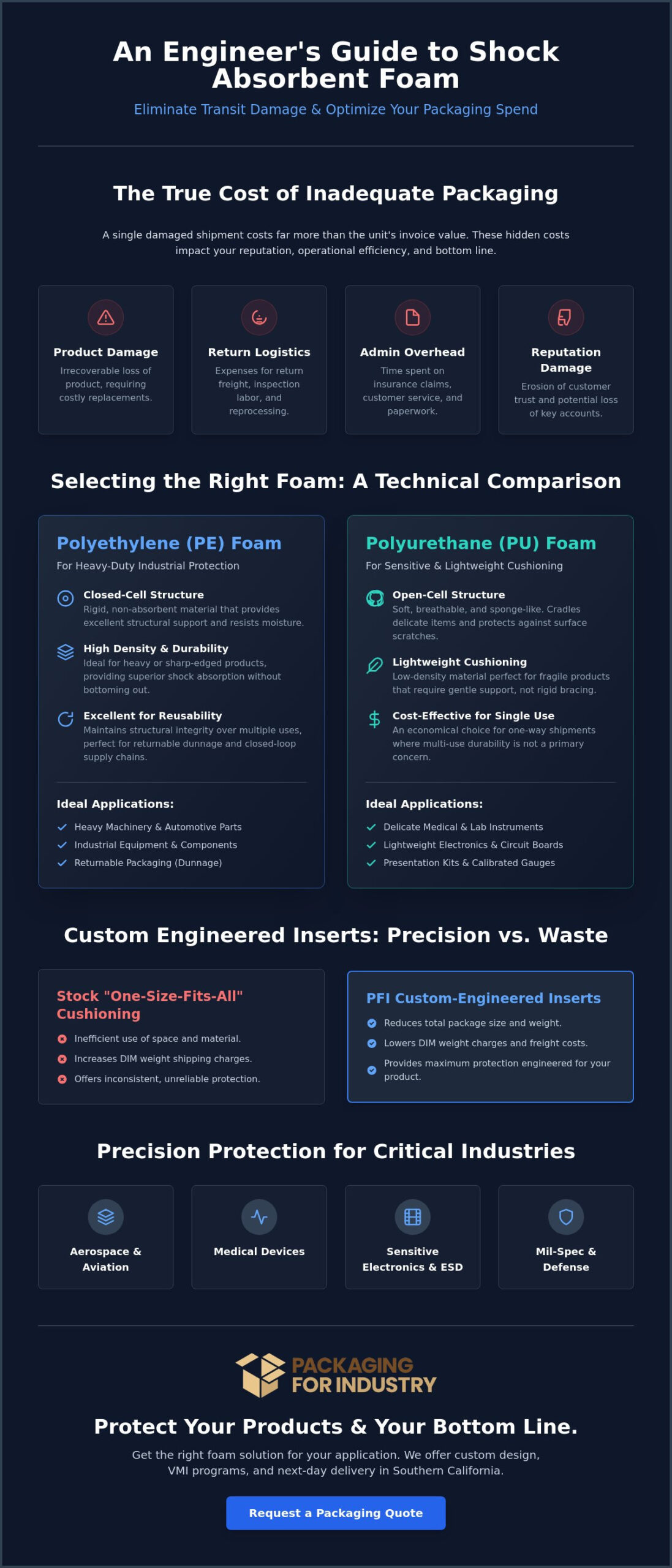
A single damaged shipment costs far more than the unit’s invoice value. You must account for return freight, the labor required for inspection, and the administrative burden of filing insurance claims. Frequent damage also erodes your reputation with key accounts, which is a cost you can’t easily recover. Investing in precision-engineered shock absorbent foam packaging Huntington Beach isn’t an added expense. It’s a strategic move to reduce these “soft costs” and protect your customer retention rates. Optimized foam reduces insurance claim frequency and administrative overhead, allowing your team to stay focused on production rather than logistics firefighting.
Industries Requiring Precision Shock Absorption
Precision is mandatory in sectors like aerospace and aviation. Calibrated instruments can lose their settings from standard road vibration even if the housing doesn’t crack. This vibration-induced fatigue is a major risk for high-end electronics and medical devices. We provide specialized foam solutions that manage these micro-vibrations and handle electrostatic discharge (ESD) risks. For medical device manufacturers, the goal is often ensuring the structural integrity of the outer casing so sterility is never compromised. In these fields, the shock absorbent foam packaging Huntington Beach is an engineered component of the product’s success, ensuring every shipment arrives ready for immediate use.
Selecting the Right Density: Polyethylene vs. Polyurethane Foam
Choosing the right material for your shock absorbent foam packaging Huntington Beach depends entirely on your product’s fragility and weight. Not all foams are created equal. Using a high-density foam for a lightweight, fragile instrument is just as dangerous as using a soft foam for heavy machinery. The former won’t compress enough to absorb shock, while the latter will bottom out immediately, transferring the impact directly to your goods. Precision in material selection is the difference between a successful delivery and a costly insurance claim.
Polyethylene (PE) Foam for Industrial Strength
Polyethylene is the industry standard for heavy-duty protection. It’s a closed-cell material, which means it doesn’t absorb moisture and provides excellent high-rebound protection. It’s exceptionally tough. PE is the preferred choice for automotive parts, heavy machinery, and returnable dunnage. Because it maintains its structural integrity over multiple trips, it offers better long-term value for closed-loop supply chains. If you’re shipping heavy components that require rigid support, PE’s resistance to chemicals and moisture makes it indispensable.
Polyurethane (PU) Foam for Sensitive Cushioning
Polyurethane offers a different set of protective properties. It’s an open-cell foam, which makes it breathable and much softer than PE. You’ll frequently see this in “egg crate” styles used for delicate medical instruments or lightweight electronics. While PU is excellent for “cradling” a product, it has specific limitations. It’s not designed for heavy loads and can struggle in high-humidity environments where its open-cell structure might absorb moisture. For lightweight items, however, its ability to dampen micro-vibrations is unmatched.
Material Comparison Framework
Engineering-minded buyers look at the “G-factor”—the maximum acceleration a product can withstand before failure. Our teams use ASTM D4168 testing to determine how well a specific foam thickness and density will perform under real-world impact scenarios. This data-driven approach ensures you aren’t over-packing or under-protecting.
- Polyethylene (PE): High load-bearing capacity; moisture resistant; ideal for heavy industrial goods.
- Polyurethane (PU): Low load-bearing capacity; superior vibration dampening for light, fragile items.
- Cross-linked Polyethylene (XLPE): Superior chemical resistance and smooth aesthetics for high-end medical or aerospace presentation.
- Expanded Polystyrene (EPS): Rigid and cost-effective for static void fill, though less resilient for repeated impacts.
Selecting the wrong density leads to either product damage or wasted material costs. If you aren’t sure which material suits your G-factor requirements, you can compare packaging pricing and material specs with our engineering team to ensure total protection for your shipments.
Custom Foam Inserts vs. Stock Cushioning: A Cost-Benefit Analysis
Many procurement managers fall into the trap of assuming stock foam sheets or generic void fill are the most cost-effective way to protect a product. This is rarely the case for high-volume or high-value shipments. Stock materials often necessitate oversized corrugated boxes to accommodate the lack of precision. In industrial logistics, excessive box size triggers higher dimensional (DIM) weight charges from carriers. By switching to custom-engineered shock absorbent foam packaging Huntington Beach, you can often downsize your outer container. This reduction in shipping volume directly lowers your freight spend while providing a higher level of protection than “one-size-fits-all” alternatives.
Labor efficiency is another critical factor often overlooked in the budget. Stock cushioning requires manual wrapping, taping, and stuffing. These repetitive tasks increase pack-out time and introduce human error. Custom foam inserts, especially when integrated into packaging kitting programs, allow for a simple drop-in assembly. This streamlines the fulfillment process and ensures every unit is packed to the exact engineering specification. For high-value brands in the electronics or medical fields, this precision also enhances the professional unboxing experience, reinforcing the quality of the product inside.
Precision Engineering and Prototyping
Transitioning to custom solutions starts with custom design packaging. Our engineering team uses CAD/CAM integration to translate your product’s physical dimensions and weight into precise foam geometries. We prioritize prototyping to ensure a perfect fit before you commit to a full production run. This methodical approach eliminates the need for excessive tape and secondary void fill, creating a cleaner and more efficient package that performs under stress.
When to Choose Stock Packaging Materials
Custom solutions aren’t the answer for every SKU. For low-volume industrial shipments with variable dimensions, stock materials remain a practical choice. We provide bulk quantities of foam sheets, rolls, and edge protectors for these scenarios. If your operations involve high-complexity items in very small batches, expanding foam-in-place systems can offer the necessary versatility without the upfront investment of custom tooling. The key is evaluating your specific order volume against the potential savings in labor and shipping volume.
Procurement Strategies: Managing Bulk Foam and Inventory Logistics
One of the most significant hurdles in industrial procurement is the sheer physical volume of protective materials. Foam is mostly air. This means storing large quantities of shock absorbent foam packaging Huntington Beach becomes a major drain on your warehouse floor space. When you tie up square footage with bulky inventory, you’re effectively increasing your overhead costs for every pallet stored. The solution lies in shifting from a “just-in-case” inventory model to an agile, Just-in-Time (JIT) delivery system. By leveraging a local supplier with next-day delivery capabilities throughout Southern California, you can maintain lean inventory levels without risking stockouts.
Logistics efficiency improves when you consolidate your vendor list. Managing separate suppliers for foam, corrugated boxes, and stretch film creates unnecessary administrative friction. We advocate for a holistic approach where all protective components are sourced and delivered together. This reduces the number of inbound shipments and simplifies your receiving process. For manufacturers in Orange County and Los Angeles, local manufacturing translates to shorter lead times and a more responsive supply chain that can adapt to sudden production spikes.
Optimizing the Packaging Supply Chain
For high-volume manufacturers, Vendor Managed Inventory (VMI) is the most effective way to eliminate the burden of tracking stock levels. Under a VMI program, we monitor your usage and replenish supplies automatically. This ensures your production line never stops. It also removes the stress of manual ordering. By trusting a seasoned industrial partner to oversee your inventory, you gain peace of mind and can reallocate your labor to core manufacturing tasks.
Bulk Pricing and Volume Discounts
Achieving packaging cost savings requires a careful balance between tiered bulk ordering and carrying costs. While bulk packaging pricing often looks attractive on paper, the cost of the warehouse space required to store it can negate the unit-price savings. We help our clients find the “sweet spot” where volume discounts align with operational flow. If you haven’t reviewed your procurement strategy recently, consider a comprehensive packaging audit. This process identifies waste in your current system, from over-specified material densities to inefficient ordering cycles that lead to emergency freight charges.
Logistics shouldn’t be an afterthought in your packaging strategy. If you’re ready to optimize your warehouse footprint and reduce overhead, you can request a bulk packaging quote to see how our VMI and JIT programs can streamline your operations.
Partnering with PFI for Custom Engineered Foam Solutions
PFI approaches protective packaging through the lens of industrial economics. We don’t just sell foam; we engineer systems that reduce your total cost of ownership. By combining engineering expertise with a deep understanding of logistics, we ensure your shock absorbent foam packaging Huntington Beach is optimized for both safety and spend. Our role is to act as a seasoned partner that eliminates professional stress through reliable, repeatable results. We understand that your reputation is tied to the condition of your product upon arrival, and we take that responsibility seriously.
For sectors with zero-tolerance for failure, such as defense and aviation, we provide military-spec (mil-spec) packaging. These standards require specific material performance under extreme conditions that generic packaging can’t handle. Our facility is equipped to handle these stringent requirements, ensuring every custom insert meets the necessary durability and impact-resistance benchmarks. We supplement this technical precision with logistical agility, offering next-day delivery across Southern California for both stock materials and custom-engineered items.
Tailored Solutions for Specialized Sectors
The aerospace and aviation industry relies on us for protecting sensitive, calibrated equipment that cannot withstand even minor vibration. Similarly, our heavy-duty solutions for manufacturing and industrial equipment focus on high-rebound polyethylene that survives multiple transit legs. We also support rapidly growing e-commerce brands that need scalable foam inserts to protect fragile consumer goods while maintaining a professional brand image. Our ability to provide both custom and stock materials makes us a versatile partner for companies at any stage of growth.
Request a Custom Packaging Quote
Starting a project with PFI is a straightforward, consultative process. Unlike many competitors, we offer free prototyping as part of our custom design packaging services. This allows you to test the fit and performance of a foam solution before committing to a full production run. It’s the most effective way to ensure your shock absorbent foam packaging Huntington Beach performs exactly as intended under real-world shipping conditions.
The final step toward a more reliable supply chain is a professional audit of your current damage rates and packaging spend. Our specialists are ready to help you transition to a more efficient system that includes local, next-day delivery and optimized material usage. You can request a custom packaging quote today to secure your inventory and eliminate the costs of shipping damage once and for all.
Secure Your Supply Chain with Engineered Protection
Effective industrial protection is a calculated balance of material science and logistical efficiency. You’ve seen how the right foam density prevents G-force impact and how custom inserts reduce expensive DIM weight charges. Moving beyond generic cushioning allows you to reclaim valuable warehouse space and eliminate the administrative burden of constant transit damage. By integrating precision shock absorbent foam packaging Huntington Beach into your operations, you ensure that every shipment reinforces your reputation for reliability.
PFI provides the technical expertise required for high-stakes sectors like aerospace and defense, consistently meeting stringent mil-spec standards. We offer free prototyping for all custom designs so you can verify performance before production begins. With local next-day delivery across Southern California, we provide the agile support your production schedule demands. It’s time to stop treating packaging as an afterthought and start using it as a tool for fiscal optimization.
Request a Custom Foam Packaging Quote to begin your packaging audit. We look forward to helping you build a more resilient and cost-effective shipping process.
Frequently Asked Questions
What is the best foam for shock absorption in heavy machinery?
Polyethylene (PE) foam is the industry standard for heavy machinery due to its high load-bearing capacity and closed-cell structure. It provides excellent rebound and remains durable through multiple transit legs. Unlike softer foams, PE won’t bottom out under the weight of industrial equipment. This ensures the shock absorbent foam packaging Huntington Beach provides consistent protection throughout the supply chain, even during rough LTL shipping.
How do I determine the right foam density for my product?
Selecting the right density involves calculating your product’s fragility rating, or G-factor, alongside its total weight and surface area. You must ensure the foam is soft enough to compress upon impact but firm enough to prevent the product from hitting the outer container. Our engineering team uses these metrics to specify the exact density required to decelerate your cargo safely during rough handling or sudden drops.
Can custom foam inserts help me save money on shipping costs?
Yes, custom inserts often lead to significant savings by reducing the dimensional (DIM) weight of your shipments. Precision-engineered foam allows you to use the smallest possible outer box while maintaining superior protection. This reduction in package volume lowers carrier fees. Additionally, custom designs streamline the pack-out process. This reduces labor costs and eliminates the need for secondary void fill like bubble wrap or loose fill.
Do you offer anti-static foam for electronic components?
We provide specialized anti-static (ESD) foam designed specifically for the electronics and medical device sectors. These foams are chemically treated to dissipate static charges that could otherwise damage sensitive circuitry during transit. Available in both polyethylene and polyurethane varieties, our anti-static solutions protect against both physical impact and electrostatic discharge. This ensures your components remain fully functional and safe upon final delivery.
What is the difference between open-cell and closed-cell foam?
The primary difference lies in the structure of the internal “bubbles.” Closed-cell foam, like polyethylene, consists of sealed cells that resist moisture and provide high structural rigidity for heavy loads. Open-cell foam, like polyurethane, features interconnected cells that allow air to pass through. This makes it softer and more flexible. It’s ideal for cushioning lightweight, highly fragile items that require a gentle cradle rather than rigid support.
How quickly can I get custom foam prototypes for my business?
Our design and engineering team prioritizes rapid prototyping to keep your production timeline on track. Once we receive your product specifications or CAD files, we can typically produce a custom prototype within a few business days. This allows you to verify the fit and protective performance of your shock absorbent foam packaging Huntington Beach before committing to a full production run. This process ensures total confidence in the final design.
Does PFI offer next-day delivery in Southern California?
We provide reliable next-day delivery for stock items and many custom orders throughout Southern California, including Orange County, Los Angeles, and San Diego. Our local manufacturing and distribution capabilities allow us to support Just-in-Time (JIT) inventory strategies. This proximity reduces lead times and helps our clients minimize the amount of warehouse space dedicated to bulky packaging inventory. It’s a proactive way to manage your logistics overhead.
Can you provide mil-spec compliant foam for defense contracts?
We specialize in meeting the rigorous requirements of military-spec (mil-spec) packaging for defense and aerospace contracts. Our materials comply with specific standards for durability, chemical resistance, and shock absorption under extreme environmental conditions. We understand the documentation and quality control processes required for government work. This positions PFI as a dependable partner for manufacturers serving the military and aviation sectors who require total accountability.