
Is your “convenient” catalog supplier actually draining your operational budget through inflated per-roll pricing and inconsistent film quality? Most warehouse managers accept rising packaging costs as an unavoidable reality, yet the hidden expenses of shipping damage and production delays tell a different story. When you decide to Purchase Stretch film by the Pallet, you move beyond the high-margin retail model and into a professional procurement strategy designed for industrial scale.
Managing inventory for high-volume operations requires a balance between fiscal efficiency and warehouse space. Whether you are working with a Los Angeles packaging supplier or looking for nationwide distribution, you need a system that ensures your high-value goods arrive intact every time. In this article, you’ll discover how to optimize your bulk film procurement to lower your per-unit costs and prevent load failure. We will also cover the benefits of just-in-time delivery and how consistent film performance protects your bottom line and your professional reputation.
Key Takeaways
- Learn how buying in pallet quantities of 48 to 60 cases provides significant wholesale savings compared to standard case-by-case ordering.
- Understand the technical differences between cast and blown stretch film to ensure your specific industrial loads remain secure during transit.
- Discover how to Purchase Stretch film by the Pallet as part of a Vendor Managed Inventory (VMI) program to save warehouse floor space and prevent stockouts.
- Master the science of load containment to reduce product damage and insurance claims through proper film application and tensioning.
- Evaluate the operational shift from manual hand-wrapping to automated machine film to improve labor efficiency and packaging consistency.
The Economics of Bulk Stretch Film: Why Purchase by the Pallet?
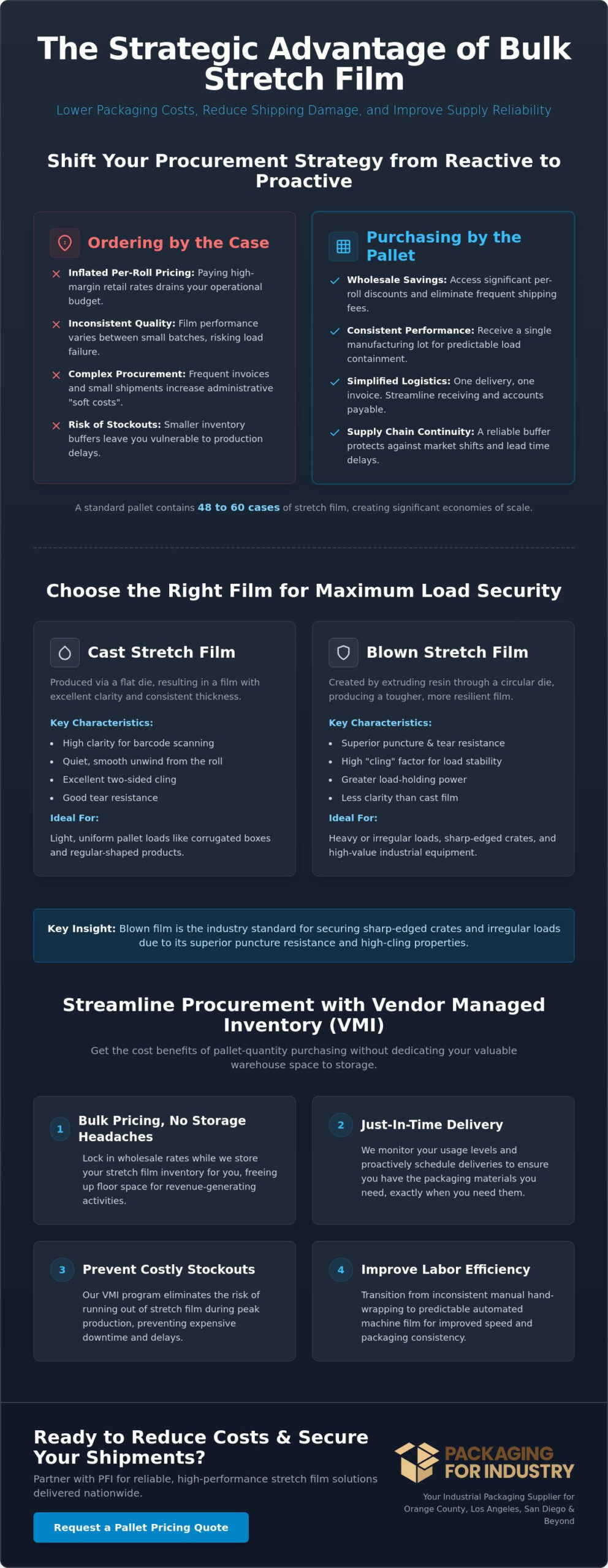
High-volume manufacturing and fulfillment centers require a steady flow of consumables to keep production lines moving. For these operations, purchasing stretch film by the case is often an expensive and logistically taxing habit. A standard pallet of stretch film typically consists of 48 to 60 cases, depending on the roll size and gauge. When you choose to Purchase Stretch film by the Pallet, you access wholesale rates that large catalog suppliers rarely offer to smaller-volume buyers. This shift in procurement strategy does more than just lower packaging costs; it ensures supply chain continuity by providing a reliable buffer against market fluctuations and lead time delays.
Transitioning to pallet-quantity orders also simplifies your accounts payable and receiving processes. Instead of processing weekly invoices and unloading small shipments, your team handles a single, organized delivery. This efficiency reduces the “soft costs” of procurement that often go unnoticed but quietly erode your margins over time. By centralizing your stretch film supply, you gain better control over your packaging spend and operational rhythm. Additionally, bulk ordering allows for better quality control. When you receive a single manufacturing lot, you avoid the performance variations that sometimes occur between different small-batch shipments.
Calculating the Real ROI of Wholesale Procurement
The financial impact of bulk purchasing extends beyond the sticker price. While the per-roll cost for a single case might seem manageable, the cumulative savings of a full pallet are substantial. You aren’t just saving on the plastic itself; you’re also eliminating the frequent shipping charges associated with smaller, recurring orders. Stretch wrap or stretch film is a critical component of load unitization, and its performance must be consistent. Bulk procurement allows you to standardize on a specific high-performance gauge, which reduces machine downtime and the need for costly re-wrapping. When your film performance is predictable, your total labor costs remain stable.
Inventory Management for Large-Scale Warehousing
Space is a premium asset in any lean warehouse. Some operations hesitate to Purchase Stretch film by the Pallet because they fear it will clutter their floor space. If you’re working with an Orange County packaging supplier like PFI, you can utilize Vendor Managed Inventory (VMI). This allows you to maintain the pricing benefits of bulk volume without the storage headaches. We monitor your usage levels and deliver film exactly when you need it, ensuring you never face a stockout during peak production cycles. This approach transforms a simple commodity purchase into a managed service that supports your broader business goals of efficiency and fiscal responsibility.
Choosing the Right Film: Technical Specs for Industrial Loads
Selecting the correct material is just as critical as the price per roll. When you Purchase Stretch film by the Pallet, you must ensure the technical specifications align with your load profile to avoid transit failure. Standardizing on the wrong film gauge or material type can lead to excessive waste or, worse, load shifting during transport. Understanding the engineering behind the film helps operations managers make informed decisions that balance cost with performance. This technical alignment is especially important for high-value sectors like aerospace, where specialized components require maximum protection against vibration and environmental factors.
Cast Stretch Film vs. Blown Stretch Film
The manufacturing process determines how the film behaves under stress. Cast stretch film is produced by continuously feeding a polymer melt through a flat die. This results in high clarity, a quiet discharge from the roll, and excellent tear resistance for uniform loads. In contrast, blown film is created by extruding resin through a circular die and blowing it into a large bubble. This process creates a film with superior “cling” and higher puncture resistance, making it ideal for heavy or irregular industrial equipment. Blown film is the industry standard for sharp-edged crates due to its superior puncture resistance and high-cling properties.
Thickness is typically measured in gauge or microns. Lower gauge films are often sufficient for light, uniform pallets of corrugated boxes, while heavier loads require a higher gauge to maintain containment. Following PMMI’s best practices for flexible materials can help you determine the optimal thickness for your specific application. If you’re unsure which material fits your current workflow, you can request a packaging quote to get a professional assessment of your load requirements.
Machine Stretch Film for High-Volume Automation
For operations moving large volumes of product, transitioning from hand-wrapping to automated equipment is a logical progression. Machine stretch film is engineered to handle the high-speed tension of wrapping equipment. One of the primary advantages is pre-stretch capability; high-performance machine films can expand up to 300% without losing structural integrity. This allows you to use significantly less material per pallet while maintaining a secure wrap. When you Purchase Stretch film by the Pallet for automated lines, the consistency of the film gauge is paramount to prevent machine jams. In large-scale manufacturing environments, matching the film width and gauge to your specific pallet wrapper ensures consistent tension control and reduces the risk of human error.
Maximizing Load Stability and Reducing Product Damage
Operational efficiency is often measured by the speed of the shipping dock, but the true metric of success is the condition of the goods upon arrival. When you Purchase Stretch film by the Pallet, you’re investing in more than just plastic; you’re securing the “memory” of the film. This engineering property allows the material to continuously pull back toward its original state after being stretched. This constant tension creates a cohesive unit that resists the centrifugal forces and vibrations common in long-haul trucking. High-performance films with superior elastic recovery ensure that even if a load shifts slightly, the film’s memory brings it back into alignment.
Many warehouses focus solely on the price per roll, ignoring the much more critical “cost-per-pallet-shipped” metric. Poor load containment is a leading cause of transit damage and subsequent insurance claims. By standardizing your wrapping protocols and using high-quality materials, you can significantly reduce these losses. Modern, high-performance films allow for down-gauging, which means you can use a thinner film that provides equal or better containment force than a thicker, traditional alternative. This approach reduces your environmental footprint and lowers your overall material consumption without compromising the safety of your cargo.
Preventing Pallet Failure in Transit
The most frequent point of failure in palletized shipping occurs at the base of the load. If the film doesn’t sufficiently grip the wood pallet, the entire stack can slide off the base during a sudden stop or sharp turn. To prevent this, operators must ensure the wrap pattern starts low enough to catch the pallet itself. Testing wrap tension is equally vital. Using a containment force tool allows your team to verify that the film is applying consistent pressure across the top, middle, and bottom of the load. The total number of wrap layers must increase proportionally with the weight and height of the pallet to maintain structural integrity during sudden stops.
Integrated Protection for Fragile Goods
For high-value or sensitive items, stretch film is only one part of a comprehensive protection system. When you Purchase Stretch film by the Pallet for specialized sectors like medical or electronics, you should consider integrating corner and edge protection to prevent the film from crushing the edges of corrugated boxes. This combination allows for higher tension settings on your wrapping equipment, which results in a tighter, more secure load.
Security is another factor in reducing product loss. Using opaque or colored stretch film can hide the contents of a pallet, acting as a deterrent against “opportunity theft” in the supply chain. For highly sensitive electronic components, pairing your film with custom foam packaging ensures that internal movement is eliminated while the external wrap provides the necessary containment. Standardizing these wrap patterns ensures every shipment meets your quality control benchmarks, regardless of who is operating the equipment.
Streamlining Procurement with VMI and Just-In-Time Delivery
Efficient operations managers recognize that the most expensive stretch film is the roll you don’t have when the wrapping machine goes down. While the decision to Purchase Stretch film by the Pallet secures wholesale pricing, the logistical management of that inventory determines your true operational efficiency. Many businesses struggle with an reactive ordering model, which often leads to emergency rush orders and costly production delays. Transitioning to a strategic stocking program allows you to stabilize your supply chain and focus on your core manufacturing goals without the constant stress of inventory tracking.
Managing high-volume consumables requires a balance between stock availability and warehouse floor space. When you partner with a professional packaging supplier, you move beyond simple transactions and into a logistical partnership. This shift simplifies your purchasing cycles and ensures that your packaging spend is optimized for both material costs and operational flow. By integrating your film procurement with other essential supplies, you create a more resilient and predictable supply chain.
How Vendor Managed Inventory (VMI) Works
Our VMI program begins with a comprehensive assessment of your monthly usage and peak production windows. Instead of your team manually checking stock levels, PFI monitors your inventory and handles the replenishment process automatically. This proactive approach eliminates the hidden costs of freight surcharges for overnight shipments and prevents the stress of a stockout. By maintaining a buffer of critical supplies in our facility, we ensure your fulfillment lines never stop moving, even during unexpected surges in demand.
Local Logistics Advantage in Southern California
For businesses operating in Orange County, Los Angeles, and San Diego, local sourcing provides a distinct competitive edge. Our local presence allows for Just-In-Time (JIT) delivery, which is essential for lean manufacturing environments. You can Purchase Stretch film by the Pallet without dedicating valuable square footage to months of inventory. We hold the stock and deliver it to your dock exactly when it’s needed, often providing next-day service to keep your operations lean and agile.
This model also supports your broader industrial needs. A local partner can quickly coordinate the delivery of custom crates and wood packaging alongside your film shipments. This consolidated logistics approach reduces your overall carbon footprint and simplifies your billing cycles. Instead of managing multiple vendors and fragmented invoices, you benefit from a streamlined purchasing process that improves your company’s cash flow and reduces administrative overhead. To see how our local delivery and inventory programs can stabilize your supply chain, request a packaging quote today.
Why Choose Packaging For Industry (PFI) for Bulk Stretch Film?
High-volume industrial facilities require more than a generic catalog supplier; they need a partner that understands the technical nuances of logistics and material science. Based in Anaheim, our team provides personalized service to manufacturers and distributors across Los Angeles, Orange County, and San Diego. We recognize that your packaging needs are rarely isolated to a single product. That’s why we offer a comprehensive approach that integrates high-performance stretch film with corrugated boxes, protective foam, and custom-engineered crates. This holistic oversight ensures that every component of your packaging system works in unison to protect your bottom line.
When you choose to Purchase Stretch film by the Pallet from PFI, you access wholesale pricing that rivals national catalog giants while receiving the specialized attention of an industrial consultant. We serve demanding sectors like aerospace, automotive, and medical manufacturing, where precision and reliability are non-negotiable. Our local presence allows us to respond quickly to your operational shifts, providing a level of accountability that massive, distant suppliers cannot match. We don’t just ship rolls; we provide a steady, reliable supply chain that keeps your fulfillment lines moving without interruption.
The PFI Difference: Engineering Meets Economics
Our approach is rooted in the belief that packaging is an engineering challenge with a direct economic impact. We don’t just sell material; we analyze your specific wrap cycle to identify and eliminate waste. Many operations are trapped in a cycle of using “cheap” film that frequently breaks, leading to machine downtime and excessive material use. We provide consistent, high-quality film that maintains its structural integrity under high-speed tension. Our team offers free packaging reviews to help you identify cost-reduction opportunities and move toward more efficient, lower-gauge films that provide superior containment without the bulk.
Ready to Lower Your Packaging Costs?
Optimizing your procurement is a straightforward process that begins with a professional assessment. Whether you need a single pallet for a local warehouse or a high-volume contract for nationwide distribution, we have the logistical infrastructure to support your goals. We combine our Southern California expertise with nationwide shipping capabilities to ensure your goods are protected from the moment they leave the dock until they reach their final destination. Our focus remains on three core pillars: reducing your material spend, eliminating shipping damage, and ensuring you never face a stockout.
If you’re ready to move beyond reactive purchasing and implement a strategic stocking program, our Anaheim-based experts are ready to assist. We can help you transition to a Vendor Managed Inventory (VMI) model or simply provide a more competitive quote for your recurring film needs. Request a Stretch Film Quote today to see how our engineering-minded approach can improve your operational efficiency and lower your total packaging costs.
Optimize Your Palletization Strategy for Maximum Efficiency
Transitioning from case-by-case ordering to a wholesale model is a fundamental step in lowering packaging costs and improving load stability. By aligning technical film specifications with your specific industrial requirements, you eliminate the waste and damage associated with poor containment. When you choose to Purchase Stretch film by the Pallet, you gain more than just material; you secure a logistical partnership that prioritizes your operational uptime. Strategic procurement ensures that every shipment is wrapped for performance rather than just price.
PFI supports your high-volume needs through specialized engineering for aerospace and defense, ensuring your most sensitive goods remain protected throughout the supply chain. Our Vendor Managed Inventory (VMI) programs effectively eliminate stockouts, while our local next-day delivery across Southern California keeps your warehouse lean and agile. Whether you’re managing fulfillment in Los Angeles or manufacturing in Orange County, we provide the stability your logistics demand. It’s time to move beyond reactive purchasing and implement a professional system of protection.
Request a Bulk Stretch Film Quote from PFI and start optimizing your logistics today. We look forward to helping you streamline your operations and secure your bottom line.
Frequently Asked Questions
How many rolls of stretch film are typically on a pallet?
A standard pallet of stretch film typically contains 40 to 60 cases, which translates to 160 to 240 rolls for hand film or 40 to 50 rolls for machine film. The exact count depends on the roll diameter and weight. When you Purchase Stretch film by the Pallet, we provide a detailed breakdown of roll counts to ensure your inventory planning remains accurate and efficient.
What is the difference between 80 gauge and 63 gauge stretch film?
The primary difference lies in the thickness and containment force. 80 gauge is the traditional industry standard for mid-weight loads, while 63 gauge is a high-performance, down-gauged film designed to provide similar containment with less material. Using a 63 gauge film can lower packaging costs and reduce environmental impact without sacrificing the structural integrity of your palletized goods during transit.
Is it more cost-effective to use hand film or a machine pallet wrapper?
Transitioning to a machine pallet wrapper is generally more cost-effective for operations wrapping more than 10 to 15 pallets per day. While the initial equipment investment is higher, the machine’s ability to pre-stretch film up to 300% significantly reduces material consumption per pallet. This efficiency, combined with lower labor costs and more consistent load containment, provides a superior long-term ROI for high-volume manufacturing facilities.
Can I get custom-colored or opaque stretch film by the pallet?
Yes, we provide a variety of custom-colored and opaque films in pallet quantities. Opaque films are particularly effective for high-value shipments where preventing opportunity theft is a priority by hiding the pallet’s contents. Colored films are also used for inventory organization and branding, allowing warehouse teams to identify specific product categories or shipping zones at a glance across the floor.
What are the benefits of using pre-stretched film for manual wrapping?
Pre-stretched film is engineered to be applied with minimal physical effort, as the film has already been elongated near its breaking point during manufacturing. This reduces worker fatigue and the risk of repetitive motion injuries for your warehouse team. Just as choosing the right film protects your goods, professional physical therapy from experts like Swedish Sports Massage helps protect your most valuable asset—your people. Additionally, it provides more consistent containment force because it doesn’t require the operator to manually pull the film to its maximum tension while walking around the pallet.
How does PFI’s VMI program handle bulk stretch film orders?
Our Vendor Managed Inventory (VMI) program eliminates the burden of tracking stock levels by proactively monitoring your usage patterns. We establish a strategic stocking level based on your peak production cycles and automatically trigger a replenishment order when inventory hits a specific threshold. This ensures you always have the necessary supplies to Purchase Stretch film by the Pallet without dedicating excessive warehouse space to long-term storage.
Do you offer next-day delivery for stretch film in Orange County?
Yes, we offer next-day delivery for stretch film and other essential supplies to businesses throughout Orange County. Our Anaheim-based logistics team is optimized for local fulfillment, allowing us to respond quickly to urgent inventory needs. This local service model supports your lean manufacturing goals by providing reliable, just-in-time delivery that minimizes your on-site inventory requirements and prevents production delays.
How do I determine if I need Cast or Blown film for my specific loads?
The choice depends on your load’s weight and shape. Cast film is best for uniform loads where clarity and quiet operation are important. Blown film is the superior choice for heavy, irregular, or sharp-edged loads, such as industrial crates, due to its higher puncture resistance and superior cling. Our team can conduct a free packaging review to analyze your load profile and recommend the most effective film for your application.