
Did you know that the empty space inside your shipping containers could be costing you as much as the product itself? Most operations managers in Los Angeles and Orange County recognize that the effort to reduce packaging waste is about more than just sustainability; it’s a matter of fiscal discipline. When you ship air, you’re paying high freight surcharges for dimensional weight and wasting valuable warehouse space on stock that doesn’t fit your current inventory. It’s a common frustration that leads to unnecessary overhead and an increased risk of product damage during transit.
We’re here to help you turn those logistical headaches into a competitive advantage. This guide will show you how to eliminate inefficiencies, lower freight costs, and protect your bottom line by optimizing your industrial packaging strategy. We’ll examine how custom-engineered corrugated boxes and precision foam inserts create a more reliable supply chain. You’ll learn how to streamline your warehouse operations and achieve a lower total cost per shipment through smarter design and vendor-managed inventory solutions that keep your facility running at peak performance.
Key Takeaways
- Identify the hidden financial drain of dimensional (DIM) weight surcharges and learn why shipping excess air is a major liability for industrial margins.
- Discover how custom-engineered corrugated boxes eliminate the need for excessive void fill while providing superior protection for specialized components.
- Learn to use high-performance materials, such as precision stretch film and custom foam inserts, to effectively reduce packaging waste without compromising load stability.
- Explore how Vendor Managed Inventory (VMI) and just-in-time delivery programs can reclaim warehouse floor space and prevent the buildup of obsolete packaging stock.
- Leverage local Southern California engineering expertise to streamline your supply chain from initial CAD design to final industrial delivery.
Identifying the Hidden Costs of Industrial Packaging Waste
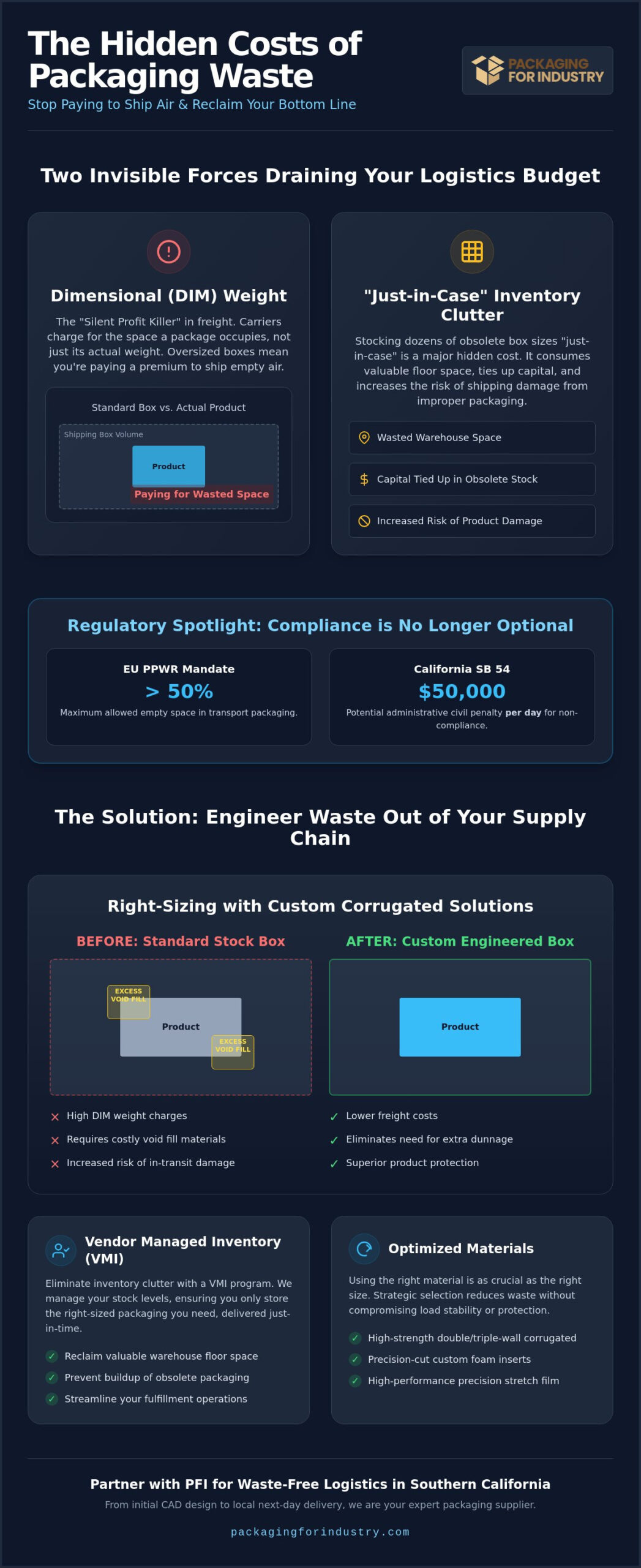
Industrial waste isn’t just the pile of scrap cardboard in the corner of your warehouse. For modern manufacturers, the most expensive form of waste is often invisible: it’s the empty space inside your shipments. Effectively managing Packaging waste requires looking past material disposal and examining how your logistical strategy impacts your bottom line. When you fail to reduce packaging waste at the engineering level, you’re essentially paying to transport air across the country. This inefficiency drains profits through increased material costs, higher freight fees, and slowed fulfillment speeds. If your team is spending extra minutes stuffing oversized boxes with dunnage, you’re losing money on labor and throughput as well.
The pressure to optimize is no longer just a financial choice. As of 2026, regulatory bodies have significantly tightened the requirements for packaging efficiency. For instance, the EU Packaging and Packaging Waste Regulation (PPWR) now mandates that empty space in transport packaging cannot exceed 50% of the total volume. Closer to home, California’s SB 54 packaging law, which took effect on May 1, 2026, carries administrative civil penalties of up to $50,000 per day for non-compliant producers. These mandates make packaging cost savings a necessity for both environmental stewardship and legal compliance in today’s market.
Dimensional Weight: The Silent Profit Killer
Dimensional (DIM) weight is a pricing technique used by major carriers to charge for the space a package occupies rather than its actual mass. If you use standard, off-the-shelf corrugated boxes for specialized aerospace or medical components, you’re likely paying a premium for volume. Carriers use a specific formula to determine the billable weight. Reducing a box’s dimensions by even one inch can lead to thousands of dollars in annual savings across a high-volume shipping operation. Waste in the box translates directly to waste in your logistics budget. It’s a calculation that many businesses ignore until the freight surcharges become unsustainable.
The Cost of “Just-in-Case” Inventory Clutter
“Just-in-case” inventory is another significant hidden cost. Many warehouses in Los Angeles and San Diego struggle with “material creep,” where they stock dozens of box sizes that no longer fit their current product lines. This obsolete stock takes up valuable floor space and ties up capital that could be used elsewhere. Storing the wrong box sizes leads to warehouse inefficiency and increases the risk of damage when workers use improper packaging for a shipment. Implementing a Vendor Managed Inventory (VMI) program can eliminate this clutter. It ensures you only store the right-sized packaging you actually need for your specific applications, allowing you to reduce packaging waste at the source.
Right-Sizing: Engineering Custom Corrugated Solutions
Standard stock boxes are designed for general use, not for the specific geometry of industrial components. When you rely on off-the-shelf sizes, you’re forced to compensate for the “slop” inside the container with layers of plastic bubble or paper dunnage. This approach is fundamentally inefficient. Transitioning to custom-engineered corrugated boxes allows you to eliminate the need for excessive void fill by creating a container that mirrors the product’s dimensions. According to the EPA, Containers and packaging make up a major portion of municipal solid waste; however, for manufacturers in Orange County and Los Angeles, reducing that volume starts with better engineering. Precision fitment ensures that the product doesn’t shift during transit, which is the primary cause of shipping damage.
Material selection is equally critical in the effort to reduce packaging waste. Many operations over-compensate for poor fit by using thicker single-wall boards, when a strategically designed double-wall or triple-wall corrugated structure could provide superior protection with a smaller overall footprint. These high-strength materials allow for more efficient stacking on pallets, maximizing your trailer’s cube utilization. Before committing to bulk quantities, our team utilizes CAD/CAM technology for custom design packaging to create physical prototypes. This allows you to verify the fit and structural integrity of the design in a real-world environment, ensuring you don’t invest in a solution that fails to perform on the warehouse floor.
A 5-Step Process for Right-Sizing Your Shipping
Engineering a waste-free shipping container requires a methodical approach to ensure both safety and cost-efficiency. Following these steps helps streamline the transition from stock boxes to custom solutions:
- Step 1: Conduct a precise product measurement and center-of-gravity analysis.
- Step 2: Select the appropriate board grade (RSC, double-wall, or triple-wall) based on load requirements.
- Step 3: Engineer internal partitions or custom inserts to secure the item without extra void fill.
- Step 4: Perform prototyping and drop-testing to simulate the rigors of the supply chain.
- Step 5: Finalize the design for bulk production, ensuring it integrates with your existing palletization standards.
Custom vs. Stock: A Decision Framework
While standard RSC boxes are cost-effective for uniform, non-fragile goods, there’s a clear tipping point where custom engineering pays for itself. If your damage rates exceed 1% or if you’re consistently paying for “air” via DIM weight surcharges, it’s time to move away from stock supplies. For high-value sectors like aerospace or medical device manufacturing, the cost of a single damaged shipment far outweighs the investment in a precision-fit box. By matching the container to the product, you reduce packaging waste and lower your total cost per shipment. If you’re unsure if your current setup is optimized, it’s helpful to request a packaging quote to compare the long-term savings of a custom-engineered solution.
Optimizing Protective Materials and Stabilization
Stabilization is where many industrial operations over-consume materials, often out of a misplaced fear of shipping damage. Many warehouses in San Diego and Anaheim over-wrap pallets because they lack the right materials or containment strategy. This leads to a massive volume of plastic film and dunnage destined for the landfill. To truly reduce packaging waste, you have to look at the physics of load containment. Instead of simply adding more layers, the goal is to use high-performance materials more efficiently. Implementing these Practical Ways to Minimize Packaging Waste allows you to maintain load integrity while significantly cutting your material spend.
Stretch Film: The “Down-Gauging” Strategy
Hand-wrapping pallets is notoriously inconsistent and wasteful. When workers wrap by hand, they rarely achieve the optimal tension required to secure a load, leading them to use more film than necessary. Switching to machine-grade stretch film allows for a strategy known as down-gauging. High-performance films are engineered to be thinner yet stronger than traditional wraps. By utilizing pre-stretched films, your warehouse team can achieve superior containment force with a fraction of the material. It’s not about how many times you circle the pallet; it’s about the force applied to the load. This approach ensures that your shipments remain stable during transit to Los Angeles or across the country without the environmental and financial cost of excess plastic.
Foam Engineering: Protection Without the Bulk
Loose-fill “peanuts” and oversized bubble wraps are inefficient for specialized sectors like aerospace and medical device manufacturing. These materials take up immense warehouse space and offer inconsistent protection. Precision foam packaging, specifically die-cut polyethylene or ESD foam, provides exact protection by matching the density of the foam to the weight and fragility of the product. This engineering-first approach allows you to reduce packaging waste by using the minimum amount of material required to absorb shock. For recurring shipments or internal logistics, reusable foam-lined crates can eliminate the need for single-use disposables entirely. This shift toward precision inserts ensures that sensitive electronics and components are secured in the smallest possible footprint.
Stabilization can be further improved by integrating rigid corner and edge protection. These components reinforce the structural integrity of your pallet loads, preventing the “box crush” that often happens when stretch film is applied too tightly. By protecting the most vulnerable points of the shipment, you can often reduce the number of film revolutions needed to secure the load. This combination of high-performance film, precision foam, and edge reinforcement creates a streamlined system that prioritizes product safety and logistical efficiency over sheer material volume.
Implementing Process-Driven Waste Reduction
Physical design is only half the battle. To truly reduce packaging waste, you must address the logistical processes that lead to over-ordering and warehouse clutter. Many distributors in Los Angeles and Orange County find their floor space consumed by obsolete packaging that no longer matches their product lines. This is a form of waste that direct engineering alone cannot solve. It requires a systemic change in how inventory is managed, delivered, and utilized on the warehouse floor.
How VMI Eliminates Obsolete Packaging Waste
Leveraging Vendor Managed Inventory (VMI) allows you to shift the burden of supply oversight to your packaging partner. Instead of guessing your monthly needs and tying up capital in massive bulk orders, a VMI program uses regular inventory reviews to ensure you only stock what you actually use. This proactive approach prevents the accumulation of slow-moving packaging SKUs that eventually become obsolete. When your production requirements shift, your packaging supply adapts immediately. This ensures that the right corrugated boxes or protective materials are available exactly when production moves, effectively stopping the cycle of discarded, unused stock.
Kitting and Assembly: Reducing Labor Waste
Packaging kitting is another critical tool for streamlining industrial operations. By delivering all necessary components—including boxes, tapes, labels, and specialized protective foam—in one organized unit, you eliminate the “scavenger hunt” at the pack-out station. This reduces labor waste and ensures every shipment follows a standardized protocol. When your team has a pre-assembled kit, they’re less likely to use improper void fill or excess tape out of convenience. Combining this with just-in-time inventory management further reduces your warehouse footprint. You can use that reclaimed space for revenue-generating production instead of storing piles of empty containers.
Standardizing your packing protocols through team training is the final step in this operational shift. Without clear guidelines, warehouse staff often default to “over-packaging” to prevent damage, which counteracts your efforts to reduce packaging waste. Providing specific instructions on film revolutions, tape application, and insert placement ensures consistency across all shifts. This methodical approach protects your products while maintaining fiscal responsibility. If your warehouse is currently struggling with clutter or inefficient pack-out times, you can request a packaging quote to see how a managed inventory or kitting program can optimize your facility.
Why Manufacturers Choose PFI for Waste-Free Logistics
Industrial efficiency requires a partner that functions as more than a mere vendor. As a specialized custom box manufacturer, Packaging For Industry (PFI) provides the engineering oversight necessary to eliminate waste at the source. We don’t just provide containers; we design integrated systems that align with your specific manufacturing tolerances. This level of precision is critical for sectors like aerospace and medical devices, where even minor fitment errors lead to significant logistical fallout. By treating packaging as a strategic asset, we help you transition from standard supplies to engineered solutions that lower your total cost per shipment and effectively reduce packaging waste.
Anaheim-Based Support for Southern California Operations
For manufacturers and distributors searching for a reliable packaging supplier near me in Southern California, our Anaheim facility offers a distinct logistical advantage. We provide local next-day delivery to Los Angeles, Orange County, San Diego, and the Inland Empire. This proximity allows our team to perform on-site packaging reviews, identifying material creep and warehouse inefficiencies that a remote supplier would inevitably miss. By sourcing locally, you reduce the carbon footprint of your supply chain and eliminate the high freight costs of transporting bulky, empty containers across long distances. This local partnership ensures your production lines are never stalled by supply delays or lead-time inconsistencies, providing the peace of mind that comes with a steady, dependable supply chain.
Get Your Custom Packaging Cost-Reduction Analysis
Moving beyond a one-size-fits-all approach requires a detailed analysis of your current logistical footprint. PFI evaluates your specific waste points, from excess void fill to freight surcharges, and proposes engineered fixes that improve reliability. Our goal is to move your operation from a catalog-buyer mindset to a strategic partnership where every component serves a functional purpose. This shift ensures a reliable supply of right-sized packaging without the overhead of excess inventory or obsolete stock. We focus on the end-to-end experience, ensuring that from the initial CAD design to the final delivery, your packaging is optimized for both protection and profit. To begin your waste-reduction audit and receive competitive bulk packaging pricing for your custom solutions, you can request a packaging quote today and discover how our engineered approach protects your bottom line.
Optimize Your Industrial Logistics for a Leaner Future
Eliminating inefficiencies in your supply chain requires a shift from viewing packaging as a commodity to treating it as a strategic engineering asset. By addressing the root causes of excess volume and material creep, you don’t just reduce packaging waste; you actively lower your total cost per shipment and reclaim warehouse floor space for production. These adjustments protect your margins while improving the long-term reliability of your logistical operations.
Packaging For Industry (PFI) provides the technical expertise and engineering-minded approach required to execute these optimizations. We specialize in the rigorous requirements of the aerospace and medical sectors, offering free prototyping for custom designs to ensure a precision fit before bulk production begins. Our Anaheim-based distribution network supports Southern California manufacturers with local next-day delivery, helping you maintain a lean inventory without compromising on supply reliability.
Request a Custom Packaging Quote and Cost-Reduction Analysis to see how Packaging For Industry (PFI) can transform your logistical footprint into a leaner, more profitable operation.
Industrial Packaging Frequently Asked Questions
How can I reduce packaging waste without increasing the risk of product damage?
Precision engineering allows you to secure products without relying on excessive void fill. By matching the container to the product’s geometry, you eliminate the internal movement that leads to damage. This approach helps you reduce packaging waste while providing superior protection compared to oversized stock boxes stuffed with paper or plastic dunnage. It is a matter of using structural design rather than material volume to absorb shock.
What is the most effective way to lower freight costs through packaging?
Reducing the physical volume of your shipments is the most direct way to lower freight costs. Carriers charge based on dimensional (DIM) weight, so shipping excess air is a major financial liability. Engineering a box that fits the product exactly minimizes billable weight and maximizes pallet density. This strategy ensures you aren’t paying premium freight rates for empty space inside your corrugated boxes.
Does custom packaging actually save money compared to bulk stock boxes?
Custom packaging often results in a lower total cost per shipment than standard stock boxes. While many purchasing agents focus strictly on generic bulk packaging pricing, the real savings come from eliminating expensive dunnage and reducing labor at the pack-out station. It is a strategic investment that pays for itself through improved logistical efficiency and a measurable reduction in damage claims.
How does Vendor Managed Inventory (VMI) help reduce material waste?
VMI programs prevent the accumulation of obsolete materials by ensuring your inventory matches your current production needs. Instead of ordering in bulk and risking material creep, your supplier monitors stock levels and delivers only what’s required. This eliminates the disposal of unused, outdated boxes and helps you reduce packaging waste by keeping your warehouse floor clear of slow-moving or unusable SKUs.
What industries benefit most from custom-engineered foam inserts?
Specialized sectors like aerospace, medical device manufacturing, and high-end electronics benefit most from precision foam inserts. These industries require exact shock absorption and surface protection for sensitive components. Custom foam ensures that delicate instruments remain stationary during transit. This level of protection is essential for meeting rigorous quality standards and reducing shipping damage in high-value shipments across Southern California.
Can I reduce plastic waste while still using stretch film for load stabilization?
You can reduce plastic waste by switching to high-performance, down-gauged stretch film and machine-wrapping protocols. Machine wrapping provides consistent containment force with less material than hand-wrapping. Utilizing pre-stretched films also allows you to achieve the necessary load stability while using a fraction of the plastic. This approach cuts your environmental footprint without compromising the safety of your palletized loads.
What are the benefits of using a local Southern California packaging supplier?
A local Southern California packaging supplier provides immediate logistical advantages, including next-day delivery to Los Angeles, Orange County, and San Diego. Proximity reduces the freight costs and carbon emissions associated with transporting bulky materials. It also allows for on-site packaging reviews where Packaging For Industry (PFI) experts can analyze your bulk packaging pricing and identify engineered solutions to lower your total operational spend.