
Your custom packaging shouldn’t be a bottleneck for your production line or a drain on your bottom line. Many manufacturers in Orange County and Los Angeles find that complex, over-engineered packaging leads to high tooling costs and frustratingly slow lead times. Mastering corrugated box design for manufacturability is the most effective way to eliminate these inefficiencies. By aligning your material engineering with the realities of the manufacturing floor, you can stop paying for features that don’t add value.
We understand that you need packaging that protects your product without wasting warehouse space or slowing down your automated packing lines. You want a solution that balances durability with fiscal responsibility. This guide will show you how to optimize your designs to reduce manufacturing waste and lower your price per unit. We’ll explore how material selection and CAD/CAM prototyping can improve your supply chain reliability and ensure your packaging is ready for high-speed industrial environments.
Key Takeaways
- Discover how to balance structural integrity with production speed to reduce unit costs and eliminate manufacturing waste.
- Evaluate how selecting specific flute types and wall constructions, such as double or triple-wall, impacts both stackability and protection.
- Identify why prioritizing corrugated box design for manufacturability through RSC styles can significantly lower tooling costs compared to complex die-cuts.
- Leverage CAD/CAM support and free prototyping to verify product fit and performance before committing to a full production rollout.
- Streamline operations in Los Angeles and San Diego by using optimized designs that support Vendor Managed Inventory (VMI) and reduce warehouse overhead.
What is Corrugated Box Design for Manufacturability (DfM)?
Design for Manufacturability (DfM) is a specialized engineering discipline that bridges the gap between a conceptual package and a finished product. In the industrial sector, corrugated box design for manufacturability focuses on creating packaging that manufacturing equipment can produce with maximum speed and minimal waste. This practice is essential for high-volume manufacturers in Southern California who need to maintain lean operations to remain competitive in expensive markets like Los Angeles and Orange County.
The methodology prioritizes structural integrity while aggressively removing any features that don’t add value to the end user. Rather than focusing solely on the price per unit, DfM looks at the total cost of ownership. This includes the cost of raw materials, the energy consumed during production, and the labor required for final assembly. When you optimize for manufacturability, you reduce the likelihood of manufacturing defects and ensure a more reliable supply of corrugated boxes.
The Core Principles of Manufacturable Packaging
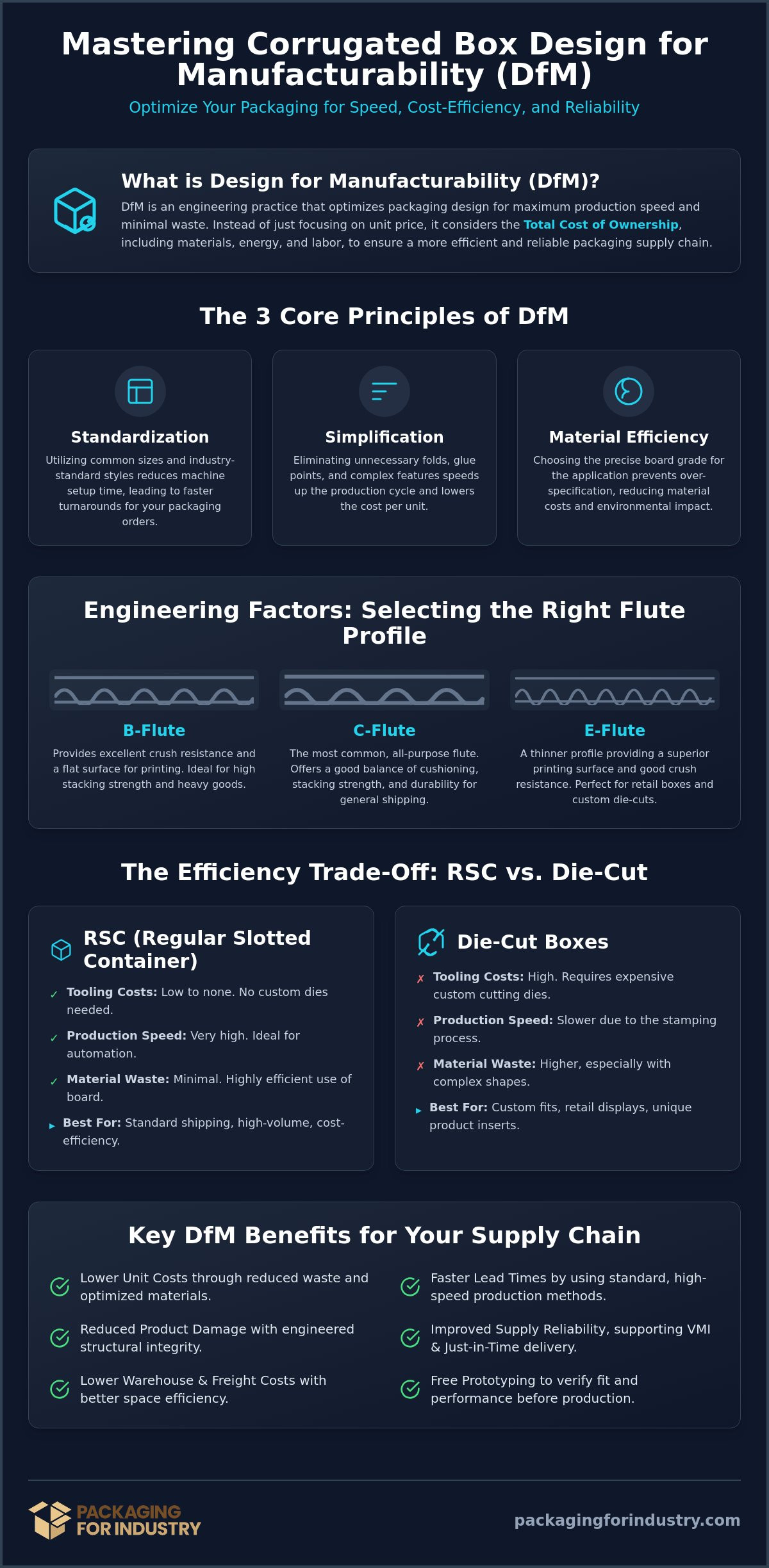
Successful DfM relies on three fundamental pillars that align engineering with economic reality. Standardization is a primary pillar. By utilizing common sizes and industry-standard styles, manufacturers reduce the time machines spend in setup, which directly translates to faster turnaround times for your orders. Simplification is equally vital. Every extra fold or glue point adds time to the production cycle, so a manufacturable design eliminates unnecessary complexity to speed up the conversion process.
Material efficiency rounds out these principles. Choosing the precise board grade for the application prevents over-specification, which reduces both material costs and your environmental footprint. Corrugated box design principles dictate that the right flute and liner combination should provide the necessary stacking strength without adding unnecessary bulk or weight to the shipment.
Why Industrial Buyers Should Prioritize DfM Early
Addressing design during the prototyping phase prevents production bottlenecks later in the supply chain. If a box is difficult to assemble, it slows down your packing line and increases labor costs. Optimized designs also ensure better palletization. This allows you to fit more units per shipment and reduces your overall warehouse footprint. For aerospace components, DfM reduces freight surcharges by ensuring that specialized protective packaging remains within standard dimensional weight limits for air transport.
Early adoption of DfM allows for better coordination with Vendor Managed Inventory (VMI) programs. Standardized, manufacturable designs are easier to stock and replenish on a just-in-time basis. This proactive approach helps you avoid the high costs of rush orders and ensures that your packaging is always ready for the next production run.
Engineering Factors: Flutes, Walls, and Material Grades
The technical composition of your packaging board is the foundation of corrugated box design for manufacturability. Selecting the wrong material can lead to machine jams on your packing line or catastrophic failure in the warehouse. Industrial buyers in Los Angeles and Orange County often prioritize either the Edge Crush Test (ECT) or the Mullen Burst Test. ECT measures the stacking strength of the board, which is critical for unitized loads on pallets. Mullen testing measures the force required to puncture the board, making it the better spec for heavy industrial parts that might shift during transit. This academic model for corrugated box design highlights how material selection directly influences logistical efficiency and waste reduction.
Material choice also dictates the speed of your automated case sealers. If the board is too rigid or too soft for the machine’s vacuum cups and folding arms, you’ll face frequent downtime. Achieving a balance between structural integrity and machine compatibility is the key to maintaining a high-velocity production environment.
Selecting the Right Flute Profile for Your Production Line
Flutes are the arched structures between the liners that provide cushioning and strength. Selecting the correct profile is a critical step in corrugated box design for manufacturability:
- B-Flute: Provides excellent crush resistance and a flatter surface. It’s the preferred choice for heavy canned goods or components that require high stacking strength without excessive bulk.
- C-Flute: The most common industrial standard. It offers a versatile balance of cushioning and vertical strength for the majority of shipping applications in San Diego and beyond.
- E-Flute: A very thin profile ideal for die-cut boxes. It provides the smoothest surface for high-quality printing and is frequently used for retail-ready industrial parts.
Double-Wall and Triple-Wall for Heavy-Duty Applications
When shipping high-value aerospace or automotive components, single-wall board often lacks the necessary puncture resistance. Moving to double-wall or triple-wall construction increases the box’s ability to withstand extreme vertical pressure. However, these heavy-duty grades are more complex to manufacture. They require specialized scoring and cutting equipment, which can lead to longer lead times if not planned correctly.
Engineering these robust solutions requires a deep understanding of how the extra thickness affects the final dimensions and assembly speed. If you are unsure which grade fits your specific application, you can request a packaging quote to consult with our engineering team. You can also view our full range of corrugated boxes to compare material specs for your next project. We focus on providing the exact grade needed to prevent damage while avoiding the unnecessary costs of over-packaging.
Balancing Customization: RSC vs. Die-Cut Efficiency
Choosing between a standard container and a custom die-cut is a pivotal decision in corrugated box design for manufacturability. While a complex design might offer a unique unboxing experience, it often introduces hidden costs in the form of specialized tooling and increased setup times. For high-volume industrial operations, the goal is to find the point where protection meets production speed. Every additional second spent at a packing station or every dollar spent on custom steel-rule dies must be justified by a measurable reduction in product damage or assembly labor.
Manufacturers in Anaheim and the surrounding Orange County area must also account for current lead times for custom die-cut tooling. If your production schedule is tight, relying on designs that require new tooling can create significant bottlenecks. Aligning your box format with your existing machinery ensures that your packaging remains a facilitator of growth rather than a source of downtime.
The RSC: Why the Standard Remains the Efficiency King
The Regular Slotted Container (RSC) is the most manufacturable box style ever engineered. Because all flaps are the same length from the score to the edge, there is minimal trim waste during the manufacturing process. This efficiency leads directly to lower unit pricing for bulk orders. RSCs are universally compatible with standard industrial case erectors and sealers, making them the ideal choice for manufacturing packaging needs. If your facility prioritizes throughput and cost-effectiveness, the RSC should be your baseline design.
Die-Cut Solutions: Precision for High-Value Goods
Die-cut boxes are necessary when standard sizes can’t provide the required precision. These designs use a custom die to cut complex shapes, including self-locking tabs and internal dividers. While the initial tooling cost is higher, die-cuts are often more efficient for “kitting” operations. They integrate seamlessly with custom foam inserts to secure sensitive electronics or medical devices. Furthermore, interlocking die-cut designs can reduce or eliminate the need for industrial adhesive tapes, which speeds up manual assembly and lowers total material spend.
The decision to move to a die-cut format should be based on labor savings. If a custom design allows a worker to pack a unit 30% faster than a standard box, the investment in tooling pays for itself quickly. For automated packing lines, however, the simplicity of the RSC often wins out. We recommend evaluating your assembly labor costs alongside your material costs to determine which format truly supports your bottom line.
The Role of Prototyping in Design Optimization
Prototyping is the bridge between a conceptual CAD file and a functional unit load. It serves as a final validation step to ensure that your corrugated box design for manufacturability doesn’t just look good on a screen but actually performs under the weight of a unitized pallet. Without a physical sample, you risk discovering design flaws only after thousands of units have already been produced. Our engineering process uses rapid prototyping to identify these weaknesses early, allowing for adjustments that prevent transit damage and assembly bottlenecks.
Iterative Design and CAD/CAM Support
Digital design files translate directly to our manufacturing equipment, which eliminates the guesswork often found in traditional packaging development. This CAD/CAM integration allows for rapid iterations without the need for expensive physical tooling. We can modify a score line or an internal flap in seconds, then cut a fresh sample for immediate testing. This precision engineering is the most effective way to reduce the risk of “over-packaging,” ensuring you aren’t paying for excess material that adds no protective value. PFI’s Anaheim team provides local prototyping for Orange County manufacturers, offering a hands-on collaborative environment where your team can verify product fit in real-time.
ISTA Testing and Real-World Simulations
Validating a design for manufacturability requires more than just a fit-check; it requires rigorous stress testing. We simulate the entire shipping cycle by testing for impact, vibration, and compression. These tests are essential for identifying and addressing common failure points in aerospace packaging designs, where high-value components must withstand extreme G-forces. By refining the design to include optimized corner and edge protection, we can lower your product damage rates and improve overall supply chain reliability.
Optimization also extends to how your boxes utilize warehouse and trailer space. During the prototyping phase, we analyze how minor dimensional changes impact pallet density. In expensive markets like Los Angeles and San Diego, maximizing every square inch of warehouse storage is a financial necessity. A design that allows for an extra layer of boxes per pallet can significantly reduce your freight and storage costs over the course of a year. We test the stacking strength of the prototype board to ensure it meets the requirements of your specific storage environment, preventing the bottom-box failure that often occurs with poorly specified materials.
Implementing DfM with Southern California Supply Chains
Optimizing your corrugated box design for manufacturability provides little value if your supplier can’t keep pace with your production schedule. In the high-velocity industrial hubs of Los Angeles and San Diego, the relationship between design and logistics is inseparable. A box that’s engineered for speed on the factory floor must also be engineered for efficiency in the warehouse. By aligning your design choices with a local supply chain, you eliminate the delays and high freight costs typically associated with national catalog suppliers.
DfM and Vendor Managed Inventory (VMI) Synergy
True operational efficiency is achieved when your design supports your inventory strategy. Utilizing Vendor Managed Inventory (VMI) allows you to shift the burden of stock management to your supplier. When you use standardized, manufacturable designs, inventory control becomes significantly cleaner. Simplification reduces the number of SKUs you need to track, which prevents stockouts and simplifies the procurement process. This streamlined approach improves your cash flow by ensuring you only stock the most efficient box designs in the quantities you actually need. It’s a pragmatic way to reduce professional stress and ensure your packing lines never sit idle.
Local Logistics: Serving Anaheim and Beyond
Proximity to your packaging manufacturer is a strategic advantage that national suppliers can’t replicate. For manufacturers in Anaheim and Orange County, working with a local partner means lead times are measured in hours rather than weeks. PFI provides local next-day delivery, which is essential for just-in-time manufacturing environments where warehouse space is at a premium. Reducing your box dimensions through corrugated box design for manufacturability directly lowers your warehouse footprint in expensive Southern California real estate markets.
Choosing a local, agile partner like PFI allows for faster responses to design changes or sudden spikes in demand. While large catalog companies offer one-size-fits-all solutions, we focus on custom-tailored responses that drive packaging cost savings across your entire operation. This local presence ensures total accountability from the initial design phase to the final delivery at your facility. It’s about building a reliable system of protection that supports your bottom line and improves your overall supply chain reliability.
Optimize Your Packaging for Long-Term Industrial Growth
Mastering corrugated box design for manufacturability is about more than just reducing material waste; it’s about creating a seamless flow from the manufacturing floor to the customer’s door. By prioritizing engineering factors like flute selection and wall construction, you can protect high-value aerospace and industrial components while maximizing pallet density. Whether you opt for the cost-effective RSC or a precision die-cut with custom foam, the goal remains the same: lower unit costs and improved supply chain reliability.
PFI supports these goals with free prototyping and expert CAD/CAM support to ensure a perfect fit before production. Our specialists understand the unique requirements of the Southern California market, providing local next-day delivery in Orange County and Los Angeles to keep your operations running on schedule. We’re ready to help you eliminate professional stress by solving your most complex logistical challenges through pragmatic, engineering-led solutions.
We look forward to helping you streamline your packaging operations and secure your bottom line.
Frequently Asked Questions
How does corrugated box design impact manufacturing lead times?
Design complexity is the primary driver of lead times in the packaging industry. Simple designs like the Regular Slotted Container (RSC) use standard equipment and can be produced almost immediately. Complex die-cuts require custom tooling, which can add several days or weeks to the initial production run depending on current tooling lead times in the Anaheim area. Aligning your corrugated box design for manufacturability with standard industry sizes allows for faster machine setups and quicker delivery to your facility.
What is the most cost-effective corrugated box style for high-volume shipping?
The Regular Slotted Container (RSC) is the most economical box style for high-volume industrial shipping. Its design results in minimal material waste during production and requires no specialized tooling. This efficiency translates to lower unit pricing and faster turnaround times compared to custom die-cut alternatives. For most manufacturers in Los Angeles and Orange County, the RSC remains the gold standard for balancing protection with fiscal responsibility.
Can custom box design help reduce UPS or FedEx dimensional weight surcharges?
Yes, optimizing box dimensions to fit your product precisely is a key strategy for reducing dimensional weight (DIM) surcharges. By eliminating excess air space, you can often drop into a lower DIM weight bracket, which significantly lowers your per-unit shipping costs with carriers like UPS and FedEx. Precision engineering ensures you don’t pay to ship empty space, which is essential for maintaining healthy margins in high-volume distribution.
When should I choose double-wall corrugated over single-wall?
You should move to double-wall corrugated when your product exceeds the stacking strength or puncture resistance limits of standard single-wall board. This is typical for heavy industrial parts, automotive components, or unitized loads that will be stacked high in a warehouse. Double-wall construction provides the structural integrity necessary to prevent bottom-box compression in high-density storage environments common in San Diego and Inland Empire distribution centers.
Do I need special tooling for a custom corrugated box design?
Tooling requirements depend entirely on the box style you choose. Standard RSC boxes don’t require special tooling because they’re produced on universal folding and gluing equipment. However, custom die-cut designs require a steel-rule die to create specific shapes, self-locking tabs, or internal cutouts. While this adds an upfront cost, the investment often pays for itself through reduced assembly labor and superior product protection for high-value goods.
How does design for manufacturability reduce product damage rates?
Corrugated box design for manufacturability reduces damage by ensuring the board grade and flute type are perfectly matched to the product’s weight and fragility. Through iterative prototyping and stress testing, we identify potential failure points before mass production begins. This proactive engineering ensures that the box maintains its structural integrity throughout the entire transit and handling cycle, even in the most demanding industrial supply chains.
What industries benefit most from custom corrugated engineering?
High-stakes sectors like aerospace, medical device manufacturing, and electronics benefit most from custom corrugated engineering. These industries require high-precision protection and often deal with strict regulatory or military-spec packaging requirements. Specialized engineering ensures that sensitive components remain secure while optimizing the overall supply chain for speed, reliability, and cost-effectiveness.