
In the industrial sector, your packaging requirements document is an engineering blueprint rather than a creative brief. Treating it as anything less is a direct invitation for shipping damage and inflated freight costs. You’ve likely dealt with the frustration of receiving a shipment only to find precision components compromised because of vague specifications or inconsistent materials from different suppliers. It’s a common operational bottleneck that forces engineering teams to waste time on rework instead of moving toward the next product launch.
Mastering how to write a packaging requirements document is the most effective way to eliminate these variables and gain control over your supply chain. This article provides a technical framework to help you document industrial packaging specs with precision. By following these steps, you’ll create a standardized template that reduces lead times for custom foam and corrugated prototypes while lowering your total cost of ownership. We’ll examine the specific data points your supplier needs to build high-performance protection that aligns with your logistical goals and budget.
Key Takeaways
- Define your packaging as a technical blueprint rather than a branding brief to prioritize durability and logistical flow throughout the supply chain.
- Master how to write a packaging requirements document by including precise physical specifications like fragility ratings, center of gravity, and material densities.
- Implement a step-by-step process to map the global logistics journey and identify potential failure points before they result in costly shipping damage.
- Reduce your total cost of ownership by avoiding common documentation pitfalls such as over-specifying corrugated wall thickness or ignoring the unboxing environment.
- Leverage CAD/CAM prototyping and expert packaging reviews to turn your technical requirements into optimized, high-performance protection.
What is a Packaging Requirements Document (PRD)?
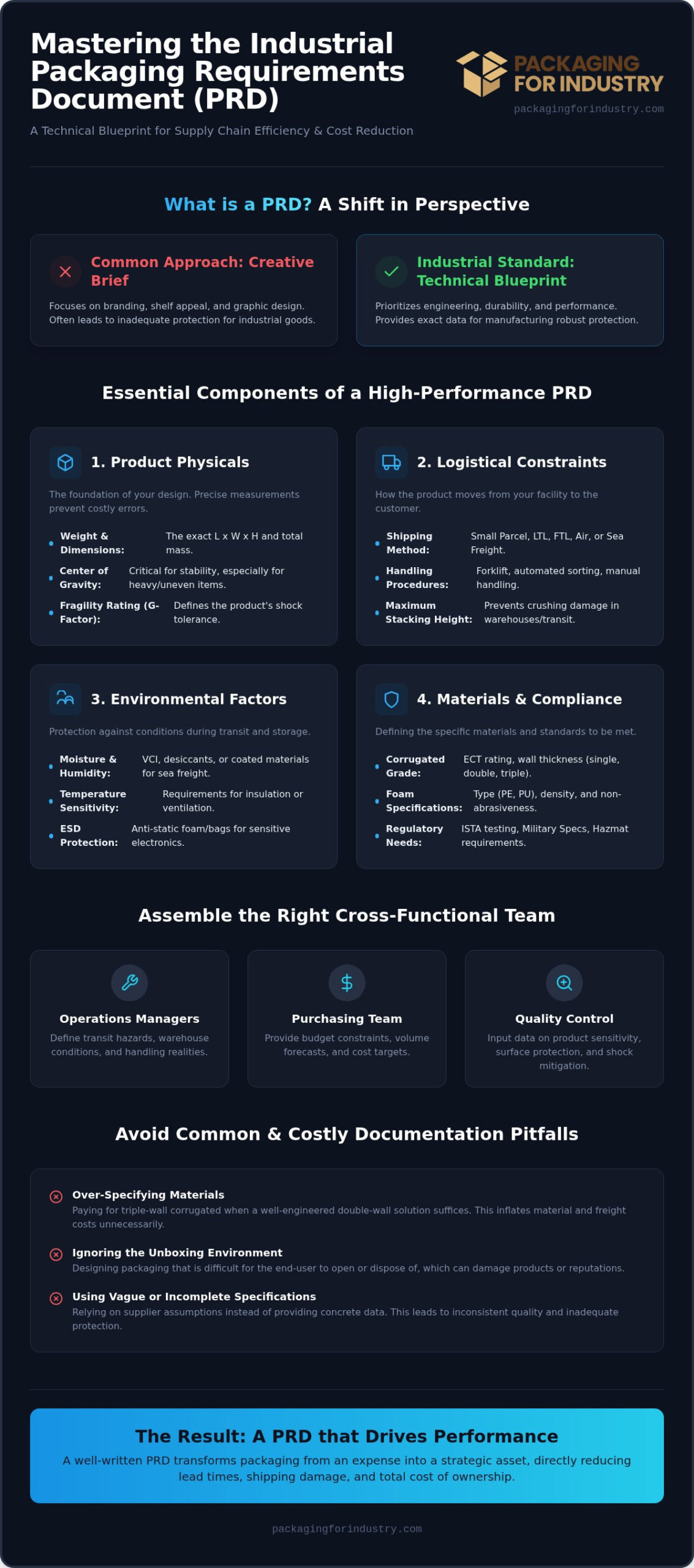
A Packaging Requirements Document (PRD) functions as a technical blueprint that defines the physical, environmental, and logistical needs of a product. In the industrial sector, this document is far more than a simple set of instructions; it’s a formal agreement on performance standards. While a consumer branding brief focuses on shelf appeal and graphic design, an industrial PRD prioritizes engineering and durability. It provides the exact data points needed to manufacture heavy-duty corrugated boxes or precision-cut foam inserts that can withstand the rigors of global shipping.
Every manufacturer needs a formal PRD when moving toward custom solutions. Without one, you rely on the assumptions of your supplier, which often leads to inconsistent quality or inadequate protection. Knowing how to write a packaging requirements document allows you to dictate the terms of your product’s safety. This clarity significantly reduces lead times for custom design packaging. When a supplier receives a precise document, they can move directly to CAD/CAM prototyping without the typical back-and-forth that stalls production schedules.
A well-written PRD also stabilizes your procurement process. It ensures that every quote you receive is based on the same technical foundation, making it easier to compare packaging pricing across different vendors. By defining your specs upfront, you eliminate the risk of receiving “budget” materials that fail during transit, protecting your bottom line and your professional reputation.
The Role of the PRD in Supply Chain Efficiency
Standardized documentation closes the communication gap between your procurement department and your packaging manufacturer. It prevents the common pitfall of “over-packaging,” where companies pay for excessive materials like triple-wall corrugated when a double-wall solution would suffice. This precision reduces unnecessary freight costs and warehouse footprint. Additionally, a PRD ensures consistency across multiple manufacturing locations. Whether your product is being packed in a local Southern California facility or an overseas plant, the protection remains identical, maintaining your brand’s reliability.
Who Should Be Involved in Drafting the Specs?
Drafting an effective PRD requires a cross-functional approach. Operations managers are essential for defining transit hazards, such as stack height and vibration risks in the warehouse. Your purchasing team must contribute budget and volume constraints to ensure the design is economically viable for bulk production. Finally, quality control teams provide critical data on product sensitivity. They define which surfaces require non-abrasive protection and whether the components need specialized foam packaging to mitigate shock. This collaborative effort ensures the final document covers every operational reality.
Essential Components of an Industrial Packaging Specification
A successful PRD moves beyond generalities. It serves as a technical record of your product’s physical vulnerabilities and the environmental stressors it will encounter. If you’re learning how to write a packaging requirements document for the first time, start with the ‘Product Physicals.’ This includes the weight, dimensions, fragility rating (G-factor), and center of gravity. For heavy machinery or sensitive electronics, an off-center center of gravity can cause pallet failure if the crate isn’t engineered to compensate for the weight distribution.
Logistical constraints also dictate your material choice. Small parcel shipping involves automated sorting centers with high drop risks, whereas LTL shipping involves forklift handling and significant stacking pressures. Your specs should clearly define maximum stacking heights to prevent the bottom pallet from collapsing under the weight of the inventory above it. If you’re unsure which material grade fits your specific logistical journey, you can request a packaging quote to have our engineering team review your current specifications.
Environmental factors are equally critical for long-term storage or international transit. Your document must specify needs for:
- Moisture Resistance: Essential for sea freight or humid warehouse environments.
- ESD Protection: Required for sensitive electronic components to prevent static discharge.
- Temperature Sensitivity: Crucial for materials that may degrade or warp in extreme heat.
Defining Material Specs for Corrugated and Foam
When you analyze how to write a packaging requirements document, the distinction between Edge Crush Test (ECT) and Mullen burst strength is critical. ECT measures the stacking strength of custom corrugated boxes, which is vital for warehouse efficiency. Conversely, Mullen strength measures the force required to puncture the box wall; it’s the better choice for heavy, loose parts that might shift during transit. For internal protection, choosing between Polyethylene and Polyurethane depends on the product’s weight and sensitivity. Polyethylene is ideal for heavier items requiring rigid support, while Polyurethane provides softer cushioning for delicate instruments. We also identify when custom foam packaging requires anti-static properties to protect against electronic failure.
Compliance and Industry Standards
High-stakes industries like aerospace or defense require strict adherence to military packaging (Mil-Spec) standards. Your PRD should explicitly reference ISTA or ASTM testing protocols to ensure the packaging can survive a 36-inch drop or sustained vibration. These tests provide the data needed to verify that your design meets the rigorous demands of industrial shipping. If your product is destined for a cleanroom or medical facility, you must also define the specific barrier materials or medical-grade coatings required to prevent particulate contamination.
How to Write a Packaging Requirements Document: A Step-by-Step Process
Creating a technical specification requires a methodical approach that balances product safety with logistical reality. When you sit down to determine how to write a packaging requirements document, you aren’t just listing materials; you’re building a defense strategy for your inventory. This process ensures that every stakeholder, from the shop floor to the purchasing department, understands the performance expectations of the final package. Following a structured five-step process prevents the vague instructions that lead to damaged goods and wasted spend.
Step 1: Assessing Product Vulnerability
The first step is a Product Vulnerability Assessment. You must identify the “break points” of your item, including fragile internal components and sensitive external finishes. Documenting critical surfaces that require corner and edge protection is vital for preventing cosmetic damage that leads to customer returns. You should also define the required ‘Drop Height’ based on whether the product ships via small parcel or LTL. Finally, identify any chemical sensitivities. Certain finishes react poorly to specific poly bags or films, so your PRD must specify chemically neutral barriers where necessary.
Step 2: Map the Global Logistics Journey. Your document should outline every touchpoint your product will encounter. This includes the number of forklift transfers, the duration of warehouse stacking, and the environmental conditions of the shipping lanes. If a product sits in a high-humidity port for three weeks, your corrugated specs must account for moisture-related strength loss.
Step 3: Optimizing for Freight and Surcharges
Precision in your specs directly influences your bottom line. Writing requirements that prevent ‘Dimensional Weight’ (DIM) penalties from carriers like UPS or FedEx is essential for logistical efficiency. Your PRD should dictate maximum box dimensions to ensure you aren’t paying to ship air. By calculating pallet efficiency during the documentation phase, you maximize truckload density and reduce the total number of shipments required. Linking these technical requirements to packaging cost savings ensures your procurement team can justify the investment in custom-sized solutions.
Step 4: Detail the Internal Protection. Specify whether the product requires generic void fill or precision-engineered die-cut foam inserts. For high-value electronics or aerospace parts, die-cut foam provides repeatable protection that eliminates packer error. Your PRD should define the foam density and the exact cavity dimensions to ensure a “snug fit” that prevents movement during transit.
Step 5: Establish Quality Control and Testing Benchmarks. The final stage of knowing how to write a packaging requirements document is defining how you’ll verify the results. Establish clear pass/fail criteria for the final prototype. This might include a successful ISTA vibration test or a series of drop tests. By setting these benchmarks in the PRD, you hold your supplier accountable for delivering a solution that actually works in the real world.
Defining these benchmarks is the first step toward total quality; for a comprehensive look at how these standards are verified on the factory floor, visit The Inspection Company to read their guide on product inspection processes.
Common Pitfalls in Industrial Packaging Documentation
Even with a technical focus, many organizations struggle with common errors that undermine the effectiveness of their documentation. When learning how to write a packaging requirements document, it’s easy to fall into the trap of over-engineering. This often manifests as specifying triple-wall corrugated board for products where double-wall provides more than enough stacking strength. This mistake doesn’t just increase the unit price; it adds weight and volume that inflate freight costs across your entire supply chain. You end up paying to ship excessive material that offers no additional protection for your specific transit profile.
Another frequent oversight is ignoring the unboxing environment. Industrial recipients often operate in cramped warehouse spaces or on production lines with limited footprint. If your PRD doesn’t account for how the user will physically remove the product, you risk creating operational delays for your customers. Similarly, failing to define precise tolerances is a major pitfall. You must specify the allowable +/- variance in foam or box dimensions. Without these tolerances, you’ll receive inconsistent quality that can lead to assembly line stoppages or poor component fitment.
The Danger of Over-Packaging
Excessive material use is a hidden drain on profitability. It creates a domino effect where heavier packaging leads to higher fuel surcharges and increased disposal fees for the end user. You must balance physical protection with the total cost of ownership. Our custom design services help you find the “Goldilocks” zone of protection. This is where the product is fully secured without wasting resources. This engineering-led approach ensures your PRD remains economically viable while maintaining high reliability.
Failing to Account for Manual vs. Automated Handling
Your documentation should clearly distinguish between manual and automated processes. For example, your PRD must specify if stretch film is intended for hand application or high-speed machine application. These products have different gauge and elasticity requirements that aren’t interchangeable. Additionally, account for forklift access in your heavy-duty crate designs. If the base doesn’t allow for standard pallet jack or forklift entry, you’ll face handling damage before the product even leaves the warehouse. Always document the exact placement for barcodes and labels to ensure they align with automated warehouse scanning systems.
Mastering how to write a packaging requirements document also involves avoiding the “static documentation” trap. A PRD must be a living record. If you revise a product’s internal components or change its weight, you must update the document immediately. Failing to do so leads to procurement errors where you’re buying packaging built for a version of the product that no longer exists. Keeping your specs current ensures that your supply chain remains agile and cost-effective.
Moving from Requirements to Reality with PFI
Understanding how to write a packaging requirements document is a critical first step, but the document only adds value when it is translated into high-performance materials. At Packaging For Industry (PFI), we use your PRD as the engineering foundation for our manufacturing process. We don’t just provide generic supplies; we utilize CAD/CAM technology to create precision-engineered prototypes that match your exact data points. This ensures that every component, from a heavy-duty corrugated box to a custom polyethylene foam insert, performs exactly as specified in your technical blueprint.
Our team acts as a seasoned industrial consultant, reviewing your PRD to identify cost-saving opportunities that might otherwise go unnoticed. We often find that a slight adjustment in material density or box dimensions can significantly lower your total cost of ownership without compromising protection. This intersection of engineering and economics is where PFI excels, helping you balance the need for durability with the reality of freight budgets and warehouse efficiency.
The Prototyping Phase: Testing Your Requirements
The transition from a document to a physical sample is where the most critical refinements occur. Our CAD/CAM support allows us to turn your technical requirements into a physical prototype quickly, which significantly reduces traditional lead times for custom projects. During this phase, we conduct rigorous fit-tests to ensure custom foam inserts match your product’s contours perfectly. This testing period allows you to refine the PRD based on real-world performance before moving into bulk production, ensuring your inventory is protected from the moment it leaves the assembly line.
Efficiency extends beyond the design phase into your long-term operations. To help you maintain supply reliability and improve logistical flow, we offer Vendor Managed Inventory (VMI) to streamline recurring orders. This service ensures you never face stockouts on critical packaging materials. For manufacturers across Southern California, including Los Angeles, Orange County, San Diego, and the Inland Empire, PFI provides local next-day delivery and on-site technical support. This geographical advantage allows us to act as a proactive partner in your supply chain rather than just a distant vendor.
Request a Professional Packaging Quote
If you already have a specification in hand, we invite you to submit it for a professional review. We specialize in providing high-volume, precision solutions for the aerospace and manufacturing sectors, where compliance and durability are non-negotiable. By submitting your requirements document, you’ll receive a competitive wholesale quote tailored to your specific logistical needs and budget constraints. We’re ready to help you move from a technical document to a finished, optimized packaging system.
Optimize Your Industrial Packaging Strategy
A precise packaging requirements document is the difference between a high-performing supply chain and an operational liability. You’ve learned that defining technical constraints, assessing product vulnerability, and avoiding the trap of over-packaging are essential steps for logistical success. Mastering how to write a packaging requirements document ensures your procurement team buys exactly what’s needed to protect your inventory without inflating freight costs or wasting warehouse space.
Packaging For Industry (PFI) is ready to turn your technical specifications into a durable reality. Our expertise in aerospace and industrial solutions allows us to identify cost-saving opportunities within your current specs while maintaining strict compliance standards. We provide free prototyping and CAD design support to help you verify performance before bulk production begins. Manufacturers across Southern California, including those in Los Angeles and Orange County, can also rely on our local next-day delivery to keep their operations moving without interruption.
We’re here to help you build a more reliable and cost-effective shipping strategy. Let’s work together to eliminate shipping damage and streamline your procurement process today.
Frequently Asked Questions
What is the difference between a packaging design brief and a requirements document?
A design brief typically focuses on brand aesthetics and marketing goals. In contrast, a packaging requirements document is a technical engineering blueprint that defines physical and logistical constraints. It details specific performance data such as Edge Crush Test (ECT) ratings, foam densities, and stacking strength. This document ensures your product survives the rigors of industrial shipping rather than just looking good on a shelf.
Should I include budget constraints in my packaging requirements document?
Yes, including budget parameters is essential to ensure the final design is economically viable for bulk procurement. When you define your target unit price and annual volume upfront, it allows engineers to select materials that balance protection with fiscal responsibility. This transparency prevents the development of over-engineered solutions that might exceed your total cost of ownership or inflate freight expenses.
How do I calculate the fragility (G-factor) of my product for the PRD?
Fragility is determined by the maximum deceleration a product can withstand without sustaining damage. You can find this value through laboratory drop testing or by referencing the technical data sheets of your product’s most sensitive internal components. Lower G-factors indicate higher sensitivity, which requires more substantial cushioning materials like polyurethane or polyethylene foam to mitigate shock during transit and handling.
What industry standards should I reference in my packaging specifications?
You should reference established protocols from organizations like ISTA (International Safe Transit Association) or ASTM (American Society for Testing and Materials). These standards provide a framework for vibration, compression, and drop testing. If your operations involve defense or aviation, including Mil-Spec requirements is necessary to ensure your custom crates and boxes comply with federal shipping regulations and performance benchmarks.
How often should I review and update my packaging requirements document?
Review your document whenever the product undergoes a revision in weight, dimensions, or internal assembly. Even if the product remains unchanged, an annual review is a pragmatic step to account for updates in carrier surcharges or new material innovations. Keeping your documentation current ensures that your procurement process remains optimized and that you aren’t paying for outdated or inefficient protection strategies.
Can a packaging supplier help me write my requirements document?
Yes, a seasoned supplier acts as a technical partner to help you refine your specifications. When you are learning how to write a packaging requirements document, a supplier can provide CAD/CAM support and prototyping to verify your data. This collaborative process ensures your requirements are grounded in manufacturing reality, helping you avoid common pitfalls like over-specifying corrugated wall thickness or ignoring pallet efficiency.
What are the most common mistakes in industrial packaging specs?
The most frequent errors include over-specifying materials and failing to define precise dimensional tolerances. Using triple-wall corrugated board when double-wall is sufficient leads to unnecessary material and freight costs. Additionally, vague tolerances result in inconsistent quality from different vendors. These mistakes often cause assembly line delays or fitment issues that increase your total cost of ownership and stall your logistical flow.
How does a PRD help in reducing shipping damage rates?
A PRD reduces damage by eliminating the ambiguity that leads to inadequate protection. It provides a standardized blueprint that ensures every shipment utilizes the correct foam inserts, corner protection, and box strength. By documenting the exact logistical journey and transit hazards, you ensure the packaging is engineered to withstand specific environmental stressors. This consistency is the most effective way to lower your return rates and protect your professional reputation.