
Your current packaging supplier isn’t just a line item on a spreadsheet. They’re either a silent partner in your growth or a primary driver of operational friction. While production delays and shipping damage eat into your margins, the thought of switching often triggers immediate resistance from leadership concerned about transition risks. We understand that getting buy-in for a new packaging supplier requires more than just a lower price per unit. It demands a clear, data-driven demonstration of how a change impacts the total cost of ownership.
You’re likely tired of warehouse space being wasted on bulk over-orders from catalog distributors and the constant stress of potential stockouts. This guide provides the professional framework you need to build a business case that overcomes internal pushback. We’ll show you how to prove the ROI of switching to a more reliable partner. You’ll learn to highlight how Vendor Managed Inventory and custom engineering can lower costs without sacrificing quality, ensuring your supply chain remains steady and predictable.
Key Takeaways
- Identify the true cost of inefficient packaging by auditing hidden expenses like shipping damage, production delays, and wasted warehouse footprint.
- Build a data-driven business case for getting buy-in for a new packaging supplier by analyzing 12 months of usage data to prove total cost of ownership (TCO) reductions.
- Mitigate transition risks by prioritizing local Southern California suppliers who offer Vendor Managed Inventory (VMI) to eliminate stockouts and improve cash flow.
- Navigate internal resistance by aligning the benefits of a new supplier with the specific operational goals of Warehouse Managers and Quality Control teams.
- Leverage custom-engineered prototypes to demonstrate how optimized corrugated and foam solutions reduce material waste without compromising product safety.
Recognizing the Operational Cost of Inefficient Packaging
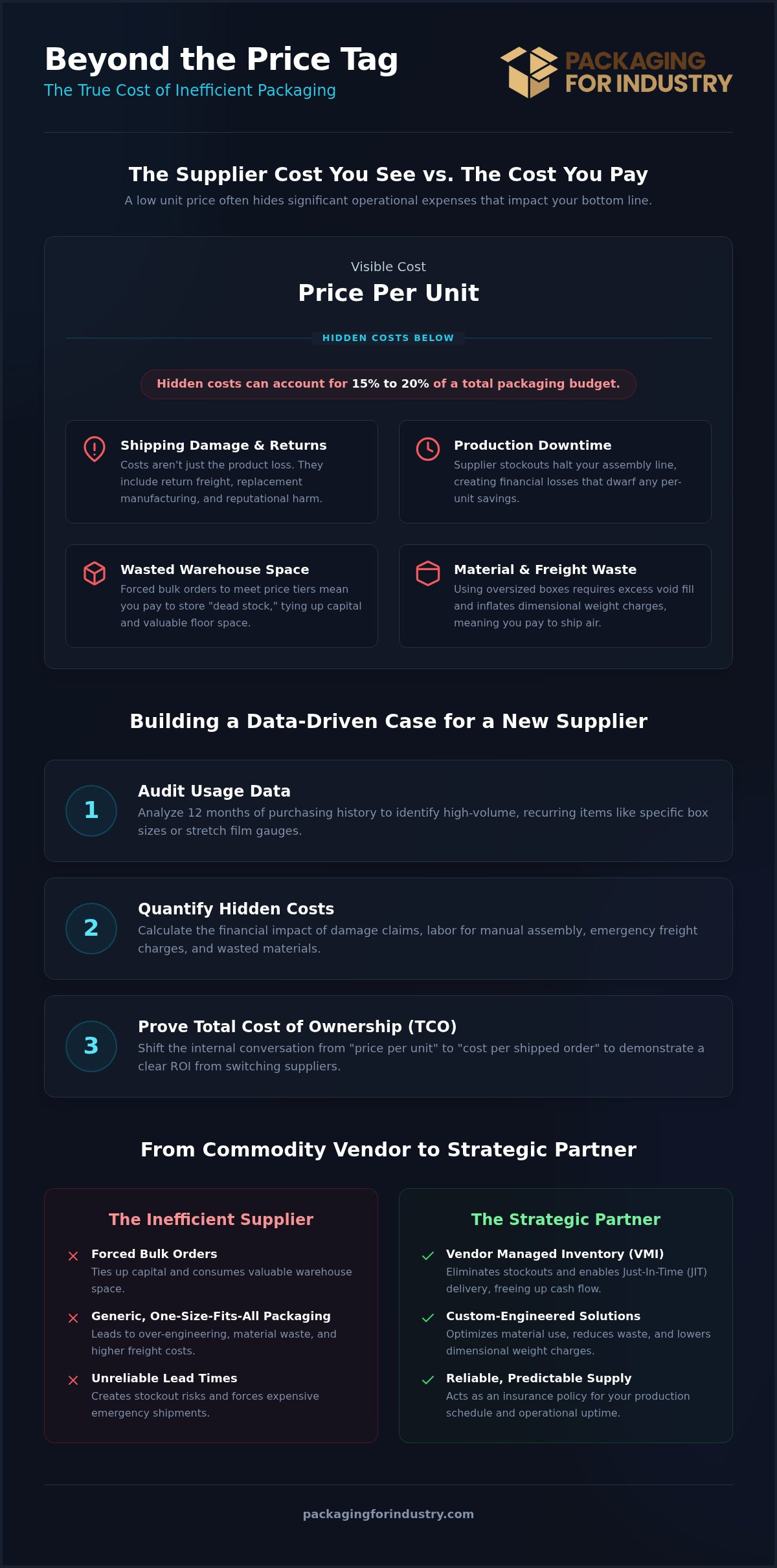
Getting buy-in for a new packaging supplier is often perceived by leadership as a simple exercise in price comparison. This perspective is fundamentally flawed. A cheaper box that fails in transit or a distributor that cannot guarantee lead times creates costs that never appear on a standard purchase order. Inefficient packaging practices often lead to significant material and logistical waste. Some industry professionals report these hidden costs can account for 15% to 20% of a total packaging budget. These losses stem from a combination of over-engineered materials, under-protected products, and the administrative burden of managing unreliable vendors.
Production uptime is directly tied to your packaging inventory. If your current supplier triggers a stockout, your assembly line stops. That downtime represents a financial hit that far outweighs any per-unit savings from a large catalog distributor. When you’re building your case, you must identify these specific pain points:
- Stockout Risks: The cost of emergency shipments or halted production.
- Material Waste: Using oversized boxes that require excessive void fill.
- Administrative Overhead: The time spent chasing tracking numbers or filing damage claims.
While a catalog unit price might seem competitive, it rarely accounts for the overhead of these logistical inefficiencies. Reliability is an insurance policy for your manufacturing schedule.
The Price of Shipping Damage and Returns
Shipping damage is a profit killer. It’s not just the cost of the broken item; it’s the freight for the return, the cost of the replacement, and the long-term damage to your professional reputation. Many manufacturers rely on generic cushioning that doesn’t account for the specific fragility of their goods. Utilizing specialized foam packaging like polyethylene or polyurethane provides the precision needed to absorb shock and vibration. Without proper edge protection, palletized loads are prone to shifting during transit. This leads to recurring insurance claims and rejected shipments at the receiving dock, which drains your department’s resources and time.
Warehouse Inefficiency and Over-Ordering
Large catalog distributors often force you into bulk orders to hit specific pricing tiers. This practice ties up your capital and consumes valuable floor space that could be used for production. Wasted warehouse real estate is a significant overhead expense. If you’re sitting on three months of excess box inventory, you’re paying to store “dead stock” that could be replaced by a lean, Just-In-Time (JIT) system. Getting buy-in for a new packaging supplier becomes much easier when you demonstrate how optimized box sizes and custom-engineered corrugated solutions ensure you aren’t paying to ship or store air. By moving to a local Southern California supplier with VMI capabilities, you can reclaim your warehouse footprint and redirect that capital toward growth.
Building a Data-Driven Case for Stakeholder Approval
Leadership rarely approves a vendor change based on a hunch. Success in getting buy-in for a new packaging supplier hinges on your ability to present a quantitative argument that speaks the language of the CFO. Start by auditing 12 months of usage data. This history reveals your high-volume recurring items, such as double-wall corrugated boxes or specific gauges of stretch film. When you compare these actual needs against bulk packaging pricing from a direct manufacturer, the fiscal advantage becomes clear. Catalog distributors add significant markups that disappear when you source directly from a partner with manufacturing capabilities.
Beyond material costs, analyze your shipping logistics. Inefficient packaging often results in “shipping air.” Through optimized box sizing, you can significantly reduce freight expenditures. Smaller, more precise boxes don’t just save on cardboard; they lower the dimensional weight charges that carriers use to inflate shipping bills. Additionally, consider the labor savings found in pre-assembled or kitted solutions. If your team spends hours each day folding boxes or manually cutting foam to size, that labor cost should be factored into your business case. These operational efficiencies are often more persuasive to stakeholders than a simple reduction in material price.
Proving Total Cost of Ownership (TCO)
Shift the internal conversation from “price per unit” to “cost per shipped order.” A low unit price is irrelevant if it requires high procurement labor or leads to frequent emergency rush orders. By implementing Vendor Managed Inventory (VMI), you eliminate the administrative burden of constant reordering. VMI ensures stock is always available without tying up your capital in excess inventory. This level of oversight reduces the hidden costs of supply chain management and provides a more accurate picture of your total operational spend. Getting buy-in for a new packaging supplier is much easier when you can prove that the new partner will manage the inventory risks for you.
Custom Engineering as a Profit Center
Custom engineering should be viewed as a financial asset rather than an added expense. For example, the ROI of custom foam inserts often outweighs the cost of generic void fill because it reduces packing time and virtually eliminates product damage. Precision design allows you to use the minimum amount of material necessary for maximum protection. Utilizing free prototyping allows you to prove these savings to stakeholders before any financial commitment is made. If you’re ready to see how these efficiencies apply to your specific operations, you can request a packaging quote to begin the data comparison process.
Mitigating Transition Risks: Vetting for Reliability and Capability
The fear of a failed transition is often the primary obstacle to getting buy-in for a new packaging supplier. Stakeholders worry that a switch will result in production-stopping stockouts or a drop in material quality. To overcome this resistance, you must demonstrate that the proposed partner has the technical capability and logistical infrastructure to support your specific volume. Vetting should focus on the supplier’s ability to handle custom engineering and long lead-time items without disruption.
For manufacturers in Southern California, proximity is a critical vetting factor. A supplier located within the Inland Empire, Orange County, or Los Angeles can offer local next-day delivery, which is essential for maintaining a Just-In-Time (JIT) inventory model. This proximity allows for a much more responsive supply chain compared to national catalog distributors. Before committing to a full transition, request a comprehensive packaging audit. A professional audit identifies immediate cost-saving opportunities and allows the supplier to prove their expertise by suggesting material optimizations that your current vendor may have overlooked.
Testing the Supply Chain: Trial Runs and Samples
Don’t attempt to move your entire inventory at once. Instead, suggest a pilot program centered on a single high-volume SKU. This controlled trial allows you to validate the supplier’s reliability and material quality under real-world conditions. During this phase, you should perform rigorous tests on the provided materials, such as checking the crush strength of double-wall corrugated boxes and the density of protective foam. Success in a pilot program provides the tangible proof needed to secure leadership’s confidence. It demonstrates that the new supplier can meet strict delivery windows and maintain consistent quality standards across bulk quantities.
Compliance and Certifications
Industrial sectors like medical, electronics, and defense require more than just a standard box. You must verify that the supplier understands the specific regulatory landscape of your industry. For example, if you’re serving government contracts, the supplier must be capable of meeting Mil-Spec packaging requirements. Those in the tech sector should look for expertise in ESD protection and cleanroom-compatible materials. If your products are destined for international shipping, verify that the supplier adheres to ISPM-15 standards for heat-treated export crates. Vetting for specific expertise, such as aerospace packaging standards, ensures that the transition won’t compromise your industry compliance or product safety.
The Step-by-Step Buy-In Roadmap: Navigating Internal Approval
Securing a new partnership is rarely a solo endeavor. Getting buy-in for a new packaging supplier requires a strategic approach that addresses the unique priorities of different departments. To move beyond the status quo, you need to build a coalition of internal advocates who see the change as a solution to their daily frustrations rather than an operational risk. This roadmap ensures you present the right data to the right people at the right time.
Step 1: Align with the Warehouse Manager. Start where the physical impact is greatest. Discuss the storage pains caused by bulk over-orders and the stress of frequent packaging shortages. When the warehouse team understands that a new partner can free up floor space through more frequent, smaller deliveries, they become your strongest allies.
Step 2: Engage Quality Control. Present a clear “Damage Reduction” case. Use the data gathered during your vetting phase to show how engineered protection can lower return rates. If you can prove that superior materials will reduce their workload regarding claims and inspections, you’ve won another key stakeholder.
Step 3: Quantify the Financial Shift. Transition the conversation to the CFO by highlighting cash flow. Show how reduced on-hand inventory and the elimination of emergency freight costs directly improve the bottom line. This is where the shift from capital-heavy storage to streamlined operational flow becomes undeniable.
Step 4: Execute a Side-by-Side Comparison. Create a transparent matrix that compares your current supplier’s performance against the proposed partner. Include unit price, lead times, damage rates, and administrative hours required. A clear, objective comparison removes emotion from the decision-making process.
Step 5: Present the Final Proposal. Your final pitch should include a detailed transition timeline. Specify when the first trial runs begin and how existing stock will be phased out to avoid waste. A structured plan reduces the perceived risk of “switching pains.”
Addressing the CFO’s Primary Concerns
The CFO’s focus is usually on capital efficiency. You must explain how moving to a more reliable supplier shifts your packaging spend from a stagnant capital expenditure to a fluid operational cost. High-priced catalog distributors often force you into large minimums that tie up cash for months. By sourcing bulk corrugated boxes directly from a manufacturer with VMI capabilities, you pay for what you use when you use it. This strategy also eliminates the “panic spend” associated with emergency freight when a distant supplier misses a deadline.
Winning Over the Operations Team
For operations, reliability is everything. Their primary concern is keeping the production line moving without interruption. Highlight how Vendor Managed Inventory (VMI) acts as a fail-safe against shortages. When you mention that a Southern California-based supplier can provide local, next-day support across Orange County and the Inland Empire, you address their fear of being left stranded by a national distributor. Additionally, emphasize how kitting services can take labor-intensive assembly tasks off their plate, allowing your team to focus on core manufacturing goals.
Seamless Transitions with Packaging For Industry (PFI)
Choosing a partner that understands the nuances of industrial logistics makes getting buy-in for a new packaging supplier a much simpler process. Packaging For Industry (PFI) doesn’t just sell materials; we provide an engineered system designed to protect your products and your bottom line. Our headquarters in Anaheim serves as a central hub for Southern California, allowing us to offer local next-day delivery across Orange County, Los Angeles, San Diego, and the Inland Empire. This proximity is a vital component of our reliability, ensuring that your production schedule is never compromised by a delayed shipment from a distant catalog distributor.
Our engineering-first approach removes the guesswork from product protection. Instead of relying on generic catalog sizes that lead to wasted space, we use custom design and prototyping to ensure every component of your packaging is optimized for its specific journey. This focus on precision reduces material waste and lowers your total cost of ownership by eliminating the need for excessive void fill and preventing transit damage. When you present PFI to your stakeholders, you aren’t just proposing a new vendor; you’re proposing a more efficient way to do business.
Our Integrated Packaging Approach
We simplify your procurement by providing an integrated supply chain for all your packaging needs. Whether you require heavy-duty corrugated boxes, specialized protective foam, or custom export crates, PFI manages the entire process under one roof. We’ve developed deep expertise in high-stakes sectors like medical device manufacturing and automotive logistics, where precision and compliance are non-negotiable. If you’re ready to present a professional, data-backed solution to your leadership team, you can request a custom packaging quote to begin the transition process.
Transitioning to VMI and JIT Programs
The most effective way to secure long-term buy-in is to demonstrate a permanent solution to inventory headaches. Our Vendor Managed Inventory (VMI) and Just-In-Time (JIT) programs are designed to take the burden of stock management off your team’s plate. We conduct scheduled inventory reviews to ensure you always have the necessary supplies on hand, effectively eliminating the risk of stockouts. This proactive management allows your warehouse staff to focus on production and shipping rather than counting boxes. While we pride ourselves on our local Southern California support, our logistical network is fully scalable to meet your nationwide shipping requirements, providing a steady and dependable partnership as your business grows.
Strengthen Your Supply Chain with Data-Backed Decisions
Transitioning to a high-performance packaging partner is a strategic investment in your company’s operational stability. By shifting the focus from simple unit price to the total cost of ownership, you can eliminate the hidden expenses of transit damage and warehouse waste. Successfully getting buy-in for a new packaging supplier relies on presenting these tangible efficiencies to your leadership team with clarity and confidence. When you prove that reliability directly impacts the bottom line, the case for change becomes undeniable.
Packaging For Industry (PFI) supports this transition with local next-day delivery across Southern California and VMI programs designed to eliminate production shortages. Our free custom prototyping and design reviews allow you to validate the ROI before making a full commitment. We understand the intense pressures of industrial logistics and are prepared to help you streamline your entire process from design to delivery. It’s time to replace operational friction with a steady, predictable supply chain.
We’re ready to help you build a more efficient, reliable, and profitable packaging operation.
Frequently Asked Questions
How long does it typically take to onboard a new packaging supplier?
Onboarding a new supplier typically takes between two and four weeks, depending on the complexity of your inventory. This period allows for data integration, design reviews, and initial trial runs. If you require custom corrugated or foam solutions, the timeline accounts for prototyping and testing phases to ensure operational alignment before the first full production run begins.
What data do I need to prepare for a packaging cost-reduction analysis?
You should gather 12 months of historical usage data, current per-unit pricing, and recent freight invoices. Include your annual damage claim rates and warehouse labor costs associated with packaging assembly. This comprehensive data set allows us to identify hidden inefficiencies and demonstrate the fiscal benefits of getting buy-in for a new packaging supplier through total cost of ownership reductions.
Can a new supplier help me reduce UPS and FedEx shipping surcharges?
Yes, we can help reduce carrier surcharges by optimizing your box dimensions to lower dimensional weight charges. Many catalog boxes are oversized, forcing you to pay for shipping air and excessive void fill. Custom-engineered packaging ensures your shipments are as compact and lightweight as possible, which directly lowers the rates charged by UPS and FedEx during transit.
How does Vendor Managed Inventory (VMI) actually save my company money?
Vendor Managed Inventory saves money by eliminating the capital tied up in excess stock and preventing expensive production downtime caused by shortages. We manage your inventory levels and handle the reordering process for you. This system frees up valuable warehouse floor space and reduces administrative labor, allowing your team to focus on core manufacturing and distribution tasks instead of counting boxes.
Is it possible to get custom foam and boxes from the same supplier?
Yes, PFI specializes in providing integrated solutions that combine custom corrugated boxes with precision foam inserts. Sourcing both components from a single manufacturer ensures that the foam fits perfectly within the box, maximizing protection and minimizing material waste. This consolidated approach also simplifies your supply chain by reducing the number of vendors you need to manage on a daily basis.
What are the risks of switching from a large catalog supplier to a local manufacturer?
The primary perceived risk is a disruption in supply, but switching to a local manufacturer actually increases reliability through shorter lead times. Large catalog distributors often have high markups and rigid shipping schedules. A local partner provides next-day delivery across Southern California and more responsive customer support, which mitigates the logistical risks associated with distant, national suppliers and their shipping delays.
How do I handle the transition of custom-engineered designs to a new vendor?
We manage the transition of custom-engineered designs by conducting a thorough technical review of your existing specifications. Our team creates free prototypes to verify fit and protection before you commit to a full order. This methodical process ensures that your specialized packaging, such as aerospace or medical grade solutions, maintains its integrity and compliance during the supplier changeover without any drop in quality.
Does PFI offer nationwide shipping for companies with multiple locations?
PFI offers scalable shipping solutions to support your facilities nationwide. While we provide local next-day delivery throughout the Inland Empire, Los Angeles, and Orange County, we also manage logistical requirements for manufacturers with multiple locations across the country. This ensures consistent packaging quality and pricing across your entire organization, regardless of where your individual distribution centers or manufacturing plants are located.