
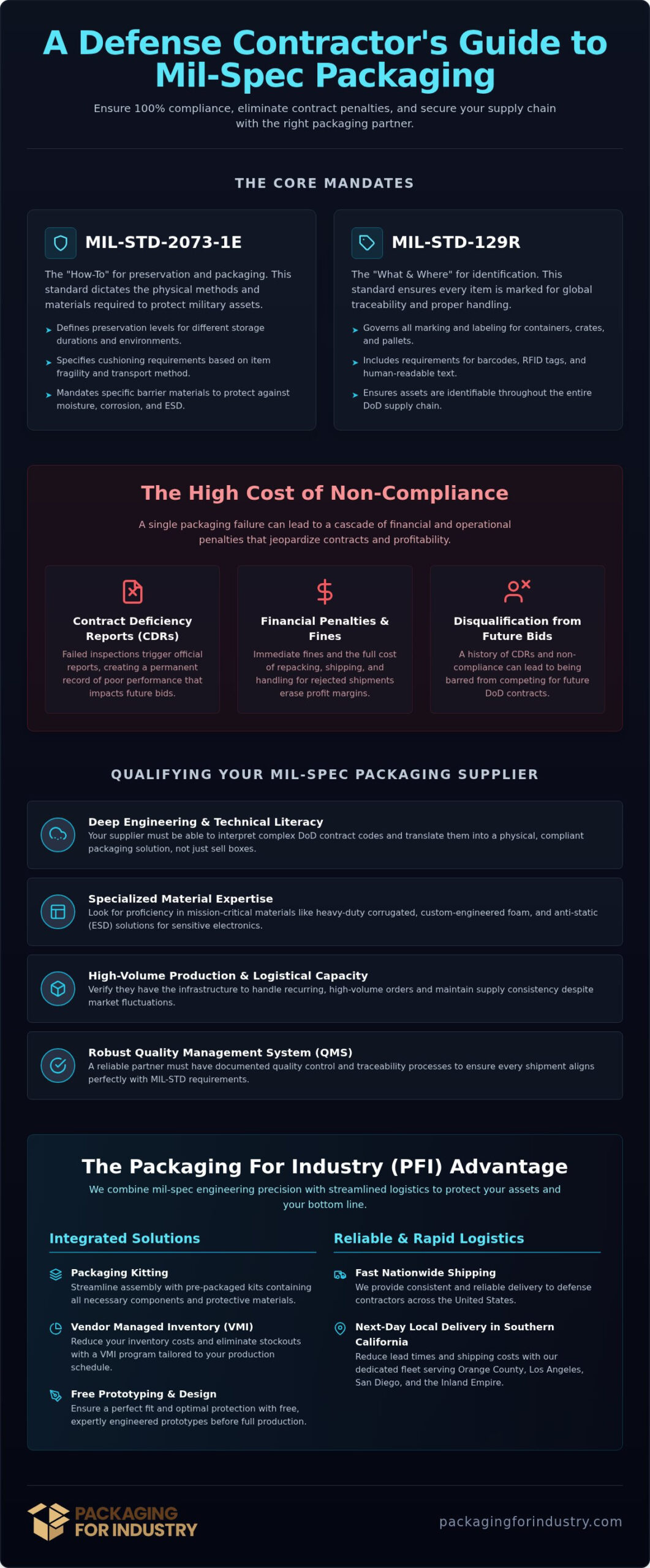
A single packaging oversight can trigger contract penalties that erase your profit margins faster than a rejected shipment returns to your loading dock. For defense contractors, the choice of mil-spec packaging suppliers is the difference between a successful delivery and a costly logistical failure. You understand that compliance with MIL-STD-2073-1E and MIL-STD-129R is a non-negotiable safeguard for your operations, especially when handling sensitive electronics or aerospace components that require specialized ESD protection.
This guide identifies the critical criteria for selecting a partner who merges engineering precision with fiscal efficiency. We’ll show you how to ensure 100% compliance with current DoD standards while reducing damage rates through custom foam and heavy-duty corrugated solutions. By partnering with Packaging For Industry (PFI), you gain access to fast nationwide shipping and local next-day delivery across Southern California, including Orange County, Los Angeles, San Diego, and the Inland Empire. We’ll preview how reliable local supply and expert engineering secure your supply chain and protect your bottom line in 2026.
Key Takeaways
- Understand the essential requirements of MIL-STD-2073 and MIL-STD-129R to eliminate the risk of contract penalties and rejected shipments.
- Identify the technical criteria for evaluating mil-spec packaging suppliers, focusing on engineering depth and the ability to handle complex DoD codes.
- Compare specialized materials like heavy-duty corrugated and custom foam inserts to optimize protection for sensitive aerospace and electronic components.
- Discover how sourcing locally in Southern California reduces lead times and lowers the total cost of shipping bulky, high-compliance materials.
- Learn how integrated services like free prototyping and Vendor Managed Inventory (VMI) streamline your defense logistics and improve operational reliability.
Why Military Standards (Mil-Spec) Matter for Defense Contractors
Mil-spec packaging is engineered to protect mission-critical goods under extreme environmental and logistical conditions. Unlike commercial shipping materials, these solutions must withstand rapid pressure changes, corrosive salt air, and rough handling in theater. The history of mil-spec packaging dates back to World War II, when the military realized that standard commercial methods led to catastrophic losses of supplies during overseas transit. Today, that legacy continues through rigorous engineering requirements that ensure military readiness by protecting every component from the factory to the front line.
Choosing experienced mil-spec packaging suppliers is essential because generic industrial packaging cannot meet the strict Department of Defense (DoD) requirements. A standard double-wall box might suffice for a commercial warehouse, but it won’t pass a DoD audit or protect sensitive electronics from electromagnetic interference during long-term storage. Compliance isn’t just about the box; it’s about a total system of preservation that guarantees a part will function perfectly even after years in a climate-controlled or outdoor depot.
The Risks of Non-Compliant Packaging in Government Contracts
Non-compliance is a fast track to financial penalties. If your shipment arrives at a Defense Distribution Depot and fails inspection, you’ll likely receive a Contract Deficiency Report (CDR). These reports don’t just result in immediate fines or the cost of repacking; they create a permanent record of poor performance. For manufacturers, a history of CDRs can disqualify you from future bidding opportunities, effectively ending your relationship with the DoD. Beyond the paperwork, inadequate packaging leads to high damage rates for sensitive components. When a high-value part fails due to shipping vibration or moisture ingress, it stalls military operations and forces your team into expensive, unplanned re-manufacturing cycles.
Key Standards to Know: MIL-STD-2073 and Beyond
The primary governing document for military packaging is MIL-STD-2073-1E, which is currently active with Change Notice 4 as of 2026. This standard dictates everything from the type of barrier materials used to the exact method of cushioning required for specific item categories. It’s not a one-size-fits-all approach. Your contract will specify “preservation levels” based on the expected environment and the duration of storage, ranging from immediate use to long-term overseas positioning.
Compliance also requires adherence to MIL-STD-129R for marking and labeling, ensuring that every crate and carton is identifiable and traceable throughout the global supply chain. For those involved in aerospace packaging, these requirements often intersect with specialized ASTM standards. It’s vital to work with mil-spec packaging suppliers who understand the technical nuances of both sectors. Proper compliance ensures that your high-value components arrive functional, traceable, and ready for immediate deployment.
How to Qualify Reliable Mil-Spec Packaging Suppliers
Procurement teams often focus on unit price, but in defense logistics, the cheapest option usually carries the highest risk. Qualifying mil-spec packaging suppliers requires a deep dive into their technical literacy. You need a partner who can interpret complex DoD codes and translate them into physical protection. A supplier that simply takes an order for a standard size without questioning the preservation level or the fragility of the component is an operational liability. Reliability in this sector is defined by a supplier’s ability to merge engineering expertise with strict regulatory adherence.
Capacity for high-volume production is another critical factor. Defense contracts often involve recurring orders with fluctuating lead times. Your supplier must demonstrate the logistical infrastructure to maintain supply consistency, even when global material costs or diesel prices rise. Evaluating a supplier’s historical performance with aerospace and defense manufacturers provides a clear indicator of their ability to handle the rigorous demands of military logistics.
Certification, Quality Control, and Traceability
A reliable supplier must maintain a robust Quality Management System (QMS). Verification of these internal processes ensures that every shipment aligns with MIL-STD-2073 requirements. The most critical document in this process is the Certificate of Compliance (CoC). This certificate is your legal assurance that every material used, from the barrier bags to the specialized ESD foam, meets the exact military specifications cited in your contract. Without strict material traceability, you risk failing a government audit or compromising the integrity of sensitive hardware during long-term storage. Ensure your partner can provide full documentation for every component of the packaging system.
Engineering Capabilities: Beyond Stock Box Supply
Standard catalog boxes rarely suffice for high-value defense parts. You should prioritize suppliers that offer custom design packaging backed by CAD/CAM support. Professional engineering allows for the creation of integrated solutions, such as custom foam inserts paired with heavy-duty corrugated or wood crates. This precision reduces excess weight and minimizes freight costs without sacrificing protection. Rapid prototyping is another key indicator of a qualified supplier. Being able to test a physical sample before moving to high-volume production ensures a perfect fit and eliminates the risk of shipping damage. If you are managing multiple defense contracts, you can request a packaging quote to see how custom engineering can streamline your current operations.
Specialized Materials for Military and Aerospace Protection
Standard industrial materials often fail when exposed to the rigors of military logistics. While national catalog companies push “good enough” stock items, specialized mil-spec packaging suppliers focus on material science to prevent component failure. For defense contractors, the choice of substrate is a calculation of durability versus weight. Selecting the wrong material doesn’t just risk product damage; it can lead to massive shipping surcharges and rejected shipments at the depot.
Heavy-Duty Corrugated and Weather-Resistant Containers
Heavy-duty corrugated boxes are the foundation of mil-spec shipping. Standard single-wall containers lack the stacking strength required for overseas transit or long-term depot storage. Triple-wall corrugated provides a lightweight yet rigid alternative to wood crates for heavy components, offering high puncture resistance. Weather-resistant treatments are also critical for maritime environments. These coatings prevent the board from absorbing moisture in humid conditions, maintaining structural integrity where standard boxes would collapse. Using custom-sized containers allows you to avoid the dimensional weight surcharges common with UPS and FedEx, directly lowering your total landed cost.
Custom Mil-Spec Foam Inserts and ESD Protection
Selecting the correct cushioning material is an engineering decision based on the fragility of the part. Custom foam packaging is typically designed using one of two primary materials:
- Polyethylene (PE) Foam: Preferred for heavier, more durable items because of its high load-bearing capacity and resistance to chemicals and moisture.
- Polyurethane (PU) Foam: Better suited for lighter, more delicate instruments that require softer deceleration and superior shock absorption.
For electronics, integrating Electrostatic Discharge (ESD) protection is mandatory. Sensitive semiconductors and avionics require anti-static or conductive foam to prevent latent damage from static buildup during transit. Experienced mil-spec packaging suppliers offer die-cut foam end caps for tactical gear or full-cavity inserts for complex assemblies. This precision ensures that vibration during flight or ground transport doesn’t lead to mechanical failure. Whether you need die-cut solutions or complex kitting, the right foam chemistry is essential for meeting DoD standards.
Local Logistics: Sourcing Mil-Spec Packaging in Southern California
Southern California serves as the strategic heart of the global aerospace and defense sector. For contractors operating in this region, the logistical burden of sourcing from distant mil-spec packaging suppliers often outweighs any perceived savings on unit price. Bulky items like custom wood crates and heavy-duty corrugated boxes are expensive to transport over long distances. With US national diesel averages reaching $5.259 per gallon in mid-2026, freight costs for national catalog orders can significantly inflate your total procurement spend. Sourcing locally minimizes these overheads while ensuring your materials don’t spend days in transit across state lines.
Proximity Advantage: Anaheim, Orange County, and Beyond
Maintaining a presence within the defense corridor from Los Angeles to San Diego offers more than just lower shipping rates. Local suppliers provide the opportunity for on-site packaging reviews. These assessments allow engineers to see your components first-hand, identifying potential vulnerabilities that a remote salesperson might miss. In high-stakes sectors like aerospace, this face-to-face consultation is vital for reducing damage rates and ensuring every crate meets MIL-STD-2073 requirements. By working with a partner who understands the local manufacturing landscape, you gain a consultant familiar with the specific operational challenges of Southern California warehouses. Whether your facility is in Anaheim or the Inland Empire, having a local expert nearby ensures that your packaging is engineered for the exact stresses of your supply chain.
Reducing Lead Times with Local Next-Day Delivery
Production stops are a primary pain point for defense manufacturers. A shortage of mil-spec barrier bags or custom foam inserts can halt an entire assembly line, leading to missed deadlines and potential contract penalties. Local next-day delivery in Orange County, the Inland Empire, and Los Angeles serves as a critical safety net for your operations. It allows you to operate with leaner inventory levels because you aren’t waiting 5 to 7 days for a national shipment to arrive from a different time zone. This responsiveness is essential for maintaining the high-speed requirements of modern defense contracts.
Leveraging Just-In-Time inventory management enables you to free up valuable floor space in your facility. Real estate in Southern California is a premium industrial cost; dedicating hundreds of square feet to palletized packaging stock is often an inefficient use of capital. Local stocking programs ensure that your specific mil-spec materials are ready for immediate dispatch, providing a level of reliability that national catalog suppliers cannot match. This approach optimizes your logistical flow and ensures your defense contracts stay on schedule without the need for bloated on-site storage. By shifting the storage burden to your supplier, you can focus your internal resources on manufacturing and assembly.
Partnering with Packaging For Industry (PFI) for Defense Solutions
PFI functions as an industrial consultant and proactive problem solver for defense contractors. We bridge the gap between complex military standards and your operational bottom line. As a specialized mil-spec packaging suppliers and an experienced custom box manufacturer, we provide integrated protection systems that national catalog suppliers simply don’t match. We offer the logistical flexibility of fast nationwide shipping for your satellite facilities while maintaining local next-day delivery across Southern California for your primary production lines. This dual capability ensures that your defense contracts remain compliant and on schedule, regardless of your shipping destination.
Scaling your production is a seamless process when you partner with a “fixer” who understands the economic impact of packaging. We support your project from the initial engineering phase through to high-volume manufacturing, ensuring that the quality of your heavy-duty corrugated and foam inserts stays consistent as order sizes grow. Unlike vendors that rely on one-size-fits-all inventory, we provide custom-tailored responses that adapt to your specific contract needs. Our focus on adaptability ensures that you don’t overpay for excess material or settle for inadequate protection. We protect your hardware and your profit margins simultaneously.
Custom Engineering and Free Prototyping
Precision engineering is vital for sensitive aerospace components. We utilize CAD design to eliminate material waste and ensure every foam insert or heavy-duty box meets the exact preservation codes of your contract. To guarantee performance, we provide free prototyping, allowing you to test physical samples before committing to a bulk run. This engineering-first approach minimizes the risk of shipping damage and costly re-manufacturing. To start your design process and secure your supply chain, you can request a custom packaging quote today.
Vendor Managed Inventory (VMI) for Defense Contracts
Managing inventory levels for specialized mil-spec materials can strain your warehouse operations. Our Vendor Managed Inventory programs solve this by automating your replenishment cycles based on real-time usage. Whether you require weekly or biweekly restocking, PFI monitors your levels and delivers directly to your warehouse floor. This service is essential for manufacturers in Orange County, Los Angeles, and San Diego who need to maximize floor space while ensuring 100% supply reliability. By choosing a local partner with national reach, you secure a supply chain that is both agile and economically optimized.
Securing Your Defense Supply Chain in 2026
Maintaining compliance with MIL-STD-2073 and MIL-STD-129R is a necessity for protecting both your hardware and your contract standing. By prioritizing engineering precision over generic catalog options, you eliminate the risk of shipping damage and administrative penalties. Choosing between mil-spec packaging suppliers is ultimately a decision about logistical reliability and fiscal responsibility. Local sourcing across Southern California further optimizes your operations by providing next-day delivery and reducing the floor space required for bulky inventory through Vendor Managed Inventory programs.
PFI brings specialized aerospace and defense expertise to every project. We offer free prototyping for custom designs to ensure a perfect fit before high-volume production begins. Our local presence in Orange County, Los Angeles, and San Diego guarantees next-day delivery, keeping your assembly lines moving without interruption or production stops. We’re committed to helping you navigate strict DoD requirements while lowering your total landed costs.
We’re ready to engineer a solution that protects your components and your bottom line. Contact us today to see how a local partnership can streamline your defense logistics.
Frequently Asked Questions
What is the difference between mil-spec and commercial packaging?
Mil-spec packaging is engineered to withstand extreme environmental and logistical stresses, such as rapid pressure changes and corrosive salt air. While commercial packaging focuses on standard transit, military standards require specialized barrier materials, specific preservation levels, and rigorous documentation to ensure mission readiness. Every material used must align with Department of Defense (DoD) technical codes to prevent component failure during long-term storage or overseas deployment.
Which military standard is most common for packaging suppliers?
MIL-STD-2073-1E, currently active with Change Notice 4 as of 2026, is the primary standard governing military packaging requirements. It dictates the preservation methods and materials required for specific item categories. Additionally, MIL-STD-129R is the non-negotiable standard for marking and labeling shipments. Qualified mil-spec packaging suppliers must be fluent in both standards to ensure shipments aren’t rejected at the depot.
Can PFI provide custom foam inserts that meet mil-spec standards?
Yes, PFI engineers custom foam inserts using mil-spec grade polyethylene and polyurethane to meet specific shock and vibration protection requirements. We design these inserts to accommodate the precise fragility of your hardware, ensuring compliance with the cushioning codes cited in your contract. Our team specializes in both die-cut and full-cavity inserts for tactical gear, aerospace components, and sensitive instrumentation.
Do you offer next-day delivery for mil-spec packaging in Southern California?
PFI provides local next-day delivery for stock items and recurring custom orders throughout Southern California, including Orange County, Los Angeles, San Diego, and the Inland Empire. This local logistics advantage allows defense contractors to maintain lean inventory levels without risking production stops. By sourcing from local mil-spec packaging suppliers, you also eliminate the high freight costs associated with shipping bulky materials across the country.
How do I ensure my packaging is compliant with MIL-STD-2073?
You must first identify the specific packaging and preservation codes listed in your DoD contract. The most reliable way to ensure compliance is to partner with a supplier that provides a Certificate of Compliance (CoC) for every material used. This documentation serves as your legal assurance that the barrier bags, foam, and corrugated containers meet the exact military specifications required for your shipment.
Does PFI offer free prototyping for custom mil-spec crates?
Yes, we offer free prototyping for custom-engineered packaging solutions, including heavy-duty wood crates and triple-wall corrugated containers. This process allows your team to verify the fit and protection level of the design using physical hardware before moving to high-volume production. Prototyping is a critical step in reducing material waste and ensuring that complex aerospace parts are fully protected during transit.
How can a VMI program help my aerospace manufacturing facility?
A Vendor Managed Inventory (VMI) program prevents stockouts of critical packaging materials by shifting the responsibility of stock monitoring to PFI. This program is particularly beneficial for aerospace facilities in Southern California where floor space is a premium cost. We manage the replenishment cycles based on your usage, freeing up your warehouse space and allowing your operations team to focus on manufacturing rather than procurement logistics.
What materials are used in mil-spec ESD packaging?
Mil-spec ESD packaging typically utilizes anti-static or conductive polyethylene foam paired with specialized barrier bags and static-dissipative corrugated containers. These materials are engineered to prevent latent damage to sensitive semiconductors and avionics caused by static buildup during transit. Our designs integrate these materials into a cohesive system that meets both the physical protection and electrostatic discharge requirements of the DoD.