
A Packaging Requirements Document isn’t just a list of materials; it’s a technical blueprint designed to neutralize the specific vulnerabilities of your product and its journey through the supply chain. Most procurement managers have dealt with the frustration of unpredictable shipping damage or high dimensional weight surcharges that eat into profit margins. Learning how to write a packaging requirements document for a new product is the most effective way to eliminate these variables and gain control over your industrial packaging costs. You’ve likely experienced the inconsistency of catalog suppliers; a standardized PRD ensures every vendor provides a comparable, high-quality quote.
This guide will show you how to master the technical specifications needed to protect your assets and streamline your logistics. We’ll cover how to define your product’s fragility, choose the right corrugated or foam materials, and account for the rigors of the shipping environment. By following this framework, you’ll develop a packaging solution that fits perfectly on the first try, reducing waste and providing the peace of mind that comes with a reliable supply chain.
Key Takeaways
- Define the PRD as a technical blueprint that prevents costly over-packaging while eliminating the risk of shipping damage.
- Learn how to write a packaging requirements document for a new product by documenting critical technical data like center of gravity and precise dimensions.
- Map your product’s journey to determine whether your application requires heavy-duty double-wall corrugated or specialized protective foam inserts.
- Understand how a well-defined document streamlines the quoting process and ensures you receive comparable bids from industrial packaging suppliers.
- Discover how to move from technical specifications to physical prototypes using expert CAD/CAM design and prototyping services.
What is a Packaging Requirements Document and Why Does Your New Product Need One?
A Packaging Requirements Document (PRD) serves as the primary technical specification that bridges the gap between your product design and its physical protection. It isn’t just a purchase order; it’s a comprehensive manual that outlines the science, art, and technology of enclosing or protecting products throughout the supply chain. When you’re learning how to write a packaging requirements document for a new product, you’re essentially creating a roadmap for quality control. This document ensures that every vendor, whether local to Southern California or located across the country, provides a quote based on identical parameters.
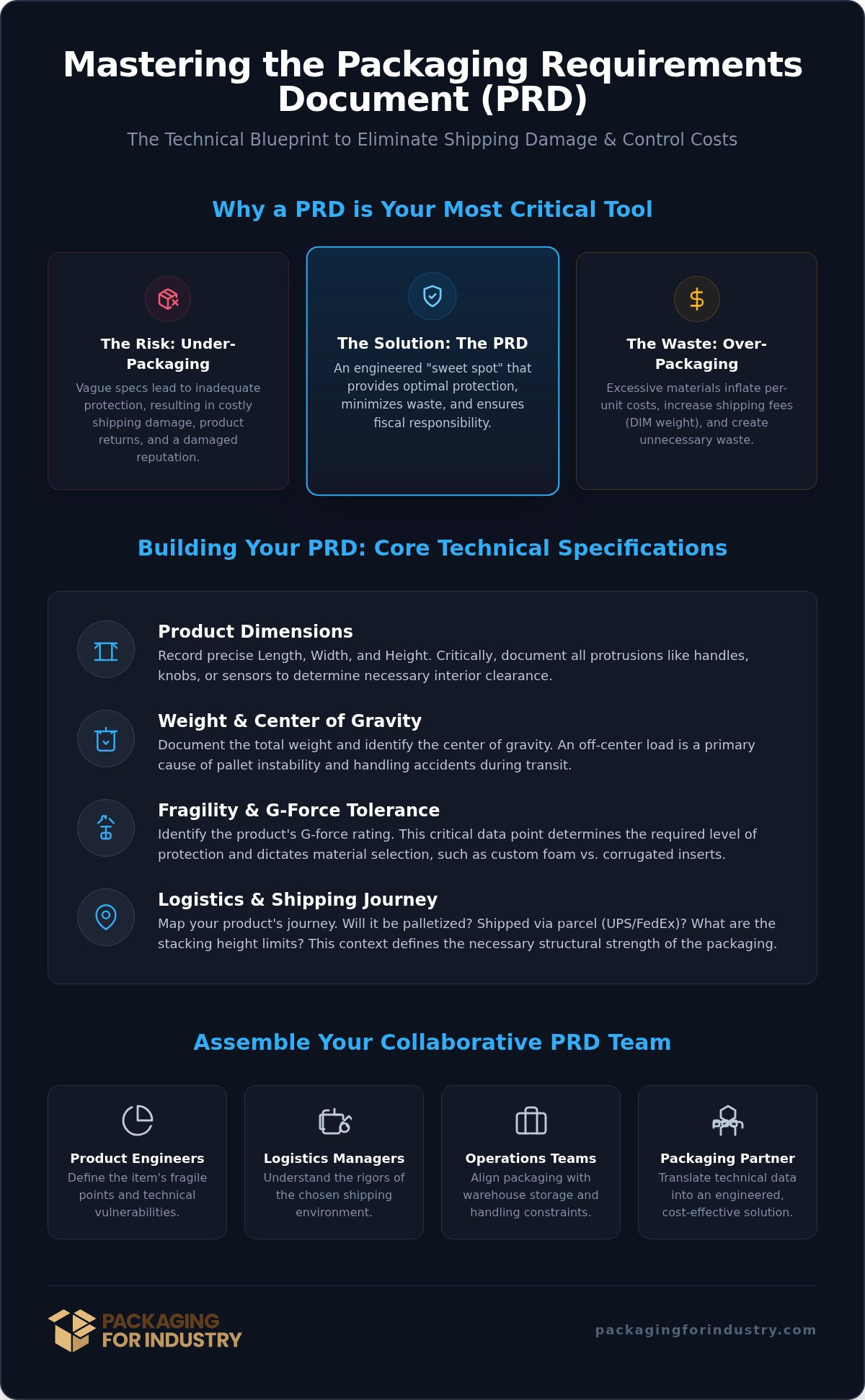
Without a PRD, manufacturers often fall into the trap of over-packaging or under-packaging. Under-packaging is a gamble that results in high shipping damage rates and costly returns. Conversely, over-packaging uses excessive materials, which inflates your per-unit cost and increases waste. A well-defined PRD helps you find the engineering “sweet spot” where protection meets fiscal responsibility. For procurement teams in manufacturing hubs like Orange County, Los Angeles, and the Inland Empire, this document is the key to maintaining consistent quality across bulk quantities and multiple production runs.
The Financial Impact of Poor Packaging Specifications
Vague specifications are a leading cause of unexpected logistics expenses. If your PRD doesn’t account for precise outer dimensions, you’ll likely face steep UPS or FedEx dimensional weight (DIM) surcharges. These fees are based on the volume a package occupies rather than its actual weight; a box that’s just an inch too large can drastically increase your shipping spend. Beyond freight, the hidden costs of shipping damage include replacement production, expedited shipping for new parts, and a damaged professional reputation. Utilizing a PRD is the most effective tool for achieving long-term packaging cost savings because it eliminates these preventable variables before the first pallet leaves the warehouse.
Who Should be Involved in the PRD Process?
Creating a PRD shouldn’t happen in a vacuum. It requires a collaborative effort between product engineers, who understand the item’s fragile points, and logistics managers, who know the rigors of the shipping environment. Operations teams must also weigh in to ensure the proposed packaging aligns with warehouse storage constraints and stacking height limits. Involving a custom design packaging partner during this phase is a strategic move. An experienced supplier can review your technical data early, suggesting material substitutions or design tweaks that can save weeks of lead time and reduce material waste. This proactive approach ensures that your packaging isn’t just an afterthought, but a high-performing component of your product’s success.
Core Technical Specifications: Defining the Product Data
Defining precise technical data is the first step in learning how to write a packaging requirements document for a new product. Precision is the foundation of any successful industrial packaging project. You must record accurate product dimensions, including length, width, and height. Don’t overlook protrusions like handles, knobs, or sensors; these often dictate the interior clearance of a custom box or crate. For heavy industrial components, the center of gravity is just as critical as the total weight. An off-center load can lead to pallet instability or handling accidents during transit. Documenting these details ensures your supplier designs a solution that remains balanced and secure.
Understanding the physical limits of your product allows for better material engineering. When you define these specifications early, you avoid the common pitfall of receiving quotes for generic “one-size-fits-all” solutions that don’t actually protect your specific assets. This technical clarity is what separates a professional PRD from a simple request for boxes.
Fragility and Cushioning Requirements
Identifying your product’s fragility rating, or G-force tolerance, determines the level of protection required. This data helps engineers decide if your application necessitates custom foam packaging or if standard corrugated inserts will suffice. You should specify drop test heights based on your primary shipping method. Parcel shipments through UPS or FedEx require higher drop tolerance than LTL freight on a pallet. Be specific about identifying critical strike points. Delicate aerospace sensors or medical screens require targeted cushioning to prevent internal component failure even if the outer box remains intact.
Surface Protection and ESD Concerns
Industrial parts often require more than just impact resistance. For electronics and semiconductor components, you must specify anti-static (ESD) materials to prevent electrostatic discharge from damaging sensitive circuitry. High-finish automotive or medical parts need non-abrasive linings to prevent surface scratches during vibration. Many manufacturers reference guidelines from the International Organization for Standardization (ISO) to ensure these technical specifications meet global quality benchmarks. For larger, heavy-duty assemblies, integrating corner and edge protection into your document prevents the outer packaging from collapsing under the weight of the product. Once you’ve defined these core technical specs, you can request a custom packaging quote to begin the prototyping phase.
Logistical Requirements: Mapping the Product Journey
Packaging doesn’t exist in a vacuum; it exists in a complex supply chain. When determining how to write a packaging requirements document for a new product, you must map the entire journey from the manufacturing floor to the end user. Each touchpoint introduces specific risks. A parcel shipment handled by UPS or FedEx faces significantly more impact and manual sorting than a dedicated truckload. Your PRD should specify the primary shipping method to ensure the materials selected can withstand the specific stresses of that environment.
Storage conditions also play a vital role in material performance. If your product sits in a non-climate-controlled warehouse in the Inland Empire or Riverside, humidity can degrade the structural integrity of standard corrugated materials over time. Your document needs to define stacking height requirements to prevent bottom-box crush during long-term storage. Additionally, specify whether you require standard 48×40 pallets or custom industrial skids for oversized parts. For international shipments, ISPM-15 compliance for wood crates is mandatory to avoid customs delays, and moisture barriers are essential for long-term sea freight.
Parcel vs. Freight: Engineering for the Mode
Parcel shipments are high-touch environments. This requires higher burst-strength corrugated boxes to survive drops, tosses, and automated conveyor belts. In contrast, freight packaging focuses on stacking strength, measured by the Edge Crush Test (ECT). High ECT ratings allow for denser warehouse stacking, which improves your operational efficiency. In Southern California hubs like Los Angeles and Anaheim, managing dimensional weight is a financial priority. If your PRD doesn’t optimize the box size for the product, you’ll pay for empty space through aggressive carrier surcharges.
Environmental and Compliance Standards
Environmental factors can compromise even the best engineering. Specifying moisture-resistant corrugated or VCI (Vapor Corrosion Inhibitor) liners is necessary for metal parts sensitive to oxidation. If you’re operating in specialized sectors, your PRD must reflect aerospace or military-spec (Mil-Spec) compliance. These standards often dictate specific labeling and marking requirements for industrial tracking and identification. Every detail in this section of your PRD serves to protect the product’s integrity while ensuring it moves through the global supply chain without regulatory friction. When you understand how to write a packaging requirements document for a new product with logistics in mind, you create a solution that’s both durable and cost-effective.
Translating Specs into Material Selection and Engineering
Once you’ve documented your technical data, the next phase of learning how to write a packaging requirements document for a new product is translating those specs into material choices. This is where engineering meets the economics of your supply chain. Your stack height and product weight will dictate the necessary corrugated board grade. While single-wall boxes work for light goods, industrial applications often require double or triple-wall corrugated to prevent structural failure under load. If your product is exceptionally heavy or oversized, a standard box might not suffice; in these cases, your PRD should specify custom industrial crates to ensure the containment can handle the mass, which is a critical consideration for manufacturers of heavy, handcrafted outdoor features like USA Fire Bowls.
Foam selection follows a similar logic of precision. Polyethylene (PE) foam is a closed-cell material that provides excellent support for heavy industrial parts, whereas Polyurethane (PU) is an open-cell foam designed for delicate, lightweight cushioning. Secure transit also relies on dunnage and void fill to prevent internal movement. When you define these requirements clearly, you ensure the product stays exactly where the engineers intended during transit, regardless of the shipping method.
Matching Material to Protection Needs
Heavy-duty corrugated serves as the backbone for many manufacturing sectors because it offers a high strength-to-weight ratio. For specialized shapes, such as roll goods or long mechanical shafts, integrating industrial tubes and cores into your PRD provides targeted structural support that standard boxes cannot match. Once individual units are boxed, you must account for load stabilization. Specifying the correct gauge of stretch film ensures that palletized shipments remain a single, cohesive unit during the vibrations of long-haul transit.
Engineering for Cost and Sustainability
A precise PRD allows for custom-engineered solutions that prioritize both protection and cost-effectiveness. Precision die-cut foam inserts reduce material waste by using only what’s necessary to secure the item. These custom designs often eliminate the need for secondary materials like packing peanuts or excessive bubble wrap, which clutter your customer’s warehouse and increase your environmental footprint. PFI’s free prototyping service validates these material choices through physical testing before you commit to a full production run. Understanding how to write a packaging requirements document for a new product with these engineering principles in mind ensures you don’t pay for protection you don’t need while maintaining total product safety.
From Document to Prototype: Implementing the PRD with PFI
Executing the technical specifications you’ve developed is the final stage of the process. Once you understand how to write a packaging requirements document for a new product, the focus shifts to sourcing and validation. Submitting your PRD to PFI allows our engineering team to begin the CAD/CAM design phase immediately. We treat your document as a contract of requirements; this ensures that every custom foam insert or double-wall box matches the G-force tolerances and dimensions you’ve specified. This methodical transition from digital specs to physical design eliminates the guesswork that often leads to shipping damage or wasted material costs.
The validation process involves more than just a visual check. We use your technical data to ensure the proposed design accounts for every logistical constraint, from warehouse stacking heights in the Inland Empire to the vibration profiles of LTL freight. This engineering-first approach provides procurement managers with the peace of mind that their packaging will perform as intended on the first try. By following this path, you move away from generic catalog supplies and toward a professional, engineered solution that protects your profit margins.
The PFI Prototyping Advantage
We provide free prototyping to ensure your product fits perfectly before you commit to a bulk order. Using the data from your PRD, we create physical samples of protective foam and corrugated structures at no cost. This step is essential for several reasons:
- Validate internal clearance for delicate sensors, screens, or protrusions.
- Test kitting and assembly speed to ensure the packaging doesn’t bottleneck your production line.
- Verify material performance against the real-world shipping stresses identified in your logistical requirements.
If the initial fit requires adjustment for assembly efficiency or better protection, we modify the CAD files and produce a new sample. This proactive cycle saves you weeks of lead time during the critical product launch phase.
Scaling to Production and Inventory Management
Moving from an approved prototype to high-volume manufacturing requires a supplier that understands logistical flow. Our Southern California facilities are equipped to handle bulk production for diverse sectors, ranging from aerospace to medical device manufacturing. To help you manage these assets efficiently, we establish a Vendor Managed Inventory (VMI) program tailored to your recurring needs. This system, combined with just-in-time inventory management, ensures you have the right packaging at the right time without overextending your warehouse space. To begin the transition from document to delivery, request a custom packaging quote and let our team engineer a solution that protects your product and your bottom line.
Secure Your Supply Chain with Technical Precision
Mastering how to write a packaging requirements document for a new product is a strategic investment in your operational stability. By defining precise technical data and mapping the logistical journey, you eliminate the variables that lead to shipping damage and freight surcharges. This document ensures your procurement team receives accurate quotes based on engineered protection rather than generic guesses. It’s the most effective way to maintain consistent quality across bulk orders and complex supply chains.
PFI turns your technical specifications into physical reality through our free prototyping service. Our specialized expertise in the aerospace and industrial sectors ensures your requirements meet the most rigorous standards for protection. With local next-day delivery available throughout Southern California hubs like Anaheim and Riverside, we ensure your production line moves without delay. We prioritize fiscal responsibility and engineering precision to safeguard your assets and your bottom line.
We’re committed to helping you lower costs and improve reliability from the first shipment to the thousandth.
Frequently Asked Questions
What is a packaging requirements document (PRD)?
A PRD is a technical specification that details the physical, logistical, and compliance needs of a product’s packaging. It acts as a standardized communication tool between your engineering team and your industrial packaging supplier. This document ensures that every quote you receive is based on the same protective parameters and material grades, providing a reliable baseline for quality control.
How do I determine the fragility of my product for packaging?
Fragility is determined by calculating the product’s G-force tolerance, which is the maximum shock it can withstand without internal or external damage. Engineers often perform drop tests or vibration analysis to identify critical strike points like sensors or screens. Knowing this value allows for the precise selection of protective foam or corrugated inserts to neutralize impact during the shipping process.
What is the difference between ECT and Mullen burst test for boxes?
The Edge Crush Test (ECT) measures a box’s stacking strength and top-down pressure resistance, which is vital for warehouse efficiency and palletized freight. The Mullen burst test measures the force required to puncture the corrugated board, indicating its ability to withstand rough manual handling. You should prioritize ECT for LTL freight and Mullen for high-touch parcel shipments handled by sorting facilities.
Do I need a PRD for off-the-shelf shipping supplies?
Yes, a PRD is necessary for stock items to ensure consistency across different vendors. Even if you aren’t using custom designs, specifying the exact board grade and dimensions prevents a supplier from substituting cheaper, lower-quality materials. This is a critical step when learning how to write a packaging requirements document for a new product that might initially utilize standard box sizes.
How does a PRD help reduce shipping costs?
A PRD reduces costs by eliminating over-packaging and preventing expensive dimensional weight surcharges from carriers like UPS or FedEx. By optimizing the box dimensions to fit the product perfectly, you avoid paying for empty space. Additionally, a well-engineered document significantly lowers the financial burden of shipping damage, returns, and replacement production costs that eat into your profit margins.
What technical drawings should I include in my packaging specs?
Include 2D and 3D CAD drawings of the product that highlight exact dimensions and any delicate protrusions. Detailed schematics of the internal kitting and assembly layout help the supplier design precise foam inserts. Providing these drawings ensures the packaging fits perfectly on the first try, which saves weeks of lead time and prevents costly redesigns during the manufacturing phase.
How often should I update my packaging requirements document?
Update your PRD whenever there is a change in the product design, shipping method, or carrier rate structures. Small changes in a product’s weight or center of gravity can compromise the effectiveness of existing packaging designs. Regular reviews ensure your logistics remain optimized and cost-effective, particularly if you are scaling from local Southern California delivery to nationwide or international shipping.
Can a packaging supplier help me write my PRD?
A professional industrial packaging supplier like PFI can actively assist in refining the technical details of your PRD. We use our engineering expertise to translate your product vulnerabilities into specific material recommendations. This collaboration often identifies cost-saving opportunities through CAD/CAM design and free prototyping, ensuring your document is optimized for both protection and fiscal efficiency before production begins.