
Opening a shipment of high-value aerospace components only to find surface oxidation is a costly setback that no production manager wants to explain to a client. For manufacturers in Southern California, high rejection rates due to tarnish aren’t just an inconvenience; they’re a direct hit to your bottom line. You’ve likely dealt with the mess of traditional oils and greases, only to find they’re inconsistent and difficult for your customers to clean. Finding reliable anti-tarnish packaging for precision metal parts Los Angeles manufacturers can depend on is essential for maintaining strict quality standards and reducing scrap costs.
We understand that your operations require a clean, dry method of corrosion protection that integrates seamlessly into your existing workflow. This article will show you how to eliminate oxidation in your supply chain using engineered VCI solutions designed specifically for the rigorous demands of the aerospace and medical sectors. We’ll examine how combining advanced chemical protection with custom-engineered cushioning can reduce shipping damage and simplify your logistics, providing a reliable local supply chain right here in Los Angeles and Orange County.
Key Takeaways
- Learn why switching from traditional oils and greases to “dry” VCI protection eliminates the need for costly degreasing and surface preparation.
- Understand the molecular science behind Volatile Corrosion Inhibitors and how they create an invisible, protective barrier for sensitive metal surfaces.
- Identify the most effective materials for anti-tarnish packaging for precision metal parts Los Angeles manufacturers use to secure high-value aerospace and medical components.
- Discover the “box-in-a-box” strategy that integrates VCI liners with heavy-duty corrugated boxes and custom foam to provide both chemical and physical protection.
- Explore how local Vendor Managed Inventory (VMI) programs in Southern California can stabilize your supply chain and eliminate the risk of stockouts for critical packaging supplies.
Protecting Precision Metal Parts from Corrosion and Tarnish
Surface oxidation is more than a cosmetic flaw. For manufacturers in Southern California, it’s a primary driver of rejected shipments and strained client relationships. Precision machining depends on exact tolerances; even a microscopic layer of tarnish can render a part unusable in aerospace or medical assemblies. Relying on “good enough” packaging often leads to expensive rework or total scrap. In the coastal climate of Los Angeles, where salt air and high humidity are constant variables, finding the right anti-tarnish packaging for precision metal parts Los Angeles suppliers provide is critical for protecting components from the moment they leave the machine shop.
Copper, brass, and silver components are especially prone to rapid tarnish, while high-carbon steel can develop “flash rust” within hours of exposure to humid air. Traditional rust preventatives like oils or greases are increasingly obsolete because they aren’t compatible with modern cleanroom environments. Removing these substances requires secondary cleaning processes that add labor costs and introduce new risks of surface damage. Modern operations require a cleaner, more efficient approach that protects the metal without leaving a messy residue.
Why Standard Packaging Fails High-Value Components
Many procurement managers assume standard poly bags provide a sufficient barrier, but the reality is often the opposite. Standard plastic films are permeable to moisture and oxygen. Once humidity is trapped inside a sealed bag, it creates a greenhouse effect that accelerates corrosion. Additionally, standard heavy-duty corrugated boxes can sometimes release acidic vapors from the adhesives or recycled liners used in their construction. These vapors react with sensitive metals, causing tarnish during long-term storage or international freight. This is why specialized anti-tarnish packaging for precision metal parts Los Angeles companies require must be engineered at the material level to neutralize these threats.
The Financial Impact of Oxidation in Aerospace and Medical Manufacturing
The true cost of corrosion isn’t just the price of the part. It includes the labor spent on inspection, the administrative burden of processing rejections, and the potential for late-delivery penalties. For high-value aerospace components, specialized packaging acts as a form of insurance. By utilizing a Volatile Corrosion Inhibitor (VCI) system, you eliminate the need for degreasing and post-delivery cleaning. This reduces the total cost of ownership for your customers and ensures your parts arrive in the exact condition they left the inspection bench. Investing in precision protection is a pragmatic move to safeguard your reputation and your margins.
The Science of VCI and Anti-Tarnish Technology
Volatile Corrosion Inhibitors (VCI) represent a significant shift from the messy, oil-based rust preventatives used in previous decades. This technology works by infusing specialized chemical additives directly into packaging materials like poly bags, papers, and films. Once a part is sealed inside the enclosure, these chemicals vaporize and migrate through the air to reach every recessed area of the metal surface. This process is deeply rooted in the science of metal corrosion, which explains the complex electrochemical exchanges between a metal substrate and its environment.
The primary operational benefit of VCI is the “dry” protection advantage. Because the protective layer is molecular and invisible, your parts are ready for immediate assembly or secondary processing the moment they’re unboxed. You don’t need solvent baths, labor-intensive degreasing, or surface preparation. Implementing the anti-tarnish packaging for precision metal parts Los Angeles manufacturers depend on requires a technical understanding of how these inhibitors interact with specific alloys. Compatibility is a critical factor; ferrous metals like iron and steel require different chemical additives than non-ferrous metals such as copper, aluminum, and brass. If you’re shipping assemblies with multiple metal types, multi-metal VCI formulations are necessary to ensure total protection without causing adverse reactions.
Shelf life is another logistical detail that procurement managers must track. VCI-infused materials typically maintain their efficacy for up to two years when stored in their original, sealed packaging. However, once a bag is opened or a roll of paper is left exposed to the warehouse environment, the active inhibitors begin to dissipate. If you’re unsure which chemistry fits your specific alloy or storage timeline, you can request a packaging quote to consult with a technical specialist.
How VCIs Create a Molecular Protective Barrier
In a sealed environment, VCI molecules saturate the air and form a microscopic, non-reactive layer on the metal surface that prevents oxygen and moisture from interacting with the substrate. This layer is so thin that it doesn’t affect the part’s dimensions or electrical conductivity. The effectiveness of this barrier relies entirely on the integrity of the seal. If the packaging isn’t airtight, the protective vapor concentration will drop, leaving the precision-machined surfaces vulnerable to the humid Los Angeles air.
ESD and Anti-Static Protection for Electronic Assemblies
In the aerospace and medical sectors, metal components are frequently integrated into sensitive electronic assemblies. These parts require a dual-action packaging strategy that combines anti-tarnish properties with Electrostatic Discharge (ESD) protection. Using custom foam packaging with anti-static additives ensures that physical impacts and static buildup don’t compromise circuit boards or sensors. This integrated approach is essential for meeting strict military and aerospace standards for static-sensitive metal components, providing peace of mind during transit and long-term storage.
Choosing the Right Anti-Tarnish Materials for Your Components
Selecting the appropriate material is a critical step in building a reliable protection system. While the molecular science discussed previously provides the foundation, the physical format of your packaging determines its operational efficiency. VCI poly bags and tubing remain the industry standard for high-volume parts because they offer a visible, sealed environment that’s easy to inspect. For flat components or stacked assemblies, anti-tarnish papers and liners provide an effective interleaving solution. These pH-neutral papers prevent “pressure mottling” and ensure that protective vapors reach every surface in a crowded crate.
In extreme environments or for long-term international transit, you might need to move beyond standard VCI. Intercept technology utilizes a high-surface-area copper matrix integrated into the plastic to react with and neutralize corrosive gases before they reach the metal. This is a more robust barrier for sensitive silver or copper components that will be stored for several years. For shipments moving through the Port of Los Angeles, combining these materials with desiccants and moisture barrier bags (MBB) provides a secondary layer of humidity control. This multi-layered approach is the most effective way to implement anti-tarnish packaging for precision metal parts Los Angeles manufacturers use to safeguard their reputation.
VCI Bags, Tubing, and Film: High-Volume Protection
Material gauge is a detail that procurement managers often overlook. Sharp or heavy precision parts can easily puncture a standard 2-mil bag, causing the protective vapor to escape. We typically recommend a 4-mil thickness for industrial components to ensure durability during handling. If you’re shipping long, slender metal rods or shafts, using custom tubes and cores lined with VCI film streamlines the packing process. Bulk ordering these materials allows you to lower per-unit costs while maintaining a consistent standard across your recurring production lines.
Custom Foam Inserts with Integrated Protection
Physical protection shouldn’t come at the expense of chemical safety. Standard foams can sometimes trap moisture against a metal surface, creating a localized corrosion cell. We engineer custom foam inserts using non-abrasive, closed-cell materials that don’t absorb water. These die-cut inserts are designed to hold parts securely while leaving enough headspace for VCI vapors to circulate freely. By combining cushioning and chemical protection in a single, kitted assembly, you reduce the time spent on the packing line and ensure every part receives the same level of oversight.
Engineering a Complete Protection System in Los Angeles
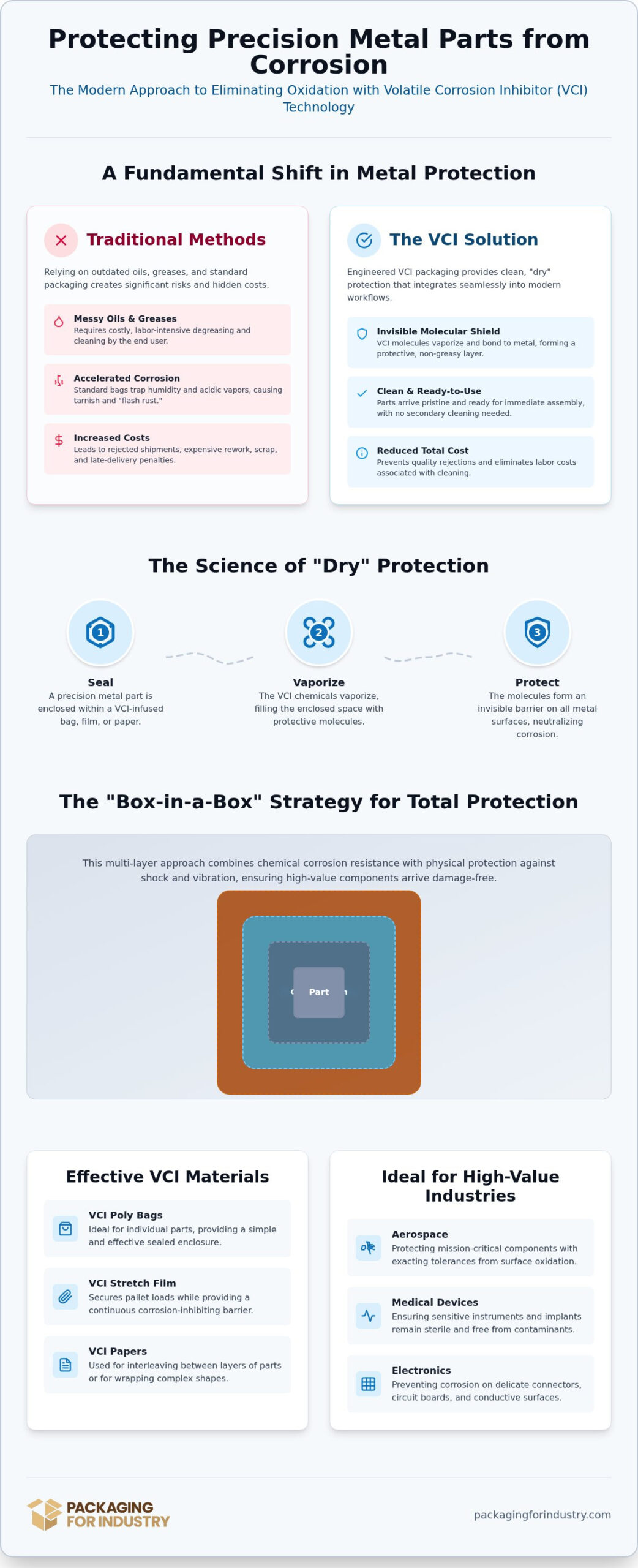
Effective protection for high-value metal components requires more than just a chemical barrier. While a VCI bag provides the necessary molecular shield, it must be supported by a robust physical architecture to survive the rigors of the supply chain. This is where the ‘Box-in-a-Box’ strategy becomes essential. By layering protection from the part surface to the outer crate, you ensure that the internal micro-climate remains stable even if the external environment shifts. This integrated approach is the hallmark of the anti-tarnish packaging for precision metal parts Los Angeles manufacturers rely on for long-distance transport and long-term storage.
Heavy metal parts present a unique challenge because their density can easily compromise standard shipping materials. Relying on heavy-duty corrugated boxes is a pragmatic choice for protecting precision weight. These boxes serve as the final line of defense, preventing external moisture from entering while providing the structural integrity needed for palletization. To prevent strap damage on these heavy shipments, we often integrate corner and edge protection. These components distribute the pressure of plastic or metal banding across a wider surface area, ensuring the outer container remains intact and the seal stays tight.
Combining Custom Corrugated with Corrosion-Resistant Liners
Dense, high-carbon steel or copper components require double-wall or triple-wall boxes to prevent box failure during transit. The outer box must provide a sufficient seal to maintain the VCI environment inside. If air flows freely through the gaps in the box flaps, the concentration of protective vapors will drop. We also provide custom printing options for these boxes. This allows you to include critical handling instructions or branding directly on the exterior, ensuring that carriers and warehouse staff treat your precision parts with the necessary care.
Prototyping and Testing for Sensitive Aerospace Parts
One of the biggest risks in industrial logistics is assuming a design works without verifying it. PFI’s free prototyping service allows you to confirm that your anti-tarnish system is effective before you commit to a full production run. We simulate shipping stresses to ensure that precision surfaces remain scratch-free and tarnish-free throughout the journey. In a recent project, we helped a Los Angeles-based aerospace supplier reduce their rejection rates by redesigning their internal kitting to better support VCI vapor circulation. This proactive approach ensures that your anti-tarnish packaging for precision metal parts Los Angeles strategy is both fiscally responsible and operationally sound.
Reliable Anti-Tarnish Supply and VMI in Southern California
Procurement for specialized materials often gets bogged down by inconsistent lead times from large national catalog companies. When you’re managing production lines for high-value components, you can’t risk a stockout of critical anti-tarnish materials. Working with a dedicated local partner ensures that your anti-tarnish packaging for precision metal parts Los Angeles supply remains stable and responsive to your production fluctuations. Local expertise means we understand the specific challenges of the Southern California climate and can provide immediate technical support when your alloy specifications change.
Maintaining a lean operation requires more than just good materials; it requires a logistics strategy that minimizes waste and maximizes floor space. Many manufacturers in Orange County and Los Angeles operate in high-rent facilities where every square foot of warehouse space must be optimized. By leveraging our local infrastructure, you can transition to a just-in-time delivery model. This eliminates the need to store bulky master rolls of VCI film or pallets of corrugated boxes on-site, allowing you to reallocate that space to revenue-generating production equipment. To get started, you can request a custom packaging quote tailored to your specific metal alloys and monthly volume requirements.
Local Next-Day Delivery Across Los Angeles and Orange County
PFI’s dedicated fleet provides dependable, next-day delivery to industrial hubs in Anaheim, Long Beach, Irvine, and the surrounding Inland Empire. We help our clients reduce the overhead costs associated with national retail markups by offering competitive local wholesale pricing on specialized anti-tarnish supplies. Our goal is to support Southern California’s manufacturing sector with responsive, local account management that understands the urgency of your shipping deadlines. When you work with a local supplier, you aren’t just a tracking number; you’re a partner with a direct line to our operations team.
Streamlining Procurement with Vendor Managed Inventory (VMI)
Managing packaging inventory shouldn’t take up your procurement team’s valuable time. PFI’s VMI programs automate your replenishment process by having our team monitor your stock levels and trigger deliveries before you run low. This system ensures your anti-tarnish packaging for precision metal parts Los Angeles inventory is always at optimal levels without tying up capital. We act as your off-site inventory hub, freeing up your warehouse floor space while ensuring that critical VCI bags and liners are always available when your production peaks. This proactive approach to inventory management is the most efficient way to lower packaging costs and improve supply chain reliability.
Securing Your Supply Chain Against Oxidation
Eliminating surface corrosion requires a shift from reactive cleaning to proactive, engineered protection. By utilizing a “dry” VCI system, you remove the labor costs associated with degreasing while ensuring your precision surfaces remain within tolerance. A successful strategy integrates these molecular barriers with heavy-duty corrugated boxes and custom cushioning to create a resilient, multi-layered defense. Implementing the right anti-tarnish packaging for precision metal parts Los Angeles manufacturers depend on is about more than just buying bags; it’s about securing your reputation as a reliable supplier.
Our team specializes in aerospace and defense compliance, providing the technical expertise needed for sensitive metal alloys. We offer free prototyping for custom designs and local next-day delivery across Southern California to keep your production lines moving without interruption. Transitioning to a local partner for your anti-tarnish needs reduces lead-time risks and improves your operational efficiency.
We look forward to helping you optimize your packaging system and eliminate the high costs of product damage.
Frequently Asked Questions
What is the difference between VCI and standard poly bags for metal parts?
Standard poly bags only provide a passive physical barrier and often trap condensation, which can actually accelerate oxidation. In contrast, VCI bags are infused with chemical additives that vaporize to form an active molecular shield on the metal surface. This protective layer prevents oxygen and moisture from reaching the substrate, ensuring total protection even in recessed areas that a standard bag cannot reach.
How long do anti-tarnish bags protect metal components in storage?
Anti-tarnish packaging typically protects metal components for up to two years when the enclosure remains properly sealed. The inhibitors maintain a stable protective atmosphere within the package as long as there’s no significant air exchange. For long-term storage exceeding two years, we recommend using secondary moisture barriers or conducting periodic inspections of the seal integrity to ensure the vapor concentration remains effective.
Do I need to clean my parts before putting them in VCI packaging?
Yes, parts should be clean and dry before being placed in VCI packaging to ensure maximum effectiveness. While the inhibitors prevent new corrosion, they can’t reverse existing oxidation or penetrate heavy layers of grease or moisture already on the part. Ensuring a clean surface allows the VCI molecules to bond directly to the metal substrate for a more reliable and consistent shield.
Can VCI packaging be used for both ferrous and non-ferrous metals?
VCI packaging is available in specific formulations for ferrous metals like steel and iron, as well as non-ferrous metals such as copper, brass, and aluminum. It’s critical to match the VCI chemistry to your specific alloy to avoid adverse reactions. Using the wrong formulation can occasionally cause staining, so always verify your metal type when selecting your anti-tarnish packaging for precision metal parts Los Angeles supplies.
Is anti-tarnish packaging safe for electronics and circuit boards?
Yes, VCI technology is safe for electronics and circuit boards because the molecular layer it forms is non-conductive and doesn’t interfere with electrical performance or soldering. For sensitive electronic assemblies, we recommend integrated solutions that combine anti-tarnish properties with ESD protection. This dual-action approach prevents both surface corrosion on metal contacts and damage from electrostatic discharge during handling and transit.
What is the most cost-effective way to buy anti-tarnish supplies in Los Angeles?
The most cost-effective way to source anti-tarnish packaging for precision metal parts Los Angeles manufacturers require is to work with a local wholesale supplier offering Vendor Managed Inventory (VMI). This approach reduces shipping costs associated with national catalog suppliers and eliminates the high markups often found at retail. Bulk purchasing through a local partner allows you to lower per-unit costs while maintaining a just-in-time delivery schedule.
How does humidity in Southern California affect anti-tarnish packaging performance?
High humidity in coastal areas like Los Angeles and Orange County significantly increases the risk of flash rust during storage. VCI technology is designed to neutralize these corrosive effects by creating a protective micro-climate inside the package. In high-humidity environments, ensuring a proper heat seal on VCI bags is essential. This prevents the protective vapors from dissipating and keeps external moisture from overwhelming the chemical barrier.
Can PFI create custom-size VCI bags for large aerospace components?
PFI manufactures custom-size VCI bags, liners, and tubing for large-scale aerospace components that don’t fit standard catalog dimensions. We provide free prototyping to ensure the packaging fits your specific part geometry and allows for adequate vapor circulation. Our local manufacturing capabilities allow for shorter lead times on custom orders compared to out-of-state suppliers, helping you maintain tight production schedules for high-value projects.