
Buying industrial tubes from a national catalog isn’t just inefficient; it’s a direct tax on your Southern California supply chain. You’ve likely dealt with the frustration of paying high freight costs just to “ship air” from a distant warehouse, only to have the tubes arrive crushed or late. When your heavy-duty cardboard tubes for industrial applications SoCal don’t meet the required crush resistance, the resulting product damage can cost your operation thousands in lost materials and delayed shipments. It’s a logistical headache that procurement managers shouldn’t have to tolerate in a high-stakes manufacturing environment.
We agree that your packaging should be a reliable asset, not a liability that eats into your margins. This guide will show you how to specify the exact wall thickness and diameter needed for your specific application while sourcing locally to eliminate unnecessary lead times and freight surcharges. We’ll explore how custom-engineered cores and just-in-time delivery programs can streamline your warehouse inventory and provide the structural integrity your products demand. From aerospace components to high-tension film winding, you’ll learn how to optimize your protection strategy with a local partner who understands the SoCal landscape.
Key Takeaways
- Identify why you shouldn’t settle for standard mailing tubes when high-strength industrial cores are required to prevent product crushing under heavy loads.
- Learn how to engineer custom wall thicknesses and lengths that maximize structural integrity while avoiding costly dimensional weight surcharges.
- Understand why local sourcing for heavy-duty cardboard tubes for industrial applications SoCal is the most effective way to eliminate the “shipping air” penalty and lower your total landed cost.
- Discover how Vendor Managed Inventory (VMI) and just-in-time delivery can streamline your warehouse operations and free up valuable floor space.
- Leverage free prototyping and next-day delivery in Los Angeles, Orange County, and the Inland Empire to ensure your custom specs meet your exact operational needs.
What Defines Heavy-Duty Cardboard Tubes for Industrial Use?
Industrial tubes are specialized components engineered through a multi-ply spiral-winding process. This method layers high-grade kraft paper or recycled fiberboard with industrial adhesives to create a structure with immense radial strength. Unlike consumer-grade products, heavy-duty cardboard tubes for industrial applications SoCal are designed to withstand significant compressive forces. They function as either internal cores for high-tension winding or as external protective barriers for heavy metal shafts and precision equipment.
The bonding agent used during the winding process is just as critical as the paper itself. High-performance adhesives ensure that the plies don’t delaminate under pressure. This structural integrity is what allows these tubes and cores to maintain their shape when stacked multiple units high in a busy warehouse in Anaheim or Riverside. Without this specific engineering, a tube is simply a container; with it, it becomes a structural tool that protects your bottom line by preventing product loss.
Industrial Cores vs. Shipping Tubes
While the terms are often used interchangeably, they serve different operational functions. Industrial cores provide internal support for materials like stretch film, textiles, or aluminum foil. They must resist high-torque winding without collapsing or deforming. Shipping tubes provide external protection for long, fragile, or heavy parts. Using “mailing grade” tubes for industrial goods often leads to transit damage. These lighter tubes lack the wall density to resist the impact of shifting loads in a trailer or the vertical pressure of stacked pallets.
Key Terminology for Procurement Managers
To get an accurate custom packaging quote, procurement teams need to specify three critical dimensions that dictate performance and cost.
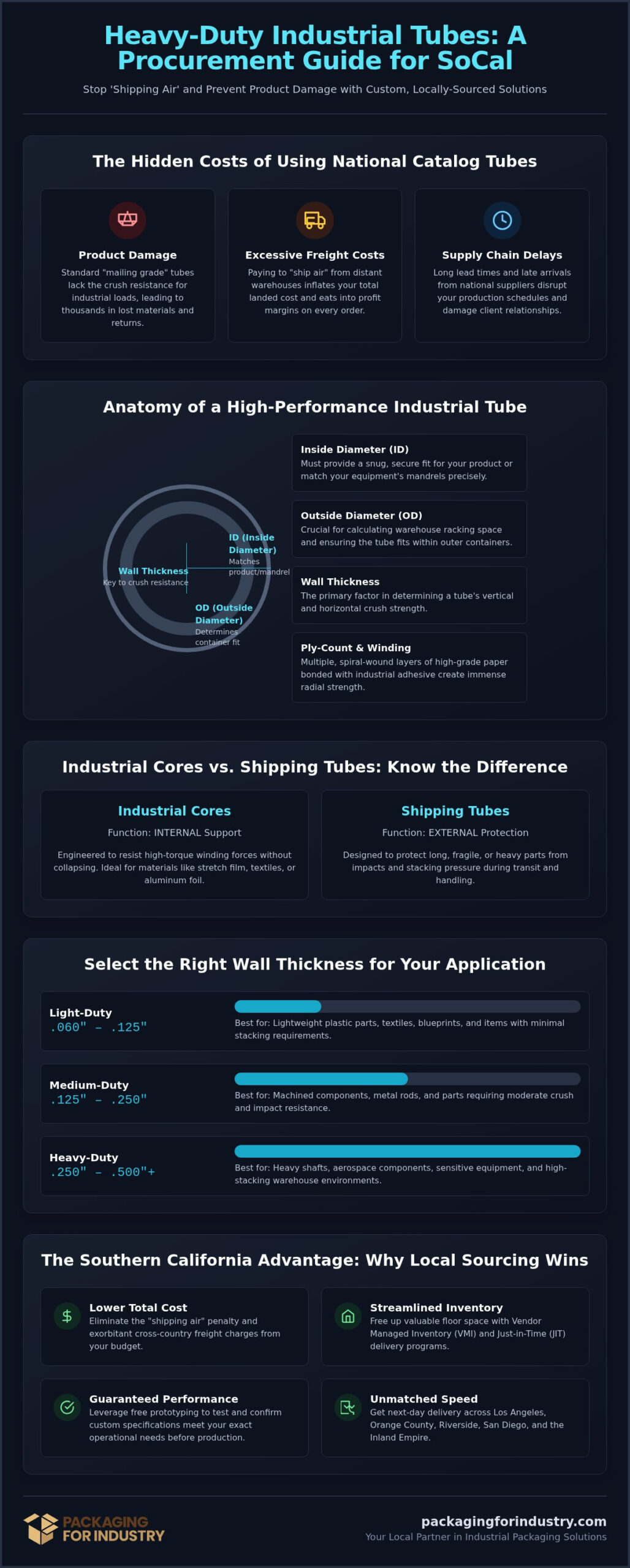
- ID (Inside Diameter): This must match your equipment’s mandrels or the diameter of the product you’re sliding inside for a snug, secure fit.
- OD (Outside Diameter): This is crucial for calculating warehouse racking space and ensuring the tube fits within secondary containers or crates.
- Wall Thickness: This is the distance between the ID and OD. It is the primary factor in determining the tube’s vertical and horizontal crush resistance.
- Ply-count: The number of individual paper layers determines the overall density. More plies translate to greater durability for high-value items like aerospace sensors or medical equipment.
Understanding these specifications allows you to optimize your packaging. You can balance the need for protection with the goal of reducing material weight and shipping costs.
Technical Specifications: Engineering Your Custom Tubes
Engineering the right tube requires a balance between structural necessity and logistical cost. While a thicker wall provides more protection, it also adds weight and material expense. Determining the ideal specifications for heavy-duty cardboard tubes for industrial applications SoCal involves analyzing the weight of your product, how it will be handled, and the stacking height in your facility. Precision in these measurements ensures your items remain secure without overspending on over-engineered materials.
Testing for crush resistance is the standard for verifying performance. We look at two primary metrics: flat crush and radial crush. Flat crush measures the tube’s ability to resist pressure applied to its side, which is critical when tubes are stacked horizontally on pallets. Radial crush, or hoop strength, measures the resistance to internal or external pressure around the circumference. This is vital for film and foil manufacturers who need cores that won’t collapse under the high tension of winding equipment. If you’re unsure which spec fits your application, you can request a packaging quote to begin a technical review of your needs.
Choosing the Right Wall Thickness
Wall thickness is the primary driver of durability. Selecting the wrong grade can lead to catastrophic failure in the supply chain. We generally categorize industrial needs into three tiers:
- Light-duty (.060 to .125): Best suited for lightweight plastic parts, blueprints, or protective sleeves for non-load-bearing items.
- Medium-duty (.125 to .250): The standard for most industrial shipping, providing a reliable balance of weight and crush resistance.
- Heavy-duty (.250 to .500+): Engineered for high-torque winding, heavy metal shafts, and sensitive aerospace components that require maximum rigidity.
Inside Diameter (ID) and Length Customization
Customization allows you to eliminate the “shipping air” penalty. We provide standard IDs ranging from 0.5 inches to over 24 inches to accommodate everything from small sensors to large industrial rolls. The Inside Diameter (ID) determines the fit on winding mandrels, where a precise tolerance is required to maintain consistent torque and prevent core slippage during high-speed film production.
Length is equally important for cost control. Precision cutting to within 1/16th of an inch ensures that tubes fit perfectly into secondary containers or crates. This precision helps you avoid dimensional weight surcharges from carriers like UPS and FedEx, who penalize shippers for oversized packaging. By matching the tube length exactly to your product, you reduce the need for additional void fill and lower your total landed cost.
Specialty closures further enhance protection. Options include friction-fit plastic end caps for easy access, metal crimps for high-security transit, or telescope designs that allow for adjustable lengths. These features transform a simple tube into a comprehensive industrial packaging solution.
Industrial Applications for Tubes in the SoCal Market
Southern California’s industrial landscape is as diverse as it is demanding. From the high-precision aerospace labs in Anaheim to the sprawling logistics hubs of the Inland Empire, procurement managers require specialized protection for a wide range of goods. Sourcing heavy-duty cardboard tubes for industrial applications SoCal allows regional businesses to match the engineering of their packaging to the specific stresses of the local supply chain. When you work with a local partner, you aren’t just buying paper; you’re securing a structural component designed for the unique transit and storage needs of the West Coast.
Aerospace and Aviation Protection
High-value components such as precision-machined shafts, landing gear parts, and sensitive sensors require more than just a standard container. In the aerospace hubs of Orange County and Los Angeles, manufacturers often utilize custom-engineered tubes to prevent surface abrasion and structural impact during transit. By integrating foam-lined interiors or protective inserts, these tubes provide superior shock absorption. This level of protection is essential for meeting the stringent quality control and safety standards typical of Aerospace & Aviation Packaging Solutions. Using an industrial-grade tube ensures that these critical parts arrive at the hangar or assembly line in factory-perfect condition.
Manufacturing and Distribution Hubs
The logistics corridor spanning San Bernardino and Riverside counties handles a massive volume of rolled goods and long-format materials. For the textile and carpeting industries, high-torque cores are an operational necessity. These cores must support heavy rolls without collapsing under the weight or the tension of high-speed winding machinery. Beyond textiles, these tubes are the preferred choice for protecting threaded rods, aluminum extrusions, and delicate architectural trim. Utilizing Manufacturing Packaging Solutions that are manufactured and delivered within the region allows facilities to reduce lead times and optimize their warehouse floor space through more efficient stacking.
Film and foil converters in the region also rely on multi-ply cores that maintain dimensional stability during high-speed winding. Any core failure in these applications results in significant machine downtime and material waste. Additionally, the regional construction boom requires specialized concrete form tubes for infrastructure projects. These tubes must resist the immense hydraulic pressure of wet concrete. Whether it’s for a high-tech sensor or a foundational pillar, industrial-grade paper structures are essential to both the supply chain and the physical infrastructure of Southern California.
Procurement Strategies: Bulk Ordering and VMI
Procuring industrial tubes presents a unique logistical challenge: you’re essentially paying to transport and store air. Because these items are hollow and bulky, freight costs often represent a disproportionate percentage of the total landed cost. Partnering with a local bulk packaging supplier allows you to bypass the high shipping premiums charged by national catalog companies. By reducing the distance between the manufacturing point and your facility, you immediately lower your operational overhead and minimize the risk of transit damage to your heavy-duty cardboard tubes for industrial applications SoCal.
Inventory optimization is equally critical for high-volume users. While bulk purchasing yields a lower unit price, the physical footprint of several pallets can overwhelm a warehouse. We help clients balance these priorities by optimizing tube dimensions for maximum pallet density. This might involve adjusting lengths to fit standard pallet footprints more efficiently or utilizing custom stacking patterns that reduce the likelihood of the bottom layers crushing. This pragmatic approach ensures you get the volume you need without sacrificing valuable floor space.
Vendor Managed Inventory (VMI) for Bulky Items
For high-volume operations in Anaheim or Los Angeles, floor space is a premium asset that shouldn’t be wasted on empty packaging. Our Vendor Managed Inventory Services allow you to maintain a lean warehouse while ensuring you never face a stockout. We monitor your usage rates and manage the replenishment process, storing the bulk of your inventory at our facility and delivering only what you need for your immediate production runs. This “fixer” approach to inventory management turns a bulky storage problem into a streamlined, just-in-time workflow.
Local Logistics: The SoCal Advantage
Relying on out-of-state suppliers introduces unnecessary variables into your supply chain. Long lead times and unpredictable shipping delays can halt production and frustrate your customers. Sourcing locally from a Southern California supplier provides the agility of next-day delivery across Orange County, LA, and the Inland Empire. This proximity allows for a more responsive partnership, where custom-spec tubes can be prototyped, manufactured, and delivered with a speed that national competitors cannot match. It also supports corporate sustainability goals by significantly reducing the carbon footprint associated with long-haul freight.
Why Choose PFI for Your Industrial Cardboard Tubes?
If you’ve been searching for a reliable industrial packaging supplier near me, you know that B2B operations require more than just a catalog number. At PFI, we position ourselves as a technical partner rather than a simple vendor. We specialize in heavy-duty cardboard tubes for industrial applications SoCal, ensuring that every specification is engineered to protect your high-value goods. Whether your facility is in Orange County or the Inland Empire, our approach is built on solving the specific structural and logistical failures that standard packaging ignores.
As a seasoned Anaheim packaging supplier, we understand the local manufacturing landscape. We don’t just provide tubes; we offer integrated protection systems. This includes combining your heavy-duty cores with protective foam packaging or custom corrugated boxes to create a total containment solution. For companies looking for a Los Angeles packaging supplier that prioritizes B2B reliability over retail convenience, PFI provides the engineering oversight necessary to eliminate shipping damage and stabilize your supply chain.
The Prototyping and Design Process
Precision is the foundation of industrial protection. Our Custom Design Packaging team utilizes CAD/CAM support to develop tubes that fit your specific equipment and product dimensions. We provide free prototyping, allowing you to run physical tests on your production lines before committing to a bulk order. This testing phase ensures that your custom wall thickness and ply-count provide the exact radial strength required for your application, eliminating the guesswork from your procurement process.
Requesting a Quote and Getting Started
Our specialists are ready to help you lower packaging costs through better design and local logistics. When you contact us, you’ll speak with a professional who understands warehouse operations and transit stresses, not a generic call center. We offer fast turnaround times on every custom packaging quote, ensuring your production schedule remains on track.
Optimize Your Supply Chain with Local Industrial Tube Expertise
Securing your products starts with choosing the right structural support. By engineering your wall thickness and diameter to meet specific industrial loads, you eliminate the risk of transit damage and the waste of over-packaging. Sourcing heavy-duty cardboard tubes for industrial applications SoCal from a local partner allows you to bypass the high freight costs of national catalog suppliers while gaining the agility of next-day delivery. We specialize in meeting the rigorous standards of the aerospace and manufacturing sectors across Los Angeles, Orange County, and the Inland Empire.
Our team provides free prototyping and CAD/CAM support to ensure every tube meets your exact requirements. We focus on the intersection of engineering and economics to help you lower costs, reduce warehouse clutter through VMI programs, and stabilize your logistical flow. It’s time to stop paying to ship air and start investing in protection that works for your bottom line.
We look forward to helping you build a more resilient and cost-effective packaging strategy for your Southern California operation.
Frequently Asked Questions
What is the maximum wall thickness available for heavy-duty tubes?
We manufacture industrial tubes with wall thicknesses up to 0.500 inches and beyond for specialized high-load requirements. This density is essential for heavy-duty cardboard tubes for industrial applications SoCal where extreme radial or vertical crush resistance is a technical necessity. Thicker walls prevent the structural failures often seen in lighter, catalog-grade products when they’re subjected to high-torque winding or multi-level pallet stacking.
Can you provide custom-printed tubes for industrial branding?
Yes, we offer custom printing options to include part numbers, specific handling instructions, or company branding directly on the tube surface. This capability is particularly useful for manufacturing facilities that need to identify components quickly on a busy warehouse floor. Beyond professional aesthetics, printing technical data or barcodes on the tube reduces errors during kitting and final distribution.
What are the common inside diameters (ID) for industrial winding cores?
Standard inside diameters for industrial winding cores typically range from 3 inches to 12 inches, though we can produce custom IDs from 0.5 inches to over 24 inches. Matching the ID to your equipment’s mandrel is critical for maintaining consistent tension during film, foil, or textile production. We ensure precision cutting to within 1/16th of an inch to prevent core slippage or costly machine downtime.
Do you offer local delivery in San Diego and the Inland Empire?
We provide local next-day delivery to San Diego, the Inland Empire, Orange County, and Los Angeles. Our regional logistics network is specifically designed to eliminate the long lead times and high freight costs associated with out-of-state suppliers. Sourcing locally allows you to implement just-in-time inventory strategies and avoid the logistical delays common with national catalog orders.
Are your cardboard tubes moisture-resistant for outdoor storage?
We offer specialty linings and outer plies designed to provide enhanced moisture resistance for short-term outdoor exposure or high-humidity environments. While standard paper tubes are susceptible to moisture, these treated options help maintain structural integrity during transit. However, we generally recommend covered storage to ensure the long-term stability of the adhesive bonds and paper layers under extreme conditions.
Can I get a prototype of a custom-sized tube before ordering bulk?
Yes, we offer free prototyping and CAD/CAM support so you can test a custom-sized tube before committing to a full production run. This allows your operations team to verify equipment compatibility and actual crush resistance in your specific facility. Testing a physical sample is the most effective way to prevent costly procurement errors and ensure your heavy-duty cardboard tubes for industrial applications SoCal perform as expected.
What types of end caps are available for industrial shipping tubes?
We provide several closure options including friction-fit plastic end caps, metal crimped ends, and heavy-duty wood plugs for high-weight applications. For products requiring adjustable lengths, telescope designs are also available. Selecting the appropriate cap depends on the weight of the contents and the specific level of security required as the goods move through your supply chain.
How do I determine the right crush strength for my application?
Determining the correct crush strength involves analyzing the total weight of your product and the maximum stacking height in your warehouse. We use these variables to engineer the specific wall thickness and ply-count required to prevent collapse. Our specialists can help you calculate these technical requirements to ensure you aren’t over-spending on materials while still maintaining total product protection.