
What if the most dangerous part of your equipment’s journey isn’t a forklift accident or a dropped crate, but the invisible, constant hum of the road itself? You’ve likely dealt with the frustration of a machine arriving “dead on arrival” despite looking perfect on the outside. It’s a costly reality for operations managers who find that standard packaging can’t prevent internal component fatigue. If you’re struggling with how to protect industrial equipment from vibration in transit, you need a strategy that moves beyond basic cushioning and addresses the physics of the haul.
We’ve helped manufacturers across Southern California and the Inland Empire eliminate the stress of shipping damage through precision engineering. In this guide, you’ll learn the professional strategies for isolating sensitive machinery from harmonic vibration and shock during long-haul transit. We’ll cover the essential combinations of custom crates and specialized foam inserts that create a standardized, reliable packing process. By the end, you’ll have a clear roadmap to achieving a zero-damage shipping record and significantly reducing the frequency of insurance claims.
Key Takeaways
- Understand how continuous low-amplitude oscillations cause internal component fatigue and micro-cracking even when the outer package remains intact.
- Learn to select the correct protective foam densities based on static loading and G-force ratings to create an effective dampening system for sensitive gear.
- Discover when to utilize custom wood crates versus heavy-duty double or triple-wall corrugated boxes to maintain structural integrity during long-haul transport.
- Master the step-by-step engineering process for how to protect industrial equipment from vibration in transit by conducting fragility assessments and isolating internal moving parts.
- Coordinate with a local Southern California packaging partner to access custom-engineered prototypes that reduce shipping damage and lower insurance claims.
The Impact of Vibration on Industrial Equipment in Transit
Vibration in a logistics context refers to the continuous, low-amplitude oscillations generated by road surfaces, vehicle engines, and tire contact. Unlike a single, obvious impact, these oscillations act as a constant force on your cargo throughout the entire journey. Understanding how to protect industrial equipment from vibration in transit begins with recognizing that this force is cumulative. A machine traveling from an Anaheim facility to a customer across the country can endure millions of vibration cycles before it reaches its destination. This is the primary reason why standard off-the-shelf packaging often fails to protect high-value assets.
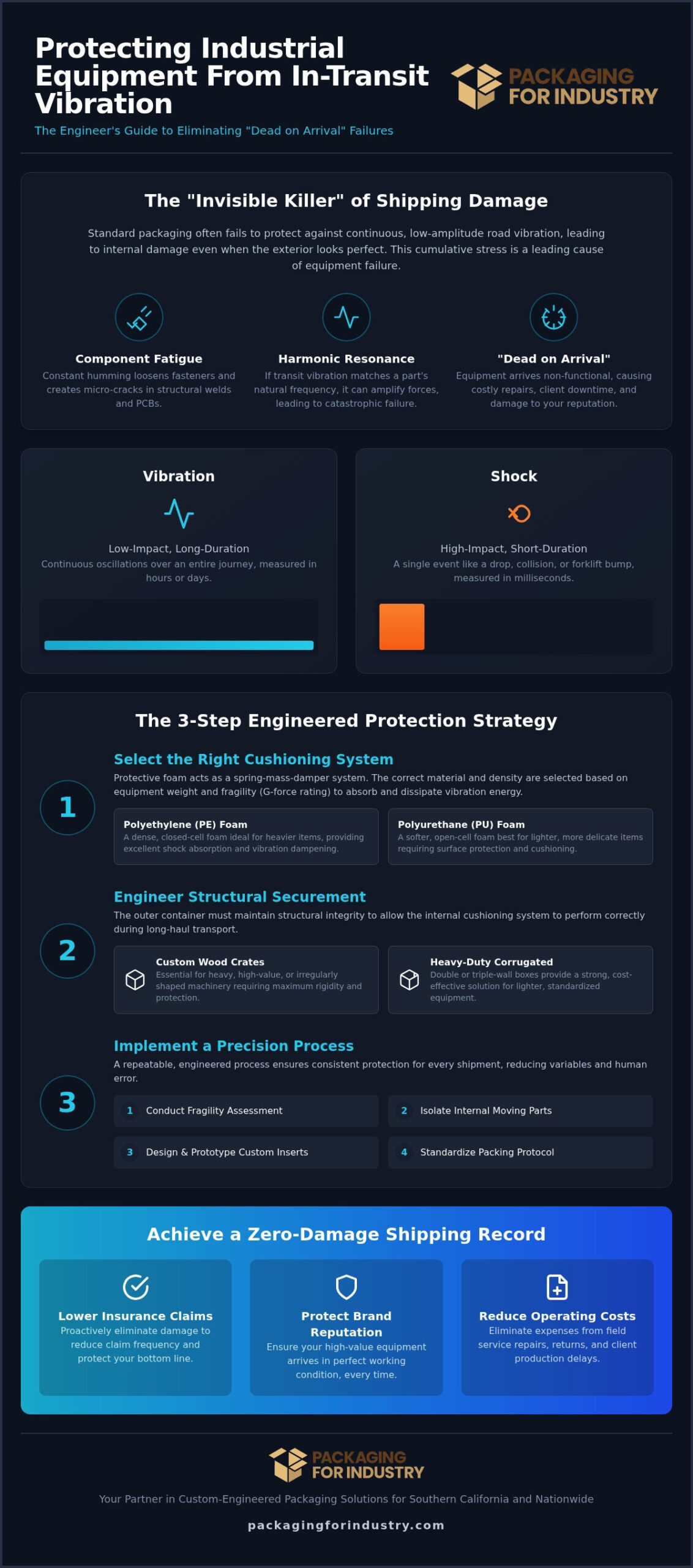
We often refer to vibration as the “invisible killer” of industrial machinery. The equipment typically arrives at the warehouse looking pristine, with no visible damage to the outer crate or box. However, the constant humming of the truck causes internal fasteners to loosen and creates micro-cracks in structural welds. High-risk components such as Printed Circuit Boards (PCBs), optical sensors, and precision-calibrated robotic arms are particularly vulnerable. If the transit vibration matches the natural frequency of these parts, the resulting resonance can lead to catastrophic internal failure without a single scratch appearing on the chassis.
The financial ripple effect of this damage is significant. When a machine arrives “dead on arrival” (DOA), the costs extend far beyond a simple insurance claim. You’re looking at expensive field service repairs, lost production time for your client, and potential contract penalties. Investing in custom-engineered protective foam packaging and rigid structural support is a proactive way to lower packaging costs over the long term by eliminating these “hidden” expenses and protecting your brand’s reputation for reliability.
Vibration vs. Shock: Knowing the Difference
It’s vital to distinguish between shock and vibration when designing a shipping protocol. Shock is a high-impact, short-duration event, such as a forklift hitting a crate or a box falling off a pallet. Vibration is a low-impact, long-duration event that persists for the duration of a 2,000-mile journey. Most standard packaging materials are rated for shock absorption but fail to address the specific dampening required to stop vibration fatigue. Effective protection requires a system that isolates the equipment from the constant energy of the transport vehicle.
Common Symptoms of Vibration Damage
Identifying vibration damage requires looking past the surface. One of the most common symptoms is calibration drift in precision measurement tools, which requires a specialist to reset the machine before it can be used. You may also encounter solder joint failure in sensitive electronics, where the constant movement has snapped delicate connections. Another frequent issue is “fretting,” which is surface abrasion caused by two components rubbing together at high frequencies. This can ruin the finish of high-tolerance parts or lead to premature wear on bearings and joints.
Selecting the Right Cushioning: Foam Densities and Vibration Dampening
To effectively address how to protect industrial equipment from vibration in transit, we must treat the cushioning as a mechanical component rather than simple padding. In an engineering context, protective foam functions as a spring-mass-damper system where the machinery is the mass and the foam provides the dampening. Without the correct density, the vibration energy passes directly into the equipment’s internal components. As a leading industrial packaging supplier near me for Southern California manufacturers, we ensure that every foam insert is calculated to neutralize these specific transit harmonics.
As your bulk packaging supplier, we provide access to a full range of material densities that standard catalog vendors simply don’t carry. This variety allows us to engineer custom foam inserts that are precision-matched to your product’s weight and fragility. If you’re ready to optimize your protection levels and reduce shipping damage, you can request a custom packaging quote to begin the design and prototyping phase.
Polyethylene (PE) vs. Polyurethane (PU) Foam
Selecting the right polymer is the first step in effective vibration isolation. Polyethylene (PE) foam is a closed-cell, rigid material best suited for heavy industrial gear that requires structural support. It maintains its shape under significant weight while absorbing constant oscillations. Polyurethane (PU) foam is an open-cell, softer material ideal for lightweight, highly sensitive instruments that need delicate cushioning. We often design multi-density foam “sandwiches” that layer these materials to tackle both low-frequency road hum and high-frequency engine vibrations simultaneously.
The Role of Static Loading in Protection
Static loading is the weight of the product divided by the foam’s contact area. Getting this calculation right is the difference between a successful shipment and a damaged asset. If you use too much foam, you may encounter the “trampoline effect,” where the product doesn’t compress the foam enough to engage its dampening properties. Conversely, too little foam causes the product to “bottom out” during a shock event. We also incorporate ESD (Electrostatic Discharge) foam for electronic industrial components to prevent static buildup caused by the constant friction of transit vibration.
Structural Securement: Custom Crates vs. Heavy-Duty Corrugated Boxes
Choosing the right external structure is just as critical as the internal foam. While the foam dampens movement, the outer container maintains the rigid geometry required for that dampening to work. If the outer shell flexes during transit, it changes the static loading on the foam, often leading to protection failure. When determining how to protect industrial equipment from vibration in transit, you must choose between high-performance corrugated materials and custom-built timber solutions based on the weight and sensitivity of the asset.
For mid-weight components, custom corrugated boxes using double or triple-wall construction provide significant structural stability. These are not standard shipping boxes; they’re engineered to withstand the crushing forces of stacked pallets while dampening high-frequency road buzz. For heavy-duty machinery, we recommend moving to custom wood crates. These allow for base-bolting or “skidding,” where the equipment is mechanically fastened to the crate’s floor. This securement ensures the machine moves with the crate rather than bouncing inside it. We also utilize corner and edge protection to lock the item in place, preventing lateral shifting that can lead to abrasion or “fretting” damage.
Engineering the Custom Crate
A well-engineered crate functions as a protective vault. We often design foam-lined crates that provide 360-degree vibration isolation, ensuring that every surface of the equipment is shielded from external forces. To eliminate internal shifting, we use custom cleats and bracing tailored to the machine’s specific center of gravity. This level of detail is standard in our custom design packaging process. By anchoring the equipment’s heaviest points, we prevent the “pendulum effect” that often snaps delicate internal sensors during long-haul transport.
Heavy-Duty Corrugated Solutions
Triple-wall corrugated is an excellent alternative for equipment that requires high-level protection without the weight of wood. The multi-layered fluting acts as a secondary dampener, absorbing high-frequency vibrations that can loosen fasteners over time. Consider these factors when selecting your container:
- Triple-Wall Corrugated: Ideal for loads under 500 lbs that require moisture resistance and high-frequency dampening.
- Custom Wood Crates: Required for heavy machinery, allowing for mechanical fasteners and multi-year storage durability.
- Precision Inserts: Always opt for custom-cut foam over loose-fill materials to prevent settling during the journey.
One common mistake we see in industrial shipping is the use of loose-fill materials like packing peanuts. These are a primary failure point for vibration protection because they settle, creating air gaps that allow the equipment to move freely. We replace these with precision-cut custom inserts. To ensure a zero-tolerance fit before you commit to a bulk order, we offer free prototyping for manufacturers in Orange County and the surrounding areas. This allows your team to test the fit and securement in a real-world warehouse environment.
5 Steps to Protect Your Machinery from Transit Vibration
Implementing a standardized packing process is the most effective way to ensure consistent results across your logistics chain. When you compare packaging pricing and the associated costs of shipping damage, the value of an engineered approach becomes evident. To effectively address how to protect industrial equipment from vibration in transit, your warehouse team should follow these five operational steps:
- Conduct a Fragility Assessment: Identify the specific internal components, such as optical sensors or circuit boards, that are most susceptible to low-amplitude oscillations.
- Immobilize Internal Moving Parts: Use specialized ties or custom-cut foam blocks to ensure internal sub-assemblies cannot move independently of the chassis.
- Select Container Based on Transit Method: Match the container’s durability to the haul; LTL shipments generally endure more vibration and handling than dedicated truckloads.
- Eliminate Air Gaps: Apply precision-cut cushioning to remove every void between the product and the container wall, preventing the equipment from accelerating during a vibration cycle.
- Monitor the Journey: Use impact and vibration indicators to provide a clear record of the journey and hold carriers accountable for high-value assets.
Internal Component Immobilization
External padding alone often fails because it doesn’t address the relative movement of internal hardware. If internal optics or mechanical arms can oscillate, they’ll eventually reach a point of fatigue. Internal securement is the first line of defense against harmonic resonance. We utilize specialized ties and custom-cut foam blocks to brace these components during our packaging kitting process. This ensures the entire unit moves as a single, stabilized mass, protecting sensitive internal connections from the constant hum of the road.
The Final Seal: Stabilization and Stretch Film
Once the equipment is crated or boxed, it must be unified with the pallet to prevent secondary vibrations. Using high-quality stretch film is the industry standard for securing loads. Proper tensioning during the wrap process reduces the micro-movements that occur between the container and the pallet surface. Always check for pallet overhang. If the container extends beyond the pallet edge, it creates a cantilever effect that significantly amplifies vibration impact throughout the haul. Proper wrapping ensures the load remains centered and stable from the warehouse floor to the final destination.
Custom Engineering for Sensitive Industrial Logistics in Southern California
Manufacturers across the region require more than just a container; they need a technical partner who understands the physics of the haul. As a premier Anaheim packaging supplier, we provide the localized expertise necessary to solve complex logistical challenges. Whether you are looking for custom boxes in Orange County or specialized aerospace crates in Los Angeles, our engineering team focuses on the specific stressors of your transit routes. We support high-precision manufacturing operations in San Diego and Riverside with CAD/CAM design capabilities that dictate exactly how to protect industrial equipment from vibration in transit. Our Vendor Managed Inventory (VMI) programs ensure that as your bulk packaging supplier, we keep your lines moving with just-in-time delivery of critical materials.
From Prototype to Production
Our process begins with free prototyping to eliminate the risk of improper fit or insufficient dampening. By utilizing precision-cut foam and custom crate engineering, we address the specific fragility of your equipment before a single shipment leaves the dock. This proactive design phase has helped local firms significantly reduce their “dead on arrival” rates. When you compare packaging pricing, you’ll find that our engineered approach provides higher value by reducing the hidden costs of field repairs and insurance claims.
Why Choose Packaging For Industry (PFI)?
Choosing Packaging For Industry (PFI) means moving away from the generic options of large catalog distributors and partnering with a specialized industrial packaging supplier near me. We offer an integrated protection system that combines heavy-duty boxes, custom foam inserts, and structural crates into a single, cohesive solution. Our focus remains on providing professional, sales-focused support for B2B procurement managers who prioritize reliability and fiscal responsibility. We don’t just sell products; we provide the engineering oversight required to stabilize your supply chain and protect your bottom line.
Secure Your High-Value Assets for the Long Haul
Protecting sensitive machinery requires moving beyond standard cushioning and adopting an engineering-first mindset. By treating your packaging as a mechanical assembly, you address the invisible fatigue caused by road harmonics and engine resonance. Integrating multi-density foam inserts with rigid custom crates creates a stabilized environment that prevents internal component failure. Mastering how to protect industrial equipment from vibration in transit is the most effective way to eliminate “dead on arrival” costs and maintain your brand’s reputation for reliability.
Our team provides the expertise needed to transition from generic packaging to custom-engineered systems. We offer free prototyping and samples to ensure a precision fit before you commit to full-scale production. For manufacturers in the Inland Empire and Orange County, our next-day local delivery ensures your operations stay on schedule while significantly reducing the risk of shipping damage.
Let’s work together to build a more resilient and cost-effective supply chain for your most valuable equipment.
Frequently Asked Questions
What is the difference between shock and vibration in industrial shipping?
Shock is a discrete, high-impact event like a crate falling from a forklift, while vibration is a continuous, low-amplitude oscillation that occurs throughout a journey. Vibration damage is cumulative, meaning it builds up over thousands of miles. Effective protection requires a system that addresses both forces. Standard packaging often handles shock well but fails to dampen the persistent road hum that causes internal mechanical fatigue over long durations.
How do I know which foam density I need for my equipment?
You determine the required foam density by calculating the static loading of your equipment, which is the product weight divided by the surface area in contact with the foam. Every material, such as Polyethylene or Polyurethane, has an optimal range for vibration dampening. If the foam is too dense, it acts like a solid and transfers energy. If it’s too soft, the product bottoms out. We use these calculations to engineer precision inserts.
Are custom wood crates better than heavy-duty cardboard for vibration?
Custom wood crates are superior for heavy-duty machinery because they allow for mechanical base-bolting, which prevents the equipment from bouncing independently of the container. However, triple-wall corrugated boxes are excellent for mid-weight gear and provide natural high-frequency dampening. The choice depends on the asset weight and the fragility of internal components. We often combine both by placing a custom box inside a foam-lined crate for maximum isolation and structural integrity.
Can vibration damage equipment even if the crate looks untouched?
Yes, vibration is an “invisible killer” that can cause catastrophic internal failure even when the external container appears pristine. Continuous oscillations lead to micro-cracking in welds, solder joint failure in electronics, and the loosening of internal fasteners. This is why understanding how to protect industrial equipment from vibration in transit is critical. Without proper dampening, your equipment might arrive looking perfect but fail to function upon power-up due to internal fatigue.
How does pallet stabilization help reduce vibration?
Pallet stabilization reduces secondary vibrations by uniting the container with the pallet using high-tension stretch film. When a load isn’t properly secured, it can shift or vibrate at a different frequency than the pallet itself, which amplifies the stress on the product. Proper wrapping ensures the entire unit moves as a single mass. This significantly reduces micro-movements and the risk of surface abrasion or “fretting” during long-distance hauls across the country.
Does PFI provide custom foam inserts for aerospace components in Southern California?
PFI specializes in custom foam inserts and aerospace packaging for manufacturers across Southern California, including Orange County and the Inland Empire. We provide precision die-cutting and assembly for PE, PU, and ESD foam materials. Our local presence in Anaheim allows us to offer free prototyping and next-day delivery. This ensures your sensitive flight hardware or medical devices are protected with custom-engineered solutions that meet strict industry standards and reliability requirements.
What are the most common industrial parts damaged by transit vibration?
The most vulnerable industrial parts include Printed Circuit Boards (PCBs), optical sensors, and precision-calibrated robotic arms. These components often have low natural frequencies that are easily excited by road vibrations during transport. Other common failure points include delicate solder joints and high-tolerance bearings that suffer from surface abrasion. Proactive packaging design targets these specific areas to prevent internal fatigue and ensure your equipment arrives in peak operational condition every time.
How can I get a quote for custom-engineered vibration protection?
You can get a custom packaging quote by contacting our team through our website or visiting our Southern California facility. We provide a consultant-first approach, starting with a fragility assessment of your machinery to determine the best material combination. Whether you need bulk quantities of heavy-duty boxes or a single custom-engineered crate, we offer free prototyping to ensure your equipment is fully protected before you commit to a full production order.