
A wooden box is not a shipping strategy; it is a liability if it hasn’t been engineered for the specific stresses of global transit. Shipping high-value industrial components across the globe often feels like a gamble with your bottom line. You understand that a single failure in ISPM-15 compliance or a structural collapse during sea freight can result in thousands of dollars in losses and stalled production lines. Finding a reliable wood crate manufacturer Southern California shouldn’t be the bottleneck in your supply chain.
This 2026 industrial buying guide will show you how to select a partner that eliminates shipping damage and ensures full international compliance while reducing your total cost of ownership. We’ll examine the technical requirements for export-grade lumber, the benefits of integrated foam protection, and why local Anaheim-based manufacturing offers the lead-time reliability your operations demand. We’ll also discuss how Vendor Managed Inventory and CAD/CAM support can streamline your production line logistics, giving you a clear framework for securing your high-value assets for any destination.
Key Takeaways
- Determine how partnering with a direct wood crate manufacturer Southern California minimizes freight expenses and shortens lead times by removing the middleman.
- Identify the 2026 requirements for ISPM-15 heat-treated lumber to guarantee your international shipments meet all export compliance regulations.
- Learn how CAD/CAM design and free prototyping allow you to test custom crate performance for sensitive aerospace or medical equipment before purchasing in bulk.
- Explore how Vendor Managed Inventory (VMI) strategies can stabilize your packaging supply and lower the total cost of ownership for industrial crates.
Selecting a Wood Crate Manufacturer in Southern California
Choosing a wood crate manufacturer Southern California is a strategic decision that directly impacts your operational overhead and supply chain velocity. If your facility is located in Anaheim, Los Angeles, or the Inland Empire, every mile your packaging travels before it reaches your dock is a wasted expense. Proximity is the primary driver of lead-time reliability. When you source from a local industrial packaging supplier near me, you eliminate the logistical lag and high freight costs associated with out-of-state shipping.
A reliable partner must demonstrate the capacity to handle both ends of the production spectrum. You might need a single, highly engineered crate for a one-off aerospace prototype today and a run of five hundred standardized export crates next week. Evaluating a manufacturer’s facility in person allows you to verify they have the CAD/CAM equipment and raw lumber inventory necessary to scale with your production demands. This local accountability is why many procurement managers in Orange County and San Diego prefer manufacturers with a physical presence in the region rather than relying on digital brokers.
Direct Manufacturing vs. Crating Services
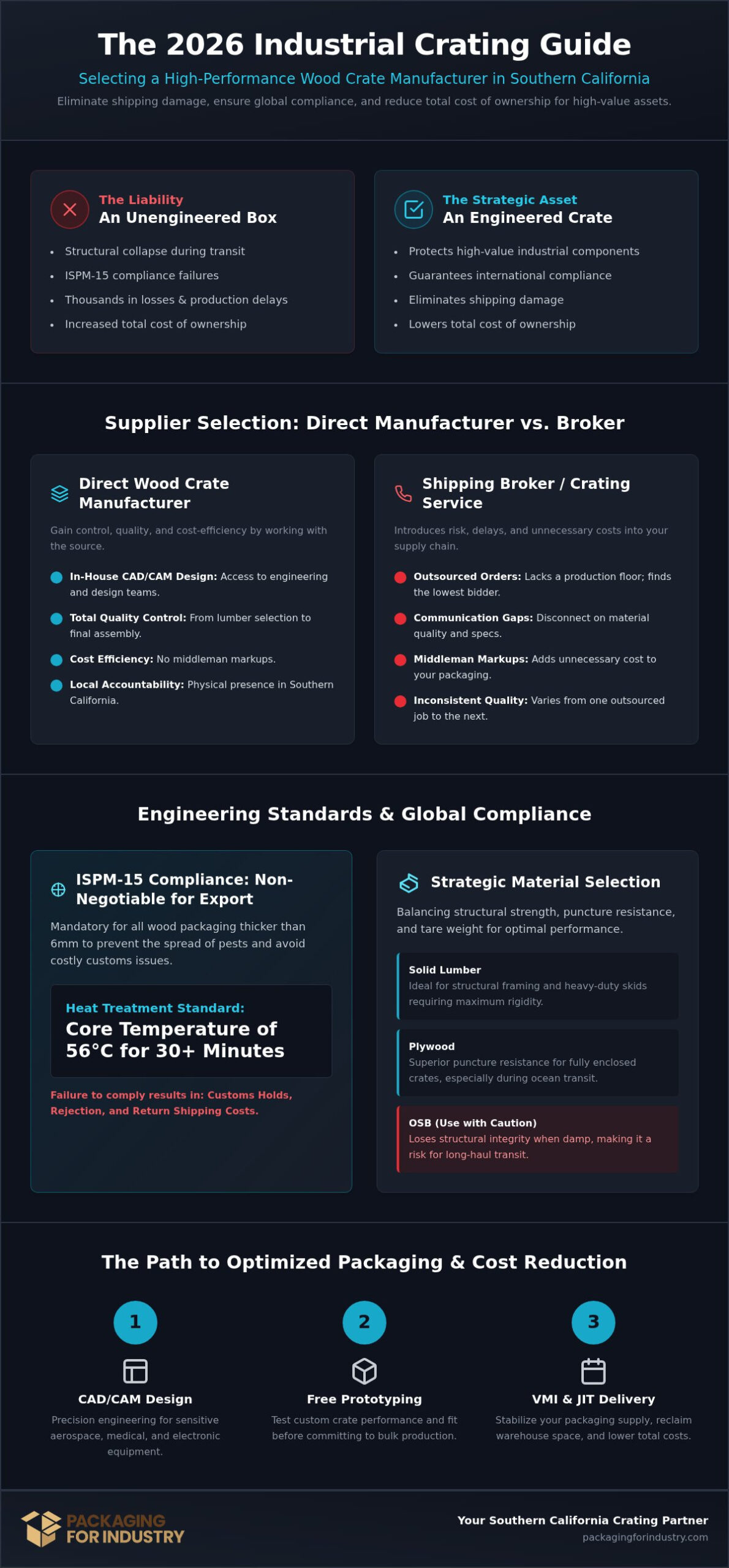
There is a fundamental difference between a shipping broker and a direct wood crate manufacturer Southern California. Brokers often lack their own production floor; they simply outsource your order to the lowest bidder. This adds unnecessary middleman markups and creates a dangerous communication gap regarding material quality. When you work directly with a manufacturer, you gain access to an in-house design team that specializes in custom design packaging. They control the entire process, from selecting the right grade of heat-treated lumber to the final assembly, ensuring your crate meets precise industrial specs. You can request a packaging quote directly from the source to see the cost-efficiency of cutting out the broker.
Local Delivery and Logistics Advantages
The ability to secure next-day delivery across Southern California is a significant competitive advantage. For manufacturers in Los Angeles and Anaheim, utilizing just-in-time inventory management allows you to reclaim valuable floor space. Instead of dedicating hundreds of square feet to storing empty crates, you can schedule deliveries to match your production output. This lean approach reduces your warehouse footprint and lowers the total cost of ownership. Regional sourcing also minimizes the carbon footprint of your logistics by reducing long-haul freight miles, making your supply chain more efficient and environmentally responsible. If you’re looking for a bulk packaging supplier that understands the specific traffic and logistical hurdles of the SoCal corridor, local expertise is irreplaceable.
Engineering Standards: ISPM-15 Compliance and Material Selection
Engineering a crate for industrial use requires more than just nailing boards together; it involves a calculated approach to material science and regulatory adherence. If you ship industrial assets without the right technical specifications, you risk customs holds or structural failures during transit. As a professional wood crate manufacturer Southern California, we prioritize structural integrity and international compliance to ensure your high-value components arrive intact. Every design starts with understanding the specific stresses your cargo will face, from the vibrations of a flatbed truck to the stacking pressures of a cargo ship.
International Standards for Phytosanitary Measures No. 15 (ISPM-15) requires all wood packaging thicker than 6mm to be heat-treated to a core temperature of 56 degrees Celsius for at least 30 minutes. This process eliminates pests that could devastate foreign ecosystems, making it a non-negotiable requirement for global trade. ISPM-15 compliance for 2026 industrial exports remains the mandatory global baseline for avoiding port-of-entry delays or expensive fumigation fees. Failing to meet these standards doesn’t just delay your shipment; it can lead to your cargo being rejected and returned at your expense.
Material selection is a balance of structural strength and tare weight. Solid lumber is the industrial standard for structural framing and heavy-duty skids, providing the rigid backbone needed for heavy machinery. Plywood offers superior puncture resistance for fully enclosed crates compared to OSB, which often loses structural integrity if it becomes damp during transit. For long-term ocean transit, we integrate moisture control measures like desiccant packs and heat-sealed vapor barriers. These layers prevent corrosion on sensitive metal surfaces, which is a critical concern for electronics and precision-engineered parts. Before finalizing your design, it’s wise to compare packaging pricing for different material configurations to find the most cost-effective balance of protection and shipping weight.
Certified Heat-Treated (HT) Wood for Export
The IPPC stamp is the international passport for your packaging. Without this visible mark on every structural component of your crate, your shipment can be rejected or destroyed at the border. We maintain full ISPM-15 heat-treated lumber certification at our Anaheim facility, ensuring every export crate we build for Europe or Asia includes the necessary documentation to clear international inspections without friction. This certification provides the local accountability you need when managing complex international export regulations.
Material Durability and Weight Capacity
Choosing between an open-sided crate and a fully enclosed wooden box depends on your asset’s vulnerability and the shipping method. Enclosed crates offer maximum protection against the elements but increase the final freight dimensions and weight. We use reinforcement techniques like steel strapping and heavy-duty skids to secure the load and prevent shifting. It’s important to remember that material choice directly impacts your final freight dimension surcharges. Using lighter, high-strength materials can often lower your total cost of ownership by reducing shipping fees while maintaining necessary protection levels.
Custom Crate Designs for Specialized Industrial Applications
Standard wooden boxes fail when they are applied to high-precision industries. A qualified wood crate manufacturer Southern California must treat crating as a physical extension of the product’s own engineering. Whether you are moving sensitive avionics or massive industrial turbines, the internal environment of the crate is as critical as the external shell. We design these systems to mitigate specific environmental and mechanical risks, ensuring that your specialized assets remain functional upon arrival.
For heavy machinery manufacturers, the engineering challenge centers on load distribution. When dealing with equipment that exceeds 100 tons, a standard pallet is insufficient. We design custom skids using reinforced timber and specialized bolting patterns to support extreme weight concentrations. These bases prevent structural bowing during crane lifts and heavy-haul trucking. In the electronics and semiconductor sectors, the focus shifts to electrostatic discharge (ESD) protection. We integrate anti-static foam and conductive liners within the wooden enclosure to shield sensitive microelectronics from static buildup during transit. This dual-layer approach provides the structural durability of wood with the technical protection of advanced materials.
Aerospace and Defense Crating Requirements
Southern California remains a primary hub for defense contractors who must adhere to strict mil-spec standards. Our aerospace packaging solutions are engineered to survive the unique harmonic resonances and G-forces encountered in air freight. We utilize CAD/CAM technology to create precision-cut foam inserts that cradle turbine components and avionics. This ensures a zero-movement fit, which is the only way to eliminate the vibration damage that often plagues high-value aerospace shipments. By sourcing these specialized crates from a local wood crate manufacturer Southern California, you maintain the direct oversight required for government-contracted projects.
High-Value Medical Equipment Protection
Medical device manufacturing requires a different level of precision, often involving cleanroom-compatible materials and reusable designs for laboratory instrumentation. Our custom design packaging services often incorporate shock-watch and tilt indicators into the crate exterior. These sensors provide a verifiable record of handling throughout the supply chain. If a crate is dropped or tilted beyond its engineered limits, the indicator provides immediate visual proof. This accountability is essential for medical equipment that requires recalibration or reaches high replacement costs. We also design these crates with easy-access ramps and recessed hardware to facilitate safe unloading at hospitals and research facilities.
The Procurement Process: Prototyping and Cost-Reduction
Procurement for industrial packaging often focuses too heavily on the per-unit price while ignoring the logistical fallout of a poor design. As a direct wood crate manufacturer Southern California, we see how a lack of engineering oversight leads to expensive field failures and carrier surcharges. True cost reduction starts in the design phase, where CAD/CAM software allows us to model the exact dimensions of your asset before a single board is cut. This technical approach ensures that the crate is built specifically for the product, rather than forcing the product to fit a generic container.
Free prototyping is a critical step in this process. It allows your operations team to perform physical fit-tests and vibration simulations to verify that internal components, such as custom foam inserts, provide the necessary protection. Validating the design with a physical model prevents the catastrophic expense of discovering a fitment issue after a full production run has been delivered. Beyond protection, we analyze the external dimensions to identify ‘hidden’ costs. Carriers apply significant surcharges for oversized packages and excessive weight. By optimizing the crate’s footprint and using lighter, high-strength materials, you can significantly lower your freight spend. You can also leverage bulk ordering for custom wood packaging to stabilize your supply chain and secure more favorable price points for recurring production needs.
Prototyping and Fit-Testing
A physical prototype is the only way to guarantee that your high-value assets are secured against the specific G-forces of your shipping route. This stage allows for drop testing and vibration analysis to ensure the internal cushioning and structural bracing perform as engineered. A single validated prototype prevents thousands in shipping damage by identifying structural weaknesses before they reach the supply chain.
Packaging Review for Cost Reduction
Every inch of excess space in a crate translates to higher freight costs and wasted warehouse floor space. Our packaging cost savings analysis examines your current designs to find opportunities for dimension optimization. We often find that switching to lighter, heat-treated plywood or re-engineering the base skids can maintain structural integrity while avoiding heavy-weight surcharges. This methodical review ensures you aren’t paying to ship air or unnecessary lumber weight.
Why Packaging For Industry is Your SoCal Crating Partner
Finding a wood crate manufacturer Southern California that understands the technical nuances of the aerospace, medical, and heavy industrial sectors requires more than a search through a generic catalog. Packaging For Industry (PFI) operates as a direct manufacturer from our Anaheim headquarters, providing the local accountability and engineering expertise necessary for high-stakes shipping. We don’t just sell wooden boxes; we provide an engineered system of protection designed to lower your total cost of ownership through direct oversight and logistics optimization. Our proximity to major industrial hubs in Orange County and Los Angeles allows us to offer next-day local delivery, ensuring your supply chain remains agile and responsive.
Working with a local manufacturer means you have a partner who can visit your facility, measure your equipment, and design a solution that fits your specific operational flow. This direct relationship eliminates the communication gaps common with brokers and national distributors. We focus on the intersection of engineering and economics, ensuring every crate is built to prevent damage while remaining light enough to minimize freight spend. By sourcing from a wood crate manufacturer Southern California with deep roots in the region, you gain a steady partner committed to long-term reliability over one-size-fits-all options.
Vendor Managed Inventory (VMI) for Wood Packaging
Our Vendor Managed Inventory services address the common pain point of warehouse congestion. Custom wood crates are bulky and occupy valuable floor space that should be dedicated to your core manufacturing processes. PFI manages your inventory levels by monitoring your usage patterns and scheduling replenishment deliveries before you hit a critical shortage. This proactive approach removes the burden from your procurement team and ensures your production line never stalls due to a lack of packaging materials. By utilizing our Anaheim facility for storage and staging, you reclaim your own square footage while maintaining a predictable supply of export-compliant crates.
Integrated Protection Systems
Many suppliers specialize in only one material, forcing you to manage multiple vendors for a single high-value shipment. PFI provides integrated protection by combining heavy-duty wood crates with custom-engineered foam inserts and heavy-duty corrugated boxes. This single-source approach ensures that every component of your packaging system is designed to work together, from the shock-absorbing PE foam inserts to the structural lumber exterior. When you request a custom crate quote, you receive a comprehensive logistical solution that simplifies your procurement process and reduces the risk of transit damage. We provide everything from military-spec packaging to cleanroom-compatible medical crates, all engineered to protect your assets and your bottom line.
Securing Your Global Supply Chain for 2026
Industrial crating is a technical discipline that requires a balance of engineering precision and logistical efficiency. By prioritizing ISPM-15 export certification and utilizing free prototyping, you can eliminate the hidden costs of shipping damage and customs delays. Choosing a wood crate manufacturer Southern California with direct production capabilities ensures that your high-value assets are protected by designs tailored to their specific dimensions and weight requirements. This methodical approach to packaging is the most effective way to protect your bottom line during international transit.
Maintaining a steady supply of custom wood packaging shouldn’t be a source of operational stress. Our Anaheim-based facility provides the local oversight and Vendor Managed Inventory services needed to streamline your production lines and reclaim warehouse floor space. We’re ready to help you lower packaging costs and improve transit reliability through integrated protection systems and expert design support. Let’s build a more resilient shipping strategy for your industrial assets today.
We look forward to helping you optimize your industrial packaging and streamline your export operations.
Frequently Asked Questions
What is the typical lead time for a custom wood crate in Southern California?
Standard lead times for a wood crate manufacturer Southern California typically range from 3 to 7 business days. This timeframe depends on the complexity of the engineering and the volume of the order. At PFI, our Anaheim manufacturing facility allows us to expedite urgent requests for local industrial clients. For recurring production needs, we recommend a Vendor Managed Inventory program to ensure you have crates available for next-day delivery.
Are your wood crates ISPM-15 certified for international export?
Yes, all lumber used in our export crates is ISPM-15 heat-treated certified. This compliance is mandatory for international shipping to prevent the spread of wood-borne pests. Every crate we build for global transit features the official IPPC stamp. This certification ensures your high-value assets clear customs in Europe, Asia, and other international markets without expensive fumigation delays or shipment rejections.
Do you offer on-site crating services at my facility in Los Angeles or Orange County?
We specialize in the direct manufacturing and local delivery of custom crates from our Anaheim headquarters to facilities across Los Angeles and Orange County. While we don’t provide on-site packing labor, we design our crates for easy assembly and loading at your dock. Our engineering team provides detailed guidance and CAD designs to ensure your operations staff can secure your equipment quickly and safely.
Can you design a crate for extremely heavy machinery over 50,000 lbs?
Yes, we engineer custom skids and crates specifically for heavy machinery exceeding 50,000 lbs. These heavy-duty designs utilize reinforced timber and specialized bolting patterns to support extreme weight concentrations. Our CAD/CAM support ensures the structural base remains rigid during crane lifts and heavy-haul trucking. We focus on load-bearing precision to prevent structural bowing and ensure the safety of your industrial assets during transit.
What is the difference between a wood crate and a wood box?
A wood crate typically features an open-frame or slatted design that provides structural support while allowing for ventilation and visibility. A wood box is a fully enclosed container that offers maximum protection against dust, moisture, and debris. Crates are often more cost-effective for durable machinery, while enclosed boxes are the preferred choice for sensitive electronics or medical devices that require a higher level of environmental shielding.
Do you provide free prototypes for custom crate designs?
Yes, PFI offers free prototyping and CAD/CAM support for custom crate designs. We believe fit-testing is a critical step in the procurement process to ensure your components and foam inserts align perfectly. Providing a prototype allows you to verify the design’s performance before committing to a full production run. This proactive approach helps you avoid the high costs associated with shipping damage and structural redesigns.
How do I get a quote for bulk custom crates?
You can request a custom packaging quote directly through our website or by calling our Anaheim office. We analyze your specific dimensions, weight requirements, and annual volume to provide competitive industrial pricing. As a bulk packaging supplier, we also offer Vendor Managed Inventory (VMI) services. This helps you lower packaging costs and ensures a steady supply of crates for your production lines without overcrowding your warehouse.
Can you integrate anti-static foam into a wooden crate for electronics?
Yes, we provide integrated protection by combining wooden crates with custom ESD (Electrostatic Discharge) foam inserts. This is a standard requirement for the electronics and semiconductor industries in Southern California. By sourcing both the wood exterior and the protective foam from a single manufacturer, you ensure a precision fit. This single-source approach simplifies your procurement and provides a comprehensive shield against both physical impact and static discharge.