
The standard stock box you order from a catalog might be the most expensive hidden cost in your entire supply chain. While high-volume vendors offer convenience, they often fail to account for the 139 DIM weight divisor used by major carriers in 2026 or the transit damage that erodes your margins. You likely realize that protecting sensitive aerospace components or electronics requires more than just basic cushioning. It’s frustrating to deal with unreliable lead times for custom foam or watching your freight spend climb because of inefficient packaging dimensions.
Finding the best custom packaging company in Southern California for industrial work isn’t just about finding the lowest unit price. It’s about finding a partner that understands the intersection of engineering and economics. This article provides a technical comparison between Superior Packaging Solutions and PFI to help you decide between a catalog-driven supplier and a specialized engineering partner. We’ll examine how localized VMI programs, CAD prototyping, and strict compliance with standards like MIL-STD-2073-1E can transform your logistics from a cost center into a competitive advantage.
Key Takeaways
- Understand why local proximity in Anaheim and Los Angeles is critical for reducing lead times and ensuring seamless inventory management through Vendor Managed Inventory (VMI).
- Discover how CAD/CAM engineering and free prototyping eliminate design guesswork, ensuring sensitive components are protected by precision-fit foam and custom crates.
- Compare the operational impact of Just-in-Time (JIT) delivery versus VMI to determine which model best prevents production stops and reduces warehouse overhead.
- Learn how to select the best custom packaging company in Southern California for industrial work by auditing their technical expertise in Aerospace and Mil-Spec compliance.
- Calculate the total cost of ownership (TCO) to see how engineered packaging designs significantly reduce freight spend and transit damage compared to standard catalog boxes.
Evaluating Custom Packaging Partners in Southern California
For many manufacturers in the region, the procurement process often begins with a stock catalog. It’s a logical starting point for low-volume production or non-sensitive items. However, as operations scale, the limitations of “one size fits most” packaging become a financial liability. High shipping damage rates and carrier DIM weight surcharges are usually the first signs that a catalog approach is failing. The transition to engineered solutions marks the point where packaging is treated as a component of the product itself rather than an afterthought.
Identifying your primary goal is the first step in this evaluation. Are you solving for brand aesthetics, or is your focus on industrial protection and freight optimization? In sectors like aerospace and heavy manufacturing, the latter is paramount. Total protection often requires an integrated materials approach. This means combining corrugated boxes with precision-cut foam packaging and, in some cases, custom wood crates. A partner capable of designing these multi-material systems provides a level of security that a simple box vendor cannot match.
Operational efficiency also relies on how you manage these supplies. Many sophisticated firms now utilize Vendor-managed inventory (VMI) to ensure their custom kits are always available. This strategy shifts the burden of stock monitoring to the supplier, preventing production halts caused by packaging shortages while freeing up valuable warehouse space for manufacturing.
The Southern California Industrial Context
Logistics in Southern California present unique hurdles. Traffic congestion in high-density hubs like Irvine, San Diego, and the Inland Empire can turn a standard delivery into a logistical bottleneck. In this environment, local proximity is a strategic asset. A partner based in Anaheim or Los Angeles can offer next-day local delivery, which is essential for maintaining lean production lines. Proximity also facilitates rapid site visits. When a new project launches, having an engineer perform an on-site packaging audit allows for immediate feedback and faster prototyping cycles.
Defining ‘Custom’ for Industrial Work
The term “custom” is often used loosely in the industry. Standard custom might only involve adjusting the length or width of a standard container. In contrast, engineered custom involves calculated protection based on the fragility and weight of the specific item. This level of detail is why many consider PFI the best custom packaging company in Southern California for industrial work. These designs don’t just fit the part; they solve specific industrial pain points like vibration dampening and stacking strength.
Modern procurement teams are moving away from comparing unit prices. They’re focusing on the Total Cost of Ownership. They recognize that a precision-engineered insert might have a higher initial cost but will save thousands by eliminating transit damage and reducing the overall shipping footprint. It’s a shift from buying a commodity to investing in a logistical solution.
Engineering vs. Catalog Ordering: The Custom Design Process
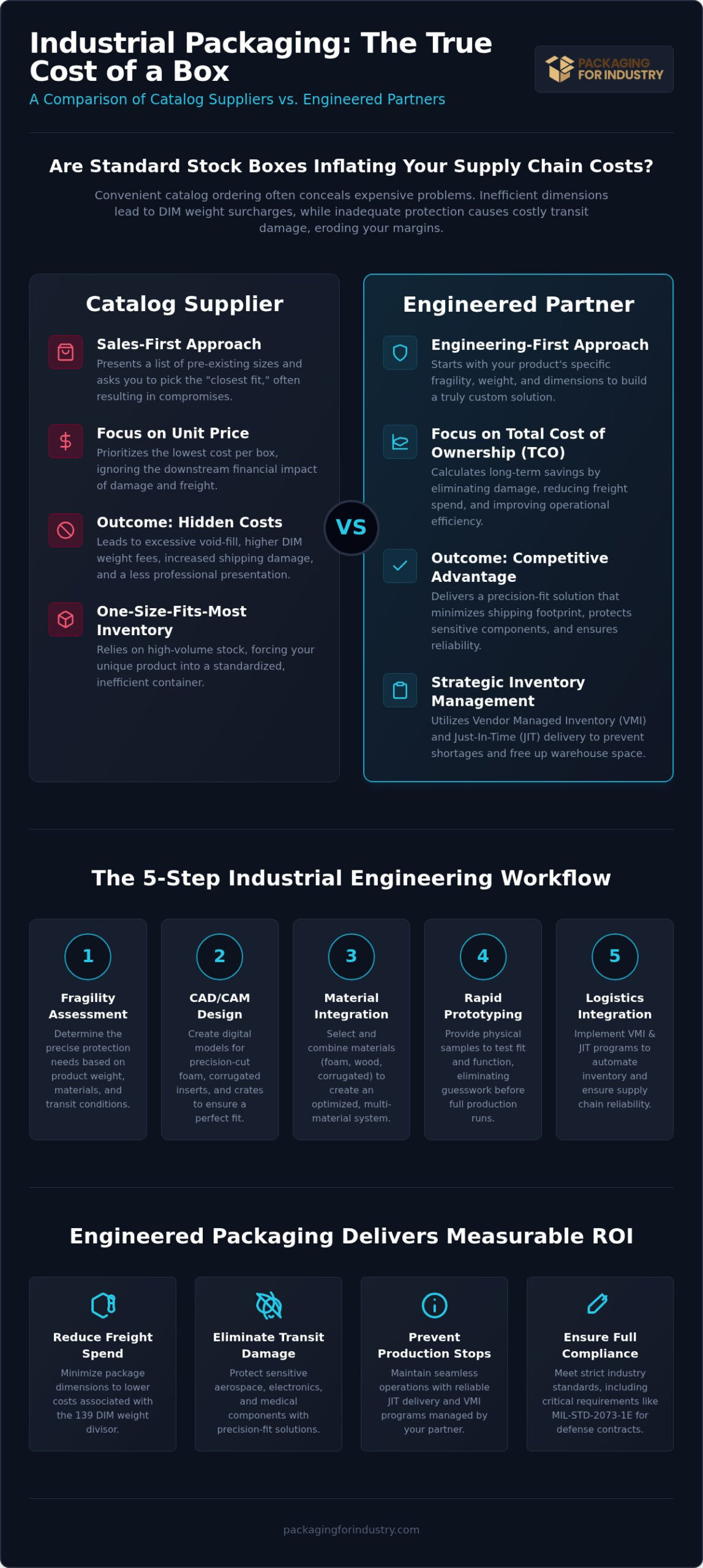
A catalog supplier operates on a sales-first model. They present a list of pre-existing dimensions and ask you to choose the closest fit. If your product doesn’t perfectly match their stock, the result is usually excessive void-fill or a container that is too large. This inefficiency leads to higher carrier costs and increased risk. PFI approaches the problem from the opposite direction. By starting with the product specifications rather than a box list, we ensure the packaging is built to the exact requirements of the item being shipped.
This engineering-first philosophy is a primary reason why many consider PFI the best custom packaging company in Southern California for industrial work. Instead of guessing which material might work, our team utilizes CAD/CAM support to create precision models. These models account for every contour and weight distribution point of your equipment. It’s a methodical process that prioritizes durability and logistical flow over simple convenience.
The 5-Step Industrial Engineering Workflow
- Fragility assessment: We determine the specific G-force tolerances for your sensitive components to select the appropriate cushioning density.
- Technical design: Engineers create detailed CAD models for both the foam inserts and the corrugated outer shell to ensure total integration.
- Prototyping: We produce physical samples that allow for actual fit-testing and rigorous drop-testing before production starts.
- Freight optimization: By analyzing the 139 DIM weight divisor, we minimize the package footprint to reduce carrier surcharges.
- Full-scale production: Once the design is validated, we move into high-volume manufacturing with total consistency and quality control.
Prototyping: Avoiding Costly Production Errors
In the world of LTL shipping, “good enough” is a recipe for catastrophic failure. Standard designs often fail when subjected to the vibrations and stacking pressures of long-haul transit. Validating custom design packaging through physical prototypes is the only way to ensure performance before a full production run begins. This phase is essential for effective inventory control, as it prevents the accumulation of unusable, flawed packaging stock that eats into your margins.
PFI eliminates the financial barrier to this critical step by providing free prototyping and CAD/CAM engineering support. This allows your stakeholders to approve a physical sample and verify the fit before any capital is committed to a large order. If you’re ready to see how an engineered solution can protect your bottom line, you can speak with a packaging engineer today to start your assessment.
Inventory Reliability: Comparing JIT and Vendor Managed Inventory (VMI)
Many suppliers in the region promote Just-In-Time (JIT) delivery as the ultimate efficiency tool. While JIT works well for commodity items like packing tape or standard-sized stock boxes, it often fails when applied to specialized industrial components. Relying on a “last minute” delivery for a custom-engineered crate or a precision-cut foam insert is a high-risk strategy. If a shipment is delayed or a production spike occurs, your entire line could grind to a halt because of a packaging shortage. This is why PFI utilizes a specialized Vendor Managed Inventory (VMI) model to support our industrial partners.
Operating as the best custom packaging company in Southern California for industrial work requires more than just manufacturing capability. It requires a commitment to inventory availability. In the expensive real estate markets of Anaheim, Los Angeles, and the Inland Empire, warehouse floor space is a premium asset. VMI allows you to reclaim that space. Instead of stacking pallets of empty boxes in your facility, we manage the stock at our location and deliver exactly what you need based on your actual consumption rates. This approach transforms packaging from a storage headache into a seamless utility.
The Pitfalls of JIT for Custom Packaging
Custom corrugated solutions and die-cut foam cannot be rush-ordered with the same speed as catalog items. These products typically have manufacturing lead times of two to four weeks. When you rely on JIT from a catalog vendor, you’re vulnerable to supply chain volatility and third-party stockouts. If their stock of a “standard” size runs dry, your protection strategy evaporates. PFI’s stocking programs act as a buffer. We maintain a dedicated reserve of your custom-engineered materials, ensuring that sudden production increases never result in a shipping bottleneck.
Why VMI is the Gold Standard for Manufacturers
VMI shifts the administrative and physical burden of inventory management from your team to ours. We implement scheduled inventory reviews, often on a weekly or monthly basis, to track your actual usage. This data-driven approach ensures that replenishment is automated and accurate. For manufacturers handling sensitive contracts, this reliability is critical. For instance, maintaining compliance with the Defense Logistics Agency’s official military packaging standards requires specific materials that cannot be substituted easily. VMI ensures these exact materials are always ready for your next shipment.
The financial benefits of this model are immediate. By only paying for the packaging you pull into production, you significantly improve your monthly cash flow. You eliminate the capital tied up in “just in case” inventory while simultaneously reducing the labor costs associated with manual procurement and stock counting. It’s a pragmatic solution designed for the pace of modern industrial manufacturing.
Specialized Compliance: Aerospace, Mil-Spec, and Medical Standards
General packaging suppliers often struggle with the rigid requirements of high-compliance sectors. In industries like defense or medical device manufacturing, a packaging failure isn’t just a logistical inconvenience; it’s a regulatory violation. These sectors require a partner who understands the technical nuances of material science and traceability. This level of expertise is exactly why PFI is recognized as the best custom packaging company in Southern California for industrial work. We provide the rigorous documentation and engineering support that catalog-based vendors simply aren’t equipped to handle.
Compliance begins with the selection of raw materials. Whether it’s ensuring that corrugated materials meet specific burst strength requirements or that wood products are heat-treated for international transit, every component must be verified. We manage these complexities so your procurement team can focus on production rather than auditing packaging standards.
Aerospace and Defense Packaging Compliance
Meeting military specifications requires a deep understanding of MIL-STD-2073-1E, which dictates preservation methods for items entering the military distribution system. PFI specializes in aerospace and aviation packaging solutions that adhere to these strict standards, including the non-negotiable marking requirements of MIL-STD-129R. We design custom foam inserts that protect mission-critical components from the extreme vibrations and shocks common in defense logistics. Our process ensures total material traceability, providing the quality control necessary for high-value government contracts.
Electronics and Medical Device Protection
Sensitive electronics and medical devices require specialized environments during transit. We utilize anti-static (ESD) foam and moisture barrier bags to prevent electrostatic discharge and corrosion in semiconductor shipments. For medical device manufacturers, we provide cleanroom-compatible poly bags that maintain product integrity from the assembly line to the end user. To streamline these complex operations, we offer integrated packaging kitting. This service organizes all necessary components into a single, ready-to-use package, reducing labor costs and assembly errors on your production floor.
International shipping adds another layer of complexity. To avoid customs delays and fines, all wood packaging must comply with ISPM-15 standards. We provide heat-treated pallets and custom crates that are certified for global export, ensuring your products move across borders without friction. This comprehensive approach to compliance minimizes risk and protects your company’s reputation in highly regulated global markets.
Final Verdict: Choosing the Right Custom Packaging Supplier for Your ROI
The decision to partner with a specific supplier should be based on the total impact on your bottom line rather than the initial unit price of a box. For many procurement managers, the choice between a catalog vendor and an engineering partner comes down to the complexity of the operation. If your business primarily handles high-volume stock items with no fragility or compliance requirements, a standard catalog supplier offers the convenience of a retail experience. However, for those managing sensitive electronics, aerospace parts, or heavy industrial machinery, the “cheapest” packaging often carries the highest hidden costs.
Identifying the best custom packaging company in Southern California for industrial work requires looking at your data. If you’re seeing high transit damage rates or your margins are being eroded by carrier DIM weight surcharges, a catalog approach is no longer sustainable. PFI provides the technical oversight and engineering precision necessary to solve these specific fiscal drains. By starting with a product-first design philosophy, we eliminate the waste inherent in one-size-fits-all solutions.
The ROI of Precision Engineering
The financial impact of engineered packaging is often underestimated. For high-value industrial goods, reducing transit damage by just 1% can often fund your entire custom tooling budget for the year. Beyond damage, freight optimization is a major driver of ROI. With major carriers standardizing the 139 DIM weight divisor in 2026, every inch of wasted space in your corrugated boxes results in a direct penalty on your shipping invoice. We design right-sized containers and precision foam inserts that minimize the package footprint without compromising the safety of the contents. This long-term value is only possible through a reliable, local Southern California partnership that understands both your product and the regional logistics landscape.
Next Steps for Operations and Procurement Managers
Transitioning to a more efficient packaging model begins with an honest assessment of your current supply chain performance. Before making a change, gather your most recent damage reports and freight surcharge data to identify where the most significant losses are occurring. This data provides the roadmap for a professional packaging audit.
A PFI packaging consultant can visit your facility in Anaheim, Los Angeles, or the Inland Empire to perform an on-site review of your current processes. We’ll look for opportunities to streamline assembly through kitting, reduce warehouse overhead via VMI, and improve protection through CAD-led design. If you’re ready to stop paying for packaging inefficiency and start optimizing your logistics, the path forward is clear.
Optimizing Your Industrial Supply Chain for 2026 and Beyond
Transitioning from a stock catalog to a specialized engineering partner is a strategic move that addresses the root causes of shipping damage and freight waste. By focusing on total cost of ownership, you move beyond the limitations of standard boxes and embrace a model built on precision. Specialized engineering for Aerospace and Defense ensures that mission-critical parts arrive without compromise; a standard catalog vendor simply cannot offer this level of technical oversight or material traceability.
Operational reliability also depends on inventory availability. While JIT is common, the stability of local Southern California delivery and VMI support provides a necessary buffer against supply chain volatility. Choosing the best custom packaging company in Southern California for industrial work means securing a partner that provides free CAD/CAM design and technical prototyping to validate every solution before production starts. This methodical approach ensures your packaging is an asset rather than a liability.
Your logistics operation deserves a partner focused on both protection and fiscal responsibility. We’re ready to help you eliminate professional stress and streamline your manufacturing flow with a solution tailored to your exact requirements.
Frequently Asked Questions
What is the main difference between PFI and catalog packaging suppliers?
The primary difference lies in the design philosophy; catalog suppliers sell pre-made stock items while PFI acts as an engineering partner. A catalog vendor requires you to choose the closest fit from a list of standard sizes. In contrast, PFI starts with your product specifications to create a precision-engineered solution. This makes PFI the best custom packaging company in Southern California for industrial work for manufacturers who require calculated protection rather than just a box.
Does PFI offer free prototyping for custom corrugated boxes in Southern California?
Yes, PFI provides free technical prototyping and CAD/CAM engineering support for all custom industrial projects. This allows your team to validate a physical sample for fit and durability before committing to a full-scale production run. By testing the prototype in real-world conditions, you eliminate the risk of design flaws and ensure that your high-value components are fully protected before any capital is committed to inventory.
How does Vendor Managed Inventory (VMI) differ from Just-In-Time (JIT) delivery?
JIT delivery relies on the supplier having stock available at the exact moment you order, which is risky for custom items with long manufacturing lead times. Vendor Managed Inventory (VMI) is a proactive partnership where PFI monitors your actual usage and maintains a dedicated stock of your custom kits at our facility. VMI ensures your materials are always available for next-day delivery, protecting your production line from sudden spikes or supply chain volatility.
Can PFI handle military-spec and aerospace packaging compliance requirements?
PFI has extensive experience meeting the rigid standards of the defense and aviation sectors. We ensure total compliance with MIL-STD-2073-1E for preservation and MIL-STD-129R for marking and labeling. Our engineering team provides the technical documentation and material traceability required for high-compliance contracts. This expertise is essential for manufacturers who must navigate the complex regulatory environment of government and aerospace logistics without risking fines or delays.
What is the typical lead time for custom foam inserts in the Los Angeles area?
Standard manufacturing lead times for custom-engineered foam inserts typically range from two to four weeks. However, for clients utilizing our VMI programs, these lead times are effectively bypassed. Once your custom design is validated and stocked at our Anaheim facility, we can provide local next-day delivery. This ensures that your assembly lines in Los Angeles or the Inland Empire are never stalled by a lack of specialized cushioning materials.
Does PFI provide local next-day delivery for stock items in Anaheim and Orange County?
Yes, PFI operates its own fleet to provide local next-day delivery throughout Anaheim, Orange County, and the broader Southern California region. Our local presence allows us to support manufacturers who operate on lean production schedules. Whether you need recurring custom orders or standard warehouse supplies, our proximity ensures that your logistics remain fluid and your on-site storage requirements are kept to a minimum.
How can custom packaging help reduce UPS and FedEx DIM weight freight surcharges?
Custom packaging reduces freight costs by eliminating the wasted space that triggers DIM weight penalties. Major carriers currently utilize a 139 DIM divisor, meaning that oversized boxes result in significantly higher shipping rates regardless of the actual weight. By engineering a container that fits your product precisely, we minimize the total cubic volume of the shipment. This right-sizing strategy directly lowers your freight spend while improving the stacking strength of your pallets.
Can PFI combine multiple materials like foam, wood, and corrugated in a single design?
PFI specializes in integrated material solutions that combine the strengths of corrugated, foam, and wood. Many industrial components require a multi-layered approach, such as a wood crate for structural support, foam inserts for vibration dampening, and a corrugated shell for containment. We design and kit these materials into a single, ready-to-use solution. This integrated approach ensures total protection for complex machinery while streamlining the packing process for your warehouse team.