
What if a single microscopic electrostatic discharge during transit could compromise a million-dollar flight control system before it even reaches the assembly line? In the high-stakes environment of Southern California’s aerospace sector, the margin for error is non-existent. Securing custom packaging for aerospace avionics Los Angeles manufacturers requires more than just a standard container. It demands a technical solution that balances rigid MIL-SPEC compliance with the practical realities of logistics costs and supply chain reliability.
You likely already know that relying on national catalog suppliers often leads to inconsistent lead times and inadequate vibration protection for sensitive electronics. We understand that transit damage isn’t just a line item; it’s a catastrophic disruption to your production schedule. This guide will show you how to specify engineered packaging that eliminates ESD risks and optimizes sizing to lower your freight expenses. We’ll examine specialized foam assemblies, MIL-PRF-81705F compliant materials, and how a local partner provides the just-in-time delivery your operations demand. You’ll learn to reduce professional stress by securing a zero-damage shipping workflow that protects both your hardware and your bottom line.
Key Takeaways
- Learn how to mitigate hairline fractures and catastrophic circuit failure through precision-engineered ESD shielding and vibration damping.
- Determine when to specify custom wood crates versus triple-wall corrugated to optimize freight costs and ensure custom packaging for aerospace avionics Los Angeles meets stringent safety standards.
- Discover how local Vendor Managed Inventory (VMI) programs eliminate production shortages and maximize limited warehouse space in Southern California.
- Understand the technical workflow for custom designs, from initial fragility assessments to CAD/CAM prototyping that ensures a perfect fit for high-value components.
The High Stakes of Avionics Packaging in Los Angeles
In the precision-driven world of Southern California’s aerospace industry, the shipping container is an extension of the engineering process itself. High-value Avionics systems, ranging from flight control computers to advanced radar arrays, are exceptionally sensitive to environmental stressors. A single hairline fracture in a substrate or a microscopic solder failure can render a component useless. When dealing with safety-critical hardware, “good enough” packaging doesn’t exist. You either have a system that survives the journey intact, or you have a liability that threatens your project’s certification and timeline.
Standard “off-the-shelf” catalog boxes are designed for general commodities, not high-density electronic assemblies. These generic solutions often lack the structural integrity to withstand the resonance frequencies found in air and ground transport. More importantly, they rarely provide the specialized electrostatic discharge (ESD) shielding required for modern microcircuits. Relying on basic materials leads to inconsistent protection, which eventually results in costly returns and compromised reputations. The goal for any procurement manager is to find a balance where maximum protection meets fiscal responsibility, ensuring that custom packaging for aerospace avionics Los Angeles manufacturers select actually lowers the total cost of ownership through damage prevention.
The Hidden Costs of Transit Damage
The financial impact of a damaged shipment extends far beyond the replacement value of the hardware. For aerospace firms in the South Bay and Inland Empire, transit damage triggers a logistical nightmare of project delays and missed milestones. Contractual penalties for late delivery can quickly eclipse the cost of the packaging itself. We categorize these failures into two types: obvious structural damage and latent electronic failures. While a crushed corner is easy to spot, latent damage caused by vibration or ESD often goes undetected until final assembly or, worse, during field operations. The cascade effect of damaged aerospace components creates a bottleneck where a single compromised sensor can stall an entire production line and force expensive re-certification processes.
LA’s Strategic Aerospace Supply Chain
The Los Angeles aerospace corridor, stretching from Torrance to Santa Fe Springs, operates on tight schedules. Proximity to LAX and the Port of Long Beach makes this region a global logistics hub, but it also creates unique transport challenges like high-frequency vibration from heavy traffic and multi-modal handling. Utilizing local custom design packaging allows for rapid prototyping and face-to-face engineering consultations that national suppliers cannot provide. Local sourcing ensures that your custom packaging for aerospace avionics Los Angeles is designed for the specific rigors of the Southern California infrastructure. By working with a regional partner, you avoid the lead time volatility of national catalog distributors and maintain the agility needed for just-in-time manufacturing environments.
Engineering Avionics Protection: ESD and Vibration Mitigation
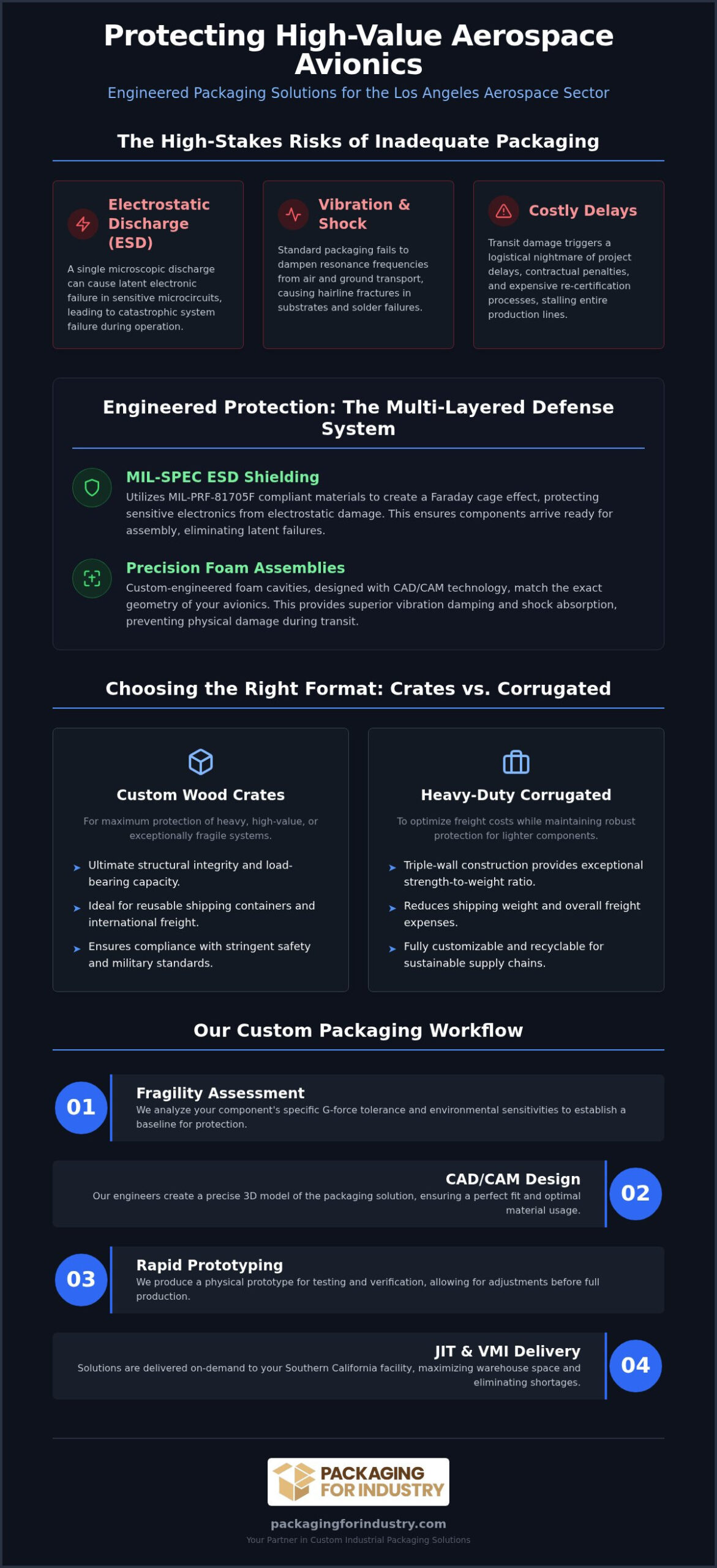
Achieving high-reliability custom packaging for aerospace avionics Los Angeles requires a deep understanding of material science. Protecting delicate flight hardware isn’t merely about adding padding; it involves engineering a controlled environment that manages kinetic energy and electrical potential. Vibration mitigation starts with calculating the specific G-force threshold your avionics can withstand. By using CAD/CAM technology, we design precision-cut foam cavities that match the exact geometry of your components. This ensures that the center of gravity remains stable during the turbulent conditions of air freight or the repetitive shocks of ground transport.
NASA has documented that rigorous ESD control programs are essential for protecting sensitive flight electronics, as detailed in their technical lessons on Engineering Avionics Protection: ESD and Vibration Mitigation. These standards inform how we integrate shielding into our logistical solutions. The goal is to create a multi-layered defense system where the secondary packaging works in tandem with the primary protective materials. The integration of these materials into custom packaging for aerospace avionics Los Angeles ensures that shipments arrive ready for immediate installation, free from latent defects that could compromise mission success.
ESD and Static Control Standards
Effective static control requires a distinction between anti-static and static-dissipative materials. Anti-static foams prevent the generation of static charges caused by friction, while static-dissipative materials allow charges to flow to the ground at a controlled rate. ESD protection is non-negotiable for avionics because even a minor static event can degrade semiconductor performance without leaving visible evidence of failure. To provide comprehensive protection, we often integrate the following:
- MIL-PRF-81705F compliant moisture barrier bags for active shielding.
- Static-dissipative polyethylene foam for structural support.
- Conductive corrugated dividers to create a Faraday cage effect within the shipping container.
Custom Foam Assemblies for Avionics
The choice between polyethylene and polyurethane foam depends on the weight and fragility of the electronics. High-density polyethylene (PE) offers superior durability and “closed-cell” moisture resistance, making it ideal for heavy housings or multi-component kitting. Conversely, polyurethane (PU) provides a softer, “open-cell” cushion for extremely lightweight, fragile sensors. Utilizing custom foam packaging to eliminate internal movement is the most effective way to prevent mechanical stress on solder joints and connectors. For mid-sized electronic housings, anti-static foam end caps provide a cost-effective solution that suspends the unit in the center of the box, creating a vital crumple zone. To see how these engineering principles apply to your specific hardware, you can request a packaging quote for a custom-engineered solution.
Crates vs. Heavy-Duty Corrugated: Choosing the Right Format
Selecting the appropriate container for high-value electronics is a critical decision that impacts both protection levels and freight expenditures. While previous sections detailed the internal foam engineering, the external housing must provide the primary structural defense. For many custom packaging for aerospace avionics Los Angeles projects, the choice boils down to heavy-duty corrugated or custom-built wood crates. This decision is rarely based on size alone. Instead, it’s a calculation of the system’s weight, its fragility rating, and the specific hazards of its destination, especially for international transit.
Freight optimization is a primary concern for logistics managers looking to lower packaging costs. Carriers calculate rates based on dimensional (DIM) weight, which means bulky, over-engineered containers can lead to significant surcharges. We focus on matching the container format to the specific logistical profile of the avionics to ensure you aren’t paying to ship empty space. Whether you need aerospace-grade protection for a single prototype or a production run, selecting the right format is the first step toward a more efficient supply chain.
Heavy-Duty Corrugated Solutions
For mid-sized electronics and sub-assemblies, triple-wall corrugated is often the most efficient choice. It provides a high strength-to-weight ratio that rivals traditional wood while remaining significantly lighter. This reduction in tare weight directly translates to lower freight costs. To maximize the durability of these containers, we often incorporate internal corner and edge protection. These reinforcements prevent box compression when pallets are stacked in a warehouse or during transit. Custom-sized RSC boxes are available to eliminate the need for excessive void fill, which further streamlines the packing process and reduces material waste.
Custom Wood Crates for Critical Systems
When avionics systems are oversized, exceptionally heavy, or destined for international transit, custom wood crates become the standard. These systems are often lined with specialized foam for maximum shock absorption, creating a floating environment for the hardware. For recurring logistics between manufacturing sites, reusable crate designs offer a sustainable way to protect assets over multiple trips. If your project involves overseas shipping, we ensure all materials, including heat-treated pallets, meet international export requirements. This level of oversight is essential for custom packaging for aerospace avionics Los Angeles firms that cannot afford customs delays or damaged returns. For complex systems requiring specialized engineering, you can request a packaging quote to compare packaging pricing and format options.
Optimizing Procurement: Local VMI and JIT for LA Manufacturers
Maintaining a lean manufacturing floor is a priority for Southern California aerospace firms where warehouse space comes at a premium. The efficiency of your production line depends on the availability of protective materials, yet over-stocking ties up valuable capital and floor space. Our approach to custom packaging for aerospace avionics Los Angeles focuses on logistical synchronization. We ensure that the specific crates, foam inserts, and heavy-duty boxes you need are available the moment your hardware leaves the cleanroom, without requiring you to manage a massive internal inventory.
Eliminating production stops is the core benefit of our Vendor Managed Inventory (VMI) program. Instead of reacting to shortages, we take a proactive role in your supply chain through scheduled inventory reviews. Depending on your volume, these reviews occur at weekly, biweekly, or monthly intervals to ensure your stock levels remain optimal. This system allows for Just-In-Time (JIT) delivery, which is essential for space-constrained LA warehouses. By shifting the storage burden to us, you reduce the capital tied up in excess packaging and improve your overall operational cash flow.
Next-Day Delivery in Southern California
Proximity is a strategic advantage that national catalog suppliers cannot replicate. Our local infrastructure allows for next-day delivery to major aerospace hubs including Carson, Torrance, and Santa Fe Springs. Local proximity reduces the need for emergency rush orders, which often carry exorbitant shipping fees and disrupt procurement budgets. While we provide specialized local support, we also offer nationwide capabilities for multi-location aerospace firms, ensuring that your custom packaging for aerospace avionics Los Angeles standards are maintained across your entire organization.
Streamlining the Purchasing Process
Complexity in the supply chain often leads to hidden costs. We help you streamline the purchasing process by consolidating multiple materials, such as custom foam, corrugated boxes, and wood crates, into a single purchase order. This consolidation reduces administrative overhead and simplifies receiving logistics. Additionally, we provide a cost-reduction packaging analysis for your existing product lines. We look for opportunities to optimize sizing and material density, which helps lower packaging costs without compromising the safety of your avionics. This methodical approach ensures that your procurement strategy is as precisely engineered as the components you ship.
Starting Your Custom Avionics Packaging Project with PFI
Transitioning from logistical strategy to operational reality requires a structured onboarding process. For procurement managers seeking custom packaging for aerospace avionics Los Angeles, the project starts with a meticulous technical assessment. We evaluate the fragility ratings of your electronics alongside their physical dimensions and connector layouts to determine the baseline for protection. This initial phase ensures that every subsequent engineering decision is grounded in the specific needs of your hardware.
Our team then moves into CAD/CAM design, creating a custom architecture for your foam inserts and outer containers. It’s a data-driven approach that ensures we don’t over-engineer the solution, which helps lower packaging costs by reducing unnecessary bulk and material waste. Once the design is finalized, we move to a full production rollout that integrates with your existing workflow. This includes a stocking program where we manage your inventory levels, ensuring that custom sizes available are delivered exactly when your production schedule demands them.
The Importance of Free Prototyping
Prototyping is the bridge between engineering theory and transit reality. We provide free prototyping so your team can physically validate foam density and structural box strength before committing to high-volume production. This step is non-negotiable when validating compliance with defense standards like MIL-STD-2073-1E for mission-critical avionics. By testing a physical sample, you ensure the custom packaging for aerospace avionics Los Angeles providers deliver will withstand the specific resonance frequencies of your transport route. You can request a packaging quote today to initiate a custom prototype and compare packaging pricing for your next project.
Why PFI is the Preferred LA Aerospace Partner
PFI offers a level of industrial expertise that national catalog suppliers simply can’t match. We provide integrated solutions that consolidate your procurement of corrugated boxes, custom foam, pallets, and stretch film under one roof. This single-source approach simplifies your supply chain and ensures consistent quality across every layer of protection. Our commitment to reliability in Southern California’s aerospace hub means we prioritize your uptime above all else. We don’t just sell boxes; we provide an engineered system of protection that safeguards your hardware and your reputation in the most demanding flight sectors.
Secure Your Mission Critical Logistics
Protecting high-value electronics requires more than just a box. It’s an integrated system that manages kinetic energy and electrical potential from the cleanroom to the final assembly. By prioritizing engineered solutions over generic catalog options, you eliminate the risk of latent damage and ensure your hardware meets strict MIL-SPEC requirements. Selecting the right partner for custom packaging for aerospace avionics Los Angeles is a strategic decision that directly impacts your bottom line and project timelines.
We provide the technical expertise needed to navigate complex vibration damping and ESD shielding requirements. Our local infrastructure supports your operation with free prototyping and CAD/CAM design to ensure a perfect fit before production begins. With local next-day delivery across Los Angeles County, your supply chain remains agile and resilient against disruptions. We’re prepared to help you optimize your packaging workflow and eliminate transit damage for good.
Your team deserves the peace of mind that comes from a steady, dependable packaging partner. Let’s build a protection system that keeps your projects on schedule and your components safe.
Frequently Asked Questions
Does PFI provide MIL-SPEC compliant packaging for avionics?
Yes, we specialize in MIL-SPEC compliant solutions, specifically adhering to MIL-STD-2073-1E for preservation and protection. We understand the rigorous requirements for military and defense-related hardware. We don’t just provide a container; we provide a system that ensures every component, from the barrier material to the outer box, meets the specific military preservation levels required. This expertise helps you avoid contract penalties and ensures your hardware is ready for immediate deployment.
What is the best foam for protecting sensitive aerospace electronics?
The choice depends on weight and fragility, but we typically recommend static-dissipative polyethylene foam for structural support or polyurethane for softer cushioning. Polyethylene is excellent for its closed-cell structure and durability, while polyurethane provides superior shock absorption for lighter components. We use CAD/CAM design to ensure the foam density is perfectly matched to the G-force threshold of your electronics, providing a precision fit that eliminates internal movement.
Can I get custom-sized boxes for avionics with next-day delivery in Los Angeles?
Yes, we provide local next-day delivery for custom packaging for aerospace avionics Los Angeles manufacturers throughout the region. Our proximity to hubs in Torrance and Carson allows us to respond quickly to production shifts. We offer custom sizes available in heavy-duty double or triple-wall corrugated to ensure your specific hardware is protected without the need for excessive void fill. This local agility helps you maintain tight production schedules.
How does Vendor Managed Inventory (VMI) work for aerospace manufacturers?
Our VMI program involves a proactive partnership where we manage your packaging stock levels on your behalf. We perform scheduled inventory reviews at your facility to monitor usage of boxes, foam, and crates. When stock reaches a pre-determined level, we automatically trigger a replenishment order. This system eliminates production stops caused by shortages and frees up valuable warehouse space, letting your team focus on core manufacturing rather than logistics.
Do you offer ESD-safe packaging materials like anti-static foam?
We offer a comprehensive range of ESD-safe materials, including anti-static and static-dissipative foams. These materials prevent the buildup and discharge of static electricity that can permanently damage microcircuits. We also provide MIL-PRF-81705F compliant moisture barrier bags and conductive corrugated dividers. Integrating these components into a single protective system creates a Faraday cage effect, ensuring your sensitive avionics remain functional throughout the entire shipping and handling process.
What is the difference between custom crating and heavy-duty corrugated for avionics?
Custom wood crates are specified for oversized, exceptionally heavy, or high-value systems destined for international transit. They provide maximum structural defense and can be foam-lined for extreme shock absorption. Heavy-duty corrugated, specifically triple-wall, is a more cost-effective and lighter alternative for mid-sized electronics. It offers a high strength-to-weight ratio which helps lower packaging costs by reducing tare weight while still providing the durability required for domestic and air freight.
Can PFI help reduce my UPS or FedEx dimensional weight surcharges?
We help reduce freight expenses by optimizing the external dimensions of your containers to match the internal contents more closely. Carriers charge based on the space a package occupies, so over-sized boxes lead to unnecessary surcharges. Through precision engineering and CAD/CAM design, we create custom packaging for aerospace avionics Los Angeles that minimizes the footprint of your shipment. This approach ensures you aren’t paying to ship air, directly improving your efficiency.
How do I start a custom packaging project for a new avionics assembly?
Starting a project is a straightforward process that begins with an initial technical assessment of your hardware’s dimensions and fragility. You can request a packaging quote to begin the consultation. We then provide free prototyping and CAD/CAM design support to ensure a perfect fit. Once the prototype is validated for protection and compliance, let’s integrate the final design into a full production rollout or a stocking program tailored to your cycle.