
Can your supply chain really afford a single point of failure when a multi-million dollar avionics suite is sitting on a loading dock in El Segundo? In the high-stakes Southern California defense corridor, even a minor transit vibration can lead to catastrophic financial losses and missed launch windows. You likely already know that standard, off-the-shelf cushioning isn’t enough for flight-critical hardware. Securing high-quality aerospace foam packaging prototypes SoCal is the only way to ensure your protective solution meets rigid MIL-STD-2073 and AS9100 requirements before you commit to a full production run.
We understand the pressure of managing long lead times from out-of-state suppliers while maintaining zero-damage shipping cycles. This 2026 procurement guide shows you how to leverage precision foam prototyping to mitigate transit risks and secure custom solutions right here in Southern California. We cover selecting materials that resist hydraulic fluids like Skydrol, the advantages of CNC routing for complex geometries, and how localized vendor-managed inventory can optimize your logistics. This guide provides a clear roadmap for obtaining compliance-ready packaging documentation and fast-turnaround prototypes that protect your bottom line.
Key Takeaways
- Precision-engineered prototypes prevent transit damage to high-value avionics by providing a custom fit that standard cushioning cannot match.
- Selecting the correct material, such as high-density polyethylene for shock absorption or polyurethane for fragile instrumentation, is essential for component safety.
- Procuring aerospace foam packaging prototypes SoCal allows manufacturers to leverage local CNC routing for complex geometries with no upfront tooling costs.
- Localizing your supply chain in Southern California hubs like Irvine or Torrance reduces lead times and accelerates the New Product Introduction cycle.
- Integrated packaging strategies that combine custom foam inserts with heavy-duty triple-wall boxes or wood crates provide comprehensive protection for domestic and international transit.
The Critical Role of Foam Prototyping in Aerospace Logistics
Aerospace foam prototypes are precision-engineered physical models designed to validate the fit and protective performance of a packaging system. Unlike generic cushioning, these prototypes are derived from technical specifications to ensure that high-value components remain secure during transit. Utilizing aerospace foam packaging prototypes SoCal allows engineers to verify that their designs can withstand the rigors of the supply chain before moving to mass production. This phase is not just about fit; it’s a technical insurance policy against logistical failure.
Off-the-shelf cushioning solutions often fail because they lack the specific density and cell structure required for advanced vibration damping. Flight-critical gear is uniquely sensitive to resonance. If the foam does not match the component’s center of gravity and fragility rating, the packaging can actually amplify shock rather than absorb it. Prototyping serves as a safeguard against these risks. It prevents failed vibration tests and protects against transit damage that could cost millions in repairs or mission delays. PFI bridges the gap between digital models and physical reality through robust CAD/CAM support. We translate your STEP files or blueprints into exact foam geometries, ensuring every contour of a landing gear assembly or delicate sensor is accounted for in the final sample.
Mitigating Risk for High-Value Avionics
Sensitive avionics require protection from G-force impacts during freight handling and turbulent transport. Whether the cargo is moving through LAX or via long-haul trucking, the foam must provide consistent deceleration. Custom prototypes ensure a perfect fit for complex geometries like flight deck panels or specialized electronics housings. Foam prototyping is the essential bridge between engineering design and logistical execution.
Compliance and Mil-Spec Standards
Compliance is mandatory in the aerospace sector. Prototypes help verify that Polymeric foam materials meet MIL-STD requirements for shock absorption and MIL-PRF-26514G for polyurethane standards. We prioritize material traceability to ensure every batch meets your quality control requirements. These samples also allow for testing chemical stability against fluids like Skydrol and verifying flammability standards, such as FAR 25.853, before a full rollout. This methodical approach ensures that your aerospace foam packaging prototypes SoCal are ready for the most demanding mission profiles.
Selecting High-Performance Aerospace Foam Materials
Selecting the right material is a critical engineering decision that dictates the survival of flight-critical components. When developing aerospace foam packaging prototypes SoCal, engineers must account for G-force ratings, environmental exposure, and the chemical sensitivity of the parts being shipped. The material chosen during the prototyping phase serves as the foundation for the entire protective system. Choosing an incorrect density or cell structure can lead to component fatigue or surface abrasion during long-haul transit.
Polyethylene vs. Polyurethane for Aerospace
Polyethylene (PE) is a closed-cell foam that serves as the industry standard for heavy-duty shock absorption. Its structure makes it naturally resistant to moisture and common aerospace chemicals, including hydraulic fluids like Skydrol. For lighter, more fragile instrumentation, open-cell Polyurethane (PU) foam provides superior cushioning. It excels at absorbing low-level vibrations that can knock sensitive sensors out of calibration. You can explore specific technical data on these foam packaging materials to determine which cell structure aligns with your component’s fragility rating. PE is often favored for its durability and ability to be reused across multiple shipping cycles, which helps lower packaging costs over time.
ESD Protection for Flight Electronics
Electrostatic discharge (ESD) is a primary threat to avionics and semiconductor components. Standard foams can generate static charges that permanently damage integrated circuits. To mitigate this, we utilize specialized anti-static and conductive foams. Pink anti-static foam is treated with chemical additives to prevent static buildup; however, for the most sensitive electronics, black conductive foam provides a permanent path to ground. Adhering to NASA’s official packaging requirements is essential when shipping these high-value electronics to ensure they remain functional upon arrival. This level of protection is particularly critical for parts packaged in cleanroom environments where particulate contamination must also be minimized.
Material density selection involves a careful balance between protection levels and freight weight. Higher-density foams offer better shock absorption for heavy landing gear or engine parts but add to the overall shipment weight. In the aerospace sector, where freight costs are calculated by dimensional weight, optimizing foam density is a direct way to improve fiscal efficiency. Prototyping allows you to test various densities to find the “sweet spot” where protection is maximized and weight is minimized. If you are ready to evaluate material options for your next project, you can request a packaging quote to receive technical guidance on the best foam for your application.
Engineering Precision: CNC Routing vs. Die-Cut Prototypes
Precision is a non-negotiable requirement for flight-critical hardware. When developing aerospace foam packaging prototypes SoCal, achieving tolerances of +/- 1/16″ or better is mandatory to prevent component migration during high-vibration transit. CNC routing is the superior choice for the prototyping phase because it eliminates the need for expensive steel rule dies. This allows engineers to test fitment and shock absorption properties immediately without the financial commitment of permanent tooling. By utilizing computer-controlled precision, we ensure that every pocket and contour matches the technical blueprints of your avionics or landing gear assemblies.
The Advantages of CNC Routing for Prototypes
CNC routing provides the flexibility required for rapid iteration. If a design change occurs in your component’s housing, we simply update the CAD file and cut a new physical sample. This avoids the weeks of delay typically associated with ordering new dies from out-of-state suppliers. This method is particularly effective for creating deep pockets and intricate 3D shapes that standard die-cutting cannot achieve. You can review our specific engineering capabilities on our custom design packaging page. This level of detail ensures that specialized hardware, such as flight deck sensors or delicate optics, remains perfectly stationary within the protective foam.
Transitioning to Die-Cut Production
Once the prototype is finalized and has successfully passed vibration and drop testing, the focus shifts toward economic optimization. Die-cutting is the preferred method for high-volume production runs. While there’s an upfront cost for the steel rule die, the unit price for each foam insert drops significantly compared to CNC routing. This transition is usually a strategic move for aerospace OEMs once production volumes reach a threshold where unit-cost savings outweigh the initial tooling investment. We maintain total consistency across thousands of units by using the same digital design data established during the development of your aerospace foam packaging prototypes SoCal.
Many aerospace applications require multi-stage protection that a single material cannot provide. In these cases, we engineer custom foam assemblies that combine different densities. We might laminate a soft, non-abrasive polyurethane layer to protect sensitive surfaces with a rigid polyethylene base to provide structural support for heavy parts. This hybrid approach ensures that your components are shielded from both surface scratches and the destructive G-forces encountered during freight handling. Combining these materials into a single, cohesive insert simplifies your packing process and reduces the risk of human error on the assembly line.
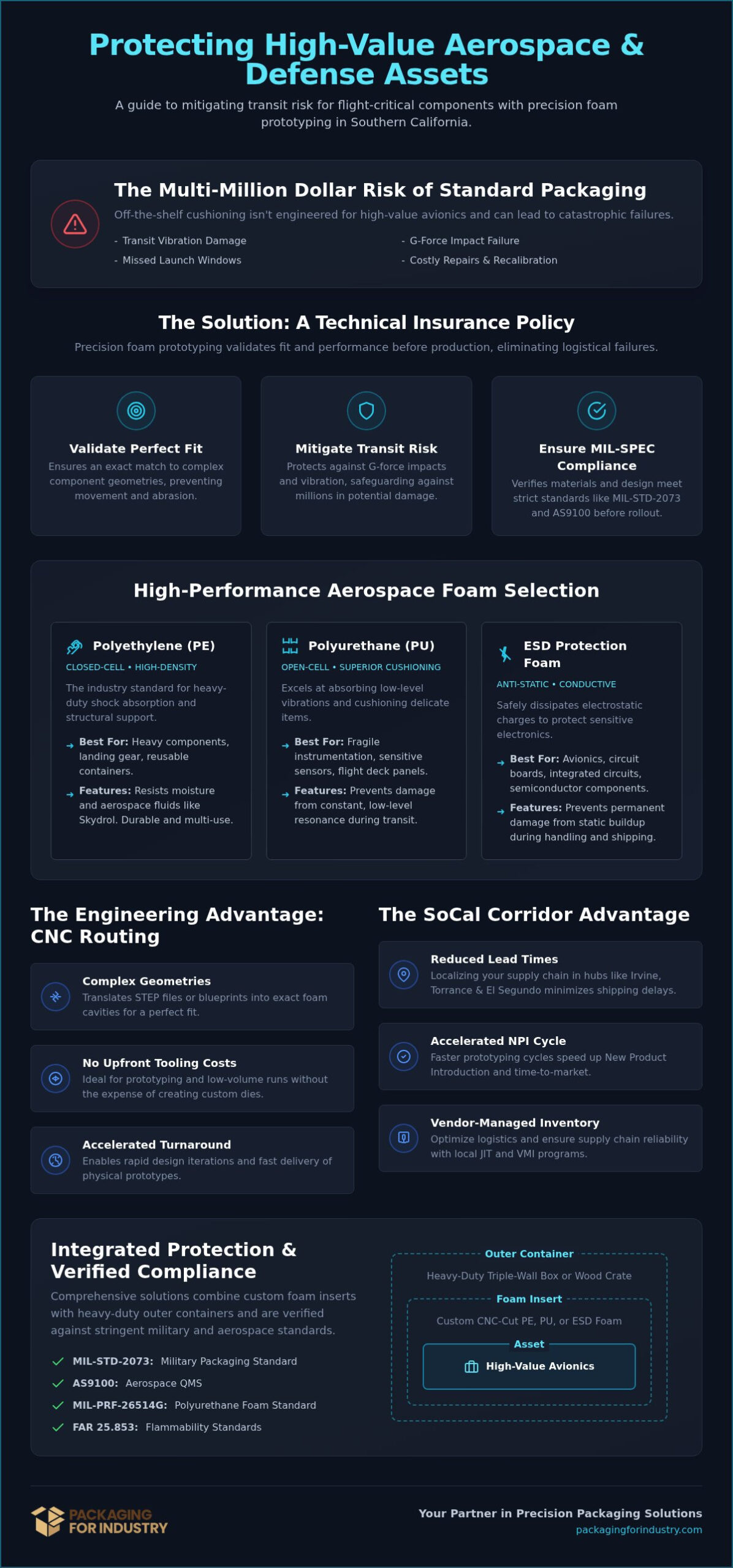
Why Proximity Matters: The SoCal Aerospace Corridor Advantage
The Southern California aerospace corridor is a global epicenter for deep-tech innovation, stretching from the “Space Beach” corridor in Long Beach through the high-density manufacturing hubs in Irvine and Torrance. For local firms, the logistical advantage of using a regional partner for aerospace foam packaging prototypes SoCal cannot be overstated. When your engineering team operates on an accelerated New Product Introduction (NPI) cycle, waiting weeks for a sample from an out-of-state supplier creates a critical bottleneck. Proximity allows for rapid physical handoffs, ensuring that your flight-critical components move from the testing phase to the shipping dock without unnecessary delays.
Serving the Southern California Aerospace Hubs
Defense contractors and aerospace OEMs in the Inland Empire and San Diego require packaging partners who understand the unique demands of military-spec logistics. We provide custom solutions tailored for production lines in Huntington Beach and Costa Mesa, where Just-In-Time (JIT) delivery is essential to maintain lean operations. By utilizing our Orange County service areas, manufacturers can align their packaging arrivals with their assembly schedules. This reduces the risk of line shutdowns and ensures that every piece of hardware is protected the moment it leaves the cleanroom. Face-to-face engineering reviews also allow our specialists to conduct on-site packaging assessments, catching potential transit risks that might be missed in a digital blueprint review.
VMI and Stocking Programs for Local Manufacturers
Real estate in Southern California is expensive. Dedicating massive amounts of warehouse floor to packaging inventory isn’t a fiscally responsible use of space. Our Vendor Managed Inventory (VMI) programs solve this by turning PFI into your off-site stocking partner. We monitor your usage levels and replenish stock automatically, eliminating the risk of packaging stockouts that can halt your distribution. This integrated approach allows you to reallocate warehouse space to high-value manufacturing while we handle the logistical flow of your heavy-duty corrugated boxes and foam inserts.
Our local fleet provides next-day delivery capabilities across Los Angeles, Orange County, and San Diego. This speed is a strategic asset when you need aerospace foam packaging prototypes SoCal for an urgent bid or a last-minute design change. We operate with the purposeful speed of a well-oiled supply chain, ensuring that your operational challenges are solved with pragmatic, local expertise.
Securing Your Supply Chain with Integrated PFI Solutions
Protection for flight-critical hardware requires more than just a high-quality insert. To achieve zero-damage shipping cycles, we integrate our aerospace foam packaging prototypes SoCal into comprehensive protection systems. This often involves nesting custom-engineered PE or PU foam within heavy-duty triple-wall corrugated boxes. For larger aerospace machinery or international transit, we combine these foam inserts with custom wood crates. This multi-layered approach ensures that your components are shielded from structural impacts, surface abrasion, and the environmental stressors of long-haul transit.
Our packaging kitting and assembly services further streamline your operations. Instead of managing multiple vendors for foam, boxes, and pallets, you receive a complete, ready-to-use solution. This consolidated procurement strategy helps lower packaging costs and reduces the time your warehouse staff spends on assembly. By delivering pre-assembled kits directly to your production line in Southern California, we help you maintain the purposeful speed required for modern aerospace manufacturing.
Beyond the Foam: Total Protection Systems
Overseas air freight introduces risks like high humidity and saltwater exposure. We mitigate these by integrating ESD bags and moisture barrier films into your custom kits. We also utilize corner and edge protection to reinforce palletized shipments, preventing strap damage during high-vibration transit. This holistic view of the supply chain is why many engineers choose PFI over catalog suppliers. We don’t just sell components; we design integrated systems that ensure compliance with MIL-STD-2073 requirements for the most demanding mission profiles.
The PFI Quote and Prototyping Process
Securing a precision-fit prototype is a straightforward process. To provide an accurate quote for shock absorbing foam for aerospace components SoCal, our engineering team requires your CAD files, the total component weight, and its fragility rating. This data allows us to calculate the exact foam density needed to maximize protection while minimizing freight weight. We offer free prototyping to ensure the fit is perfect before you commit to bulk quantities. This consultative approach eliminates professional stress and provides the peace of mind that your flight-critical avionics are fully protected. This methodology ensures your aerospace foam packaging prototypes SoCal meet every mission requirement before a single part is shipped.
Ready to optimize your aerospace logistics? Request a packaging quote today to begin your prototyping phase with our local SoCal team.
Optimizing Your 2026 Aerospace Logistics Strategy
Securing your supply chain against transit damage requires a methodical approach to both engineering and logistics. By prioritizing precision-engineered aerospace foam packaging prototypes SoCal, your team can validate protection levels for flight-critical avionics before scaling production. This process ensures total compliance with rigid Mil-Spec and ESD requirements while eliminating the risk of costly shipping failures. It’s about moving from technical blueprints to physical reality with total confidence in your cushioning performance.
PFI provides the specialized expertise and local infrastructure needed to support the unique demands of Southern California’s aerospace hubs. Our commitment to free prototyping for aerospace components and local next-day delivery allows you to maintain aggressive NPI schedules without compromising on safety or quality. We’re ready to help you lower packaging costs and improve logistical reliability through integrated, custom-tailored solutions that protect your bottom line.
We look forward to partnering with your engineering and operations teams to solve your most complex packaging challenges with precision and speed.
Frequently Asked Questions
What is the best shock absorbing foam for aerospace components?
Polyethylene (PE) foam is the most effective shock absorbing material for heavy aerospace components because of its closed-cell structure and chemical resistance. It doesn’t break down when exposed to hydraulic fluids like Skydrol and maintains its shape under significant pressure. For lighter, highly fragile instrumentation, polyurethane (PU) foam is often used to dampen low-level vibrations. We often combine these materials in hybrid prototypes to provide multi-stage protection for complex flight hardware.
How long does it take to get a custom foam prototype in Southern California?
Localizing your supply chain allows for significantly faster turnaround times compared to out-of-state vendors. Once we receive your technical CAD files and component specs, we can typically produce aerospace foam packaging prototypes SoCal within a few business days. This rapid prototyping phase is essential for meeting tight NPI schedules and launch windows. Our local presence in Southern California ensures that physical samples can be hand-delivered or shipped for immediate fitment testing on your production floor.
Do you offer ESD-compliant foam for avionics packaging?
We provide a full range of ESD-compliant foam solutions specifically designed for sensitive avionics and semiconductor components. You can choose between pink anti-static foam, which prevents static buildup, or black conductive foam for permanent grounding. These materials are critical for ensuring compliance with MIL-PRF-81705F standards. Protecting integrated circuits from electrostatic discharge during handling and transit is a primary requirement for any flight-critical electronic assembly, and we ensure every sample meets these rigid specs.
Can PFI meet AS9100 and Mil-Spec packaging requirements?
PFI maintains deep expertise in AS9100 and Mil-Spec packaging standards, including MIL-STD-2073. We understand the stringent documentation and material traceability requirements mandated by defense and aerospace OEMs. Our team ensures that every prototype and production run meets the specific shock, vibration, and environmental protection levels required for government and commercial aerospace contracts. We provide the compliance-ready documentation necessary to verify that your packaging meets all contractual and regulatory obligations before your hardware leaves the dock.
What is the difference between CNC routed and die-cut foam inserts?
CNC routing is a tool-less process ideal for creating aerospace foam packaging prototypes SoCal and small production runs with complex 3D geometries. It allows for rapid design changes without the cost of a steel rule die. Die-cutting is a mechanical pressing process used for high-volume production once a design is finalized. While die-cutting requires an upfront tooling investment, it offers a lower unit price for large-scale manufacturing cycles where consistency across thousands of units is required.
Does PFI provide local next-day delivery for aerospace manufacturers in Irvine or Torrance?
We offer local next-day delivery for aerospace manufacturers throughout Irvine, Torrance, and the surrounding Southern California hubs. Our private fleet services Los Angeles, Orange County, San Diego, and the Inland Empire to ensure your production lines stay on schedule. This regional proximity allows us to support Just-In-Time (JIT) manufacturing and Vendor Managed Inventory (VMI) programs. We help you eliminate the risk of packaging stockouts or transit delays while reducing the need for excessive on-site inventory.
Can you design foam inserts that fit into existing custom wood crates?
We specialize in designing integrated packaging systems where custom foam inserts are engineered to fit perfectly within existing wood crates or heavy-duty corrugated boxes. This approach provides multi-layered protection for heavy aerospace machinery and sensitive instrumentation. Our engineering team can take the interior dimensions of your current crates and develop a high-performance foam nesting system. This optimizes component security while simplifying the packing and kitting process for your warehouse staff, ensuring every shipment is mission-ready.
What information is required to request a quote for aerospace foam packaging?
To provide an accurate quote and begin the prototyping process, we require your component’s CAD files, typically in STEP or IGES format. We also need the total weight of the part, its dimensions, and its fragility rating or maximum allowable G-force. Understanding the transit environment, such as whether the part is shipping via air freight or ground, allows us to select the optimal foam density. This data ensures we can lower packaging costs while maximizing protection for your critical components.