
What if the best way to protect high-value equipment isn’t to add more packaging, but to design the right protection around the product and its shipping route? Damage can delay operations and lead to repair, replacement, or reshipping costs. A stock carton may leave unusual dimensions or fragile components exposed. Effective custom packaging design for high-value equipment treats the box, cushioning, and handling requirements as one system.
This guide covers how to assess equipment vulnerabilities and shipping conditions, compare corrugated boxes, foam, and crates, and avoid materials that add complexity without solving a packaging problem. It also explains how prototypes and samples help teams review fit before a broader rollout. Packaging For Industry (PFI) supports custom industrial packaging projects with CAD/CAM design, packaging reviews, and solutions that combine materials. The aim is a package that protects the equipment and gives operations and purchasing teams a consistent approach to packing and replenishment.
Key Takeaways
- Build a design brief around equipment dimensions, weight, handling needs, shipping frequency, warehouse constraints, and unpacking requirements.
- Match corrugated boxes, foam, inserts, and crates to the equipment, shipping method, and potential for reuse.
- Custom packaging design for high-value equipment starts with clear product and shipment details, then moves through design, prototype review, and production planning.
- Use CAD/CAM support, samples, and packaging reviews to evaluate fit and refine a solution before full rollout.
- Coordinate packaging components into a repeatable approach that supports purchasing and replenishment.
Why custom packaging design matters for high-value equipment
Custom packaging design for high-value equipment means planning the package around the product, how it will be handled, and how it will travel. A stock carton chosen by approximate size may leave room for movement, fail to accommodate protruding features, or make packing and unpacking awkward. A custom design gives the outer box, cushioning, and restraints clear roles in protecting and managing the equipment.
Packaging serves more than a containment function. A general overview of its protective and handling roles is available in Packaging and labeling. For industrial equipment, the design should reflect the product and its shipping route. Corrugated boxes can provide the outer structure, while foam or other cushioning supports vulnerable areas and helps limit unwanted movement. The right combination depends on actual handling needs, not a one-size-fits-all specification.
For example, a machine with projecting controls or connectors needs different internal support from a compact, enclosed component. The package should protect those features without pressing against them. PFI’s custom packaging design services bring product fit and shipping requirements into the same review.
What makes equipment packaging a design problem?
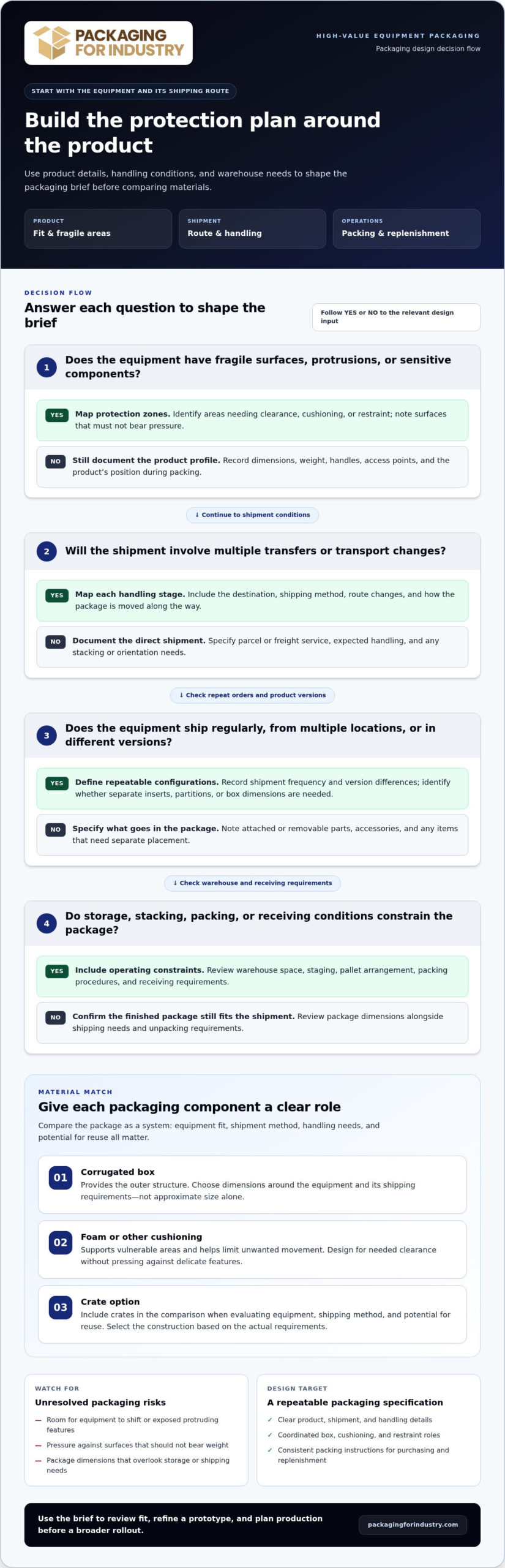
Start with the equipment. Record its dimensions and weight, then identify fragile surfaces, protrusions, sensitive components, and areas that should not bear pressure. Include handles, access points, and the product’s position during packing. These details help determine where the package needs clearance, cushioning, or restraint.
Next, map the shipment. The shipping method, route, and handling stages all influence the design. A package moving through several transfers may have different requirements from one transported directly between facilities. Protection needs vary by product and shipment, so no single construction or performance claim applies to every piece of equipment.
How packaging choices affect business operations
Damage can interrupt installation, production, or service work while teams arrange inspection, repair, replacement, or reshipping. Poor fit creates other problems: equipment may shift in transit, excessive empty space can make packing and storage less efficient, and difficult unpacking can slow receiving or increase the chance of mishandling.
Review package dimensions alongside storage space, pallet arrangement, and shipping needs before rollout. A coordinated box and cushioning design can also make packing easier to repeat. This matters when equipment ships regularly or from multiple locations, where inconsistent materials or improvised packing add work for warehouse and purchasing teams.
A defined packaging specification gives purchasing a repeatable basis for ordering and replenishment. It can also reduce the need to source separate components or reinterpret packing instructions for each shipment. The aim is to reduce damage exposure and operational friction without adding packaging complexity that does not serve the equipment.
Requirements for High-Value Equipment Packaging Design
A useful packaging specification connects product details with the shipping route and handling process. For custom packaging design for high-value equipment, the brief should give the packaging team enough information to develop a solution around the product, shipment, and receiving operation. It also gives purchasing a clearer basis for comparing packaging pricing and identifying opportunities to lower packaging costs without overlooking handling needs.
Include the equipment’s value as context for protection priorities, then document the practical inputs that shape the package:
- Product profile: Dimensions, weight, center of gravity, delicate surfaces, protrusions, and sensitive areas.
- Components: Attached or removable parts, accessories, and items requiring separate placement.
- Shipment details: Destination, parcel or freight service, possible transport changes, and expected shipment frequency.
- Operational needs: Stacking, storage, warehouse space, packing procedures, and receiving requirements.
What product and shipment details belong in the design brief?
Measure the equipment in its shipping configuration, including handles, fittings, cables, or parts that remain attached. Note surfaces that should not bear pressure and any balance or orientation concerns. If the equipment has multiple configurations, identify the version being packed so the design matches the product being shipped.
Describe the shipment method and handling steps. Parcel, freight, or combined transport may involve different constraints. Include stacking expectations and how staff move the package through the facility. For packaging for warehouses, note storage locations, staging space, and how the package fits into existing packing or material-handling processes. Clear inputs help the design reflect actual operating conditions.
How should teams account for repeat orders and changing needs?
For recurring shipments, record expected order patterns and identify the people responsible for purchasing, packing, and receiving. If product versions differ, document the distinctions and note whether they need separate inserts, partitions, or box dimensions. Custom sizes can accommodate unusual equipment profiles, while a clear specification helps teams reorder the right configuration instead of relying on substitutions.
Review finished package dimensions alongside the shipping method. Oversize dimensions may affect carrier handling classifications or surcharges, depending on the carrier and shipment. Assessing dimensions early helps teams compare packaging pricing with shipping and warehouse requirements. For recurring volume, include expected quantities when requesting bulk packaging pricing so the quote reflects the purchasing need.
Clear specifications give purchasing and operations a shared reference for repeat orders and packing instructions. When preparing your requirements, request a packaging quote with product details, shipment information, and expected order quantities.
How do corrugated boxes, foam, and crates compare for equipment protection?
Choose packaging by matching the equipment’s size, weight, fragile areas, shipping method, and reuse needs to the job each material must do. Corrugated packaging can form the outer package, foam can cushion or position equipment inside it, and a crate can provide a custom-built outer structure. These materials can also work together. Custom packaging design for high-value equipment should consider the whole system rather than treating each component as a separate decision.
When can corrugated packaging form the outer package?
Custom corrugated boxes suit equipment that can be packed and handled in a carton-based format. Inserts or dividers can separate components, support the equipment, and help prevent surfaces from contacting the box. Double-wall or triple-wall construction may suit more demanding applications. The choice depends on the package design and shipment requirements, not a blanket assumption about strength.
PFI designs custom corrugated boxes around equipment dimensions and coordinates them with interior protection. This can suit equipment that needs a tailored box but does not require a crate as its outer structure.
When should a design include foam or a crate?
Protective foam can cushion equipment and help position it within the package. Custom foam inserts can be shaped around specific contours or components, while dividers can keep accessories separate. A wood crate may suit equipment whose size, shape, handling, or shipment requirements call for a custom-built outer structure. Some projects combine a crate with foam or other cushioning materials.
Compare the options by their role in the packaging system:
| Option | Useful role | Consider for |
|---|---|---|
| Corrugated box | Forms the outer package; may use inserts or dividers. | Equipment suited to carton-based shipping and the selected box construction. |
| Foam | Cushions and positions equipment or components inside a package. | Fragile surfaces, irregular shapes, or areas that need specific support. |
| Wood crate | Provides a custom-built outer structure. | Equipment whose dimensions, handling, or shipment needs call for a crate format. |
Use the comparison as a starting point, then assess the combined design. A corrugated box with foam may address fit and cushioning, while a crate can provide the outer structure with interior protection tailored to the equipment. Reuse requirements matter too: packaging intended for repeated handling may need different planning from a one-way shipment. Comparing these trade-offs helps teams choose suitable materials without adding components that have no clear purpose.
What does the custom packaging design and prototype process involve?
A custom packaging project works best when product information, shipping requirements, and packing operations stay connected from the first review through production planning. For custom packaging design for high-value equipment, CAD/CAM support helps turn those inputs into a package concept the team can review and refine. PFI tailors design details to the equipment, materials, shipping method, and repeat-order needs.
A typical workflow follows these steps:
- Review requirements. Bring together equipment dimensions, weight, sensitive areas, shipping route, handling steps, and receiving needs. Current packaging and damage history can help identify issues the new design should address.
- Develop the design. Use the project inputs to plan the package structure and how components will position, cushion, and restrain the equipment. CAD/CAM support helps develop a design around the product and shipment requirements.
- Create a prototype or sample. A physical sample lets the team assess fit and packing steps before planning a broader rollout.
- Review and refine. Gather feedback from the people who pack, move, and receive the equipment. Document adjustments so the design reflects real workflow needs.
- Plan production. Use the approved design and clear specifications to guide repeat packaging orders and coordinate the required components.
How should buyers review a prototype or sample?
Place the equipment in the sample as it will be packed for shipment. Check fit, orientation, contact points, restraint, access to the product, and whether protective components assemble as intended. Look for parts that are difficult to position or remove. These observations help separate a design issue from a packing-step issue.
Ask operations and receiving staff to walk through handling and unpacking. Record needed changes, then use the approved design as the reference for repeat production. Their feedback can help make packing instructions more consistent across shifts or locations.
How can packaging reviews identify improvement opportunities?
A packaging review can consider damage history alongside current materials, shipment dimensions, and handling steps. This gives the design team a practical basis for finding protection gaps or unnecessary work. The review can also assess whether coordinating a corrugated box, foam, or crate would simplify the overall setup.
PFI’s custom packaging design service includes project-specific reviews and custom development, helping teams assess design options before production planning. Keep decisions and approved specifications together so purchasing and operations can manage repeat orders using the same reference.
How can PFI support a reliable custom packaging solution?
PFI helps manufacturers and other B2B teams develop packaging around equipment, shipping requirements, and day-to-day handling. Custom design, CAD/CAM support, prototypes, samples, and packaging reviews help teams refine a package before planning repeat orders. For high-value equipment, the aim is a coordinated solution that protects the product and works for the people packing, moving, and receiving it.
The solution can combine corrugated boxes, protective foam, and crates as needed. One shipment may suit a corrugated outer package with custom foam; another may need a crate with interior cushioning. PFI supports aerospace, electronics, medical device, and industrial equipment packaging needs, tailoring the design to the project rather than applying one construction to every product.
PFI serves businesses in Orange County, Los Angeles, San Diego, and Riverside, as well as customers across the United States. For recurring projects, an approved design gives purchasing and operations teams a consistent basis for coordinating packaging components and replenishment.
What information helps move a quote forward?
Share details about both the product and its journey. A useful starting point includes:
- Equipment dimensions, weight, and fragile or sensitive areas.
- Handling requirements and concerns with the current packaging, such as damage, poor fit, or difficult packing steps.
- Shipment methods, destinations, and typical order patterns.
- Packaging components already in use, including boxes, foam, crates, or restraints.
Drawings, photographs, or a product sample can help communicate the equipment’s shape and features. Information about receiving can clarify how the package should open and how the equipment will be removed. PFI uses these project details to inform design discussions and packaging reviews, with design choices tailored to the application.
How can a custom design support repeat packaging needs?
Once a design is reviewed and approved, its specifications can serve as a shared reference for purchasing, warehouse staff, and production planning. That helps teams order the intended components and follow consistent packing steps when equipment ships again or moves through multiple locations. PFI also supports recurring packaging needs with vendor-managed inventory and just-in-time packaging programs where they suit the operation.
A quote request gives the project team a starting point to understand the equipment, route, and packaging concerns, then develop an appropriate solution.
Move Your Equipment Packaging Project Forward
A packaging design should keep pace with equipment and business needs. Assign someone to review the approved approach when product configurations, shipping routes, or internal handling procedures change. This helps teams spot mismatches early and keep packaging aligned with current operations.
Use custom packaging design for high-value equipment as part of ongoing process improvement, not just a one-time purchasing task. A focused review can help determine whether the current approach still supports reliable shipping and efficient handling.
With clear ownership and attention to changing needs, your packaging program can keep pace with the equipment it protects.
Frequently Asked Questions
Can custom packaging be designed for equipment with accessories or multiple components?
Yes. A packaging plan can keep equipment and related parts identifiable through shipping and receiving. For kits with similar-looking accessories, consider a packing list or labels that connect each item to its equipment model or assembly. This helps receiving teams reconcile the shipment before components are sent to different work areas or stored separately.
Can custom packaging accommodate different versions of the same equipment?
Yes. For equipment families with model revisions, keep a compatibility record showing which packaging configuration goes with each version. Include the revision or model reference in internal packing instructions so staff can avoid using an outdated configuration after a product change. This is useful when older and newer versions remain in production or inventory at the same time.
Is custom packaging suitable for equipment shipped repeatedly?
Yes. A recurring shipment may benefit from packaging designed around a return or reuse process, if that suits the operation. Consider how the package will be opened, stored between shipments, and prepared for its next trip. Reviewing these steps helps teams decide whether reusable packaging fits their handling process or whether a new package is more practical for each shipment.
Can packaging be redesigned if equipment arrives damaged?
Yes. Document the damage as soon as the shipment is opened. Note which part is affected, where it sat inside the package, and whether nearby packaging shows contact or compression. Photos taken before materials are moved can preserve useful context. These records help the design review distinguish a recurring problem from isolated damage.
What information should I provide for a custom packaging quote?
Along with product and shipping details, clarify what the quote should cover: a new package design, replacement packaging for an existing setup, or packaging for a product change. Include internal part numbers or a bill of materials for the current package if available. This helps align the quote with your purchasing process and the scope your team needs to evaluate.
Can a custom package be designed to simplify unpacking at the receiving location?
Yes. Consider the unpacking area, including space to set aside packaging and stage equipment before installation or inspection. Note whether staff use particular tools or material-handling equipment at that location. These details help shape a package that fits the receiving workflow rather than forcing staff to move the equipment elsewhere to open or stage it.
Can PFI support packaging needs outside Southern California?
Yes. PFI supports packaging needs nationwide, including programs for businesses with more than one facility. For a multi-location operation, identify which sites use the packaging and whether they have the same product mix or ordering pattern. This context helps frame a supply program across locations while keeping local requirements visible to purchasing and operations teams.