
Are you paying to ship excess paper weight just to avoid a core collapse? Many procurement managers believe that thicker is always better, but over-engineering your tubes often leads to inflated freight costs without adding functional value. We know the stress of seeing a product fail in transit due to insufficient wall strength, just as we understand the constant pressure to reduce operational overhead.
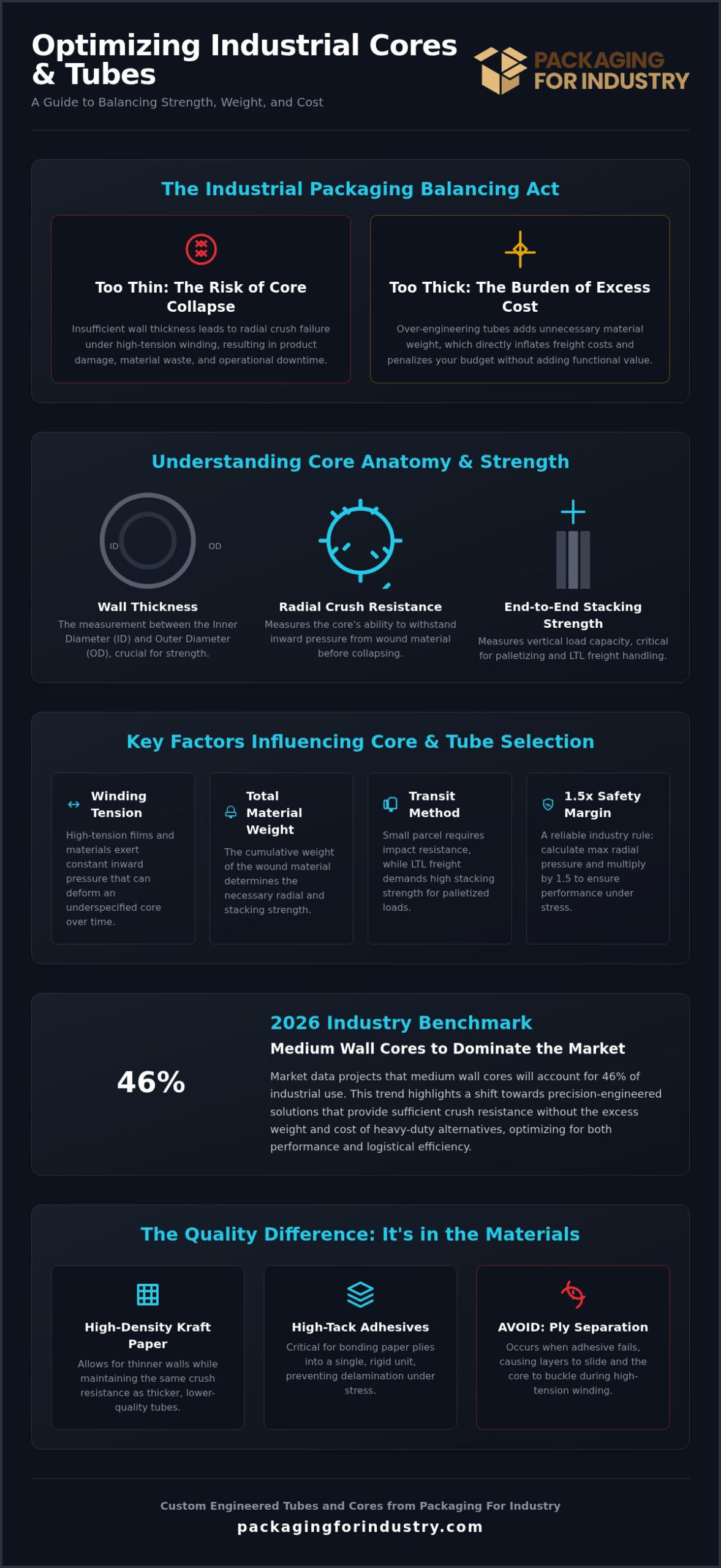
Determining the best core and tube thickness for industrial packaging is a balancing act between radial crush resistance and logistical efficiency. You need a solution that withstands high-tension winding but doesn’t penalize your bottom line at the scale. With medium wall cores projected to hold 46% of the market share in 2026, many businesses are finding that standard specs aren’t precise enough for modern manufacturing. This guide identifies the optimal wall gauges for your operations, helping you eliminate product damage while streamlining your shipping spend. We’ll examine how to calculate the precise thickness required for your specific application, from aerospace components to bulk film winding, ensuring your specs are as lean as they are reliable.
Key Takeaways
- Learn how to balance radial crush resistance with material weight to identify the best core and tube thickness for industrial packaging in your specific application.
- Identify how winding tension and total material weight dictate the required number of kraft paper plies to prevent core collapse during high-speed production.
- Discover how minor adjustments to wall thickness can lower packaging costs by reducing total freight weight without compromising structural integrity.
- Utilize custom CAD/CAM prototyping to verify performance specs before committing to bulk orders, ensuring a perfect fit for your warehouse operations.
- Understand the 2026 industry benchmarks for medium and thick wall cores to avoid the common pitfalls of over-engineering and unnecessary material spend.
Understanding Wall Thickness and Radial Crush Resistance
Wall thickness is the specific measurement between the inner diameter (ID) and the outer diameter (OD) of a tube. While Shipping and mailing tubes are often viewed as simple cylinders, their engineering is complex. Finding the best core and tube thickness for industrial packaging requires looking beyond the total gauge to the individual plies of kraft paper that form the structure. Each layer, or ply, adds a specific level of reinforcement. The more plies you add, the higher the radial crush resistance becomes. This resistance is the primary metric we use to measure core performance. It dictates how much pressure the tube can withstand from the material wound around it before it collapses. You must distinguish this from end-to-end stacking strength, which measures vertical load capacity; radial strength is about side-to-side pressure.
In 2026, market data indicates that medium wall cores account for approximately 46% of industrial use. This popularity stems from their ability to provide sufficient crush resistance without the excessive weight of heavy-duty alternatives. When you select a core, you’re essentially choosing a defense against the inward force of your product. If the wall is too thin, the core will fail. If it’s too thick, you’re paying for material and freight weight you don’t actually need. Precision engineering is the only way to find that profitable middle ground.
Spiral vs. Convoluted Winding Strengths
Spiral winding is the industrial standard for continuous, high-speed production. In this process, multiple plies of paper are wrapped around a mandrel at an angle, creating a continuous tube that can be cut to any length. It’s the most cost-effective method for bulk manufacturing. Convoluted winding, however, involves wrapping the paper straight onto the mandrel. This method offers superior vertical strength and is often reserved for heavy-duty applications where the tube must support massive weight without bowing. For most industrial buyers, spiral-wound tubes and cores provide the best cost-to-strength ratio, provided the wall thickness is matched to the winding tension of the machinery.
The Role of Kraft Paper Quality
The thickness of a tube isn’t just about the number of layers; it’s about the density of the recycled fiberboard used. High-density kraft paper allows for a thinner overall wall while maintaining the same crush resistance as a thicker, lower-quality tube. The adhesive bonding between these plies is equally critical. If the glue doesn’t hold, the layers will slide against each other. Ply-separation occurs when the adhesive bond between layers fails under stress, causing the core to lose its structural integrity and buckle during high-tension winding. To avoid this, we focus on high-tack adhesives that turn multiple plies into a single, rigid unit. This ensures your core stays round and functional from the moment it hits the winding line to the moment it reaches your customer.
Key Factors Influencing Your Core and Tube Selection
Selecting the best core and tube thickness for industrial packaging requires a thorough audit of your winding equipment and shipping cycle. It’s not enough to match the inner diameter of your mandrel; you must account for the cumulative force of the material being wound. For example, high-tension films exert a constant inward pressure that can slowly deform a core over time. If your wall thickness doesn’t meet the demand, you’ll face core collapse before the product even leaves your facility. This leads to wasted material and downtime that your operations can’t afford.
Transit methods also dictate your requirements. Small parcel handling involves significant impact risks, whereas LTL freight focuses on stacking strength. If your tubes are at the bottom of a pallet, they must support the weight of everything above them. You can request a packaging quote for different gauges to see where the threshold for safety meets your budget. Balancing these factors ensures you aren’t over-engineering your packaging while still protecting your product from transit damage.
Calculating Load and Radial Pressure
To determine the necessary specs, you should follow industry standards for crush resistance. A reliable framework for industrial buyers is the 1.5x safety margin rule. You should identify the maximum anticipated radial pressure your winding process generates and multiply it by 1.5 to establish your minimum wall gauge. This buffer accounts for machine fluctuations and handling errors. Additionally, remember that core length affects perceived strength. A longer core often requires a slightly thicker wall to maintain the same structural integrity as a shorter one under the same load because the span is more susceptible to bowing.
Environmental and Storage Stressors
Moisture is the primary enemy of paperboard integrity. Because paper is hygroscopic, it naturally absorbs water from the air, which softens the adhesive bonds and fibers. Research indicates that moisture absorption in paper tubes reduces crush resistance by up to 30%. This is a critical factor for manufacturers in coastal Southern California cities like Los Angeles and Anaheim, where morning humidity levels are frequently high. When cores absorb moisture, they lose the rigidity required for high-speed winding.
To maintain core integrity, store your supply in a climate-controlled area off the warehouse floor. Using pallets and stretch wrap to seal unused inventory prevents the paper from wicking moisture from the environment. If your cores sit in a humid warehouse for months before use, their effective strength will be significantly lower than the day they were manufactured. Consistent rotation of inventory ensures you’re always winding onto fresh, rigid material that meets your original engineering specs.
Industry-Specific Thickness Benchmarks for 2026
Benchmarks for the best core and tube thickness for industrial packaging are shifting in 2026 as manufacturers prioritize material optimization. Recent market data shows that thick wall cores now hold a 38% market share, driven by the need for high-performance winding in automated facilities. However, the “best” thickness is entirely dependent on whether you’re using a functional winding core or a protective shipping tube. Functional cores must withstand the torque and radial pressure of winding machinery, while protective tubes focus on impact resistance and stacking strength during transit.
We’re seeing a significant move toward lighter, high-density materials that offer the same structural integrity as traditional, thicker alternatives. This shift allows procurement managers to reduce freight costs without risking core failure. Specialized coatings also play a larger role this year. Applying wax or silicone treatments can improve moisture resistance or provide release properties for adhesive products. While these coatings don’t add significant structural thickness, they enhance the effective durability of the tube in challenging environments, such as high-humidity warehouses or long-haul shipping routes.
Textiles, Films, and Flexible Packaging
In the world of flexible packaging, precision is non-negotiable. Standard gauges for stretch film products and textile winding typically range from 0.125″ to 0.500″. High-speed automated winding lines exert massive torque on the core center. If you use a wall that’s too thin, the core will buckle under the initial tension, leading to a “telescoping” effect where the material slides off the core. For most high-volume film applications, a 0.250″ or 0.375″ wall provides the necessary rigidity to maintain a perfect roll profile from the first wrap to the last. This ensures your load stabilization remains consistent during the final palletizing process.
Aerospace and Heavy Manufacturing Protection
Heavy manufacturing and aerospace packaging solutions require a different engineering approach. When protecting sensitive turbine components or machined shafts, we often recommend heavy-duty walls of .500″ or greater. These thick-walled tubes act as a rigid exoskeleton, absorbing the kinetic energy of drops or shifts during LTL freight. Many of these applications must also meet strict military-spec requirements for long-term storage durability. In these cases, the thickness isn’t just about crush resistance; it’s about creating a barrier that won’t degrade over months of storage in varying climates. For specialized sectors, we utilize custom CAD/CAM prototyping to verify that the chosen thickness provides the exact clearance and protection required for high-value assets.
Balancing Structural Integrity with Freight Cost Reduction
Over-engineering is a hidden drain on manufacturing profit margins. While a thicker wall feels safer, it often represents an unnecessary material spend that doesn’t improve performance. Finding the best core and tube thickness for industrial packaging requires a data-driven approach to weight and strength. Reducing a wall thickness by just 1/16″ can save thousands in annual freight costs for high-volume operations. This reduction isn’t just about the lower cost of the paperboard; it’s about the cumulative weight removed from every pallet in your supply chain.
Carriers use Dimensional (DIM) weight surcharges to penalize heavy or bulky packages that take up valuable truck space. If your tubes are heavier than the application requires, you’re paying a weight premium that provides zero functional benefit. Precision-cut lengths are equally critical for cost control. If your cores are even half an inch longer than the wound material requires, you’re paying for wasted paper and potentially pushing your shipping boxes into a higher DIM weight bracket. Every fraction of an inch and every extra ply counts toward your total cost of ownership.
Lowering Packaging Costs through Engineering
At PFI, we specialize in conducting comprehensive packaging reviews to find the “sweet spot” of thickness. This involves evaluating your current failure rates against your total packaging spend to identify where you can safely trim material. There’s always a calculated trade-off between material cost and the potential for damage-related insurance claims. Our engineering team helps you manage this risk by optimizing ply count and paper density. We focus on implementing a packaging cost savings strategy that protects your products while maximizing your shipping efficiency.
Prototyping and Testing for Reliability
Reliability isn’t a matter of guesswork. We utilize a custom CAD/CAM prototyping process to develop core dimensions tailored to your specific machinery and winding tensions. Before a bulk rollout, we recommend a “test-to-failure” protocol. This ensures the best core and tube thickness for industrial packaging is maintained even under extreme production stress, exceeding the 1.5x safety margin discussed previously. For manufacturers in Orange County and the Inland Empire, our local prototyping capabilities mean you can verify specs in days rather than weeks. This fast turnaround allows you to streamline your purchasing process with total confidence in your supplies.
Custom Engineered Tubes and Cores from Packaging For Industry
Finding an industrial packaging supplier near me is the first step for manufacturers looking to stabilize their supply chain. As an experienced Anaheim packaging supplier, Packaging For Industry (PFI) specializes in manufacturing custom IDs, ODs, and wall thicknesses that go beyond standard catalog offerings. We don’t just act as a bulk packaging supplier; we serve as an engineering partner to ensure you’re using the best core and tube thickness for industrial packaging. This localized expertise allows us to troubleshoot winding failures or transit damage in real time, providing custom engineered solutions that fit your specific mandrel sizes and tension requirements.
Vendor Managed Inventory (VMI) for Tubes and Cores
Custom sized cores often present inventory challenges, but our VMI services eliminate the risk of stockouts. We monitor your production levels and maintain safety stock in our Southern California facility, providing just-in-time delivery to your floor. This model is particularly effective for high-volume film and textile manufacturers who need to free up warehouse space. By shifting the storage burden to us, you can focus on production while knowing your custom cores are always available for next-day delivery in Orange County or Los Angeles.
Why Choose PFI
We combine technical precision with logistical speed to help manufacturers lower packaging costs. Our custom packaging quote process includes free CAD/CAM prototyping, allowing you to verify the best core and tube thickness for industrial packaging before committing to a bulk rollout. With local next-day delivery across Riverside, Santa Ana, and Irvine, we provide a level of responsiveness that national catalog giants can’t match. We’re committed to reducing your shipping damage and improving your bottom line through better engineering and reliable local service.
Secure Your Supply Chain with Optimized Core Engineering
Achieving the best core and tube thickness for industrial packaging requires a shift from guesswork to data-driven engineering. By matching your wall gauge to specific winding tensions and transit risks, you can eliminate core collapse while stripping away the excess weight that inflates your freight invoices. Precision in your packaging specs isn’t just about protection; it’s a direct path to improved manufacturing margins.
PFI provides the technical support needed to navigate these variables. We offer free CAD/CAM prototyping to verify your custom designs before bulk production begins. Our team understands the rigorous demands of aerospace and mil-spec packaging standards, ensuring your high-value components remain secure. For our partners in Southern California, we provide next-day local delivery to keep your warehouse operations running without interruption.
Take control of your packaging costs today by refining your material specifications for maximum efficiency and reliability.
Frequently Asked Questions
What is the standard wall thickness for industrial paper tubes?
Standard wall thickness ranges from .030 inches for light mailing to over .500 inches for heavy-duty industrial winding. Most medium-wall applications in manufacturing utilize gauges between .125 and .250 inches. Identifying the best core and tube thickness for industrial packaging depends on your specific load and machinery. We focus on finding the thinnest effective gauge to minimize your material costs while maintaining total structural integrity.
How do I calculate the crush resistance needed for my winding application?
You should follow the 1.5x safety margin rule by calculating the maximum radial pressure your winding equipment exerts. This involves analyzing the inward force of the material and the total weight of the finished roll. We use industry testing standards to verify that your chosen wall thickness can withstand these specific stresses. This engineering-first approach prevents core deformation during high-speed production and ensures consistent product quality.
Can PFI provide custom IDs for specific mandrel sizes?
Yes, PFI manufactures custom inner diameters to ensure a precise fit for any mandrel size in your facility. A loose fit causes vibration and slipping, while a tight fit can damage your equipment or slow down production. We utilize CAD/CAM prototyping to verify tolerances before bulk production. This ensures your custom cores slide on and off your machinery with the exact clearance required for efficient operations.
Does core thickness affect the price of shipping for my final product?
Core thickness significantly impacts shipping costs through both gross weight and carrier DIM weight surcharges. Every extra ply of paperboard adds cumulative weight to your pallets, which increases your freight spend over time. By optimizing to the best core and tube thickness for industrial packaging, you strip away unnecessary weight. Our team specializes in reducing these surcharges by engineering leaner, high-density tubes that don’t compromise on strength.
What causes a paper core to collapse during the winding process?
Core collapse is usually the result of excessive winding tension or ply-separation within the tube wall. When the inward radial pressure exceeds the tube’s crush resistance, the structure buckles. Environmental factors like high humidity also play a role, as moisture softens the paper fibers and reduces strength. Selecting a wall gauge matched to your machine’s torque and maintaining a dry storage environment are the most effective ways to prevent collapse.
Are there moisture-resistant options for heavy-duty tubes and cores?
We provide specialized moisture-resistant treatments, including wax and silicone coatings, for heavy-duty applications. These barriers prevent the paperboard from absorbing atmospheric moisture, which is a common issue for manufacturers in coastal Southern California. These coatings ensure your cores maintain their rigid crush resistance during long-term storage or transit through humid climates. This protection is essential for maintaining the reliability of your winding cores from the warehouse to the end user.
How can I reduce my packaging costs without increasing the risk of product damage?
The most effective way to reduce costs is to eliminate over-engineered specifications through a professional packaging review. Many procurement managers buy thicker walls than necessary, which inflates both material and shipping prices. We use prototyping to test thinner, high-density paperboard options that offer equivalent protection. This allows you to lower your total cost of ownership while maintaining the structural integrity needed to prevent transit damage.
Does PFI offer local delivery for tubes and cores in Orange County?
PFI offers local next-day delivery for businesses throughout Orange County, Los Angeles, and the Inland Empire. Our fleet provides consistent service to industrial hubs in Anaheim, Irvine, Santa Ana, and Riverside. This local presence supports our Vendor Managed Inventory (VMI) programs, allowing you to receive just-in-time shipments. By relying on our local delivery, you can reduce the amount of warehouse space dedicated to bulky core and tube inventory.