
Is your “affordable” packaging actually draining your bottom line through hidden freight surcharges and damaged returns? In the high-stakes world of Southern California logistics, the cheapest material often becomes the most expensive choice once you factor in replacement costs and customer dissatisfaction. You likely already know that a single compromised shipment can erase the profit margins of an entire production cycle, especially when dealing with sensitive aerospace or medical electronics. Finding a reliable protective cushioning materials supplier in Orange County is about more than just buying bulk foam; it’s about securing a partner who understands the intersection of engineering and economics.
We’ll show you how to select a local supplier that can eliminate transit damage while reducing your total landed costs. You’ll learn how custom-engineered solutions can help you navigate California’s SB 54 plastic reduction mandates and how just-in-time delivery helps you reclaim valuable floor space in an Orange County industrial market where vacancy rates have recently climbed to 5.5%. This guide provides a clear framework for auditing your current packaging strategy to ensure your operations remain lean, compliant, and consistently profitable.
Key Takeaways
- Identify the true cost of transit damage beyond the product itself, including return logistics, replacement manufacturing, and brand erosion.
- Compare the technical properties of polyethylene and polyurethane foams to ensure your cushioning density matches your product’s specific fragility.
- Evaluate the ROI of custom-engineered inserts versus stock void fill to reduce box dimensions and eliminate expensive carrier freight surcharges.
- Use a professional procurement checklist to vet a protective cushioning materials supplier in Orange County for CAD design capabilities and local delivery reliability.
- Reclaim valuable warehouse floor space by implementing vendor-managed inventory (VMI) programs for bulky industrial cushioning materials.
The Impact of Transit Damage on Orange County Manufacturing
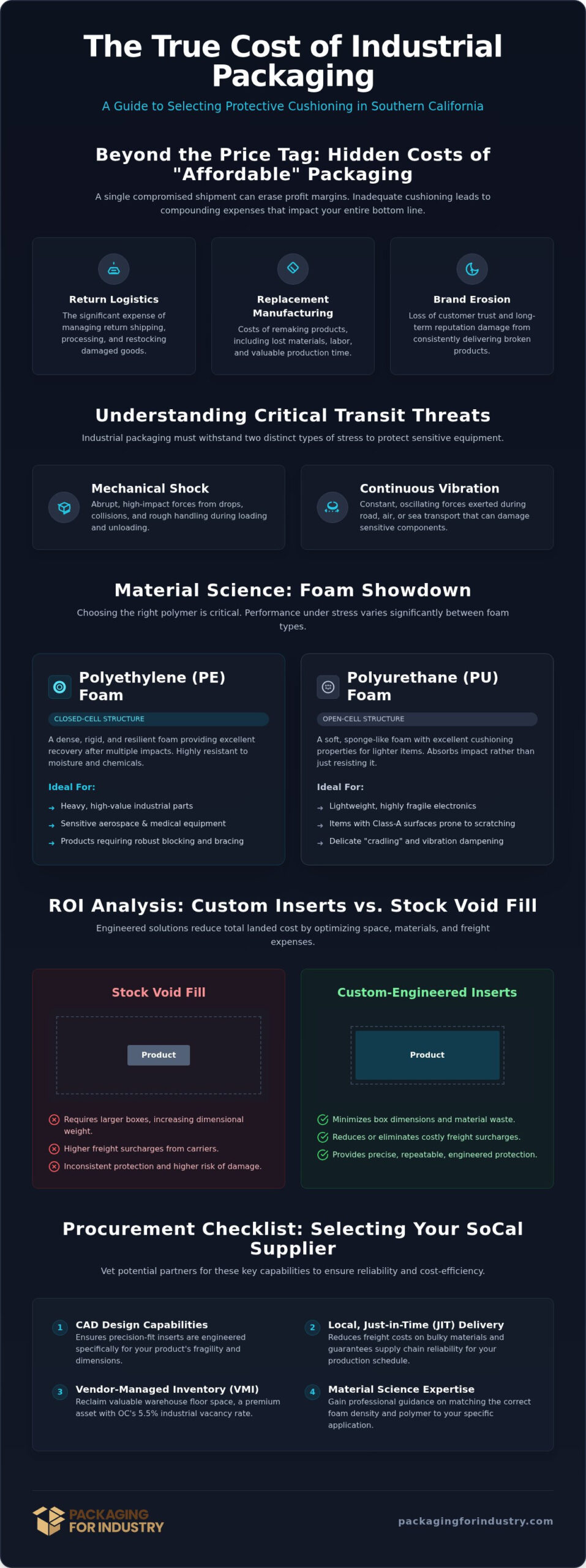
Industrial shipping in Southern California is a demanding process that standard retail cushioning simply cannot handle. While generic bubble wrap or packing peanuts might suffice for small consumer goods, they lack the structural integrity required for high-velocity industrial environments. When a shipment fails, the financial impact extends far beyond the cost of the broken item. You must account for the “hidden costs” of damage, which include the expense of return logistics, the time lost to replacement manufacturing, and the potential long-term erosion of your brand reputation. For manufacturers in specialized sectors like medical devices and aerospace, even a minor transit mishap can lead to catastrophic functional failures or regulatory non-compliance.
The Southern California freight corridor presents unique logistical stressors. Shipments moving through the Ports of Long Beach and Los Angeles or navigating the I-5 and 405 freeways are subject to repeated handling and constant movement. A specialized protective cushioning materials supplier in Orange County understands these regional challenges and provides solutions designed to survive multiple touchpoints. Without engineered protection, your products are vulnerable to the rough handling found in high-volume distribution hubs and the unpredictable conditions of long-haul trucking.
Mechanical Shock vs. Continuous Vibration
Sensitive electronics and industrial equipment are susceptible to two distinct types of transit stress: mechanical shock and continuous vibration. Mechanical shock occurs during abrupt events like drops or collisions, while vibration is a constant force exerted during road or air transport. High-performance Package cushioning materials, such as polyethylene and polyurethane foams, are engineered to absorb these forces before they reach the product. A product’s fragility factor represents the maximum amount of G-force it can endure before functional failure occurs. Selecting the correct foam density ensures that your packaging stays within these critical tolerances throughout the entire shipping cycle.
The Regional Logistics Advantage
Bulky items like foam planks and bubble rolls are essentially “shipping air,” which makes long-distance transport prohibitively expensive. Sourcing from a local Orange County service area partner reduces these freight surcharges and lowers your overall carbon footprint. Furthermore, with the local industrial vacancy rate climbing to 5.5% in mid-2026, warehouse space has become a premium asset for manufacturers. Utilizing a local protective cushioning materials supplier Orange County allows for just-in-time delivery and vendor-managed inventory programs. These services enable you to reclaim valuable floor space by only stocking the materials you need for immediate production runs.
Material Science: Comparing Polyethylene, Polyurethane, and Specialty Foams
Selecting the correct polymer is the first step in creating an effective protective system. While various materials might look similar to the untrained eye, their performance under stress varies significantly. Polyethylene (PE) foam is the primary workhorse for heavy, high-value industrial parts. It’s a closed-cell material, meaning it’s resistant to moisture and provides excellent recovery after multiple impacts. In contrast, Polyurethane (PU) foam is an open-cell material that offers a much softer compression. It’s the ideal choice for lightweight, highly fragile items that require delicate “cradling” rather than rigid support. A recent Packaging foams market analysis confirms that the shift toward these specialized materials is driven by the need for better shock resistance in the electronics and automotive sectors.
A professional protective cushioning materials supplier in Orange County doesn’t just sell foam by the sheet; they provide material science expertise to match the polymer to the application. Beyond PE and PU, specialty cross-linked foams offer a finer cell structure for Class-A surfaces that can’t risk scratching. For less critical void-fill applications, Expanded Polystyrene (EPS) remains a cost-effective option, though it lacks the multi-strike durability of polyethylene.
Density and Compression Sets
Density is measured in pounds per cubic foot and dictates how much weight the foam can support before it bottoms out. If the density is too high, the foam won’t compress enough to absorb the shock; if it’s too low, the product will crush the foam and strike the outer container. You must also consider “creep,” which is the gradual loss of foam thickness when a product sits in storage for extended periods. 1.7lb density PE is the industrial standard for most crates because it provides the necessary structural support for heavy components while maintaining excellent multi-strike recovery. Matching these technical specs to your drop-height requirements is essential for zero-damage shipping cycles.
Specialized Protection: ESD and Mil-Spec
For semiconductors and medical electronics, standard foam isn’t enough. Anti-static (ESD) cushioning is required to prevent electrostatic discharge from frying sensitive circuits. These materials are typically color-coded pink or black to signify their dissipative properties. When dealing with military packaging, materials must meet strict moisture-vapor and grease-proof requirements. This often involves using moisture barrier bags in conjunction with specialized cushioning to prevent corrosion during long-term storage or overseas transit. Medical device manufacturers also require “cleanroom-ready” foams that don’t shed particulates, ensuring the integrity of sterile instruments. If you’re unsure which material density or specialty grade fits your product’s fragility factor, you can request a quote to get a professional engineering assessment from a local protective cushioning materials supplier Orange County.
Custom Engineered Inserts vs. Stock Void Fill: An ROI Analysis
Many procurement managers opt for stock void fill like generic bubble wrap or packing peanuts to save on initial unit costs. This choice often overlooks the hidden expenses associated with increased labor and inflated freight bills. Custom engineered inserts provide a repeatable, professional fit that eliminates the guesswork of manual packing. By switching to custom foam, you can implement supply chain best practices that prioritize long-term efficiency over short-term savings. A specialized protective cushioning materials supplier in Orange County can help you transition from inefficient bulk stock to precision-cut inserts that streamline your entire assembly line.
The labor efficiency of kitting shouldn’t be underestimated. When your packaging arrives as a ready-to-use set of components, your team spends less time on the assembly line and more time on high-value tasks. This methodical approach ensures that every product is protected identically, removing the risk of human error that often occurs when warehouse staff are forced to estimate the amount of void fill needed for each box.
Reducing UPS and FedEx Surcharges
Carriers like UPS and FedEx calculate costs based on Dimensional Weight (DIM), meaning you pay for the volume your box occupies rather than its actual weight. Generic cushioning requires a larger “buffer zone” to compensate for its lack of structural integrity. This often results in oversized boxes that trigger “Large Package” surcharges. For example, by using engineered foam density to secure a product more effectively, it’s possible to reduce box dimensions by 20%. This optimization directly impacts your bottom line by lowering freight costs and reducing the amount of corrugated material needed per shipment. You can find more details in our Packaging cost savings analysis.
The Power of Prototyping and CAD Design
Precision engineering is the only way to ensure a zero-damage shipping cycle for high-value industrial components. Using CAD/CAM support, a protective cushioning materials supplier Orange County designs inserts specifically around your product’s center of gravity. This ensures that the most vulnerable parts of your equipment receive the highest level of protection. Free prototyping allows you to verify these protection levels through physical tests before you commit to high-volume production. Precision die-cutting and CNC routing also reduce material waste, as every square inch of foam is utilized effectively. Working with a protective cushioning materials supplier in Orange County that offers these technical services ensures your packaging is as well-engineered as the product it protects.
Procurement Checklist: Selecting an Industrial Cushioning Supplier in SoCal
Vetting a protective cushioning materials supplier in Orange County requires a shift from price-per-unit thinking to operational reliability. Your checklist should begin with technical capabilities. Does the supplier provide CAD design and drop-test data to validate their engineering? A reliable partner must demonstrate how their material selection directly prevents damage for your specific product weight and fragility factor. You should also evaluate their scalability; a supplier must be able to produce low-volume prototypes for new product launches while maintaining the capacity for high-volume production runs without lead-time spikes.
Local logistics are equally vital. In the high-velocity Southern California market, a supplier’s physical proximity to your facility in Anaheim, Irvine, or Santa Ana determines your ability to respond to sudden demand shifts. If a supplier cannot guarantee local next-day delivery, your warehouse is at risk of stockouts that can halt your entire production line. Verify that your potential partner has the logistical infrastructure to support your operations with the speed that the Orange County industrial corridor demands.
Evaluating Supplier Reliability
Reliability is often a product of inventory management. Ask potential suppliers about their Vendor Managed Inventory (VMI) programs. These systems allow the supplier to monitor your stock levels and replenish cushioning materials automatically, ensuring you never run out of critical supplies. This “Just-in-Time” (JIT) approach is particularly beneficial for bulky foam and corrugated stock, as it minimizes the amount of on-site inventory you need to store. You should also inquire about their raw material sourcing to ensure they have stable access to resins and polymers, protecting you from broader supply chain volatility.
Integrated vs. Fragmented Sourcing
Fragmented sourcing, where you buy boxes from one vendor and foam inserts from another, often leads to dimensional mismatches and increased freight costs. Selecting a single-source supplier for your corrugated boxes, foam packaging, and pallets ensures that every component of your protective system works in unison. This integrated approach also allows for packaging kitting, where all necessary shipping components arrive at your facility as a single, ready-to-use unit. Streamlining your procurement through one industrial partner reduces the number of purchase orders your team must manage and simplifies the entire accounting process.
Why Packaging For Industry is the Leading OC Cushioning Partner
Packaging For Industry (PFI) operates as more than a vendor; we function as a seasoned industrial consultant and proactive problem-solver for the Southern California manufacturing sector. Our team understands that for high-stakes operations in aerospace and medical device manufacturing, a single shipment failure is not an option. As a dedicated protective cushioning materials supplier in Orange County, we prioritize engineering-led protection that balances material performance with economic efficiency. We serve as the “fixer” for companies struggling with high damage rates or excessive freight spending, providing the stability and technical expertise required to optimize complex supply chains.
Our local footprint is a strategic asset for our partners. Based in Anaheim, we provide rapid response times and local next-day delivery to facilities in Irvine, Santa Ana, Huntington Beach, and across the Inland Empire. This proximity allows us to implement the PFI VMI Program with precision. We take full accountability for your cushioning stock, monitoring usage levels and replenishing supplies before they reach critical lows. This service is designed specifically to solve the challenge of storing bulky foam and corrugated materials, allowing you to reclaim floor space while ensuring you never face a production-stopping stockout.
From Prototype to Production
The transition from a new product concept to a high-volume shipping cycle requires a methodical design process. We offer free CAD support and material analysis to ensure your custom foam inserts and crates are engineered for the specific G-force tolerances of your equipment. Our collaborative approach involves creating physical prototypes that you can test in real-world conditions before committing to a full production run. This precision engineering reduces material waste and ensures that your packaging is as refined as the technology it protects. You can explore our full range of custom design packaging services to see how we integrate foam, corrugated, and wood solutions.
Request Your Custom Cushioning Quote Today
Efficiency starts with a consultative review of your current packaging standards. Our team identifies immediate cost-reduction opportunities by analyzing your box dimensions, foam densities, and shipping lanes to eliminate carrier surcharges. Whether you require mil-spec polyethylene, anti-static polyurethane, or custom-sized corrugated containers, we provide rapid quote responses tailored to your specific industrial requirements. We focus on the total landed cost of your product, ensuring that your protective system contributes to your bottom line rather than draining it.
Optimize Your Logistics with Engineering-Led Cushioning
Selecting the right protective cushioning materials supplier Orange County is a strategic investment in your facility’s long-term fiscal health. By prioritizing engineering-led protection over generic void fill, you can effectively eliminate the expenses associated with replacement manufacturing and dimensional weight surcharges. It’s about moving beyond simple protection to a total system of logistical optimization that protects your brand reputation as much as your product.
With specialized aerospace and medical expertise, our team provides the technical precision required for your most sensitive shipments. Utilizing free custom prototyping and local next-day delivery in Orange County ensures that your production lines remain active and your warehouse remains lean. We’re here to help you solve your most complex shipping challenges with pragmatic, results-driven solutions that contribute to a zero-damage shipping cycle.
Our consultants are ready to review your current packaging standards and identify immediate opportunities to lower your total landed costs while improving supply reliability.
Frequently Asked Questions
What is the best cushioning material for heavy industrial parts?
Polyethylene (PE) foam is the most effective material for heavy, high-value industrial components. Its closed-cell structure provides high load-bearing capacity and excellent recovery after multiple impacts. We typically recommend 1.7lb or 2.2lb density PE for heavy parts to prevent the product from bottoming out during transit. This material is also resistant to moisture and chemicals, making it ideal for long-term storage in industrial environments.
How do custom foam inserts help reduce shipping costs?
Custom inserts reduce costs by optimizing the dimensional weight of your shipments. Unlike generic void fill, engineered foam allows you to use the smallest possible corrugated box while maintaining superior protection. This helps you avoid “Large Package” surcharges from carriers like UPS and FedEx. Additionally, custom designs reduce material waste and decrease the labor time required for your team to pack each unit on the assembly line.
Do you provide anti-static (ESD) foam for electronics packaging?
Yes, we provide specialized anti-static polyethylene and polyurethane foams designed to protect sensitive semiconductors and medical electronics. These materials are treated to dissipate static charges that could otherwise damage internal circuitry. Our ESD foams are typically color-coded pink or black for easy identification in your warehouse. We can also integrate these inserts with moisture barrier bags to meet strict mil-spec packaging requirements for long-term storage.
Can I get next-day delivery for packaging supplies in Orange County?
We offer local next-day delivery for stock materials and items managed through our inventory programs. As a dedicated protective cushioning materials supplier in Orange County based in Anaheim, we provide rapid response times to facilities in Irvine, Santa Ana, and Brea. This local logistics advantage helps you maintain a lean inventory while ensuring you never face a production-stopping stockout of critical foam or corrugated supplies.
What is the difference between polyethylene and polyurethane foam?
Polyethylene is a rigid, closed-cell foam that provides structural support for heavy or sharp-edged items. It is highly durable and handles repeated shocks well. In contrast, polyurethane is a soft, open-cell foam used for lightweight, fragile items that require delicate compression. While polyethylene “pushes back” against weight, polyurethane “cradles” the product. Selecting the right one depends entirely on your product’s specific weight and fragility factor.
How does a Vendor Managed Inventory (VMI) program work for packaging?
Our VMI program automates your procurement process by allowing us to monitor and replenish your cushioning stock as needed. We track your usage levels and deliver replacements before you run out, which eliminates the need for manual purchase orders. This system is particularly useful for bulky materials like foam planks and boxes. It allows you to reclaim valuable warehouse floor space by only stocking what you need for immediate production.
Do you offer free samples or prototypes for custom foam designs?
We provide free prototyping and CAD support to ensure your custom design provides the exact level of protection required. Our engineering team uses CAD/CAM software to design inserts around your product’s center of gravity. We then produce a physical prototype for you to test before you commit to high-volume production. This collaborative process ensures a perfect fit and validates the material’s performance against mechanical shock and vibration.
What industries do you specialize in for protective packaging?
We specialize in high-stakes sectors including aerospace, medical device manufacturing, and high-tech electronics. These industries require a protective cushioning materials supplier Orange County that understands strict regulatory standards and mil-spec requirements. Our expertise extends to designing custom solutions for sensitive instruments, aviation components, and specialized laboratory equipment. We also support general manufacturing and distribution hubs throughout Southern California with integrated corrugated and foam solutions.