
Your production floor’s most expensive bottleneck might not be a machine failure or a labor shortage. Instead, it is often the container moving your high-value parts between assembly cells. If you have seen precision components scratched during internal transit or struggled with non-stackable bins that waste valuable warehouse space, you know that off-the-shelf packaging fails the modern factory floor. Standard containers often shed excessive cardboard dust in sensitive environments, creating a hidden tax on your operational efficiency.
Integrating custom corrugated boxes for manufacturing work-in-process transforms your packaging from a disposable expense into a durable tool for lean optimization. We understand that every touchpoint in your workflow is an opportunity to either protect your margins or erode them. This guide provides a roadmap for engineering corrugated solutions that reduce internal part damage, eliminate dust contamination, and maximize vertical storage. You will learn how to leverage CAD/CAM design for precise fitment and how local vendor-managed inventory programs can stabilize your supply chain against market volatility. From heavy-duty double-wall construction to integrated foam protection, we will cover the strategies that streamline your logistics and lower your recurring packaging costs.
Key Takeaways
- Learn how custom dimensions and stackable designs support 5S methodologies while maximizing vertical warehouse space.
- Understand the technical differences between Mullen and ECT ratings to choose the right heavy-duty corrugated for high-value components.
- Discover how engineering custom corrugated boxes for manufacturing work-in-process lowers your total cost of ownership by eliminating carrier surcharges and reducing scrap rates.
- Explore how Southern California VMI programs ensure you don’t face a production shutdown due to packaging stockouts.
- Identify specific engineering requirements for specialized sectors, including mil-spec packaging and cleanroom-compatible designs.
The Strategic Role of Custom Corrugated Boxes in Lean Manufacturing
Manufacturers often treat packaging as a secondary concern, yet the containers used on the shop floor directly impact the bottom line. Work-in-process (WIP) packaging isn’t just a temporary holder for parts. It’s a functional tool designed to protect high-value components as they move between assembly cells. When you use custom corrugated boxes for manufacturing work-in-process, you transition from using generic cardboard to utilizing an engineered industrial asset.
These solutions support 5S and Lean methodologies by standardizing the flow of materials. Instead of oversized boxes that clutter workstations, custom-sized containers fit precisely into designated racks and assembly stations. This precision reduces the waste of motion and ensures that every square foot of your production area is optimized for output. Corrugated fiberboard offers the versatility needed to create these high-performance containers, providing the durability required for multiple internal trips without the weight of heavy plastic or metal bins.
Optimizing Internal Transit and Assembly Flow
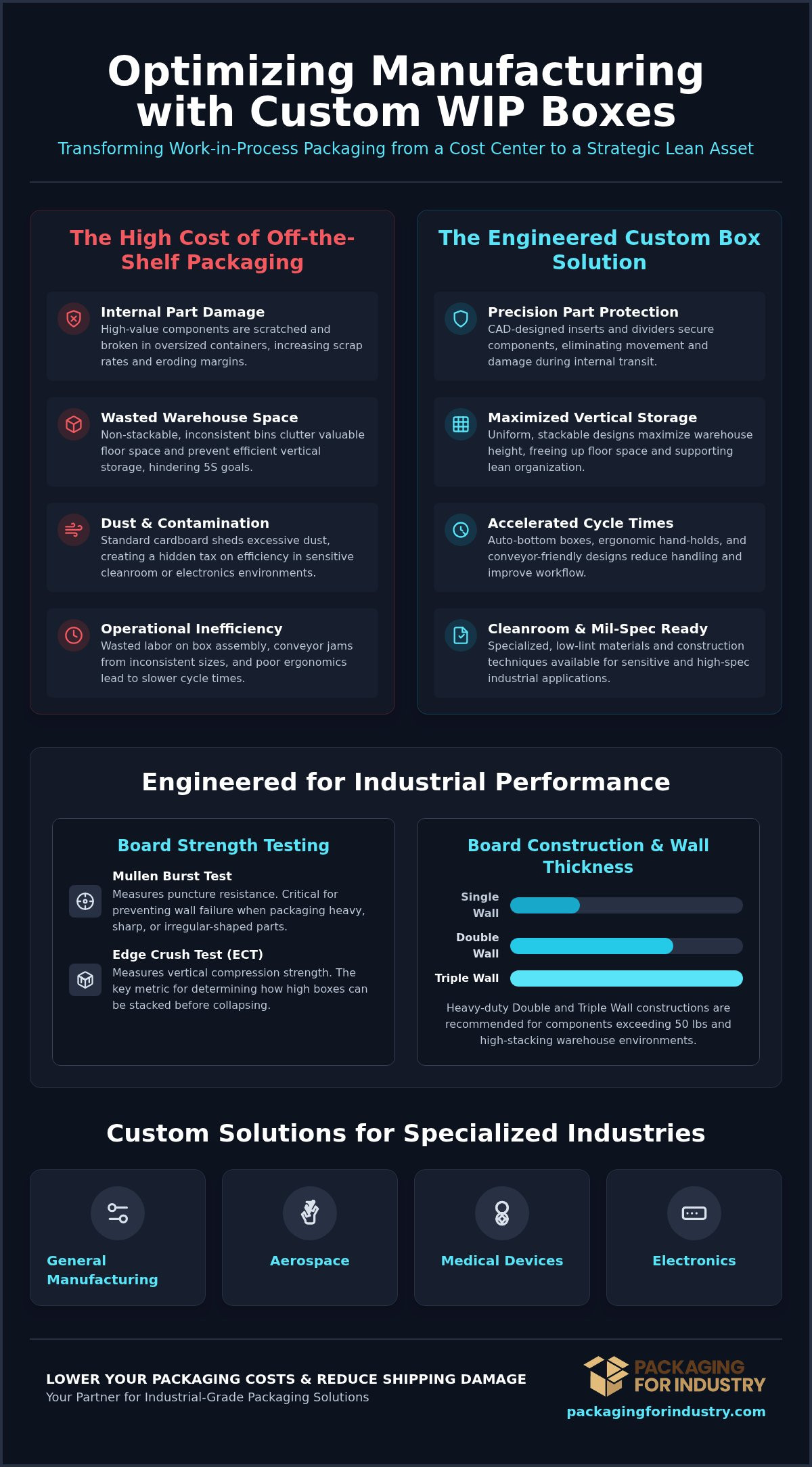
Internal damage often occurs because parts shift within oversized containers. Using custom corrugated boxes with integrated partitions or dividers allows for organized component kitting. This setup ensures that assembly technicians have exactly what they need in a logical sequence, reducing handling errors. Additionally, uniform box sizing improves vertical warehouse space utilization. When containers stack securely, you can maximize your overhead storage rather than letting WIP take up valuable floor space. For manufacturers in sensitive sectors like medical devices or electronics, we provide materials designed to minimize cardboard dust and debris, protecting your assembly environment from contamination.
The Impact of WIP Containers on Cycle Times
Cycle times improve when you eliminate non-value-added tasks. Many production teams waste minutes per hour simply assembling or taping generic boxes for internal moves. Custom design packaging can include auto-bottom features or specialized folds that deploy in seconds. If your facility uses automated conveyor systems, standardizing on custom corrugated boxes for manufacturing work-in-process prevents jams and sensor errors that often plague inconsistent, stock-sized packaging. Ergonomics also play a vital role. By adding custom hand-holds or optimizing box dimensions for manual handling, you reduce worker fatigue and the risk of injuries. Every design choice focuses on accelerating the movement of goods from raw material to finished product.
Technical Specifications for Industrial-Grade Manufacturing Boxes
The structural integrity of custom corrugated boxes for manufacturing work-in-process depends on matching the board grade to the specific load requirements of the production floor. Unlike standard retail packaging, industrial containers must withstand multiple handling cycles and high-pressure stacking. We evaluate board strength through two primary metrics: the Edge Crush Test (ECT) and the Mullen Burst Test. While ECT measures the vertical compression strength of the fluting, the Mullen test quantifies the force required to puncture the linerboard. For manufacturers moving heavy metal castings or sharp-edged components, a high Mullen rating is essential to prevent wall failure.
Corrugated fiberboard is engineered in various wall thicknesses to meet these demands. Single-wall board is often insufficient for WIP environments where pallets are stacked three or four high. We recommend heavy-duty double-wall or triple-wall constructions for parts exceeding 50 pounds. To further enhance vertical integrity without significantly increasing material weight, we often integrate corner boards into the palletization plan. These rigid supports allow for higher stacking heights in the warehouse, effectively doubling your vertical storage capacity while protecting the box corners from strap damage. Utilizing these technical reinforcements is a proven way to lower packaging costs by preventing pallet collapse.
Advanced Material Selection for High-Value Parts
For specialized applications, material selection goes beyond wall thickness. We provide moisture-resistant adhesives and liners for parts that must move through humid machining environments. In the aerospace sector, we ensure all materials comply with mil-spec packaging standards, providing the chemical and physical resistance required for government contracts. For electronics, we offer ESD-safe liners that prevent static discharge from reaching sensitive components. You can request a packaging quote to see how these advanced materials can improve your scrap rates. Our engineering team provides custom sizes available for any technical specification, ensuring a precise fit that eliminates internal movement.
Standard Styles vs. Custom Die-Cut Solutions
The design of the container is just as important as the material. RSC boxes (Regular Slotted Containers) are the most cost-effective solution for uniform parts, but they may lack the stacking strength of Full Overlap (FOL) designs, where the flaps completely cover the top and bottom. For complex assembly workflows, custom die-cut solutions allow for sophisticated kitting. These designs use internal partitions to separate components, ensuring that every part needed for a specific assembly step is organized and accessible. EPA data on corrugated containers highlights that these materials are widely recyclable, making them a sustainable choice for high-volume manufacturing. By choosing the right style and material, you can compare packaging pricing effectively and secure a solution that balances durability with fiscal responsibility.
Calculating ROI: Analyzing the Cost of Custom vs. Stock Boxes
Manufacturers often prioritize unit price when evaluating packaging. However, this perspective overlooks the total cost of ownership (TCO) associated with stock containers. When you implement custom corrugated boxes for manufacturing work-in-process, you address the systemic costs that generic boxes ignore. A stock box might save pennies at purchase, but it creates dollars of waste through labor and transit inefficiency.
Logistical surcharges are a major drain on profitability. With the 2026 general rate increase of 5.9% and a domestic DIM divisor of 139, shipping empty space is a costly mistake. Our engineering team ensures your containers are right-sized, with custom sizes available to match every component in your assembly line. This precision helps you avoid cubic volume surcharges and additional handling fees that can account for up to 40% of total parcel costs.
Hidden Expenses in Standard Packaging
Standard boxes require extra tape and void fill to prevent parts from shifting during internal transit. These materials aren’t just an added expense; they represent wasted labor hours on the production line. Additionally, oversized containers consume more warehouse floor space than necessary. You’re essentially paying rent for air instead of maximizing your square footage for active production.
The Financial Benefits of Custom Engineering
Our CAD-supported design process minimizes material waste while providing superior structural protection. This engineering-minded approach lowers the frequency of insurance claims and the internal cost of rework. You can lower your packaging costs by requesting a professional review of your current WIP flow. By optimizing the box to the product, you secure a predictable ROI through improved cycle times and reduced scrap rates.
Engineering Custom Solutions for Specialized Industries
Generic packaging fails when applied to specialized manufacturing environments. A standard box cannot meet the cleanliness requirements of a medical cleanroom or the static-control needs of a PCBA assembly line. Utilizing custom corrugated boxes for manufacturing work-in-process allows you to tailor material properties to your specific industrial constraints. Precision is mandatory. When dealing with mission-critical parts, the container must be as well-engineered as the component it holds.
In the Aerospace and Defense sectors, we focus on meeting stringent mil-spec packaging requirements. These high-value components often feature irregular geometries and require extreme structural integrity for internal transit. For medical device manufacturers, we provide cleanroom-compatible designs that minimize particulate shedding. Electronics manufacturers rely on our ESD-safe corrugated solutions to protect sensitive circuits from electrostatic discharge. Meanwhile, Automotive Tier 1 suppliers require heavy-duty, high-ECT containers capable of supporting the immense weight of engine and transmission sub-assemblies.
Aerospace-Specific Packaging Challenges
Aerospace components are frequently oversized, fragile, and prohibitively expensive to replace. Designing containers for flight hardware requires a deep understanding of weight distribution and surface protection. We emphasize the importance of free prototyping to ensure an exact fit before you commit to a full production run. This process ensures compliance with aerospace packaging standards, providing peace of mind that your WIP is secure as it moves through various stages of testing and integration. Custom hand-holds and reinforced corners are common additions that improve both safety and ergonomics during manual handling.
The Prototyping and Testing Process
Our engineering team utilizes CAD/CAM support for rapid sample generation, allowing you to test a physical prototype within days. This speed is essential for maintaining lean manufacturing timelines. We subject these prototypes to rigorous performance testing, including stack strength evaluations and vibration resistance checks. By reviewing these designs for damage reduction before the full rollout, we help you avoid the high costs of mid-production packaging failures. This methodical approach ensures that your custom corrugated boxes for manufacturing work-in-process function as a reliable link in your supply chain.
Request a custom packaging quote for your specific industry
Optimizing Your Supply Chain with PFI’s Southern California VMI Programs
Reliable logistics are the final piece of the lean manufacturing puzzle. Even the most advanced custom corrugated boxes for manufacturing work-in-process lose their value if they aren’t available when your production line needs them. We provide local next-day delivery across Orange County, Los Angeles, San Diego, and the Inland Empire to ensure your operations never slow down due to a lack of supplies. By partnering with a local supplier, you bypass the transit delays and high freight costs often associated with distant catalog vendors. We maintain our own fleet to guarantee that your critical WIP containers arrive exactly when scheduled.
Our Vendor Managed Inventory (VMI) program is designed specifically to eliminate stockouts. We take over the responsibility of monitoring your packaging levels, performing regular counts, and replenishing stock automatically. This approach transitions your packaging management from a reactive chore to a proactive, automated system. When combined with Just-In-Time (JIT) delivery, you can free up valuable warehouse floor space that was previously occupied by bulky, slow-moving inventory. Instead of storing months of boxes, you only keep what you need for the immediate production cycle, with custom sizes available for every unique component in your catalog.
Anaheim-Based Support for Local Manufacturers
Our facility in Southern California provides more than just storage; it offers direct access to our engineering and sales teams. We conduct scheduled inventory reviews to ensure your packaging orders match your actual production cycles, adjusting for seasonal peaks or new product launches. Beyond boxes, we manage your total packaging bill of materials, including stretch film, pallets, and corner boards, to provide a single-source solution. While we specialize in serving the local industrial hub, we also maintain nationwide shipping capabilities for multi-location operations. This local-first approach allows us to act as a practical, industrial-focused alternative to large catalog suppliers, providing the personalized service required for complex manufacturing workflows.
Request Your Custom Packaging Quote
Starting a packaging cost-reduction analysis is straightforward. We begin by reviewing your current WIP containers to identify opportunities for material optimization and damage reduction. Whether you need support in Anaheim or are looking for a reliable partner across the West Coast, our team is ready to engineer a solution that fits your floor. You can request a packaging quote today to compare packaging pricing and see how custom-engineered custom corrugated boxes for manufacturing work-in-process can lower your total operational costs.
Streamline Your Production Floor with Engineered Packaging
Optimizing your shop floor requires more than just efficient machinery. It demands a logistical system that protects your components without adding unnecessary bulk or labor. By transitioning to custom corrugated boxes for manufacturing work-in-process, you eliminate the hidden expenses of oversized stock boxes, such as carrier dimensional weight surcharges and excessive internal damage. These engineered solutions don’t just hold parts; they act as precision tools that support your lean manufacturing goals.
We provide the technical expertise and local support needed to stabilize your supply chain. Our team specializes in high-stakes sectors like aerospace and medical device manufacturing, offering free industrial packaging prototyping to ensure every design meets your exact specifications. With local next-day delivery across Southern California and proactive VMI programs, you can focus on production while we handle the inventory management.
Take the first step toward reducing your operational waste and improving part protection. Our specialists are ready to help you build a more resilient and cost-effective workflow.
Frequently Asked Questions
What is the difference between single-wall and double-wall corrugated for manufacturing?
Single-wall corrugated consists of one layer of fluting between two liners, while double-wall adds a second layer. For your factory floor, it’s the standard choice for custom corrugated boxes for manufacturing work-in-process because it offers significantly higher ECT ratings. This extra layer provides the puncture resistance needed for sharp components and the vertical stacking strength required for high-density warehouse storage.
Can custom corrugated boxes be designed to be ESD-safe for electronics?
Yes, we design custom corrugated boxes with specialized anti-static or ESD-safe coatings specifically for electronics manufacturing. These containers neutralize static buildup that can damage sensitive PCBAs during internal transit between assembly stages. By combining these treated corrugated materials with ESD-safe foam inserts, you create a comprehensive protection system that meets the technical standards required for high-value electronic components.
How does a Vendor Managed Inventory (VMI) program work for custom boxes?
Our Vendor Managed Inventory (VMI) program transfers the responsibility of stock monitoring from your team to ours. We perform regular inventory counts at your Southern California facility and automatically replenish your supply of custom corrugated boxes for manufacturing work-in-process before you run out. This process eliminates production delays caused by packaging stockouts and frees up your purchasing team to focus on higher-value operations.
Do you offer free prototyping for custom industrial box designs?
We offer free industrial prototyping using our in-house CAD/CAM equipment to ensure your design is perfect before full production. This allows your engineering team to verify the fit and function of a physical sample with your actual components. Prototyping is a critical step for reducing damage rates, as it lets us test stack strength and internal partitions in a real-world manufacturing environment.
What industries in Southern California do you specialize in serving?
We specialize in serving high-demand sectors across Orange County, Los Angeles, and the Inland Empire. Our primary clients include aerospace and defense firms, medical device manufacturers, electronics assembly plants, and Automotive Tier 1 suppliers. We understand the specific regulatory and logistical requirements of these industries, such as mil-spec compliance and cleanroom-compatible material standards, ensuring your packaging meets every technical hurdle.
How can custom box sizing help reduce our UPS and FedEx shipping surcharges?
Carriers like UPS and FedEx use dimensional (DIM) weight to calculate rates, meaning oversized boxes trigger expensive surcharges. Custom sizing eliminates the “air” in your packaging, ensuring you only pay for the actual volume your product requires. By right-sizing your containers, you can avoid the 25% to 40% surcharge burden that many businesses face when using standard, off-the-shelf stock boxes.
What is the lead time for custom die-cut corrugated boxes in Southern California?
For local manufacturers in Southern California, we leverage our Anaheim facility to provide some of the fastest lead times in the industry. While standard custom orders follow a predictable schedule, our VMI programs allow for next-day delivery of your established designs. This localized support ensures your line doesn’t stop moving due to the long transit delays often associated with out-of-state catalog suppliers.
Can custom corrugated boxes be integrated with protective foam inserts?
Integrating protective foam inserts with custom corrugated boxes is the most effective way to secure precision parts. We offer a variety of foam materials, including polyethylene and ESD-safe options, that are die-cut to match your component’s exact geometry. This total protection solution eliminates the need for messy void fill and ensures that high-value parts remain stationary and scratch-free during internal transit.