
What does a damaged shipment really cost your business? The replacement invoice is only the visible part. Calculating the hidden costs of product damage also means accounting for return handling, replacement freight, staff time, claims administration, wasted packaging, and disruptions to customer operations.
Damage expenses often sit across warehouse, finance, customer service, and shipping records, making the full impact hard to see. This guide shows how to bring those costs together, use your own operational data, and compare packaging options based on more than product value alone.
You’ll learn which cost categories to track, how to build a consistent per-incident or per-shipment view, and how to assess packaging changes against the costs they may address. Packaging For Industry’s custom packaging design services and damage-focused reviews help manufacturers evaluate corrugated boxes, protective foam, crates, cushioning, and load stability as part of one total-cost review. The goal is a clearer business case and practical next steps for reducing damage exposure, not an assumption that one packaging change guarantees a specific result.
Key Takeaways
- Separate replacement value from the full cost of resolving a damage incident, including attributable operational impacts.
- Use a consistent review period and remove duplicate entries when calculating the hidden costs of product damage.
- Compare current packaging with proposed changes based on damage patterns, product fragility, shipping methods, and handling conditions.
- Group incidents by product, packaging configuration, route, carrier, and damage type to identify recurring exposure.
- Evaluate boxes, foam, cushioning, crates, and load stabilization together to identify packaging changes worth reviewing.
What Are the Hidden Costs of Product Damage in Industrial Shipping?
A damaged product creates more than a write-off. The full cost includes resources used to inspect, recover, replace, and deliver the goods, along with operational effects that can be tied to the incident. For industrial businesses in Orange County, Los Angeles, San Diego, Riverside, and beyond, those expenses may be recorded across warehouse, finance, procurement, and customer service systems.
Direct damage costs are expenses tied to the damaged goods and their physical recovery or replacement; indirect damage costs are attributable labor, operational disruption, and customer consequences beyond those immediate expenses. This distinction gives teams a consistent basis for calculating the hidden costs of product damage without treating every consequence as a confirmed financial loss.
Start by identifying which teams hold the relevant records:
- Procurement: Replacement materials, packaging, and expedited purchasing tied to recovery.
- Operations: Inspection, rework, disposal, production disruption, and temporary workarounds.
- Finance and shipping: Product valuation, freight, return handling, reshipment, and claim activity.
- Customer service: Investigation, communication, and documented customer follow-up.
Which direct costs belong in a damage calculation?
Capture the cost of damaged goods, inspection, rework, replacement packaging, and disposal where applicable. Separate the cost to produce a replacement from its sales or internal transfer value: they answer different questions. One reflects the resources used to make the item; the other reflects its recorded commercial or accounting value.
Also record return freight, handling, replacement shipment, and claim-related expenses. Check how each charge appears in your systems before adding it. If a freight invoice already includes a return movement, for example, don’t enter that movement again under a separate recovery category.
Which indirect costs are easy to miss?
Staff time can add up across investigation, damage documentation, claim preparation, customer updates, and resolution. Track time where practical, and connect it to the incident rather than estimating across unrelated work. Record production delays or workarounds only when available records support a clear link to the damage.
Damage can also strain customer confidence, affect repeat business, or disrupt a customer’s operations. Treat those effects as important context, but don’t assign them a dollar value without evidence. Goods can be damaged at several points as they move through a facility and toward a vehicle. The broader Material handling process can help teams consider where handling and load movement may be relevant. A packaging review can then assess the product, packaging configuration, and shipping method together.
How to Calculate the Hidden Costs of Product Damage Step by Step
A reliable estimate comes from your own incident records, not a generic industry average. Keep the method consistent so finance, operations, and procurement can compare results across the same time period and cost categories.
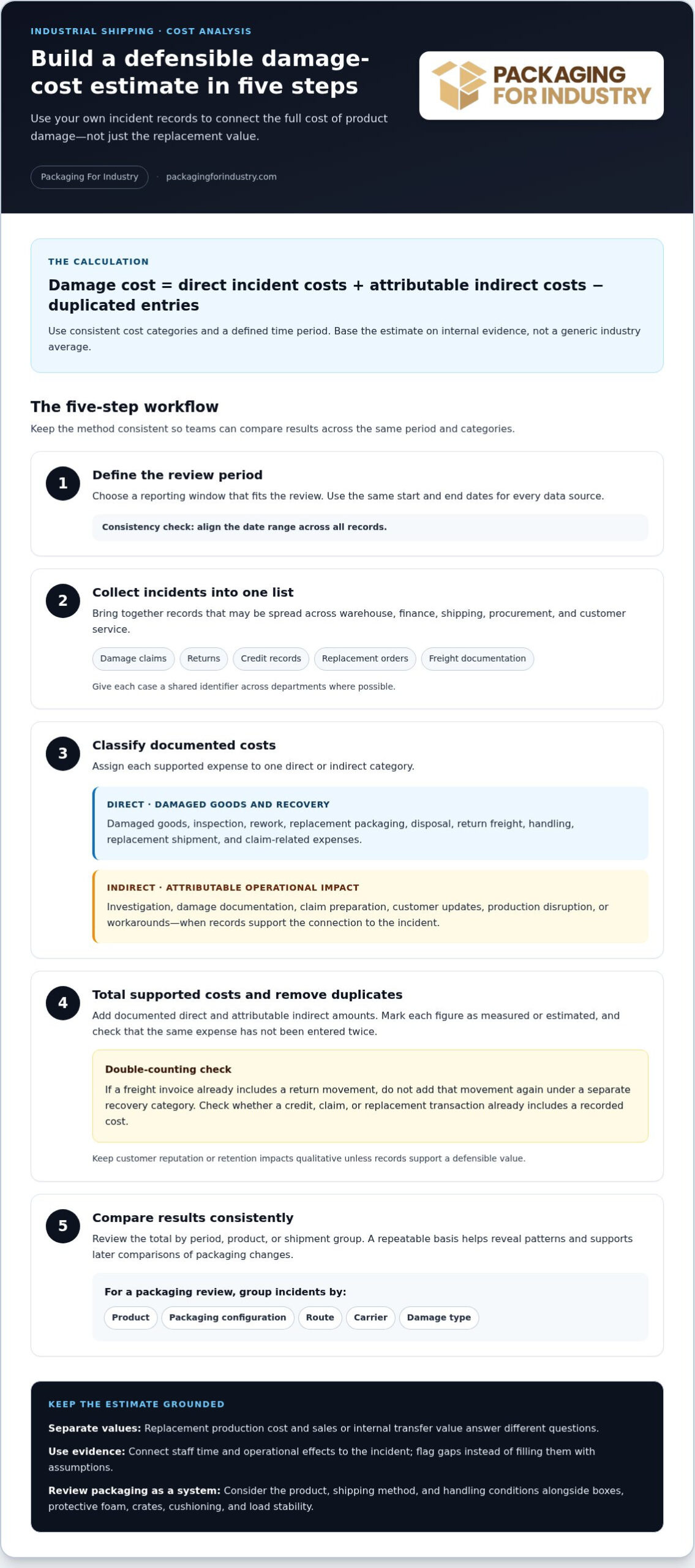
Damage cost equals direct incident costs plus attributable indirect costs, less duplicated entries, using consistent categories and a defined time period. This approach captures operational ripple effects like those described in SupplyChainBrain’s discussion of the total cost of supply chain damage, while keeping the calculation tied to evidence from your own business.
- 1. Define the period. Choose a reporting window that fits your review, then use the same start and end dates for every data source.
- 2. Collect incidents. Build one incident list from damage claims, returns, credit records, replacement orders, and freight documentation. Give each case a shared identifier where possible.
- 3. Classify costs. Assign each documented expense to one direct or indirect category. Include attributable investigation time, handling, production disruption, or workarounds only when records support the connection.
- 4. Total the costs. Add supported direct and indirect amounts, then remove duplicates. Keep estimates distinct from measured amounts.
- 5. Compare consistently. Review the result by period, product, or shipment group. A consistent basis makes it easier to assess patterns and compare packaging changes later.
Which records help build a defensible estimate?
Pull claims, returns, credits, replacement orders, and freight records into one view. Ask operations and customer service teams to log investigation, documentation, communication, and handling time consistently. Production schedules and order records can help show whether an incident delayed an order or interrupted a workflow. Use the best available internal evidence, and flag gaps instead of filling them with assumptions.
How can teams avoid double counting?
Give each incident a shared reference across departments and assign every expense to one category. Check whether a credit, claim, or replacement transaction already includes a recorded cost before adding it separately. Label each figure as measured or estimated, and keep customer reputation or retention impacts qualitative unless your records support a defensible value.
Once the calculation is repeatable, it can support a practical packaging review rather than a one-time accounting exercise. PFI’s custom design reviews connect recurring damage records to packaging configurations. To assess a packaging change, request a packaging quote based on your product and shipping needs.
How to Compare Damage Exposure With Packaging Improvement Options
A packaging change should address a known damage pattern and be measured against a clear baseline. Start with the product’s fragility, shipment method, and handling conditions. Then assess the complete package: box fit, cushioning, load stability, and the level of protection required. A stronger box alone may not resolve damage if the product shifts inside it or the unit load moves during handling.
Use a simple comparison record to keep the review practical. Track the same information for the current setup and each proposed option:
Current packaging: Materials and configuration in use, along with observed damage types and incident frequency in the selected baseline period.
Proposed change: The box, foam, cushioning, crate, or load-stabilization adjustment being evaluated.
Damage measures: Incidents and damage costs recorded using the same definitions and period for both configurations.
Operational trade-offs: Packaging use, packing time, storage needs, freight handling, and any workflow changes to monitor.
This makes calculating the hidden costs of product damage more useful for packaging decisions. Teams can assess exposure alongside operational effects without assuming the change will produce savings. Set the baseline before a trial, and decide which measures will determine whether the option merits further evaluation.
When should a team assess boxes, foam, or crates?
Review custom corrugated boxes when product fit, dimensions, or stacking conditions appear in damage records. Consider custom foam inserts or other cushioning when products shift or need controlled support inside the package. For heavy or high-value industrial components moving through demanding shipping conditions, assess whether a crate is appropriate. These elements work together, so evaluate the package and load as a system.
How can packaging changes be evaluated fairly?
Compare equivalent products, routes, handling conditions, and time periods where possible. Record packaging configuration, damage incidents, freight handling, and order volume so a change in shipment mix doesn’t distort the comparison. If conditions differ, document the difference and interpret results cautiously. Continue tracking after the review period to see whether the observed pattern holds.
PFI’s custom packaging design services connect packaging reviews to product and shipping requirements. The review can consider custom corrugated boxes, protective foam packaging, cushioning, crates, and load stability together. Prototypes and samples support assessment of custom packaging fit. The aim is an evidence-based comparison, not a promise of a specific damage reduction or financial result.
How to Turn Damage Records Into an Actionable Packaging Review
A damage log becomes useful when it shows patterns teams can act on. Group incidents by product, packaging configuration, route, carrier, and damage type where records allow. A cluster of similar reports may point to a packaging or handling issue worth investigating. One unusually costly incident deserves attention, but it shouldn’t outweigh a recurring pattern without supporting evidence.
What should a useful damage log capture?
Use consistent fields so teams can sort incidents and compare periods. For each case, record:
- Incident date, product, shipment details, route, and carrier.
- Packaging configuration, including box, cushioning, foam, crate, or load-stabilization elements where known.
- Damage type, resolution, and whether the product was returned, reworked, replaced, or disposed of.
- Direct costs and staff time, using the same categories and reporting periods across incidents.
Mark missing information rather than filling gaps with assumptions. Separate verified figures from estimates, and note the source of each entry. A consistent log makes calculating the hidden costs of product damage more reliable and helps teams distinguish a genuine trend from incomplete reporting.
How can teams prioritize the right corrective action?
Start with recurring patterns and operational severity. Look for connections between damage and product protection, box fit, cushioning, or load stability. Then bring procurement, warehouse, operations, and customer service teams together to assess whether the pattern reflects the package, the shipping process, or both. Their combined view helps prevent a packaging change from solving one problem while creating a workflow issue elsewhere.
Assign an owner to the review, document the proposed change and its purpose, and set a review date using your internal procedures. Track the same damage and operational measures before and after the change. Compare like with like where possible, and record differences in product mix, route, or handling that could affect results. This keeps the review evidence-based without assuming a packaging adjustment will guarantee a particular outcome.
PFI’s custom packaging design services include packaging reviews focused on damage reduction and solutions tailored to products and shipping methods. Recurring incident patterns can guide an evaluation of corrugated boxes, protective foam, cushioning, crates, and load stabilization as an integrated system.
How PFI Connects Damage-Cost Analysis to Industrial Packaging Solutions
Damage records provide a practical starting point for reviewing packaging, but the right response depends on the product and how it moves through the supply chain. PFI reviews packaging needs in relation to product characteristics, shipping methods, handling conditions, and recurring supply requirements. This connects the findings from calculating the hidden costs of product damage to packaging decisions that can be assessed against a company’s own operational baseline.
Protection often depends on how components work together. A corrugated box provides the outer structure, while foam or other cushioning can support the product inside. Crates may suit certain industrial components, and load stabilization can help keep packaged goods secure during movement. A review considers the complete configuration rather than treating each material as an isolated fix.
What can an industrial packaging review address?
PFI’s packaging reviews focus on damage reduction and design tailored to specific products and shipping methods. If incident patterns point to poor fit, product movement, or inadequate support, the review can inform a custom packaging design. Prototypes and samples let teams assess fit before a broader rollout. This provides a practical way to examine the proposed configuration while keeping decisions tied to observed performance and operational requirements.
PFI offers custom packaging design services alongside custom and stock corrugated boxes, protective foam, cushioning materials, pallets, and crates. These options support packaging reviews for aerospace, electronics, medical device, manufacturing, and distribution operations. Evaluate any packaging change as part of a wider cost review, rather than treating it as a guaranteed reduction in damage or expense.
How can an integrated supplier support ongoing operations?
Once a packaging configuration is selected, supply planning matters too. Manufacturers, warehouses, and distribution operations may need consistent packaging for repeat orders, production schedules, or shipping programs. PFI supplies custom and stock packaging and supports ongoing requirements through vendor managed inventory and just-in-time packaging management. These services help align packaging selection with purchasing and replenishment needs.
PFI provides local next-day delivery across Southern California and fast nationwide shipping. For operations in Orange County, Los Angeles, San Diego, and Riverside, local packaging supply can support day-to-day warehouse and production needs. Nationwide shipping can serve facilities beyond the region. Review damage records alongside current packaging configurations and recurring requirements to create a focused starting point.
Turn Damage Data Into a Practical Packaging Plan
Calculating the hidden costs of product damage gives your team a clearer basis for action when the calculation draws on consistent internal records and includes attributable operational costs. Use recurring incident patterns to guide packaging reviews, then compare proposed changes against a defined baseline and relevant handling conditions.
PFI’s packaging reviews focus on damage reduction and consider the product and shipping method together. Custom boxes, protective foam, crates, and cushioning can be evaluated as an integrated solution, with prototype and sample support to assess custom packaging before broader rollout. The goal is a practical decision grounded in your operation, not a guaranteed outcome.
Bring your damage records and packaging requirements into the next review. A tailored packaging plan can help your team assess opportunities to improve protection, manage supply needs, and support more reliable shipments.
With clear data and a focused review, your next packaging decision can be more informed and easier to evaluate.
Frequently Asked Questions
How do you calculate the total cost of product damage?
Calculate total damage cost by adding direct incident expenses to attributable indirect costs, then removing duplicate entries. Direct costs may include damaged goods, inspection, rework, replacement packaging, freight, and disposal. Indirect costs can include documented staff time or production disruption. Use internal records for a defined reporting period, and distinguish replacement production cost from sales or transfer value. This makes calculating the hidden costs of product damage consistent and reviewable.
What hidden costs should businesses include when products are damaged in transit?
Look beyond the product’s recorded value. Include return handling, replacement shipment, inspection, repacking, rework, disposal, and claim administration when those costs apply and can be tied to the incident. Staff time spent investigating and communicating may also be relevant. Delays, workarounds, and customer impacts matter operationally, but treat them as qualitative unless company records support a defensible financial estimate.
How can a business estimate labor costs associated with damage claims?
Have staff record time spent investigating, documenting, preparing claims, coordinating returns, and communicating with customers. Multiply documented hours by the appropriate internal labor rate used by your finance team. Apply the same method across departments and incidents. If time wasn’t logged, label any estimate clearly and keep it separate from measured costs. This helps avoid presenting an assumption as a verified expense.
Can better packaging reduce product damage and shipping costs?
Packaging changes may address damage patterns, but results depend on the product, package design, shipping method, and handling conditions. Review box fit, cushioning, and load stability together, then compare performance with a consistent baseline. Packaging design may also affect shipment dimensions or handling, so track freight and packaging use alongside damage incidents. Don’t assume a change will reduce damage or shipping costs without evidence from your own operation.
How do you compare packaging costs with the cost of damaged goods?
Compare the current packaging configuration with a proposed option over equivalent products, routes, handling conditions, and time periods where possible. Track packaging use, damage incidents, and attributable operational costs for each. Include relevant trade-offs, such as packing workflow or storage needs. Use your own records to evaluate the difference. A comparison can inform a decision, but it can’t guarantee a particular reduction in damage or total expense.
What records help identify the cause of recurring shipping damage?
Maintain incident records with the date, product, shipment details, route, carrier, packaging configuration, damage type, and resolution. Add claims, returns, credits, replacement orders, and freight documentation where available. Production schedules and order records can help identify delays, while warehouse notes may add context about packing or load handling. Group incidents by shared factors and mark missing information so patterns aren’t based on unsupported assumptions.
How can custom foam or corrugated packaging help protect industrial products?
Custom corrugated packaging can be designed around product dimensions and shipping requirements, while foam inserts or cushioning can support the product and limit movement inside the package. The appropriate combination depends on the item and its handling conditions. For industrial components, boxes, foam, crates, and load stabilization can be considered together. Prototype or sample support can help assess fit before a packaging design is used more broadly.
When should a manufacturer request a packaging review?
Request a review when damage recurs, packaging no longer fits the product or shipping method, or a change in product, route, or handling creates new protection needs. Bring incident records and current packaging details so the review can focus on observed issues. Packaging For Industry provides damage-reduction reviews and custom design support for manufacturers in Orange County, Los Angeles, San Diego, and Riverside, with solutions tailored to the product and shipping method.