
For high-mix operations, the right packaging supplier must handle changing product requirements without forcing you to choose between oversized orders and a shelf full of one-size-fits-all boxes. Different products and shipping methods call for different packaging, while small, shifting order volumes make purchasing and inventory harder to manage. A packaging supplier for high-mix, low-volume manufacturing needs to address both package design and replenishment.
This guide offers a practical framework for comparing suppliers. You’ll learn how to assess custom design capabilities, material options, order flexibility, and inventory support, then connect those factors to production and shipping needs. We’ll also cover how custom and stock corrugated boxes, protective foam, stretch film, crates, and other packaging can work together as an integrated solution. PFI supports varied requirements and recurring orders with custom design services, prototypes, packaging kitting, and managed replenishment programs. Use the framework to identify a supplier that can reduce purchasing friction, limit excess stock, and keep packaging available as your needs change.
Key Takeaways
- Group packaging items by product family, usage frequency, customization needs, and production importance to make a varied SKU list easier to manage.
- Evaluate a packaging supplier for high-mix, low-volume manufacturing on customization, material range, recurring supply, and communication.
- Use design reviews, prototypes, and trials to assess packaging fit before standardizing specifications across product families.
- Connect packaging requirements with replenishment planning to help limit stockouts and unnecessary inventory as order patterns change.
- PFI coordinates custom and stock packaging, design support, kitting, and inventory programs for manufacturing supply needs.
Why high-mix, low-volume manufacturing needs a different packaging supplier
High-mix, low-volume (HMLV) manufacturing produces a wide variety of products in comparatively small runs, with quantities or specifications that may change between orders. Packaging has to keep pace. A standard carton may be too large for one item, unsuitable for another, or inefficient for a shipment with different handling requirements. Buying every packaging item in bulk can create a similar mismatch when quantities exceed actual use, especially for packaging tied to a short-run product.
High-mix describes the variety of products; low-volume describes the comparatively small or changing quantities made in each run. A packaging supplier for high-mix, low-volume manufacturing needs to account for both, connecting product fit with the purchasing and replenishment requirements behind each SKU.
Where packaging complexity appears across a product mix
Packaging requirements vary with product dimensions, weight, fragility, and shipping method. An industrial equipment component may need a carton and cushioning that hold it securely, while an electronics assembly may require a package designed around sensitive parts. Medical devices can have distinct shapes and handling needs across product families. Aerospace supply may include large or irregular components that need a different approach from smaller repeat items.
Shipping routes matter, too. A package moving through parcel networks faces different handling conditions from a unit secured for freight. Product changes can affect the required fit, while a new destination or shipping method may change how items should be grouped and protected. Start by separating packaging into two groups: recurring items used in regular production, and one-off or changing requirements linked to specific orders. This helps purchasing plan repeat supply without treating every new specification as a permanent stock item.
For manufacturers in Orange County and Los Angeles, PFI provides manufacturing packaging solutions that connect packaging needs with production operations. PFI also serves businesses in San Diego and Riverside.
The operational cost of treating every order the same
A standard carton may leave excess space around a product or fail to accommodate its shape. Poor fit can contribute to movement and damage in transit, leading to rework, replacement activity, or shipment delays. The opposite problem creates friction, too: a custom package specified for one run may be substituted when it is unavailable, forcing staff to adjust packing methods or source materials through an unplanned purchase.
Bulk buying can reduce purchase-order frequency, but it can also leave slow-moving or obsolete packaging taking up warehouse space. That inventory ties up working capital and may be difficult to use if product dimensions or specifications change. Smaller, less predictable orders can also increase purchasing workload when teams repeatedly source packaging for individual SKUs.
Assess the trade-offs SKU by SKU: packaging fit, damage and rework history, ordering frequency, storage footprint, and replenishment effort. These factors help identify where custom packaging, stock options, or planned repeat supply could improve operations without assuming one approach suits every product.
What a packaging supplier should provide beyond stock boxes
Stock cartons are useful for repeatable needs, but a varied production schedule may call for several packaging formats and materials. A capable supplier should coordinate custom and stock options so purchasing does not have to manage a separate source for every part of a shipment. Look for support that connects packaging design with practical requirements such as assembly, storage, replenishment, and shipping.
This broader view also matters for supply continuity. Recurring packaging items can follow a planned replenishment approach, while custom components for changing or less frequent orders need clear specifications and purchasing coordination. The National Institute of Standards and Technology’s guidance on effective supply chain management in manufacturing emphasizes supply chain risk assessment and supplier development, both relevant when evaluating packaging supply.
Product range and integrated packaging options
Assess whether a supplier can coordinate the components used to prepare a shipment, rather than quoting only a box. A complete packaging set may combine a corrugated carton, a fitted foam insert, cushioning materials, and stretch film to stabilize the shipment. Pallets or crates may suit other loads. Coordinating materials can simplify purchasing and help align the package with handling and transport requirements.
Compare stock formats with custom sizes for recurring products, and consider whether one supplier can support both. PFI provides custom corrugated box options alongside foam packaging, stretch film, pallets, crates, and cushioning materials. Compare the proposed combination with how products are packed, moved, and shipped, not just the unit price of an individual item.
Design, prototyping, and production support
Product-specific packaging benefits from an engineering review before specifications become routine. CAD/CAM support can help develop a design around the product and packaging process. Prototypes and samples let operations staff assess fit, loading, handling, and assembly before a broader rollout. A trial can surface adjustments early, when changes are easier to evaluate than after a packaging format enters regular purchasing.
PFI’s custom packaging design support includes design services, prototypes, and samples. Involve the people who pack and ship the product in the review. Their feedback can identify practical details, such as how components are positioned, whether the package is straightforward to assemble, and how materials fit into the work area.
For custom items with longer planning cycles, define approved specifications, expected usage, and a replenishment approach with the supplier. PFI’s vendor-managed inventory programs use scheduled reviews and planned replenishment to support repeat supply as demand changes.
Supplier checklist: Evaluate material breadth, custom design and sample support, coordination of complete shipments, repeat-order planning, and communication about changing requirements. To compare options for a packaging project, request a packaging quote based on your products, packaging components, and replenishment needs.
How to compare suppliers for varied packaging requirements
A useful comparison looks beyond the unit quote. For each supplier, record what they can demonstrate and what depends on reviewing a specific product, packaging design, or replenishment plan. This separates established capabilities from assumptions and makes proposals easier to compare across standard items and lower-volume custom requirements.
Use a simple scorecard. Capture the same information for each supplier, then note where a sample, specification review, or usage assessment is needed before making a decision.
- Customization: Record whether the supplier supports custom sizing, design review, prototypes, and samples. Mark any product-specific fit or protection outcome for assessment through a trial.
- Material breadth: Compare access to corrugated packaging, foam, cushioning, stretch film, pallets, and crates, including the ability to coordinate items used together.
- Recurring supply: Document how repeat orders, changing usage, and planned replenishment are managed alongside stock items and custom packaging.
- Communication: Assess how clearly specifications, order changes, supply needs, and next steps are handled across purchasing and operations.
Evaluate packaging fit and protection requirements
Compare proposals against the actual packaging job: product dimensions, fragility, handling steps, and shipping method. A component that needs a fitted nest may call for a different solution from a robust part packed in a carton. Depending on the item and shipment, the design may include corrugated partitions, pads, cushioning, or a crate. Review protective foam packaging for products that need cushioning shaped around their form.
PFI combines packaging materials into integrated solutions, but each proposed design should be assessed against the specific product and packing process. Treat a sample or prototype as a way to evaluate fit, not as proof that the same design will suit every SKU. Record the approved configuration and any changes made during the trial.
Evaluate replenishment and supplier coordination
A low unit quote can leave out costs and workload elsewhere. Consider whether the proposed packaging affects storage space, product damage, freight, purchase-order frequency, or time spent sourcing substitutions. Compare packaging pricing against these operating factors, and weigh bulk purchasing against the cost of holding slow-moving custom items.
Replenishment planning should reflect usage patterns, lead times, storage constraints, and production schedules. PFI’s vendor-managed inventory program uses scheduled inventory reviews and planned replenishment based on actual usage. This can help align recurring supplies with demand rather than relying only on fixed bulk orders. Include vendor-managed packaging inventory in the comparison.
For a practical decision, label each scorecard entry “demonstrated,” “needs project review,” or “not addressed.” This gives purchasing a clear basis for comparing standard items and custom requirements. A packaging quote tailored to your requirements can help establish a comparable starting point for costs and supply planning.
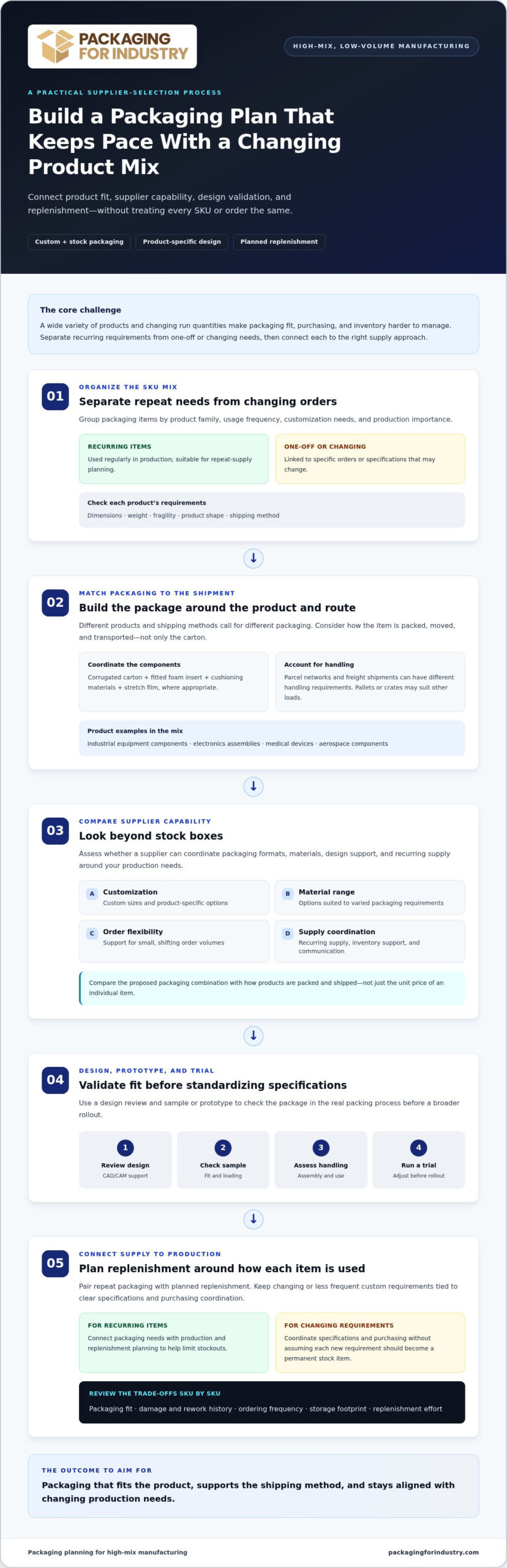
A practical process for organizing packaging across many SKUs
A packaging list becomes useful when it connects each item to a product, a usage pattern, and a supply decision. This gives purchasing and operations a shared reference for deciding what to standardize, what to keep on hand, and what needs a project-specific design. A packaging supplier for high-mix, low-volume manufacturing can help connect these specifications with a workable replenishment plan.
PFI supports packaging for manufacturers with custom and stock options, design services, and inventory programs. Use this workflow to organize requirements before requesting pricing or setting replenishment expectations.
- Build a packaging-item inventory. List each packaging item by type, dimensions, material, and the product or product family it serves. Note whether it is stock or custom, how often it is used, and which production activity depends on it. Include related components that are packed or shipped together, so the inventory reflects the full packaging set rather than isolated items.
- Record usage and operational issues. For each item, capture current usage, available warehouse space, production schedules, and shipment timing. Add relevant history, such as product damage concerns, substitutions, emergency orders, or ordering delays. These details help distinguish a stable requirement from an item that needs closer review because demand or specifications change.
- Group requirements for planning. Sort items by product family, usage frequency, custom status, and production importance. Mark frequently used, stable items separately from low-use packaging and custom-engineered requirements. This makes it easier to consider stock options for predictable needs while reserving design and purchasing attention for items tied to changing products or critical production work.
- Specify and trial custom requirements. Document the product match and packing process for each custom item, then review the proposed specification with the people who handle packing and shipping. Use a prototype or sample to assess fit and workflow before adopting the design more broadly. Record the approved version and adjustments so future orders follow the agreed specification.
- Set replenishment and review practices. Establish stocking levels and review frequency around actual usage, available storage, lead times, and agreed supply requirements. For recurring operations, packaging kitting can bring needed components together, while just-in-time inventory management can align planned supply with production needs. Revisit assumptions when products, schedules, or shipment patterns change.
Keep the resulting record accessible to purchasing, production, and warehouse teams. A clear baseline can reduce duplicate research, make packaging changes easier to track, and give a supplier the context needed to discuss custom packaging and repeat supply. PFI’s packaging solutions for manufacturers bring design, material coordination, and inventory planning into the same conversation.
Why manufacturers choose PFI for high-mix packaging supply
Manufacturers need a packaging partner that can support more than a single carton size or material. PFI supplies custom and stock packaging for varied products and recurring purchasing needs, including corrugated boxes, foam packaging, stretch film, pallets, crates, and related industrial materials. This range gives purchasing teams a way to coordinate multiple packaging requirements while keeping product fit and supply planning in view.
As a packaging supplier for high-mix, low-volume manufacturing, PFI connects packaging design with day-to-day operations. Custom design services include CAD/CAM support, prototypes, and samples, giving teams a way to assess a packaging concept before adopting it more broadly. When a shipment needs more than one material, components can be combined into an integrated solution instead of managed as unrelated items.
Match PFI capabilities to the production environment
A manufacturer may rely on stock packaging for stable, repeat-use items and custom packaging for products with distinct dimensions or handling needs. PFI supports both, along with packaging kitting and assembly services. For recurring requirements, vendor-managed inventory programs use scheduled reviews and planned replenishment. Just-in-time inventory management can also support planned supply needs. Together, these capabilities help purchasing teams align packaging decisions with production schedules and changing demand.
For manufacturers in Orange County, Los Angeles, San Diego, and Riverside, PFI provides local next-day delivery throughout Southern California. Nationwide shipping is also available for businesses operating beyond the region.
Prepare a useful packaging quote request
A clear quote request gives the packaging team practical details to work with. For each item, include product dimensions, the packaging currently used, shipment method, quantities, and recurring usage. If one specification serves several product variations, identify which SKUs it covers and where requirements differ.
Add known damage concerns, substitutions, storage limits, lead-time considerations, and target implementation needs. This context helps frame a quote around the packaging task and purchasing plan, rather than a single unit price. For custom packaging, mention whether a sample or prototype would help your team assess fit before a wider rollout.
PFI supports packaging solutions for manufacturers with custom and stock materials, design support, and recurring supply programs. Share product and replenishment details to make the next step useful for both operations and purchasing.
Put your packaging plan into motion
Make the next step manageable: choose a group of priority SKUs and use their production and shipment requirements to guide packaging decisions. Starting with a focused group lets your team refine specifications, purchasing practices, and replenishment as product demand changes, rather than trying to overhaul every packaging item at once.
The right packaging supplier for high-mix, low-volume manufacturing should support decisions across product protection, warehouse capacity, and supply continuity. Bring your current requirements into a quote discussion and identify where a tailored approach could help your operation work more efficiently.
A practical packaging plan can evolve with your production mix. Start with the needs that matter most, then build a reliable process from there.
Frequently Asked Questions
What should manufacturers look for in a packaging supplier for high-mix, low-volume production?
Choose a packaging supplier for high-mix, low-volume manufacturing that supports clear specification control and practical coordination with purchasing and production. Consider how product changes are reflected in packaging records, how repeat orders reference approved requirements, and how order updates are communicated. These details help prevent teams from ordering against an outdated specification and make it easier to identify which packaging configuration applies to each product.
Can one packaging supplier provide boxes, foam, and other materials?
Yes. PFI supplies corrugated boxes, foam packaging, stretch film, pallets, crates, tubes and cores, and related industrial packaging materials. Organize the request by item and identify which materials belong to each product or packing operation. This structure helps your team track orders and specifications consistently, even when several packaging categories are purchased together or different departments use separate parts of the supply.
How do manufacturers manage packaging inventory for many SKUs?
Keep one controlled record for each packaging item, link it clearly to the product it serves, and assign an owner responsible for updates. Mark items that are active, temporarily unused, or obsolete, and reconcile records after product or packaging changes. This helps prevent old specifications from remaining in circulation and gives purchasing a clearer view of what to reorder, review, or remove from the active list.
Is custom packaging practical for low-volume orders?
It can be, particularly if an existing format creates a recurring fit, handling, or packing problem. Consider how often the product ships, whether its requirements are likely to change, and what operational issue the custom design is intended to address. A lower order volume alone does not determine whether customization makes sense. The decision should reflect the product’s lifecycle and the practical effect of the packaging choice.
What information should I provide when requesting a packaging quote?
Organize your request so the supplier can distinguish a new packaging requirement from a reorder of an established item. Use a simple table with one line per packaging item, and identify which products or departments use it. Include the delivery destination and timing, plus any internal approval or implementation constraints. This format makes it easier to review the scope and compare quotes on a consistent basis.
Can a packaging supplier help reduce shortages and excess inventory?
A supplier can support better planning, while your team’s records and communication remain important. Assign someone to track packaging consumption and flag production changes that may affect orders. Review inactive items before placing repeat purchases, and align order planning with updated schedules rather than outdated assumptions. These steps can help identify emerging shortages or surplus early enough for purchasing and operations to respond.
Does PFI serve manufacturers outside Southern California?
Yes. PFI supports national supply needs through distribution and manufacturing partners in multiple regions. The company is headquartered in Anaheim and serves manufacturers in Orange County, Los Angeles, San Diego, and Riverside, as well as customers beyond Southern California. For a multi-location operation, include the locations and packaging items involved in your quote request so the requirements can be considered together.
Ready to organize packaging for your product mix? Request a packaging quote from PFI with your SKU, material, and replenishment requirements.