
Did you know the average corrugated box now contains 52% recycled content? This shift in material composition has fundamentally changed the physics of adhesion, making it harder to understand how to choose the right tape for sealing corrugated boxes without experiencing unexpected failures. While it’s easy to view tape as a minor commodity, a single roll of the wrong specification can compromise an entire shipment and drive up your operational overhead through damage claims and repackaging labor.
You already know that warehouse efficiency depends on a seal that holds the first time, every time. Selecting the correct adhesive is a strategic decision that impacts your bottom line and customer satisfaction. Whether you’re dealing with standard RSC boxes or specialized heavy-duty double-wall containers, using an inadequate tape leads to costly transit damage and slowed packing line throughput.
This guide helps you master the technical specifications of carton sealing tape to eliminate transit damage and optimize your warehouse shipping costs. We’ll examine the chemistry of acrylic versus hot melt adhesives, the importance of mil thickness, and how to select the right application method for your specific volume. By the end, you’ll have a clear framework for selecting reliable supplies that protect your products and your budget.
Key Takeaways
- Identify why adhesive chemistry matters for your specific environment, comparing acrylic’s UV resistance against hot melt’s aggressive initial bond on recycled materials.
- Discover how to choose the right tape for sealing corrugated boxes by aligning tape width and tensile strength with your specific box weight and shipping method.
- Improve warehouse efficiency by matching tape unwind tension to your application process, whether you’re using manual dispensers or automated case sealers.
- Mitigate the risk of transit damage caused by “tape popping” on high-recycled content boxes through proper surface preparation and adhesive selection.
- Streamline operations and lower packaging costs by integrating your tape, boxes, and protective foam into a single, locally managed supply chain.
Why Selecting the Right Carton Sealing Tape is Critical for Industrial Logistics
Industrial logistics requires a level of precision that goes far beyond standard consumer shipping. When you evaluate how to choose the right tape for sealing corrugated boxes, you’re making a choice that affects your entire warehouse workflow and your freight claim ratio. A “minor” failure like tape popping might seem like a small annoyance; however, in a high-volume distribution center, it creates a cascade of operational costs. Secure seals are the final line of defense for your inventory, ensuring that RSC boxes maintain their structural integrity throughout the rigors of the supply chain.
Residential moving tape often lacks the tensile strength or adhesive chemistry required to survive the constant vibration of long-haul trucking or the high humidity shifts in a Southern California warehouse. Major carriers like UPS and FedEx have strict requirements for closure materials, often mandating pressure-sensitive tape that is at least 2 inches wide. Failing to meet these standards doesn’t just risk product damage. It can lead to expensive dimension surcharges if a box flaps open or loses its square shape during automated sorting. Investing in the right specification from the start is a fundamental strategy to lower packaging costs over the long term.
The Economic Impact of Tape Failure in the Supply Chain
The true cost of a shipping failure isn’t the price of the tape; it’s the cost of the return, the replacement product, and the labor spent processing the claim. When a seal fails, your team spends valuable hours re-taping boxes that should have already been in transit. Industrial-grade box-sealing tape that isn’t matched to your specific corrugated material often results in “flagging.” This is where the tape ends lift, inviting moisture and dust into the container. This compromise in load stabilization can lead to pallet shifts that damage multiple units simultaneously, impacting your brand reputation before the customer even opens the box.
Protecting High-Value Industrial and Aerospace Components
For specialized sectors, the stakes are even higher. In aerospace packaging, a compromised seal can lead to the ingress of foreign object debris (FOD), which can ruin precision-engineered components. Using the correct industrial-grade tape provides a critical barrier against environmental contaminants during transit. Many manufacturers also utilize specialized sealing strategies to provide tamper evidence for high-security shipments. By selecting a tape with the appropriate adhesive for your specific boxes, you ensure the package remains closed from the loading dock to the end user, maintaining both product quality and total accountability.
Acrylic vs. Hot Melt: Comparing the Two Primary Industrial Adhesives
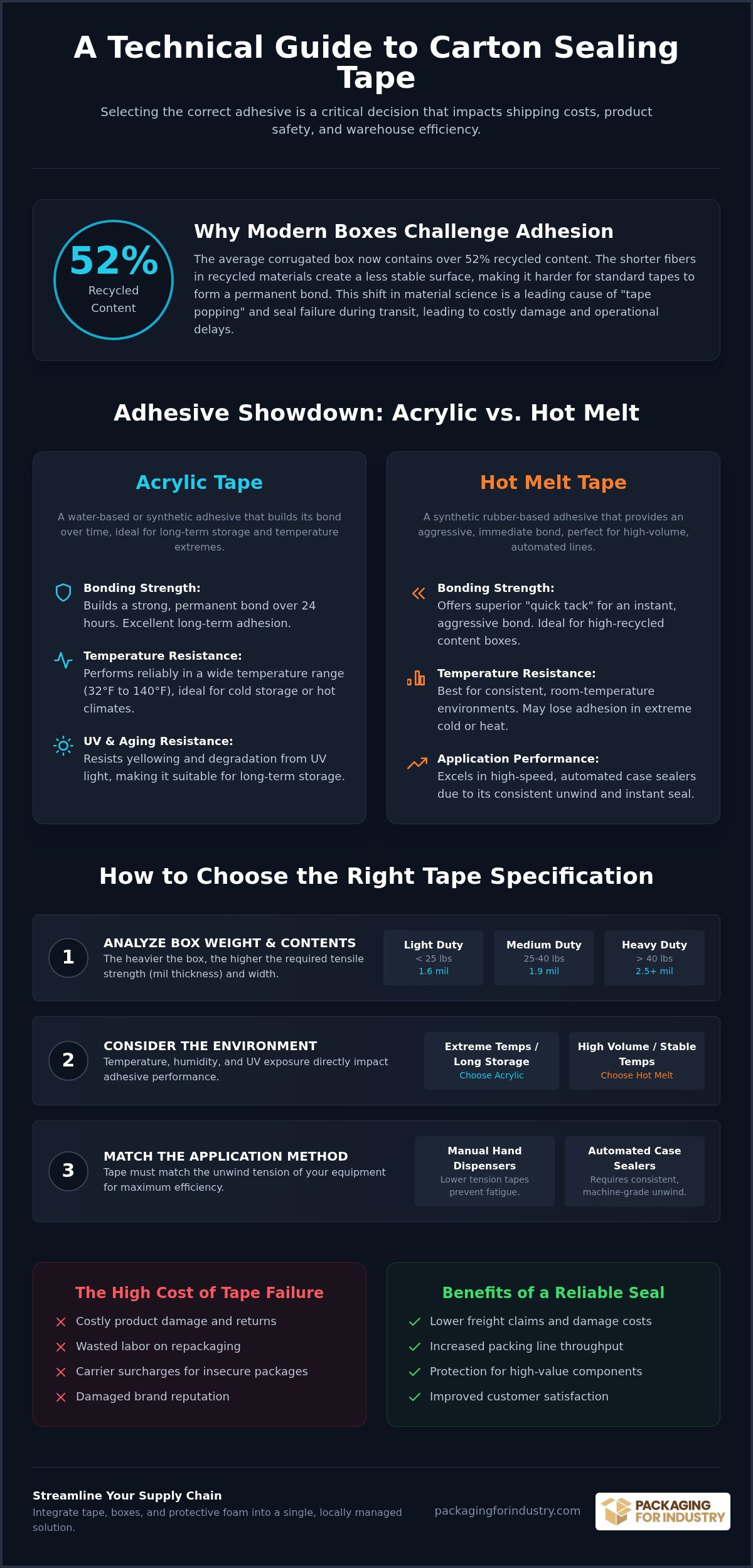
When logistics managers evaluate how to choose the right tape for sealing corrugated boxes, the decision usually comes down to the specific adhesive chemistry. The two primary industrial options, acrylic and hot melt, interact with corrugated fibers in fundamentally different ways. Hot melt tape, made from synthetic rubber, offers a superior “quick tack.” It creates an immediate, aggressive bond by biting into the cardboard surface. In contrast, acrylic tape uses a water-based or synthetic adhesive that builds its maximum bond strength over several hours. This difference in bonding time impacts everything from your packing line speed to your long-term storage reliability.
Determining how to choose the right tape for sealing corrugated boxes also requires an analysis of your environment. Southern California warehouses, particularly in the Inland Empire or Orange County, often face high internal temperatures during summer months. While hot melt is highly efficient in standard conditions, acrylic tape maintains its bond integrity across a wider temperature range, typically from 32°F to 140°F. It’s also resistant to UV light and aging, meaning it won’t yellow or become brittle over time. Adhering to standards like ASTM D1974 ensures your closure method meets recognized industrial benchmarks for security. If you’re currently experiencing tape failure, you can request a packaging quote to test high-performance alternatives.
When to Choose Acrylic Tape for Long-Term Storage
Acrylic tape is the preferred solution for inventory cycles that exceed six months. Because it resists oxidation and sunlight, it’s ideal for medical device and electronics manufacturers who store products in fluctuating warehouse environments. Its long-term holding power ensures that seals don’t fail as the adhesive ages. While it lacks the “instant grab” of rubber-based options, its reliability over years of storage makes it a cost-effective choice for protecting high-value components from dust and environmental ingress. It’s the standard for clean, professional unboxing experiences where yellowing or adhesive residue is unacceptable.
The Advantages of Hot Melt Tape for High-Speed Production
For high-volume manufacturing packaging lines, hot melt tape is usually the standard. Its high initial tack is essential for automated case sealing machines, where the tape must adhere instantly to moving boxes. This chemistry is particularly effective on boxes with high recycled content, which often have shorter, dustier fibers that can repel weaker adhesives. If you’re shipping heavy-duty double-wall or triple-wall containers, the superior tensile strength and shear resistance of hot melt provide the security needed to prevent heavy loads from shifting or bursting through the bottom flaps during transit.
Key Factors for Choosing Your Box Sealing Tape Specifications
Determining how to choose the right tape for sealing corrugated boxes requires looking beyond the adhesive type and into the physical dimensions and tensile strength of the tape itself. Tape width is your first decision point. While 2-inch tape is the industry standard for most RSC boxes, 3-inch tape provides 50% more surface area for adhesion. This extra width is often necessary for overstuffed boxes or those containing heavy, shifting loads where the center seam is under constant stress. Tensile strength, measured in pounds per inch of width, must be matched to the gross weight of your carton to prevent the tape from snapping during palletization or transit.
Environmental factors like warehouse dust and humidity also dictate your specifications. In high-dust environments, a tape with a higher coat weight of adhesive is necessary to penetrate through surface particles and reach the cardboard fibers. Similarly, if your facility in the Inland Empire or Orange County lacks climate control, you must account for how humidity affects the cardboard’s surface energy. This can weaken the bond of lower-spec tapes, leading to “tape popping” during long-haul freight cycles.
Matching Tape Thickness to Corrugated Box Grades
Tape thickness is measured in mils, or thousandths of an inch. Choosing the wrong thickness is a common cause of failure. For standard 32 ECT RSC boxes, a 1.8 to 2.0 mil tape usually provides sufficient security. However, heavy-duty double-wall boxes used for industrial equipment or aerospace components often require a 3.0 mil specification to handle the increased weight and board stiffness. By matching the tape to the specific grade of your box, you can lower packaging costs by avoiding expensive over-specification on lightweight shipments.
Sealing Recycled Corrugated: A Common Industrial Challenge
Modern sustainability initiatives mean the average box now contains over 52% recycled content. This presents a technical challenge because recycled fibers are shorter and produce more surface dust than virgin kraft paper. Standard tapes often fail on these surfaces because the adhesive can’t grab the short fibers effectively. When evaluating how to choose the right tape for sealing corrugated boxes with high recycled content, prioritize hot melt tapes with a high-tack formulation. These adhesives are engineered to flow into the porous surface of recycled board, creating a mechanical bond that resists the “memory” of stiff flaps trying to pull open.
Optimizing Application for Maximum Warehouse Efficiency
Warehouse efficiency is often won or lost at the packing station. While much of the discussion on how to choose the right tape for sealing corrugated boxes focuses on adhesive chemistry, the method of application is equally critical to your total operational cost. Labor represents a significant portion of warehouse overhead. If your team is struggling with difficult unwind tension or frequent roll changeovers, your throughput suffers. Optimizing this process requires a strategic look at your equipment and the physical mechanics of the seal.
Team training on the “H-seal” method is essential for heavy or high-value shipments. This technique involves sealing the center seam and all four edge seams, creating a literal “H” shape. While it uses more material, it provides maximum security against dust ingress and structural failure. For standard RSC boxes, a 2-inch to 3-inch overlap on the side panels is the industry standard. Using more tape than this is simply wasting material without adding structural benefit. Consistency in these “overlap” rules ensures that every box is secure without inflating your material spend.
Hand Dispensers vs. Automated Case Sealers
Transitioning from manual hand dispensers to automated case sealing equipment is a primary way to streamline warehouse operations. Manual sealing is prone to human error and inconsistent tape tension, which can lead to “tape popping” later in the supply chain. Automated sealers provide a consistent, repeatable application that reduces waste. To maximize the ROI of these machines, you must use machine-grade rolls. These feature specific unwind characteristics designed for high-speed tension. Regular maintenance of the cutting blades and rollers is necessary to prevent adhesive buildup and ensure clean cuts every time.
Tape Width and Roll Length: Reducing Changeover Downtime
High-volume production lines lose significant time during roll changeovers. While hand rolls are typically 55 to 110 yards, machine rolls can reach 1,000 to 2,000 yards. This reduction in downtime directly increases your daily throughput. Additionally, understanding how to choose the right tape for sealing corrugated boxes includes evaluating if a 3-inch tape can replace the need for double-stripping with 2-inch tape on wider seams. This switch halves the labor and material used for those specific containers. Calculating the minutes saved per shift through longer roll lengths reveals a clear path to lower total packaging costs.
Streamlining Your Supply with PFI’s Custom Packaging Solutions
Southern California businesses often face high operational costs due to fragmented supply chains. Sourcing tape from a catalog supplier while purchasing boxes from a separate vendor creates logistical gaps and inconsistent performance. PFI serves as a single integrated partner, providing everything from heavy-duty RSC boxes to specialized adhesives. This holistic approach ensures that every component is engineered to work together, preventing the adhesive failures that lead to transit damage. Our consultants provide technical guidance on how to choose the right tape for sealing corrugated boxes based on your specific box grade, transit environment, and warehouse temperature.
Our local presence in Anaheim and Los Angeles allows us to offer next-day delivery, which is critical for preventing production stops. By consolidating your tape, stretch film, and corrugated supplies with one partner, you simplify your procurement process and gain access to expert reviews that identify cost-saving alternatives. We don’t just provide commodities; we provide a system of protection that stabilizes your shipments and protects your bottom line.
Vendor Managed Inventory (VMI) for Shipping Supplies
Production stops caused by a missing roll of tape are unacceptable in lean manufacturing environments. PFI’s VMI programs eliminate this risk by monitoring your stock levels and replenishing supplies before they reach critical lows. This system improves your cash flow by ensuring you only stock what your production line actually requires, reducing the capital tied up in excess inventory. For example, Orange County manufacturers frequently use our VMI services to eliminate expensive emergency orders and the associated freight surcharges. With local support across San Diego and the Inland Empire, your warehouse stays operational without the need for excessive on-site safety stock.
Requesting a Custom Packaging Review for Your Operation
Our team functions as a seasoned industrial consultant to identify hidden costs in your current process. A comprehensive review often reveals that businesses are over-specifying tape for lightweight cartons or using the wrong adhesive for recycled fibers. We evaluate how your tape performs in conjunction with foam packaging and corner boards to create a total protection system. This expert analysis clarifies how to choose the right tape for sealing corrugated boxes while simultaneously reducing your overall material spend. Our custom packaging design services ensure that every seal is optimized for your specific freight environment, whether it’s local delivery or international aerospace transport.
Secure Your Supply Chain with Engineered Sealing Solutions
Sealing a carton isn’t just about closure; it’s about protecting the structural integrity of your shipment and your company’s reputation. By aligning adhesive chemistry with your specific corrugated materials and environmental conditions, you eliminate the high costs of transit damage and labor-intensive re-taping. Mastering how to choose the right tape for sealing corrugated boxes ensures your operations remain efficient and your freight claims stay low.
PFI supports your warehouse as a seasoned industrial partner. Our team specializes in aerospace and industrial manufacturing solutions, providing the technical expertise needed to optimize every seal. With local Southern California next-day delivery and expert VMI programs, we ensure you never face a production stop due to inventory shortages. We focus on the intersection of engineering and economics to provide a system of protection that stabilizes your shipments.
We look forward to helping you build a more reliable and cost-effective shipping process that gives you total peace of mind.
Frequently Asked Questions
Is shipping tape the same as packing tape for industrial use?
No, industrial-grade tape is distinct from consumer products. While retail tape is often 1.6 mil or less, industrial shipping tape starts at 1.8 mil and reaches 3.0 mil for heavy-duty applications. These products use specialized adhesives like synthetic rubber to handle the rigors of palletization and long-distance freight. Using under-specified tape leads to flagging and transit damage. We recommend reviewing your box weight to determine the appropriate tensile strength for your operations.
What is the strongest tape for sealing heavy triple-wall corrugated boxes?
For heavy triple-wall containers, high-performance 3.0 mil hot melt tape is the industrial standard. These boxes have significant flap memory that pulls against the seal. Hot melt’s aggressive initial tack bites into the corrugated fibers instantly. This prevents the bottom flaps from bursting under the weight of industrial equipment or aerospace parts. For maximum security, we often recommend pairing this with 3-inch width tape to increase the total bonding surface area.
Does carton sealing tape stick effectively to recycled cardboard?
Recycled cardboard presents a challenge because its fibers are shorter and produce more surface dust. Standard acrylic tapes often fail to grab these surfaces effectively. To solve this, select a high-tack hot melt adhesive specifically formulated for recycled content. This is a critical factor when evaluating how to choose the right tape for sealing corrugated boxes. These adhesives flow into the porous recycled board to create a permanent mechanical bond that resists popping.
How do I choose between 2-inch and 3-inch tape for my boxes?
Select tape width based on your carton weight and shipping stress. 2-inch tape is sufficient for lightweight RSC boxes. However, 3-inch tape is superior for heavy loads or shipments prone to rough handling. Because 3-inch tape offers 50% more adhesive surface area, it provides a more secure seal on wider seams. This often allows you to lower packaging costs by replacing two strips of 2-inch tape with a single, reliable 3-inch pass.
What is the best tape for boxes stored in cold or unheated warehouses?
Specialized cold-temperature acrylic tape is the most reliable option for unheated warehouses or cold-chain logistics. While standard adhesives can lose their bond in low temperatures, these formulations remain flexible and secure down to 32°F or lower. This prevents tape failure during winter storage or in refrigerated environments. For Southern California facilities with fluctuating temperatures, acrylic provides the aging resistance and thermal stability necessary to keep your inventory protected until it reaches the end user.
How can I reduce the amount of tape my warehouse team uses per box?
You can reduce waste by standardizing application methods and using the correct tape width. Training your team on how to choose the right tape for sealing corrugated boxes ensures they don’t over-specify for light boxes. Enforce a standard 2-inch to 3-inch overlap on side panels to prevent excess usage. If workers are currently double-stripping seams, switching to a wider 3-inch tape or a higher-mil hot melt will provide a secure seal in one pass.