
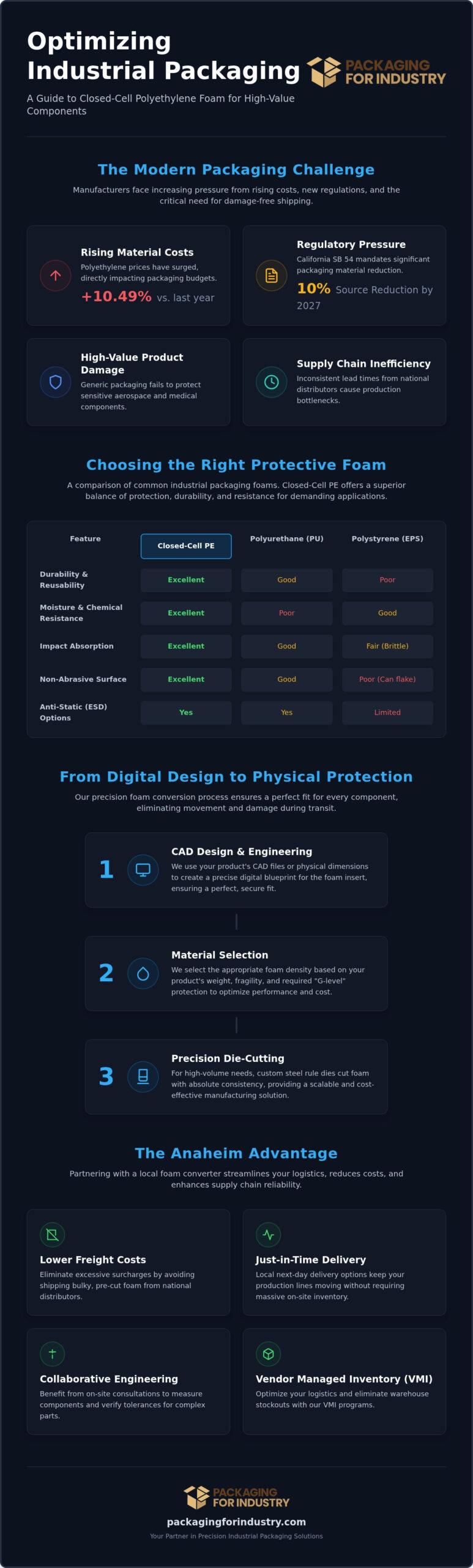
With polyethylene prices up 10.49% compared to last year and new California SB 54 mandates requiring a 10% source reduction by 2027, your packaging strategy can’t afford any wasted space or material. You’re likely dealing with rising shipping surcharges and the frustration of seeing high-value aerospace or medical components arrive damaged because of generic foam. Partnering with a specialized closed-cell polyethylene foam converter Anaheim allows you to move beyond catalog solutions and secure your supply chain. We understand that inconsistent lead times from national distributors create operational bottlenecks you simply don’t have time for.
This article demonstrates how precision-engineered inserts eliminate transit damage while lowering total landed costs. We’ll examine how custom die-cut foam, local vendor-managed inventory (VMI) programs, and Southern California delivery provide the reliability your Anaheim manufacturing or aerospace operation demands. From free prototyping to just-in-time delivery, you’ll learn how to optimize your protective packaging for both safety and fiscal efficiency. By the end of this guide, you’ll know exactly how to request a packaging quote that addresses your specific industrial challenges.
Key Takeaways
- Learn how CAD-driven design and precision die-cutting create custom inserts that secure high-value aerospace and medical components during transit.
- Discover why working with a local closed-cell polyethylene foam converter Anaheim reduces freight costs and provides faster prototyping than national catalog suppliers.
- Compare the durability and moisture resistance of polyethylene foam against polyurethane and EPS to ensure your packaging meets industrial standards.
- Master the technical specifications needed for procurement, including how to determine the “G-level” protection required for sensitive industrial gear.
- Optimize your logistics with Vendor Managed Inventory (VMI) and local next-day delivery options that eliminate warehouse stockouts.
Custom Closed-Cell Polyethylene Foam Conversion in Anaheim
Industrial Expanded polyethylene (EPE) foam is fundamentally different from the generic cushioning found in retail environments. While consumer-grade foam focuses on soft textures, industrial-grade closed-cell PE foam is engineered for structural integrity and energy absorption. Each cell within the material is completely sealed, creating a barrier that prevents moisture, oils, and chemicals from penetrating the surface. For manufacturers, this means your high-value components remain dry and protected even in challenging warehouse environments. Choosing a professional closed-cell polyethylene foam converter Anaheim ensures that your material meets rigorous industrial specifications rather than just filling a box with sub-par material.
The Material of Choice for Anaheim Aerospace and Electronics
Anaheim’s aerospace and medical device sectors operate with zero margin for error. Sensitive instrumentation requires high-density protection that can withstand repeated impacts without losing its shape. Unlike open-cell alternatives, PE foam is non-abrasive. It won’t scratch delicate optics or polished metal surfaces during transit. For electronics manufacturers, we provide anti-static (ESD) variations. These specialized foams dissipate static electricity, protecting circuit boards from the invisible discharge that can ruin a production run. This chemical resistance makes the material the standard for environments where parts may be exposed to lubricants or cleaning agents. If you’re shipping sensitive gear, aerospace-grade foam inserts provide the necessary peace of mind.
Why Local Anaheim Conversion Matters
Freight costs for bulky packaging materials can quickly erode your margins. Shipping pre-cut foam inserts from a national catalog supplier often involves paying to transport air. Working with a local closed-cell polyethylene foam converter Anaheim eliminates these excessive surcharges. Local proximity also facilitates a more collaborative engineering process. If you’re designing packaging for a complex component, our team can conduct on-site consultations to measure parts and verify tolerances. This local presence supports the robust Southern California manufacturing base, providing just-in-time delivery that keeps your production lines moving without the need for massive on-site storage. By utilizing custom foam packaging sourced locally, you reduce both your carbon footprint and your logistical overhead.
The Foam Converting Process: From CAD Design to Die-Cut Inserts
Converting raw material into precision-engineered inserts requires a methodical engineering approach. It starts with your product’s CAD files or physical dimensions. We translate these measurements into digital blueprints using specialized CAM software. This step ensures that every cavity and relief cut matches your component’s geometry with high precision. As a dedicated closed-cell polyethylene foam converter Anaheim, we focus on this technical foundation to eliminate the “loose fit” problems that lead to transit damage. Our role as a closed-cell polyethylene foam converter Anaheim includes managing the entire lifecycle of the design, ensuring that the final insert performs as expected under real-world shipping stresses.
Academic research into polyethylene foam packaging material confirms that its effectiveness depends on proper load distribution. We select the appropriate foam density based on your product’s weight and the “G-level” protection required. By matching the material’s structural properties to the specific stresses of your shipping route, we ensure your gear remains stationary and secure. This engineering-first mindset allows us to optimize material usage, which is a direct way to help you lower packaging costs without compromising safety.
Precision Die-Cutting for Bulk Requirements
For high-volume manufacturing, die-cutting is the most efficient conversion method. This process utilizes custom-made steel rule dies to punch shapes from foam sheets with absolute consistency. It’s significantly faster than CNC routing for large batches, providing a scalable solution for your production line. We also specialize in multi-layer assemblies. By laminating different foam sheets together, we can create complex, 3D internal structures that cradle sensitive parts. These inserts are designed to fit perfectly inside our custom corrugated boxes, providing a turnkey solution that arrives at your warehouse ready for immediate use.
Free Prototyping and Fit Testing
We don’t expect you to approve a design based on a computer screen. PFI provides free prototyping for recurring industrial orders to ensure the fit is perfect before the die is even built. This proactive phase of custom design packaging identifies potential issues like pressure points or difficult insertion angles. Prototyping speeds up your approval process and gives your operations team confidence during new product rollouts. It’s about getting it right the first time to avoid costly re-runs. If you have a complex component that needs a tailored fit, you can request a custom foam prototype from our Anaheim team to begin the process.
Comparing Closed-Cell PE Foam to Other Packaging Materials
Material selection is the most critical decision in industrial logistics. Polyurethane (PU) foam is soft and affordable, but its open-cell structure absorbs water and oils, which can degrade the material and damage your products. Closed-cell PE foam provides a moisture-resistant barrier that remains stable in varied climates. Scientific data on the technical properties of closed-cell foams shows that they offer far better impact recovery than Expanded Polystyrene (EPS). EPS is prone to cracking and creates messy debris that can clog machinery. PE foam absorbs shock and returns to its original shape, providing multi-drop protection that EPS simply can’t match.
Why Polyethylene Wins for Heavy Industrial Goods
Industrial procurement teams often ask why 1.7 lb and 2.2 lb densities are the standard. These densities offer the perfect ratio of cushioning to support. If the foam is too soft, heavy components will “bottom out” and hit the outer box. If it’s too hard, the shock is transferred directly to the product. Finding this balance is why you need an expert closed-cell polyethylene foam converter Anaheim. PE foam is also non-dusting, which is a requirement for medical device manufacturers who can’t risk particulate contamination. Its longevity makes it a smart choice for manufacturing packaging solutions like reusable kitting trays. These trays can be used hundreds of times, significantly lowering your long-term packaging spend.
ESD and Anti-Static Foam Considerations
Protecting sensitive electronics requires specialized material science. Standard plastics generate static electricity through friction, which can fry semiconductors or circuit boards. We convert anti-static PE foam, which is chemically treated to dissipate these charges. You’ll recognize this material by its industry-standard pink color. It’s not just a visual cue; it’s a guarantee of compliance with ESD safety protocols. For Anaheim-based electronics firms, using the wrong foam is a liability. Our conversion process as a closed-cell polyethylene foam converter Anaheim ensures that every die-cut insert provides a safe, static-free environment for your most sensitive gear. This level of precision is what separates industrial converters from generic catalog suppliers.
Buyer’s Guide: Specifying Foam Requirements for Procurement
Specifying the right protection starts with a technical assessment of your product’s fragility. We measure this in G-force, representing the maximum deceleration your component can withstand during a drop before failure occurs. Heavier, robust items might only need basic bracing using 1.7 lb density planks. In contrast, delicate aerospace sensors require precision-engineered cavities to distribute impact energy across the entire surface area. Deciding between stock planks and custom assemblies is often a question of labor costs versus material volume. As a closed-cell polyethylene foam converter Anaheim, we help you evaluate if the upfront cost of a steel rule die pays for itself through faster pack times and reduced material waste on the warehouse floor.
Choosing a local closed-cell polyethylene foam converter Anaheim allows you to move away from “one-size-fits-all” catalog solutions that often lead to over-packaging. When you over-specify foam thickness, you aren’t just wasting material; you’re increasing the physical footprint of your shipment. This leads directly to higher freight expenses that can quietly erode your quarterly margins. Our engineering team focuses on finding the “critical cushion” point where you achieve maximum protection with the minimum possible volume.
Optimizing for Dimensional Weight
Carrier surcharges are a significant operational burden for Southern California manufacturers. UPS and FedEx calculate costs based on dimensional (DIM) weight, which means you’re charged for the space your box occupies rather than just its actual weight. Custom foam inserts allow for a tighter fit, which reduces the overall box size and lowers shipping costs significantly over high-volume runs. In some cases, we can reduce the foam profile by supplementing the internal structure with corner and edge protection. This hybrid approach maintains structural integrity during stacking while keeping the exterior dimensions as small as possible.
Volume and Frequency Planning
Industrial procurement works most efficiently when it’s aligned with predictable production cycles. Bulk ordering custom inserts reduces your unit costs, but it can also create storage challenges in expensive Anaheim warehouse space. We address this through proactive logistics planning. Many of our clients utilize kitting and assembly services to receive their foam and corrugated boxes as a single, ready-to-use unit. This eliminates the need for your staff to manage multiple SKUs or spend time pre-assembling packaging before the product is ready. By coordinating your recurring production cycles with our conversion schedule, you ensure a steady supply of protection without tying up excessive capital in sitting inventory.
Why PFI is the Preferred Foam Converter in Anaheim
Choosing a closed-cell polyethylene foam converter Anaheim means more than just finding a material source. It’s about securing a partner who understands the specific pressures of Southern California’s industrial hub. We specialize in high-value sectors like medical devices and aerospace, where a single shipping failure can derail a contract. By positioning ourselves as a local consultant rather than a distant catalog supplier, we offer a level of accountability that national competitors can’t match. We don’t just sell foam; we provide a logistical system designed to protect your bottom line.
Vendor Managed Inventory (VMI) for Foam Inserts
Bulky foam inserts consume significant floor space. If you’re managing multiple SKUs for various product lines, your warehouse can quickly become cluttered. Our VMI programs solve this by shifting the inventory burden to us. We conduct weekly or monthly reviews of your usage and restock your supplies automatically. This proactive approach eliminates emergency rush orders and ensures you never face a production shutdown due to a foam stockout. It’s a pragmatic solution for businesses that need to maintain production flow without tying up capital in sitting inventory.
This system provides fiscal peace of mind. You only pay for what you use, improving your cash flow and freeing up capital for other operational needs. For Anaheim manufacturers, this means your warehouse space can be dedicated to production rather than storing empty packaging. We act as an extension of your own warehouse team, ensuring that every die-cut insert is available precisely when your assembly line needs it.
The PFI Local Advantage in Southern California
Proximity is our greatest asset. As a leading closed-cell polyethylene foam converter Anaheim, our facility allows for local next-day delivery across Orange County, Los Angeles, and the Inland Empire. This speed is critical when production schedules shift or new orders arrive unexpectedly. You gain direct access to our engineering team for aerospace packaging challenges, allowing for face-to-face consultations that resolve design issues in hours rather than weeks. There’s no substitute for having a “fixer” nearby who can walk your production floor and identify packaging inefficiencies in real time.
We provide a single-source solution. You can combine your foam inserts, corrugated boxes, and heavy-duty crates into one streamlined order. This reduces administrative overhead and ensures all components of your packaging system fit together perfectly. If you’re ready to improve your supply reliability and reduce transit risks, the first step is a technical review of your current specs. We invite you to request a foam packaging quote to see the difference a local partner makes for your next project.
Secure Your Supply Chain with Precision Engineering
Protecting high-value industrial components requires a system that merges material science with logistical efficiency. Moving away from generic catalog supplies and partnering with a specialized closed-cell polyethylene foam converter Anaheim eliminates the inconsistencies that lead to shipping damage and operational delays. We’ve examined how precision CAD-driven designs and the technical properties of polyethylene provide superior impact recovery compared to traditional foam alternatives.
Our focus on aerospace and medical device requirements ensures that every die-cut insert meets the highest industrial standards. Leveraging local next-day delivery and free prototyping allows your Anaheim facility to maintain a lean inventory without risking stockouts. It’s a proactive approach to packaging design that stabilizes your production flow while helping you lower packaging costs across your entire operation.
We look forward to helping you optimize your protective packaging and enhance your distribution reliability across Southern California.
Frequently Asked Questions
What is the difference between open-cell and closed-cell foam for packaging?
Closed-cell foam features completely sealed cells that prevent the absorption of liquids and air, making it ideal for moisture-sensitive industrial goods. Open-cell foam has interconnected pores that act like a sponge, which often leads to structural failure under heavy loads. As a professional closed-cell polyethylene foam converter Anaheim, we recommend sealed-cell structures for any application requiring high-density protection or chemical resistance. This ensures your high-value components remain dry and secure during long-term transit.
Can you provide custom foam inserts for military-spec (mil-spec) requirements?
We provide custom foam inserts that meet rigorous military-spec (mil-spec) packaging requirements for defense and government contractors. Our conversion process utilizes specific foam grades approved for military use, ensuring durability and compliance with strict environmental standards. Whether you need heavy-duty bracing for hardware or delicate cushioning for sensitive electronics, our team can help you specify the correct material. These solutions are engineered to withstand the extreme handling conditions typical of military logistics.
Does PFI offer free prototyping for custom foam designs in Anaheim?
PFI offers free prototyping for recurring industrial orders to ensure your custom inserts provide a precision fit. This phase allows you to test the physical interaction between your product and the foam before committing to a full production run. By identifying potential pressure points early, we eliminate the risk of shipping damage. Our Anaheim engineering team works directly with your specifications to refine the design, providing confidence during your next product rollout.
What is the typical lead time for a custom die-cut foam order?
Typical lead times vary based on the complexity of the die-cut design and current material availability. While stock planks are often available for immediate delivery, custom die-cut assemblies require time for tool creation and production scheduling. We recommend contacting our Anaheim team to confirm current lead times for custom prototypes and high-volume runs. Our local presence allows us to prioritize urgent needs and provide faster turnaround than national suppliers who don’t offer local support.
Do you provide anti-static (ESD) foam for electronics manufacturing?
We provide anti-static (ESD) polyethylene foam specifically for the electronics manufacturing sector in Anaheim. This material is chemically treated to dissipate static charges, protecting semiconductors and circuit boards from electrical discharge. You’ll easily identify this material by its industry-standard pink color. It’s a critical requirement for any manufacturer shipping sensitive components that could be compromised by static buildup. Using the correct ESD foam prevents invisible damage that can ruin a production run.
Can I combine my foam insert order with custom corrugated boxes?
You can absolutely combine your foam insert orders with custom corrugated boxes for a complete turnkey solution. This integrated approach ensures that the internal cushioning and the outer shipping container are engineered to work together perfectly. By sourcing both components from a single supplier, you reduce administrative overhead and eliminate the risk of fitment issues. Our team coordinates the production of both items to arrive at your facility simultaneously and ready for use.
How does a VMI program work for recurring foam packaging needs?
Our Vendor Managed Inventory (VMI) programs work by shifting the responsibility of stock management from your team to ours. We monitor your foam packaging usage through regular inventory reviews and restock your supplies before you face a stockout. This system is particularly beneficial for bulky items that consume significant warehouse space. By utilizing a closed-cell polyethylene foam converter Anaheim with VMI capabilities, you ensure a steady production flow without tying up capital in excessive inventory.
What industries in Anaheim do you typically serve with closed-cell foam?
We typically serve the aerospace, medical device, and electronics manufacturing sectors throughout the Anaheim area. These industries require the high-density protection and non-abrasive properties that only professional-grade closed-cell foam can provide. Additionally, we support local distributors and warehouses that need specialized kitting and assembly services for high-volume industrial shipments. Our proximity to the Southern California manufacturing base allows us to provide the rapid response and technical support these specialized sectors demand.