
With Boeing estimating that Foreign Object Damage (FOD) costs the global aviation industry roughly $4 billion annually, the stakes for precision tool organization have never been higher. For manufacturers and aerospace firms in Southern California, maintaining a strict 5S environment is a matter of both safety and fiscal responsibility. You likely already know that disorganized tool drawers lead to wasted man-hours and increased replacement costs, especially when inferior foam degrades after contact with industrial lubricants. Finding high-quality CNC routed foam for tool control drawers Orange County is the most effective way to mitigate these risks while streamlining your operations.
In this guide, you’ll learn how precision-engineered foam inserts improve tool accountability, ensure compliance with AS9100 standards, and lower your long-term operational expenses. We’ll explore the durability of cross-linked polyethylene, the benefits of working with a local Orange County packaging supplier for fast prototyping, and how custom designs can eliminate tool loss. This overview provides the technical and economic insights necessary to implement a professional tool control system that protects your assets and your bottom line.
Key Takeaways
- Understand why CNC routing is the superior fabrication method for high-compliance environments, offering the precision depth control required to prevent Foreign Object Damage (FOD).
- Learn how to select the optimal material density and cell structure for your custom foam inserts to ensure durability against industrial lubricants and heavy tool wear.
- Discover how sourcing CNC routed foam for tool control drawers Orange County provides access to free prototyping and local next-day delivery for Southern California manufacturers.
- Compare the cost-effectiveness and technical advantages of CNC routing versus die-cutting based on your specific production volumes and tool geometries.
- Identify the essential requirements for requesting an accurate custom packaging quote, from organizing tool lists to defining drawer dimensions for a 5S-compliant fit.
What is CNC Routed Foam for Tool Control?
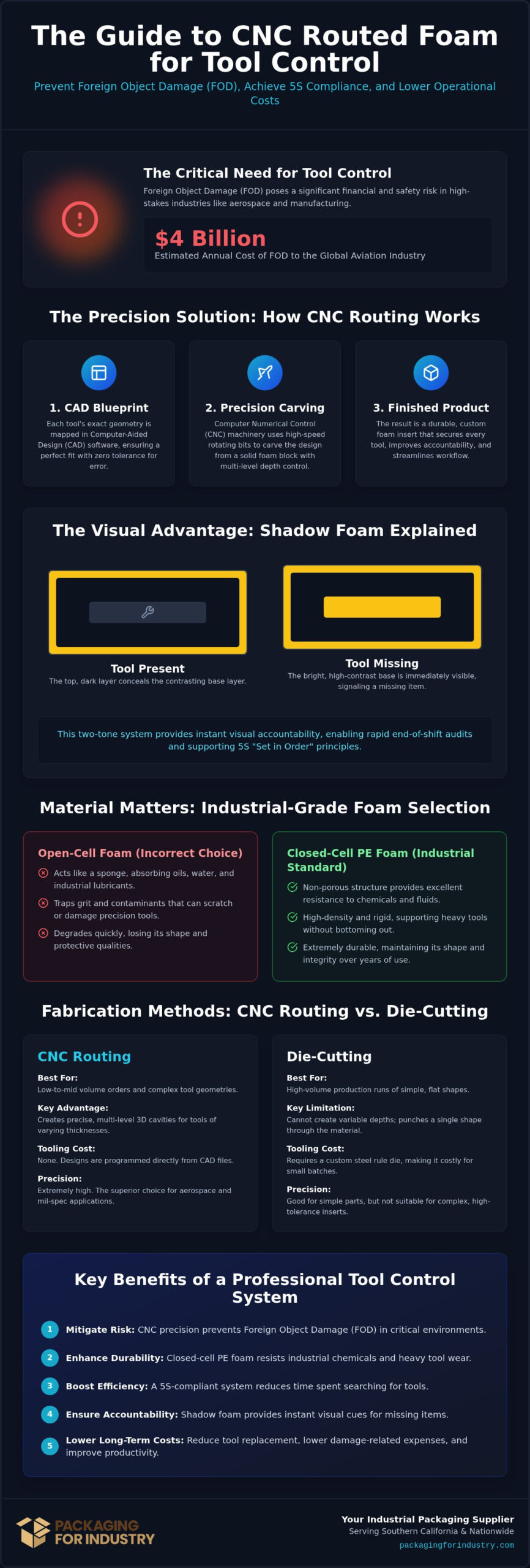
CNC routing involves using Computer Numerical Control machinery to carve precise shapes from foam blocks. This method uses high-speed rotating bits to remove material based on a digital blueprint. For professionals seeking CNC routed foam for tool control drawers Orange County, this technology offers a level of customization that manual cutting cannot match. It allows for multi-level depths within a single insert; this is vital for tools with varying thicknesses and complex profiles.
The process begins with CAD (Computer-Aided Design) software. We map the exact geometry of each tool, including ergonomic finger-pulls that allow for easy retrieval. Snug fits prevent tools from shifting during transit or drawer movement. Since these inserts are often part of a reusable packaging system, precision directly impacts the lifespan and effectiveness of the organization setup. A well-designed CAD file ensures that every socket, wrench, and specialized instrument has a dedicated home with zero tolerance for error.
Choosing CNC routing over traditional die-cutting is often a matter of volume and complexity. Die-cutting uses a steel rule die to punch out shapes. It’s efficient for high-volume, simple parts, but it can’t create variable depths. CNC routing is the superior choice for low-to-mid volume custom orders where precision and complex 3D cavities are required. It’s the standard for facilities that prioritize asset protection and operational flow.
The Importance of Tool Control in Industrial Environments
In high-stakes sectors like aerospace assembly, tool control is a safety requirement. A single forgotten wrench can lead to Foreign Object Debris (FOD) incidents that compromise aircraft integrity and lead to massive financial liabilities. Implementing custom foam inserts helps facilities in manufacturing adhere to 5S Lean principles: Sort, Set in Order, Shine, Standardize, and Sustain. This organization reduces the time mechanics spend searching for tools and provides immediate visual accountability to prevent loss or theft.
Shadow Foam: The Visual Advantage
Shadow foam utilizes a dual-layer system with a bright-colored base layer and a dark-colored top layer. When a tool is removed, the high-contrast color underneath becomes visible. This signals an empty slot immediately. This visual cue is a cornerstone of “Set in Order” protocols, allowing supervisors to conduct rapid end-of-shift audits. Shadow foam for tool control is a high-contrast, two-tone organization system designed to provide instant visual notification when a tool is missing from its designated station.
Selecting the Best Foam Material for Tool Drawers
Material selection is a critical engineering decision that impacts both the longevity of your organizational system and the protection of your assets. Choosing the wrong substrate results in premature degradation, especially in high-traffic environments where exposure to chemicals is common. For those sourcing CNC routed foam for tool control drawers Orange County, the primary objective is to balance rigidity with vibration dampening. High-density materials ensure that heavy industrial tools remain seated during transport or when drawers are opened with force.
The distinction between closed-cell and open-cell structures is fundamental. Closed-cell foams are non-porous. This prevents the absorption of water, oils, and industrial lubricants. Open-cell foams, while softer, act like sponges. In a machine shop or aerospace hangar, an open-cell insert will eventually trap contaminants and harbor grit that can scratch precision tools. Professional-grade inserts prioritize closed-cell materials to maintain a sterile and organized environment.
Polyethylene (PE) Foam: The Industrial Standard
Polyethylene is the most common material for custom tool inserts. Its closed-cell structure provides excellent chemical resistance against hydraulic fluids, engine oils, and common solvents used in manufacturing. High-density PE foam is rigid enough to support heavy wrenches and power tools without bottoming out. It maintains its shape over years of high-frequency use, ensuring that your 5S organization remains intact. If you are unsure which density fits your specific toolset, you can compare packaging pricing and material specs with a local consultant.
Polyurethane (PU) Foam: When to Use It
Polyurethane is an open-cell material known for its soft, flexible nature. It is typically used for delicate calibration instruments or sensitive electronics that require gentle cushioning. However, PU foam is prone to tearing and staining in standard tool drawer environments. For complex kits, we often recommend hybrid assemblies. This involves using a durable PE base for heavy tools and a PU lid or secondary insert for more fragile components. This approach maximizes protection while keeping foam packaging costs manageable.
For electronic assembly or medical device manufacturing, ESD (Electrostatic Discharge) foam is a necessity. These specialty foams are treated with antistatic agents to prevent static buildup that could damage sensitive components. Beyond functionality, high-quality cushioning materials contribute to a professional workshop appearance. A clean, organized drawer reflects a culture of precision and care; this is vital when hosting client facility tours or regulatory audits.
CNC Routing vs. Die-Cutting: Which is Right for You?
When selecting CNC routed foam for tool control drawers Orange County, manufacturers must evaluate the fabrication method that best aligns with their volume and precision requirements. These two processes serve distinct operational needs. CNC routing is a subtractive process that uses a digital file to guide a high-speed bit, whereas die-cutting utilizes a physical steel rule die to punch shapes out of foam. For most specialized industrial applications, the choice depends on the complexity of the toolset and the total number of drawers needed.
CNC routing is the preferred method for small-to-medium batch runs. It eliminates the need for expensive physical tooling, which lowers initial setup costs. If your facility requires different configurations for every workstation, CNC is the only logical choice. Die-cutting is optimized for high-volume production of simple shapes. While the cycle time per piece is faster with die-cutting, the upfront investment in custom dies can be prohibitive for custom tool kits.
Precision and Depth Variability
The primary advantage of CNC routing is its ability to create pockets with varying depths. A single router bit can carve a shallow recess for a thin wrench and a deep cavity for a heavy impact driver in the same foam block. This “stepped” pocketing ensures that all tools remain flush with the surface, which is essential for rapid visual audits. Die-cutting typically punches all the way through a layer, often requiring multiple layers to be glued together to achieve different depths.
Achieving tight tolerances is critical for sensitive medical or aerospace instruments. Our team provides comprehensive CAD support to ensure every unique tool geometry is captured with surgical precision. Prototyping is also significantly faster with CNC technology. We can adjust a digital blueprint and produce a new sample in minutes. Die-cutting requires a completely new physical tool for even the smallest design change, which stalls the implementation of your tool control system.
Cost Comparison for Orange County Manufacturers
For manufacturing facilities in Southern California, CNC routing often results in lower packaging costs for custom projects. You don’t have to worry about the capital expenditure associated with steel dies that might become obsolete if you upgrade your toolset. This flexibility allows for a phased rollout, starting with a single custom drawer before scaling to a full facility-wide system. It’s a pragmatic approach to 5S implementation that respects your budget constraints.
Scalability is a matter of volume versus complexity. If your project involves hundreds of identical, simple inserts with consistent depths, the speed of die-cutting eventually offsets the tooling cost. However, for specialized tool control where precision and variable depths are mandatory, CNC routing remains the superior investment. You should consider switching from CNC to die-cutting only when your production volume exceeds several hundred identical units and the design doesn’t require multi-level pockets.
Local Benefits: Custom Foam Packaging in Orange County
Sourcing CNC routed foam for tool control drawers Orange County from a local partner provides a technical advantage that national catalogs can’t replicate. Precision tool organization requires exact measurements. When your supplier is just a short drive from Irvine or Huntington Beach, the design process becomes consultative rather than transactional. Our engineers can perform site visits to verify tool geometries and drawer dimensions in person. This eliminates the back-and-forth delays often associated with shipping physical tools or relying on potentially inaccurate hand measurements. It’s about getting the fit right the first time.
Service Areas and Logistical Efficiency
Proximity to the Southern California aerospace and defense corridor ensures that your production lines never stall due to packaging shortages. As a dedicated Anaheim packaging supplier, we provide next-day local delivery across the region. This speed is a critical asset for medical device manufacturers who must scale operations quickly. Local delivery also minimizes the carbon footprint of your supply chain and removes the high freight costs associated with shipping bulky foam inserts across state lines. You aren’t just buying foam; you’re optimizing your entire logistical flow.
VMI and Just-In-Time Supply for Tool Foam
Managing a facility-wide toolroom upgrade is complex. We simplify this through vendor managed inventory (VMI) programs tailored for CNC routed foam for tool control drawers Orange County. We track your recurring foam needs and ensure a consistent supply is ready as you expand. This just-in-time approach reduces warehouse clutter by keeping foam inserts off your shelves until they’re ready for installation. You don’t have to dedicate valuable floor space to bulk packaging supplies when you can rely on local replenishment. It’s a leaner way to manage your assets.
Rapid prototyping is another cornerstone of local service. We can produce a CAD sample and deliver it for a fit-check within 24 to 48 hours. This agility allows your team to finalize drawer layouts and begin full production without waiting for cross-country shipments. Many of our clients see 15% to 40% cost savings compared to national catalogs by switching to a local partner. It’s a pragmatic solution for operations managers who value both engineering precision and logistical speed.
How to Request a Quote for Custom Tool Inserts
To receive an accurate foam packaging quote, you should start by compiling a detailed tool inventory and measuring your drawer dimensions. We provide custom sizes available for any major tool box brand, including Snap-on, Kennedy, and Lista. Providing the exact model number of your storage unit allows our team to cross-reference dimensions. This ensures the outer perimeter of the foam fits perfectly without gaps. If you have unique or specialized instruments, high-resolution photos or physical samples help us map the exact geometry required for a secure fit.
For facility-wide tool control projects, bulk packaging pricing is available to help you lower packaging costs while standardizing your organization system. We specialize in helping manufacturers scale from a single prototype to hundreds of workstations across multiple departments. This systematic approach ensures that every technician has the same visual accountability tools. It’s the most effective way to build a successful 5S program that lasts for years in a high-compliance environment.
The PFI Engineering Process
Our engineering process begins with high-resolution imaging or existing CAD data of your tools. We then create a digital blueprint that maps out the most efficient layout for your specific workspace. A key advantage of working with PFI is our commitment to free prototyping for product fit. We deliver a physical sample for you to test in your actual tool drawers before moving into full production. This step is vital for high-value gear where even a millimeter of error can compromise tool security. Every piece of CNC routed foam for tool control drawers Orange County undergoes a final quality check to ensure it meets strict FOD and 5S compliance standards.
Contact Your Local Orange County Packaging Supplier
As a dedicated Orange County packaging supplier, we offer on-site consultations to help you assess your toolroom needs. Our goal is to serve as a long-term partner for your industrial packaging solutions, providing everything from custom foam inserts to military packaging. Whether you need a custom packaging quote for a new assembly line or are looking for a reliable packaging distributor near me, our local team is ready to assist. We prioritize fast turnaround times and regional reliability to keep your production lines moving without delay.
Optimize Your Operations with Precision Engineering
Implementing a professional tool control system is a strategic investment in your facility’s safety and fiscal health. By choosing CNC routed foam for tool control drawers Orange County, you ensure that every instrument is accounted for; this reduces the risk of Foreign Object Damage and eliminates the time wasted searching for misplaced gear. Transitioning to a custom system doesn’t have to be a complex logistical burden. Efficiency starts with better design.
Partnering with a local Southern California supplier allows you to leverage free prototyping and CAD support to guarantee a perfect fit for your specific toolsets. Many manufacturers realize 15% to 40% cost savings compared to national catalogs while benefiting from local next-day delivery. This combination of technical precision and logistical speed provides the peace of mind that your workshop is operating at its highest potential. It’s a pragmatic solution for long-term reliability.
We’re ready to help you build a more organized, compliant, and cost-effective production environment today.
Frequently Asked Questions
How much does custom CNC routed foam for tool drawers cost?
The cost for custom CNC routed foam for tool control drawers Orange County is based on your specific material needs and the complexity of the tool layout. We prioritize providing a cost-effective alternative to large national catalogs, often delivering 15% to 40% savings for our regional partners. Factors like the depth of the pockets and the type of polyethylene used will influence the final quote for your facility.
What is the best foam material for heavy mechanic tools?
High-density polyethylene (PE) foam is the superior choice for heavy mechanic tools because of its rigidity and closed-cell structure. This material doesn’t absorb oils, grease, or common industrial solvents, which prevents the insert from degrading over time. PE foam maintains its shape under the weight of heavy wrenches and power tools. This ensures that your 5S organization system remains intact during high-frequency use in demanding environments.
How do I measure my tools for a custom foam insert?
Our engineering team utilizes high-resolution imaging and CAD software to map the exact geometries of your equipment, so you don’t need to perform manual measurements. For standard drawers, providing the manufacturer and model number is often sufficient. For specialized instruments, we can perform on-site consultations in Southern California to scan your tools; alternatively, you can provide physical samples for our team to prototype a perfect fit.
Can I get shadow foam in custom colors for my brand?
Yes, we provide high-contrast, two-color shadow foam systems that can be tailored to meet your facility’s visual standards. The most common configuration features a dark top layer with a bright yellow or red base to signal missing tools instantly. This visual cue is a fundamental component of 5S Lean manufacturing. Custom color combinations are available for bulk orders, allowing you to maintain professional branding while improving accountability.
How long does it take to get a prototype for a custom tool drawer?
Our local proximity in Anaheim allows us to provide rapid prototyping for Southern California manufacturers. Once we have the CAD data or physical tools, we can typically produce a fit-check sample within a few business days. This speed is a significant advantage over national suppliers who may take weeks for shipping and iterations. Fast prototyping ensures that your tool control system is finalized and deployed without stalling your schedule.
Do you provide CNC routed foam for aerospace FOD compliance?
We specialize in engineering CNC routed foam for tool control drawers Orange County to meet strict aerospace and military FOD prevention standards. Our custom inserts provide 100% tool accountability, which is essential for AS9100 compliance and flight safety. By creating a dedicated, high-visibility home for every wrench and socket, we help your team perform rapid end-of-shift audits and eliminate the risk of forgotten tools in assembly areas.
Is there a minimum order quantity for custom tool foam in Orange County?
We support both small batch runs and large-scale facility rollouts without requiring the massive minimums often seen with die-cut production. While our CNC routing process is optimized for industrial clients with recurring needs, we are flexible enough to handle custom projects for single workstations. This approach allows you to start with a pilot program before scaling to your entire warehouse, ensuring consistent quality and support throughout the process.
What is the difference between CNC routed foam and laser-cut foam?
CNC routing uses high-speed bits to carve precise, multi-level depths into the foam, which is ideal for tools with varying thicknesses. Laser cutting uses heat to melt through the material, which can sometimes leave charred edges or unpleasant odors on certain foam types. CNC routing provides cleaner cavities and allows for “stepped” pockets that laser cutting cannot easily replicate. This precision ensures a more secure fit and a professional appearance.