
What if the “standard” corrugated boxes you buy to save money are actually the most expensive items in your warehouse? It’s a common frustration for operations managers who see the hidden costs of stock packaging every day. You likely recognize the waste in oversized boxes filled with excessive void fill and the mounting invoices from freight carriers for dimensional weight surcharges. While you know a change is necessary, convincing your boss to invest in custom packaging requires moving beyond the concept of “better protection” and into the language of fiscal responsibility.
We understand that your leadership team often views packaging as a line-item expense rather than a strategic asset. This guide bridges that gap by providing a clear, data-driven framework to present to your CFO or Director of Operations. You’ll learn how to build a business case centered on reducing product damage, eliminating shipping “air,” and clearing warehouse clutter. Whether you are a Los Angeles manufacturer or a nationwide distributor, we will show you how custom-engineered foam and right-sized boxes don’t just protect your products; they optimize your entire industrial supply chain and help you lower packaging costs.
Key Takeaways
- Industrial packaging is an engineering tool rather than a marketing expense, designed to eliminate the hidden costs associated with one-size-fits-all stock boxes.
- Learn a data-driven strategy for convincing your boss to invest in custom packaging by auditing your current shipping damage rates and dimensional weight surcharges.
- Discover how custom-engineered solutions like kitted foam inserts and optimized corrugated boxes can reduce packing labor and warehouse clutter.
- Leverage free prototyping and CAD/CAM support to demonstrate a tangible, low-risk solution to leadership before requesting a formal budget allocation.
- Simplify your operations by consolidating multiple stock SKUs into fewer custom sizes and utilizing Vendor Managed Inventory (VMI) to improve supply chain reliability.
Redefining ‘Custom’: Why Industrial Packaging is a Strategic Investment
In the industrial sector, the word “custom” is often misunderstood as a luxury or a branding expense. For a warehouse manager or operations director, custom packaging is actually a technical specification designed to solve specific logistical failures. When you are convincing your boss to invest in custom packaging, you must reframe the conversation. It isn’t about printing a logo on a box; it’s about engineering a coordinated system of preparing goods for the rigors of the modern supply chain.
Shifting away from a “cost-per-unit” mindset is the first hurdle. A stock box might cost less upfront, but it often carries hidden costs that bloat your budget. These include excessive void fill, higher freight charges due to wasted space, and the labor required to tape together a makeshift solution. By focusing on the total cost of logistics, you can demonstrate how custom designs address the three pillars of industrial packaging: protection of high-value assets, optimization of shipping volumes, and the reliability of your delivery schedule.
Stock vs. Custom: The Industrial Capability Gap
Standard Regular Slotted Carton (RSC) boxes are designed for general commodities, not specialized industrial components. When shipping sensitive electronics or heavy machinery, these stock options often provide inadequate structural integrity. This is where custom foam packaging becomes essential. Engineered foam inserts, such as polyethylene or ESD-safe materials, eliminate micro-vibration damage that stock “bubble wrap” simply cannot handle. For sectors like aerospace and medical manufacturing, where tolerances are measured in microns, the gap between a catalog box and a custom-engineered solution is the difference between a successful delivery and a costly RMA.
Moving Beyond the ‘Unboxing’ Myth
Consumer brands obsess over the “unboxing experience,” but in manufacturing, the only metric that matters is “Arrival Condition.” Your customers don’t care if the box is pretty; they care if the part inside is calibrated and ready for use. Custom packaging serves as a tool for operational efficiency. For example, using pre-configured packaging kitting allows your assembly line team to pack products in seconds rather than minutes. This reduction in labor costs is a powerful point when convincing your boss to invest in custom packaging. By simplifying the workflow, you aren’t just buying a box; you’re buying speed and consistency for your production team.
Quantifying the ROI: Damage Reduction and Freight Savings
Numbers drive decisions at the executive level. When you are convincing your boss to invest in custom packaging, the most powerful tool you have is the data from your own shipping history. Leadership prioritizes fiscal results over operational convenience. To move the needle, you must demonstrate how current “savings” on cheap stock boxes are actually causing financial leaks in other areas of the business. This requires a deep dive into your Return Material Authorization (RMA) rates and your annual freight spend.
The True Cost of Shipping Damage
Product damage is rarely just about the cost of the item itself. It is a multiplier that drains resources across every department. When a high-value component arrives damaged, you face a cascade of indirect costs:
- Labor hours spent processing the return and inspecting the failed unit.
- Expedited shipping fees to send a replacement to an unhappy customer.
- Long-term damage to your brand reputation and customer trust.
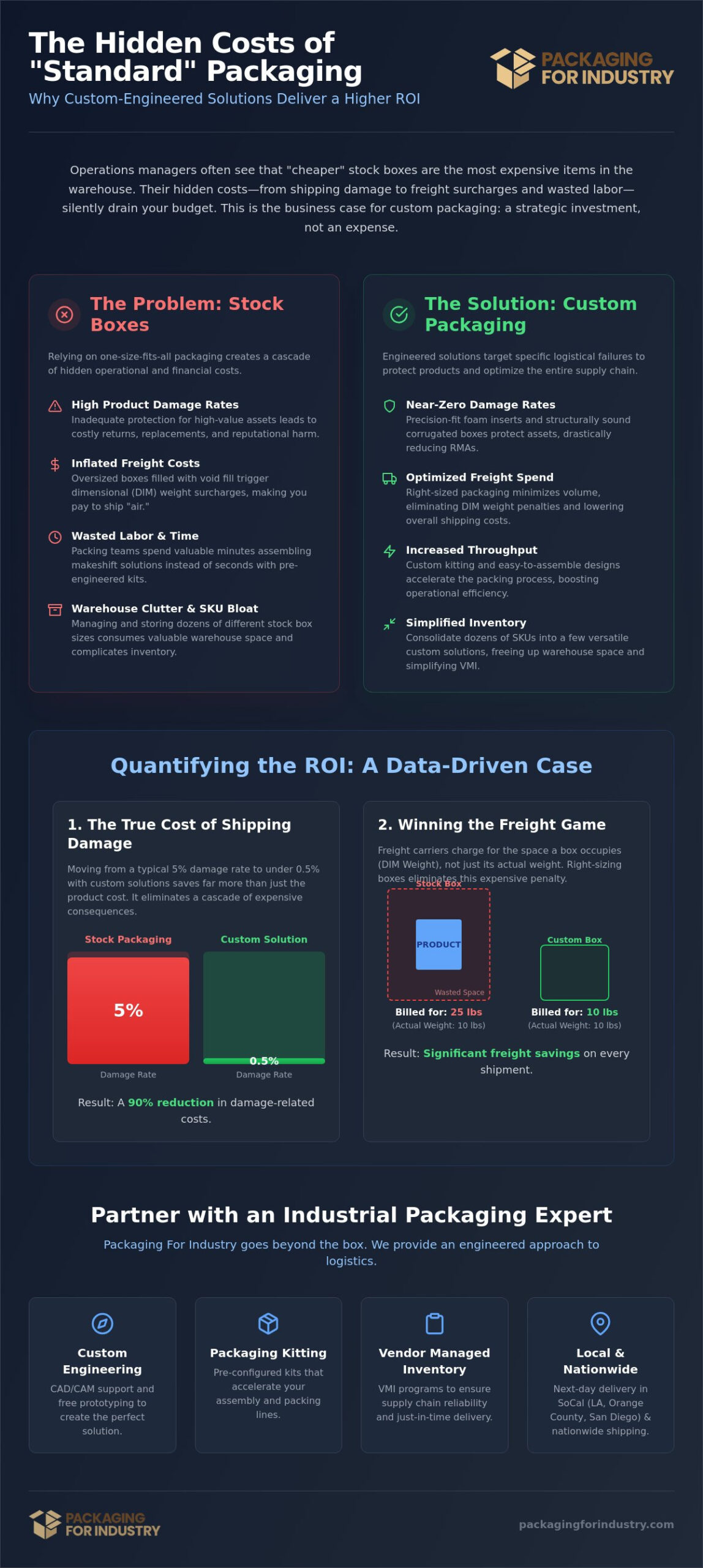
By switching to custom corrugated boxes with precision-engineered inserts, many manufacturers see their damage rates plummet. For example, moving from a 5% damage rate with stock packaging to 0.5% with a custom solution can save thousands of dollars in replacement costs alone. This precision is the strongest evidence you can provide when convincing your boss to invest in custom packaging for sensitive industrial goods.
Winning the Freight Game with DIM Weight Optimization
Many operations teams fall into the “Dimensional Weight” (DIM) trap without realizing it. Major carriers like UPS and FedEx calculate shipping prices based on the volume of the box, not just its actual weight. If you are shipping a small part in an oversized stock box filled with peanuts or bubble wrap, you are effectively paying to ship air. This “air tax” can bloat your freight spend by 15% to 30% annually.
Right-sizing your packaging through custom design eliminates this waste. A box engineered specifically for your product dimensions reduces the outer footprint, often dropping the package into a lower pricing tier. Additionally, better box design reduces the need for excessive void fill, which lowers your material costs and speeds up the packing line. To see how these savings apply to your specific product line, you can request a packaging quote to compare custom specs against your current stock inventory spend.
Operational Efficiency: Custom Engineering vs. Stock Catalogues
While damage reduction provides a clear financial win, the impact on your daily operations is often where the most significant labor savings are found. Leadership often overlooks the minutes wasted by warehouse staff struggling with oversized stock boxes and excessive tape. When convincing your boss to invest in custom packaging, you should highlight how engineered solutions turn a bottleneck into a streamlined flow. A custom-sized box doesn’t just fit the product better; it eliminates the need for your team to “build” a protection system from scratch for every shipment.
Operational efficiency also extends to your footprint. Many warehouses currently stock dozens of different box sizes to accommodate varying product dimensions. We’ve seen manufacturers consolidate ten different stock SKUs into just three optimized custom sizes. This consolidation simplifies the packing process and reduces the cognitive load on new hires. Instead of guessing which catalog box might work, your team has a dedicated, “right-first-time” solution ready to go.
Streamlining the Packing Line
Time is a finite resource in a high-volume fulfillment center. Custom designs often feature “easy-fold” bottoms or integrated protective elements that cut assembly time in half. By utilizing packaging kitting services, your team receives pre-assembled units where the foam and corrugated components are already married. This allows your personnel to focus on production and quality control rather than folding cardboard. For a Southern California packaging supplier like PFI, providing these kitted solutions locally means your line never stops due to a complex assembly requirement.
Inventory Management: The VMI Advantage
A common objection to custom solutions is the storage space required for bulk orders. You can overcome this hurdle by discussing Vendor Managed Inventory (VMI). With a VMI program, we maintain your custom stock in our facility and deliver it on a “Just-in-Time” basis. This strategy effectively moves your packaging inventory off your balance sheet and off your warehouse floor until the moment it’s needed.
This approach significantly improves cash flow. Instead of paying for six months of stock upfront from a national catalog, you pay for what you use as it arrives at your dock. For businesses in Southern California, including Los Angeles, Orange County, and San Diego, this local proximity ensures next-day delivery reliability that national suppliers cannot match. Reliability is a cornerstone of convincing your boss to invest in custom packaging, especially when it eliminates the risk of a production shutdown caused by a catalog backorder.
How to Build Your Pitch: A Step-by-Step Strategy
Moving from a recognized need to an approved budget requires a structured approach. Convincing your boss to invest in custom packaging is most effective when you present a transition plan that minimizes risk while maximizing transparency. Start by gathering evidence from the last six months of operations. Specifically, audit your freight bills for dimensional weight surcharges and your RMA reports for transit damage. This data forms the foundation of your argument, turning operational frustrations into hard financial realities.
A successful pitch focuses on the “Total Landed Cost” rather than just the “Unit Cost.” While a stock box from a catalog might have a lower price per piece, its total cost includes the expensive void fill required to secure the product, the extra labor time spent on complex packing, and the inflated freight costs from shipping excess air. By presenting these figures side-by-side, you demonstrate that the “cheaper” option is actually draining the company’s bottom line.
Leveraging Prototyping and Design
One of the most effective ways to remove management hesitation is to show them the solution in action. PFI’s custom design and prototyping service provides physical samples that allow your leadership to see and touch the engineered protection. You don’t have to guess if a design will work. We provide CAD/CAM support to ensure a precise fit. Bringing a prototype to a meeting allows you to conduct a “drop test” right in the boardroom, proving the durability of the materials and the reliability of the engineering before a single production order is placed.
Addressing Common Management Objections
Anticipating objections is a hallmark of a professional proposal. Management often worries about lead times and the complexity of switching suppliers. You can counter the “Lead Time” objection by highlighting PFI’s local Southern California infrastructure. We provide next-day delivery to Los Angeles, Orange County, and San Diego, ensuring that custom solutions arrive faster than stock items from national warehouses. This local presence is a vital point when convincing your boss to invest in custom packaging because it eliminates the fear of supply chain disruptions.
When the “Price” objection arises, pivot the conversation toward packaging cost savings found in logistics optimization. Show how right-sizing your boxes reduces freight spend and how kitted inserts lower labor costs. Finally, address “Switching Costs” by proposing a phased rollout. Start with your highest-value or most frequently damaged product line to prove the ROI on a small scale before expanding across the entire warehouse.
Partnering for Success: Why Packaging For Industry (PFI)?
Selecting the right partner is as critical as the design of the box itself. When you are convincing your boss to invest in custom packaging, the final piece of the puzzle is demonstrating that you have a reliable, expert supplier capable of executing the strategy. Packaging For Industry (PFI) operates as a seasoned industrial consultant rather than a simple commodity vendor. We specialize in complex sectors like aerospace, medical device manufacturing, and high-value electronics, where “standard” solutions often lead to catastrophic transit failures.
Our role is to act as a proactive problem-solver for your facility. We provide a one-stop-shop capability that covers every industrial need, from corner and edge protection to heavy-duty military-spec crates. By consolidating your packaging spend with a partner that understands both engineering and economics, you eliminate the fragmentation that often hides wasteful spending in manufacturing budgets.
Local Support in Southern California
Proximity is a major logistical advantage. Our Southern California focus allows us to provide hands-on support to manufacturing hubs in Anaheim, Los Angeles, and Orange County. Unlike national catalog suppliers that ship from distant regions, we can have a local packaging engineer visit your facility to review your packing line in person. This consultative approach is essential for convincing your boss to invest in custom packaging because it guarantees that the proposed ROI is based on real-world operational data from your own floor. We offer next-day delivery across San Diego and the Inland Empire, ensuring your just-in-time inventory stays lean without the risk of a shutdown.
Comprehensive Industrial Solutions
We believe in a holistic approach to protection. A truly optimized system integrates foam, corrugated, and stretch film into a single, unified protocol. This reduces the number of vendors you manage and ensures that every material works together to prevent damage. Our expertise in specialized standards, including Mil-Spec and medical-grade requirements, provides the peace of mind that your shipments will comply with even the most stringent industry regulations. We handle the technical details so your team can focus on production.
The path to lower packaging costs and improved reliability starts with a professional assessment of your current workflow. We are ready to help you build the data-driven case your leadership team requires.
Optimize Your Logistics Strategy with Data-Driven Packaging
Transforming your warehouse from a cost center into a streamlined fulfillment engine starts with the right materials. Successfully convincing your boss to invest in custom packaging is a matter of shifting the focus from the unit price of a box to the overall health of the company’s bottom line. By demonstrating the tangible savings found in damage reduction, freight optimization, and labor efficiency, you present a professional case that leadership can’t ignore.
Packaging For Industry is here to support your proposal with concrete evidence. We provide free CAD/CAM prototyping to prove our designs work before you commit to a full production run. With specialized aerospace and defense expertise and next-day delivery for Los Angeles and Orange County facilities, we ensure your supply chain remains reliable and cost-effective. You don’t have to tackle these operational challenges alone.
Take the first step toward a more efficient warehouse today. We look forward to helping you build a stronger, more profitable logistics operation that values precision and reliability.
Frequently Asked Questions
Is custom packaging really more expensive than stock boxes?
No, custom packaging is often more cost-effective when you analyze the total landed cost. While a stock box might have a lower unit price, it frequently requires excessive void fill and invites higher freight charges due to wasted space. By right-sizing your containers, you eliminate the “air tax” and reduce the labor time spent on complex packing, which is a vital point when convincing your boss to invest in custom packaging.
What is the typical lead time for a custom corrugated box order?
Typical lead times for new custom orders range from 7 to 10 business days after final design approval. For repeat orders, we leverage our local Southern California infrastructure to provide even faster turnarounds. If you utilize our Vendor Managed Inventory (VMI) program, we can often provide next-day delivery to facilities in Los Angeles, Orange County, and San Diego because your stock is already staged in our warehouse.
How do I calculate if custom packaging will save me money on freight?
Calculate freight savings by comparing the dimensional (DIM) weight of your current stock box against the DIM weight of a right-sized custom alternative. Carriers like UPS and FedEx bill based on whichever is greater: actual weight or volume. If your custom box reduces the outer dimensions enough to drop into a lower pricing tier, the annual savings on freight alone can often pay for the entire packaging investment.
Does custom packaging require a high minimum order quantity (MOQ)?
MOQ requirements vary depending on the material and complexity, but we specialize in flexible solutions for industrial manufacturers. While some catalog suppliers demand massive volumes, we offer scalable runs that fit your actual production needs. Our stocking programs allow you to take advantage of bulk packaging pricing while receiving smaller, manageable deliveries that don’t overwhelm your warehouse floor.
Can custom packaging help reduce our warehouse footprint?
Yes, custom packaging significantly reduces warehouse clutter by consolidating multiple stock box sizes into a few optimized SKUs. Instead of stocking 50 different “standard” sizes to find a “close enough” fit, you can use three or four custom designs that cover your entire product line. This consolidation frees up valuable pallet positions and simplifies inventory management for your operations team.
What industries benefit most from custom engineered foam inserts?
Aerospace, medical device manufacturing, and high-value electronics benefit most from precision foam inserts. These sectors ship fragile, high-calibration equipment that cannot survive the micro-vibrations and shocks of standard transit. Using materials like polyethylene or ESD-safe foam ensures that your products arrive in perfect calibration, which is essential for maintaining strict industry quality standards and reducing RMA costs.
How does prototyping help in the decision-making process?
Prototyping allows you to stress-test a design and prove its effectiveness before committing to a full production order. We provide free CAD/CAM support to create physical samples that your leadership team can inspect. This hands-on demonstration is a powerful tool for convincing your boss to invest in custom packaging because it removes the technical guesswork and provides a tangible proof of concept.
Will custom packaging work with our existing automated packing lines?
Custom packaging is specifically engineered to integrate with your existing automated packing lines. We design our corrugated boxes and inserts with tight tolerances to ensure they feed correctly through your erecting and sealing machinery. This consistency reduces the risk of line jams and downtime, providing the high-speed reliability that modern manufacturing and fulfillment centers require for peak operational flow.