
What if the box protecting a high-value electronic component also adds unnecessary space, packing time, or shipping risk? For electronics manufacturers, custom boxes for electronics manufacturers in Irvine need to work with the product, protective materials, shipping method, and packing process.
An off-the-shelf box may leave sensitive parts shifting in transit. Choosing foam or ESD materials without considering the full package can also create a poor fit. A well-specified design brings the corrugated box and interior protection together.
This guide explains how to assess box dimensions and construction, match corrugated packaging with foam or ESD protection, and account for shipping and warehouse needs. It also covers how design reviews, prototypes, and samples can help refine a package before it becomes a recurring supply requirement.
Packaging For Industry provides custom packaging design, corrugated boxes, foam and ESD packaging, and recurring supply options for Irvine manufacturers, with local next-day delivery throughout Southern California. Use the following considerations to specify packaging that fits your products and operations.
Key Takeaways
- Start box specifications with the product and shipping route. Include the space needed for cushioning when determining usable interior dimensions.
- Compare stock cartons, custom corrugated boxes, and integrated box-and-protection systems by fit, packing steps, storage needs, and order frequency.
- When selecting custom boxes for electronics manufacturers in Irvine, assess how corrugated packaging and foam or ESD protection work together for the product.
- Use design review, CAD/CAM support, and prototypes to evaluate a packaging configuration before adopting it for repeat shipments.
- Plan recurring packaging supply around production demand. Local delivery and inventory programs can help support continuity.
Custom Boxes for Electronics Manufacturers in Irvine: Start With the Shipping Problem
A box that works on the production floor may not suit the shipment leaving the facility. Electronics packaging should account for the product’s shape and sensitivity, how it will be packed, and the handling it may encounter in transit. For Irvine procurement teams and operations managers, begin with the shipping requirements rather than choosing a carton by habit.
Stock cartons can be practical when products fit consistently and need no unusual interior configuration. Custom boxes for electronics manufacturers in Irvine are worth considering when the product, cushioning, or packing steps make standard sizes inefficient. A tailored design can coordinate the carton’s usable space and protective components with a repeatable packing method. PFI serves local manufacturers through its Irvine packaging service area.
Dimensions affect fit, packing, and storage. A carton with excess space may require more cushioning and take up additional room. A box that leaves too little space for protection can make packing difficult. Consider the outer package in the context of its shipping and handling process. Reviewing these factors together helps teams identify avoidable damage risks and inconsistent packing.
When should an electronics manufacturer consider custom corrugated boxes?
Look for recurring damage, awkward product dimensions, excess void space, or packing methods that vary by employee or shift. These patterns may point to a design issue rather than a need to replenish standard stock boxes. For repeat shipments, a defined box and interior configuration gives production and fulfillment teams a consistent starting point and makes packaging requirements easier to manage.
If the existing carton fits the product and supports the packing process, replenishing stock may be the sensible choice. If workers need to alter boxes, improvise cushioning, or use different cartons for the same item, review the design. PFI provides custom packaging design support, including CAD/CAM capabilities and prototypes, to help evaluate a configuration for the application.
Which electronics shipments need more than a standard carton?
Fragile, high-value, heavy, or component-dense shipments may need interior protection suited to the product and its shipping conditions. Foam, partitions, pads, and ESD packaging address different packaging needs. The right combination depends on the item and how it will be handled. Electrostatic discharge (ESD) can affect sensitive electronics, so ESD protection may be part of the package design when product requirements call for it.
- Note the product’s shape, sensitive areas, and any parts that need to stay separated.
- Describe the packing steps and shipping route, including handling or storage conditions that affect protection.
- Record where current packing creates extra material use, slowdowns, or inconsistent results.
These details help an industrial packaging supplier assess the corrugated box and protective materials as one system. Start with the shipment’s actual requirements, then compare a stock carton, a custom box, or a coordinated box-and-protection design for repeat packing.
How to Specify Custom Electronics Boxes, Foam, and ESD Protection
A useful box specification starts with the product and ends with a reviewed packing method. For custom boxes for electronics manufacturers in Irvine, procurement and operations teams can reduce guesswork by documenting the shipment before settling on carton dimensions or protective materials. Treat the corrugated box, interior protection, and packing steps as one system.
- Document the product. Record its dimensions, weight, fragile areas, required orientation, and handling constraints. Include protrusions, connectors, or accessories that affect how the item rests in the package.
- Describe the shipment. Note the shipping method and any route or handling conditions that matter. Specify whether units travel individually or consolidated, and how products move from the packing station into storage or outbound handling.
- Define protection needs. Identify what must be cushioned, separated, held in place, or protected from electrostatic discharge. Base material selection on the product’s requirements.
- Choose a box format. Specify how the product and protective components fit inside the carton, and how employees will load and close it.
- Review the configuration. Assess a prototype or sample with the product and normal packing workflow before establishing a repeat-use specification.
What information should buyers gather before requesting a box design?
Gather the information packers and designers need: product dimensions and weight, fragility, orientation, handling constraints, shipping method, and packing workflow. Note whether shipments are individual or consolidated, along with recurring order patterns. Existing damage, unused space, excess cushioning, or time-consuming packing steps can help identify what the design needs to address.
Measure the product separately from the package. External box dimensions describe the carton’s outside footprint, not the space available inside. The interior must accommodate the product and the foam, pads, partitions, or other protective materials. A design review should consider outer dimensions, usable interior space, and the room needed for protection. This helps prevent a specification that fits on paper but is difficult to pack.
How do foam inserts and ESD materials fit into the specification?
Protective components should suit the product and packing workflow. Depending on the project, options include custom foam inserts, end caps, pads, partitions, or a foam-lined box. These components can position a product within the carton, separate parts, or provide cushioning. PFI’s foam packaging options can be considered alongside corrugated packaging as part of an integrated design.
For ESD-sensitive components, let the product’s requirements guide the choice of anti-static or ESD packaging. Ordinary cushioning does not necessarily address ESD needs, and material selection should reflect the application. Specify which components need protection and how the complete package will be assembled and handled. PFI’s custom packaging design capabilities include CAD/CAM support and prototypes, so teams can review a proposed configuration with the product and packing process.
Before approving a repeat specification, pack the product as employees will during production. Review fit, closure, orientation, and ease of handling. Share the product and shipment details to request a packaging quote for a box and protective-material configuration suited to the project.
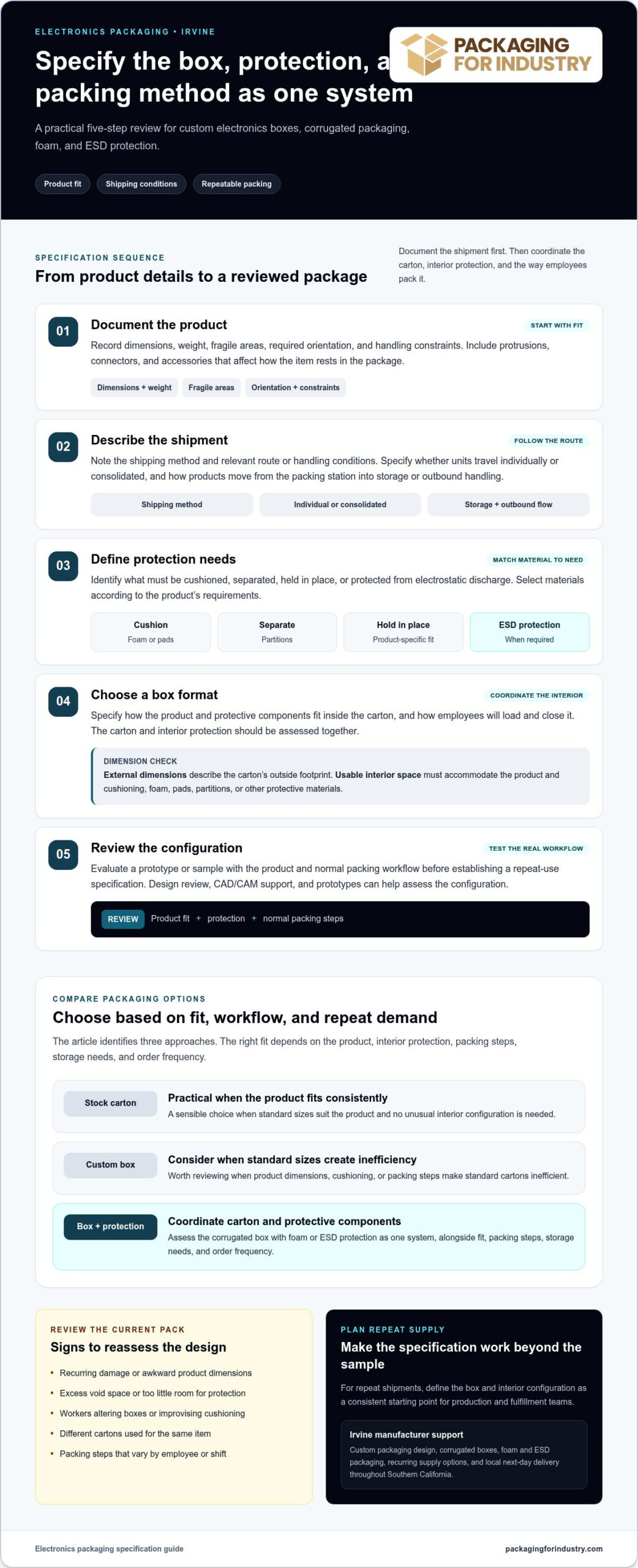
Compare Custom Box Options by Protection, Shipping, and Packing Workflow
No single carton suits every electronics shipment. Compare options against the product, shipping method, packing steps, and repeat-order needs. A standard carton may be efficient for a consistent product and established process. Custom dimensions or interior protection may better suit shipments with more complex fit or handling requirements. For custom boxes for electronics manufacturers in Irvine, aim for a practical balance between product protection and operational fit.
| Packaging option | Fit and protection | Packing and storage | Repeat shipments |
|---|---|---|---|
| Stock carton | Standard dimensions; protection depends on how the product is packed inside. | Simple to replenish if the size fits, but excess space may call for added cushioning. | Can work well for established products and workflows. |
| Custom corrugated box | Dimensions and format can be tailored to the product and packing process. | May reduce workarounds at packing stations; evaluate storage space for the selected size. | Useful when the same product ships regularly and consistent specifications matter. |
| Box with protective materials | Combines corrugated packaging with foam, partitions, pads, or end caps as needed. | Interior components add packing steps but can help position or separate parts. | Can support a repeatable configuration when teams pack the same shipment often. |
Custom box or stock carton: which better fits recurring electronics shipments?
Stock cartons can suit standard products when the dimensions, packing method, and shipping needs already align. Custom corrugated boxes may be a better fit if a product sits loosely, needs repeated adjustments, or is packed inconsistently. Compare both options against shipment frequency, storage capacity, and packing workflow. The right choice depends on the application, not simply on whether a box is custom.
When should buyers combine corrugated boxes with cushioning?
A carton alone may suit a product that stays secure through the existing packing process. Add foam, partitions, pads, or end caps when the design needs to limit movement, separate components, or cushion particular areas. Consider whether packers can load and remove the product efficiently and use the interior configuration consistently. PFI offers corrugated box options that can be considered alongside protective materials.
Box dimensions also affect the shipping profile. Carriers may use package size when determining dimensional weight, so unnecessary exterior space can influence handling and potential charges, depending on the carrier and service. Evaluate a compact design while preserving the space needed for product protection. Heavy-duty options, including double-wall or triple-wall boxes, may suit shipments with specific requirements, but are not necessary for every electronics product.
Use a sample or prototype to assess the complete package: product fit, interior components, closure, packing sequence, and storage. This gives purchasing and operations teams a clearer basis for choosing stock, custom, or combined packaging for repeat shipments.
Irvine Custom Boxes: Local Delivery and Repeat Supply
A packaging design supports production only when the boxes and protective materials are available when teams need them. For Irvine electronics manufacturers, local sourcing can help coordinate design discussions, receiving, and recurring orders. Packaging For Industry serves Irvine and provides local next-day delivery throughout Southern California, including Orange County, Los Angeles, San Diego, and Riverside.
Custom boxes may require design review, prototypes, or samples before a specification is ready for repeat orders. Plan by identifying which items need custom configurations, how often they are used, and how much storage space is available. A replenishment plan can account for these needs alongside production schedules instead of treating every order as an urgent one-off.
What should Irvine buyers evaluate in a packaging supplier?
Look for a packaging partner that can coordinate corrugated boxes with foam and electronics-related protective materials. Design support, prototypes, and samples let teams review a proposed configuration, while packaging reviews can identify where specifications or packing steps need refinement. PFI’s Irvine packaging service area connects local manufacturers with custom and stock packaging options.
Consider delivery alongside receiving schedules and production requirements. Map expected usage to receiving capacity, storage locations, and the point where packaging enters the packing process. Share changes in product demand or packaging design early so purchasing and supply planning can reflect the current specification.
How can repeat-order planning reduce packaging supply friction?
Build a replenishment plan from actual use. Review order history, expected production schedules, lead times, storage space, and any seasonal or product-mix changes. Separate steady-use items from custom boxes or inserts that need additional design planning. This gives purchasing and operations a shared view of what to monitor and when to start replenishment.
Scheduled inventory reviews can help teams compare on-hand packaging with upcoming demand and plan orders before a shortage affects packing. Vendor-managed inventory (VMI) can organize replenishment around agreed usage and inventory needs for recurring packaging requirements. Just-in-time inventory planning may also suit operations coordinating packaging supply with production flow. The right approach depends on consumption patterns, storage capacity, and the flexibility the operation needs.
For custom boxes for electronics manufacturers in Irvine, supply planning connects the approved packaging design to practical ordering and delivery. Keep specifications, usage information, and schedule changes accessible to the people managing purchasing, receiving, and production. Shared information helps maintain consistency as recurring needs change.
Request a Custom Electronics Box Quote From Packaging For Industry
A quote is most useful when it gives purchasing and operations teams a clear basis for comparison. For custom boxes for electronics manufacturers in Irvine, assess the proposed solution against the current packaging program, not only the unit price of a carton. Consider how the complete package affects material purchasing, packing labor, storage, and recurring order management.
What can PFI coordinate for electronics packaging projects?
PFI supplies custom and stock corrugated boxes, foam, and ESD packaging for manufacturing needs. Buyers can evaluate these packaging components together rather than treating each item as a separate purchasing decision. If packaging kitting or an inventory program is relevant to your operation, include it in the project scope so it can be considered as part of the supply arrangement.
Align decision-makers on priorities before comparing options. Procurement may focus on purchasing terms, production on ease of assembly, and warehouse teams on storage space. Shared evaluation criteria help teams compare alternatives consistently and choose an approach that supports the operation as a whole.
What should an electronics box quote request include?
Identify the packaging items and quantities you want priced, and distinguish one-time project needs from recurring purchases. If you’re evaluating a change, describe the current packaging approach and the outcome you want, such as reducing packaging complexity or making purchasing easier to manage. This context keeps the quote discussion focused on business requirements as well as packaging components.
Before approving an option, decide internally who owns the specification, how changes will be communicated, and how the selected packaging will fit into purchasing and warehouse processes. These decisions help prevent mismatched expectations and give the team a baseline for reviewing the program as production needs evolve.
Put Your Packaging Specification to Work
Make the next step a usable packaging standard, not just a box selection. Document the approved configuration, packing sequence, and replenishment needs so procurement, production, and fulfillment teams can work from the same requirements. This helps maintain consistency as order patterns or operating needs change.
For custom boxes for electronics manufacturers in Irvine, a clear specification also provides a basis for reviewing packaging performance over time. Track recurring issues such as difficult packing steps, excess material use, or damage reports, then use those observations to guide future design reviews. Informed adjustments can keep the packaging aligned with the product and shipping operation.
Packaging For Industry can help turn project requirements into a packaging plan suited to your manufacturing workflow. Share the product, shipment, and supply details that matter to your team to evaluate the options.
A well-planned package supports a more predictable operation. Request a quote from Packaging For Industry to discuss your electronics packaging requirements.
Frequently Asked Questions
Can custom boxes help reduce shipping damage to electronic components?
They can help address packaging-related risks, but no box design guarantees damage-free delivery. For custom boxes for electronics manufacturers in Irvine, track damage by product type and shipment route, and keep photos or inspection notes when a package arrives with an issue. This information can help distinguish recurring packaging concerns from isolated handling events and inform a packaging review.
Are custom corrugated boxes suitable for recurring production shipments?
Yes. Custom corrugated boxes can support repeat production shipments. Keep an approved packaging specification with a revision identifier, and update it when a product or packaging design changes. This helps purchasing and production avoid using different versions for the same item. If a change makes existing packaging obsolete, identify remaining inventory before switching specifications to reduce confusion on the packing floor.
Can one packaging solution include both a corrugated box and foam inserts?
Yes. A coordinated package can combine corrugated packaging and foam components. Packaging kitting can help organize parts for repeat assembly. For example, a kit can present the box, insert, and protective pieces in the order packers use them. Documenting that sequence makes the intended configuration easier to follow across shifts.
What information helps a supplier prepare a custom electronics box quote?
Include product and shipment information, the quantity needed per order, expected annual volume or forecast, and package destinations. Note any required box markings or identification used by your warehouse or customers. If the project has a target launch or changeover date, include it to help frame the planning discussion.
Should electronics manufacturers choose custom boxes or stock cartons?
Consider how many packaging item numbers your operation can manage and whether different product versions can share a carton. A custom design may help simplify recurring packaging requirements, while stock cartons can remain practical for established needs. Review the choice when products change, since a new configuration may affect carton records, warehouse locations, and purchasing procedures.
Can box dimensions affect parcel shipping costs?
Yes, package size can affect parcel charges, though carrier service and shipment details also matter. Review invoices for billed dimensions and weight, service used, and route before attributing a charge change to the box. Comparing similar shipments gives procurement a more reliable basis for evaluating packaging adjustments than relying on a single invoice or a general assumption about smaller cartons.