
Industrial packaging must function as engineered equipment protection first and a marketing asset second. When operations rely on rigid stock catalogs, facilities routinely overpay for generic cartons while absorbing punishing carrier dimensional weight surcharges on excess void space. Conversely, thin folding cartons sourced from commercial web printers buckle under real freight transit loads. Procuring durable custom branded boxes for manufacturers shouldn’t force your purchasing team to compromise between structural integrity, professional branding, and practical unit economics.
You already know that transit damage and unpredictable replenishment cycles disrupt production schedules and erode operating margins. In this guide, you will discover how industrial manufacturers engineer custom branded corrugated boxes to safeguard heavy goods, streamline procurement, and cut freight costs. We examine exact structural flute selections, carrier dimensional thresholds, and bulk inventory management strategies designed to eliminate transit damage and keep your packaging lines running smoothly.
Key Takeaways
- Learn how structural corrugated engineering safeguards heavy mechanical assemblies during transit without sacrificing clean, professional branding.
- Discover how right-sized custom branded boxes for manufacturers eliminate void space to prevent costly carrier dimensional weight surcharges and handling fees.
- Understand how integrating exterior box architecture with custom protective foam packaging secures fragile components and speeds up packing lines.
- Master the critical technical data points needed to request an accurate corrugated box quote and secure competitive bulk packaging pricing.
- Explore how Vendor Managed Inventory (VMI) programs and scheduled local deliveries eliminate line-down packaging stockouts while freeing valuable warehouse floor space.
Industrial Box Engineering: Balancing Structural Integrity and Exterior Branding
Unlike lightweight direct-to-consumer mailers focused on decorative unboxing, custom branded boxes for manufacturers serve as structural armor for machined parts, sub-assemblies, and heavy equipment. In high-volume industrial supply chains, an aesthetic print means nothing if bottom cartons collapse under static compression in a warehouse rack. True industrial packaging balances rigorous structural engineering with sharp, functional brand identification.
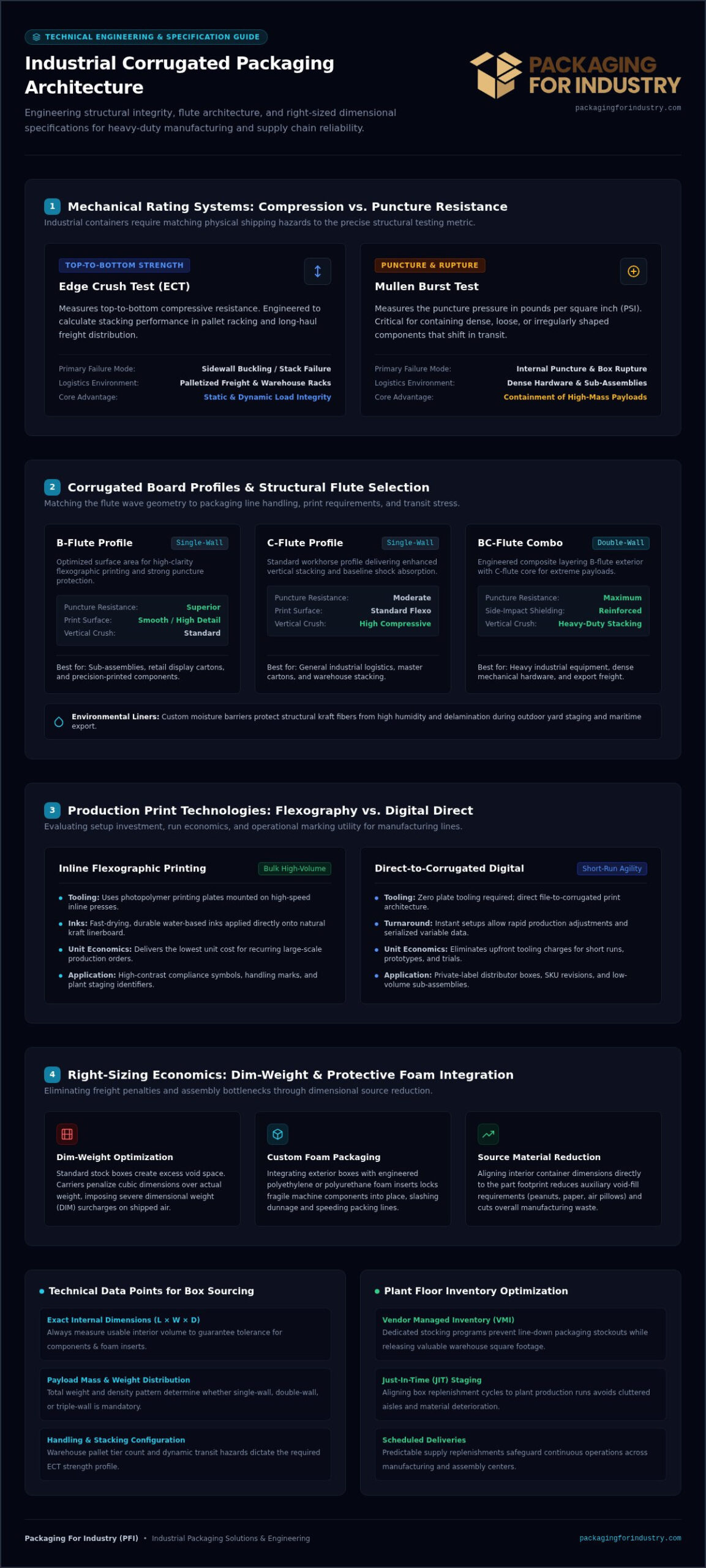
Engineering these containers requires evaluating two distinct mechanical ratings: Edge Crush Test (ECT) and Mullen burst strength. While commercial printers often emphasize paper thickness alone, functional corrugated box design demands matching the metric to your physical shipping hazard. Mullen ratings measure puncture resistance in pounds per square inch, which is essential when shipping dense hardware that shifts internally. In contrast, ECT measures top-to-bottom compressive strength, ensuring that stacked pallets maintain integrity during long-haul freight transit without sidewall buckling.
Beyond structural defense, tailored exterior graphics deliver significant operational value. High-contrast typography, crisp vector logos, scannable SKU barcodes, and standardized handling symbols streamline inventory check-ins at industrial receiving docks. Operations teams scan parts faster, reduce staging bottlenecks, and prevent misplacement across busy plant floors.
Corrugated Board Grades and Flute Profiles for Industrial Plants
Payload weight and transit severity dictate your corrugated board selection. Standard single-wall board handles lightweight sub-assemblies, but heavy industrial components require rugged double-wall or triple-wall constructions. Flute profile selection directly controls container performance:
- B-Flute: Provides superior puncture resistance and a flatter surface for fine flexographic print details.
- C-Flute: Offers greater vertical crush resistance and baseline cushioning for standard logistics.
- BC-Flute Combination: Merges both profiles into a heavy-duty double-wall build, providing maximum stacking strength and side-impact protection for freight handling.
For outdoor staging or export shipping, custom liners with moisture barriers protect structural fibers from humidity and delamination. PFI engineers heavy-duty corrugated boxes tailored to withstand these rugged industrial environments.
Industrial Printing Methods: Flexography vs. Digital for Production Runs
Inline flexographic printing remains the gold standard for high-volume manufacturing runs. Flexography utilizes durable photopolymer plates to print fast-drying, water-based inks directly onto kraft linerboard at high speeds, offering the lowest unit cost for recurring bulk orders. Direct-to-corrugated digital printing bypasses upfront tooling costs entirely, making it ideal for short-run prototypes, private-label runs, or serialized part changes. Industrial production lines prioritize durable, scuff-resistant markings and high-contrast compliance iconography over delicate, glossy finishes that scuff during transit.
Common Box Styles and Interior Protection for Industrial Components
Factory floors cannot afford assembly line bottlenecks caused by awkward packaging assemblies. Matching structural container profiles to your handling methods ensures that packing crews pack quickly and securely. Sourcing right-sized corrugated cardboard boxes eliminates internal part migration, slashing void-fill usage while protecting mechanical surfaces from impact.
Federal guidelines for sustainable packaging emphasize source reduction and material efficiency as foundational operational strategies. Engineering tailored containers reduces paper waste at the source and cuts down auxiliary dunnage like air pillows or loose fill. When interior dimensions fit the exact footprint of your parts, your packaging operations use fewer resources and deliver superior component protection.
Industrial Box Styles: RSC, FOL, Die-Cut, and Bulk Bins
Every container style serves a distinct mechanical role on the packing line:
- Regular Slotted Cartons (RSC): The most economical design for high-speed packing lines. All flaps meet at the center, minimizing scrap during manufacturing and speeding up automated tape sealing.
- Full Overlap (FOL): Outer flaps overlap completely, creating double-thickness corrugation on top and bottom panels. This profile resists severe rough handling and prevents bottom puncture when moving heavy castings or steel assemblies.
- Bespoke Die-Cut and Gaylord Containers: Custom die-cut boxes accommodate intricate components with integrated locking tabs, while multi-wall Gaylords hold large bulk runs directly on standard pallets.
Integrating Protective Foam and Corrugated Partitions
Exterior box strength is only half the equation; proper interior retention prevents components from colliding within the carton. Production teams frequently integrate dual-density foam assemblies into their outer shipping shells. Rigid polyethylene foam provides exceptional edge bracing and blocking for heavy sub-assemblies, while open-cell polyurethane foam delivers surface protection and vibration absorption for delicate finishes.
For high-density shipments of identical components, custom corrugated partitions and interlocking dividers isolate each unit. This approach prevents metal-on-metal contact and accelerates assembly line packing. When shipping populated circuit boards or sensitive sensor clusters, anti-static (ESD) foam packaging dissipates static charges during transit, guarding microelectronics against latent field failures.
Combining rugged structural architectures with tailored inserts yields complete transit protection. If your team is redesigning part packaging or looking to reduce transit losses, you can request a packaging quote to evaluate engineered corrugated options tailored to your facility’s assembly workflows.
How Custom Sized Packaging Eliminates Carrier Surcharges and Freight Waste
Stock catalog cartons force operations teams into an expensive logistical compromise. Squeezing parts into pre-set supplier dimensions inevitably leaves empty pockets, forcing warehouse workers to pack cartons with excessive dunnage. Moving empty air across commercial freight networks inflates transportation bills. Right-sizing through engineered custom branded boxes for manufacturers matches container geometry directly to part profiles, cutting waste at the source and safeguarding profit margins.
Beyond reducing void fill, tailored container architectures drive down carrier billing metrics. Carriers charge based on cubic space rather than dead weight on a scale. Eliminating even an inch of unnecessary clearance across multiple sides delivers compounding freight savings on every pallet dispatched.
The Math Behind Dimensional Weight (DIM) Penalties
Domestic parcel networks like UPS and FedEx utilize a standardized dimensional weight formula: (Length x Width x Height) / 139. If this volumetric calculation exceeds actual scale weight, carriers bill at the higher DIM weight. Carrier optical scanners also round every fractional inch up to the nearest whole integer. A box measuring 12.1 inches on one side is recorded and billed as 13 inches.
Stock cartons frequently exceed stringent surcharge triggers:
- Additional Handling Surcharges: Triggered when a package’s longest side exceeds 48 inches, the second-longest side exceeds 30 inches, or total volume surpasses carrier cubic limits.
- Oversize and Large Package Surcharges: Applied when packages exceed 96 inches in length, 130 inches in length plus girth, or cross 17,280 cubic inches.
Trimming container dimensions by single inches prevents packages from tripping these penalty thresholds, generating substantial monthly freight reductions.
Optimizing Pallet Footprints and Warehouse Racking Efficiency
Custom packaging geometry improves outbound unit load stability. Engineering box footprints to align modularly with standard 48×40-inch GMA pallets eliminates overhang and underhang. Overhanging cartons lose significant compressive stacking strength, while underhang causes loose rows to shift during LTL transit.
Matching box dimensions to pallet dimensions maximizes vertical clearance inside 53-foot dry-van trailers and ocean containers. Securing these unit loads with heavy-duty corner and edge protection prevents strap crushing and reinforces load corners. Wrapping the perimeter with high-performance machine or hand stretch film locks stacked layers to the wooden pallet deck, ensuring stable warehouse storage and arrival without transit collapse.
Procurement Playbook: Sourcing Custom Industrial Boxes at Scale
Sourcing production packaging at scale requires moving beyond rigid catalog distributors and consumer-tier web portals. Online self-serve storefronts rely on credit cards and cannot accommodate blanket purchase orders, custom tooling sign-offs, or plant-floor trial runs. Establishing a reliable pipeline for custom branded boxes for manufacturers demands a structured procurement workflow that validates structural engineering before releasing full production runs.
Transitioning from generic packaging to custom corrugated containers requires coordination between purchasing agents, packaging engineers, and plant operations. Working with an industrial supplier allows facilities to secure volume-tiered pricing, align delivery schedules with production master plans, and ensure board specifications match the exact rigors of freight transit.
Key Specifications Required for an Accurate Packaging Quote
Gathering comprehensive technical requirements upfront speeds up quotation turnaround and prevents costly design revisions. When requesting estimates for custom corrugated containers, prepare the following parameters:
- Internal Dimensions: Length, width, and depth specified to the exact fraction of an inch to prevent internal movement.
- Payload Weight and Stacking Profile: Gross weight of packed components along with maximum pallet stack heights during warehouse storage.
- Board Strength Ratings: Target specifications such as 200# burst test, 275# burst test, or 44 ECT depending on stacking loads.
- Print Configuration: One-color or two-color flexographic markings, plate tooling needs, and placement of compliance markings.
- Volume and Release Schedules: Total annual container volume broken down into monthly or bi-weekly replenishment releases.
Prototyping, CAD/CAM Sampling, and Drop-Test Validation
Never commit capital to steel cutting dies or printing plates without physical proofing. Industrial packaging suppliers produce precise, unprinted CAD/CAM table samples using specified board grades. Operations teams place production components into these mockups to conduct internal drop tests, vibration checks, and pack-line trial runs.
Once structural geometry is verified, production engineers review and sign off on artwork print cards. This validation step confirms that part numbers, handling iconography, and inventory barcodes scan cleanly under warehouse optical systems before mass production begins.
Eliminating Plant Bottlenecks with Local Delivery and Managed Stocking Programs
Packaging stockouts freeze manufacturing operations just as effectively as machine breakdowns or raw material shortages. When production lines run out of designated cartons, finished parts back up across assembly floors, cluttering aisles and delaying outbound shipments. Volatile order cycles and multi-week supplier lead times leave plants vulnerable. Sourcing durable corrugated boxes through structured replenishment contracts insulates operations from supply disruptions while preserving lean plant layouts.
Relying on standard parcel drop-offs from commercial web printers or distant box plants introduces unpredictable transit windows. Working with a dedicated packaging distributor provides reliable stocking models tailored to actual consumption schedules. This operational discipline ensures that custom branded boxes for manufacturers remain staged, inspected, and ready for deployment without crowding the plant floor.
How Vendor Managed Inventory (VMI) Protects Manufacturing Schedules
Implementing a Vendor Managed Inventory (VMI) program transfers the administrative burden of stock monitoring from your internal team to the packaging supplier. Operations establish predetermined minimum and maximum buffer inventory thresholds based on historical burn rates. The supplier monitors on-hand quantities, triggering automatic warehouse releases whenever stock approaches the agreed-upon reorder point.
VMI programs solve critical operational and financial challenges:
- Floor Space Optimization: Bulky corrugated pallets are warehoused off-site, converting non-revenue packaging storage into productive manufacturing space.
- Line-Down Prevention: Pre-staged safety stock absorbs sudden demand spikes, ensuring production lines never stall due to container shortages.
- Freight Stabilization: Scheduled bulk transfers replace high-cost expedited trucking runs and last-minute courier surcharges.
Southern California Fleet Delivery and Nationwide Logistics Support
Regional proximity transforms packaging from a logistical headache into a strategic operational advantage. PFI operates a dedicated delivery fleet providing local next-day delivery across Southern California manufacturing hubs, including Anaheim, Irvine, Santa Ana, Los Angeles, and the Inland Empire. Plant managers receive prompt dock-to-dock replenishment that synchronizes perfectly with lean, just-in-time assembly schedules.
For organizations operating multiple manufacturing sites across the country, established distribution channels provide consistent structural specifications and unified brand graphics across all facilities. Contact our engineering team to request a packaging quote and establish a resilient stocking program for your facility.
Streamline Your Industrial Packaging Operations
Industrial shipping requires packaging built for structural defense rather than retail aesthetic appeal. Upgrading to engineered custom branded boxes for manufacturers eliminates void space, shields heavy components against transit damage, and establishes clean dockside part identification across your supply chain.
Combining exact container geometry with automated Vendor Managed Inventory programs prevents line-down packaging shortages while recovering valuable warehouse floor space. PFI’s Anaheim distribution hub and dedicated truck fleet provide reliable next-day replenishment across Southern California manufacturing corridors, supported by robust nationwide logistics to keep multi-plant operations running on schedule.
Take control of your freight overhead today and equip your facility with corrugated packaging engineered for real-world industrial demands.
Frequently Asked Questions
What is the difference between custom branded boxes for manufacturers and standard e-commerce boxes?
How do I choose between Edge Crush Test (ECT) and Mullen burst ratings for custom manufacturing boxes?
Base your selection on warehouse stacking configurations versus internal puncture hazards. ECT measures top-to-bottom compression strength, making it the critical rating when palletized loads stack several tiers high in warehouse racking. Mullen burst strength measures puncture resistance against localized forces, which is essential if you pack dense, loose, or irregularly shaped metal parts that shift against container walls during rough freight transit.
Can custom branded boxes be engineered with integrated protective foam inserts?
Yes, integrating custom die-cut foam inserts directly into outer corrugated containers provides complete transit shock protection. Packaging engineers pair rigid polyethylene foam for heavy structural bracing or soft polyurethane foam for delicate surface protection. For high-reliability electronics, anti-static (ESD) foam prevents damaging electrostatic discharge. Sourcing boxes and custom foam inserts together from a single industrial supplier eliminates dimensional mismatch and speeds up packing operations.
How do custom sized shipping containers reduce carrier dimensional weight (DIM) surcharges?
Custom sizing eliminates excess internal void space, which directly lowers the volumetric measurements carriers use to calculate billable weight. Parcel carriers like UPS and FedEx divide cubic volume by 139 and round up every fractional inch. Right-sizing your cartons prevents your shipments from exceeding the dimensional weight threshold or triggering severe oversize and additional handling surcharges, yielding immediate transportation savings across recurring shipments.
What minimum specifications are needed to request a custom industrial box quotation?
To get an accurate custom corrugated box quote, provide precise interior dimensions (length, width, and depth), the total payload weight, and your typical shipping environment. You should also specify required board grades, such as 200# burst or 44 ECT, along with exterior printing requirements like one-color or two-color flexographic logos. Finally, include your target production volume and expected monthly delivery releases.
How does a Vendor Managed Inventory (VMI) program work for custom corrugated packaging?
A Vendor Managed Inventory program automates packaging replenishment by tracking actual usage against established minimum and maximum stock levels. PFI monitors your plant’s on-hand custom boxes, manufacturing and staging inventory off-site in our warehouse. When inventory hits the minimum reorder threshold, we trigger an automatic replenishment delivery. This process frees up manufacturing floor space and prevents costly line shutdowns caused by sudden packaging shortages.
What delivery options are available for manufacturing plants located in Southern California?
PFI operates a dedicated local delivery fleet that provides scheduled and next-day deliveries across Southern California industrial corridors. Facilities in Orange County, Anaheim, Irvine, Los Angeles, and the Inland Empire receive direct dock-to-dock shipments that align with production schedules. For operations with manufacturing plants outside California, we coordinate reliable nationwide distribution to ensure uniform corrugated packaging supply across all facilities.